


EN 160201:1997
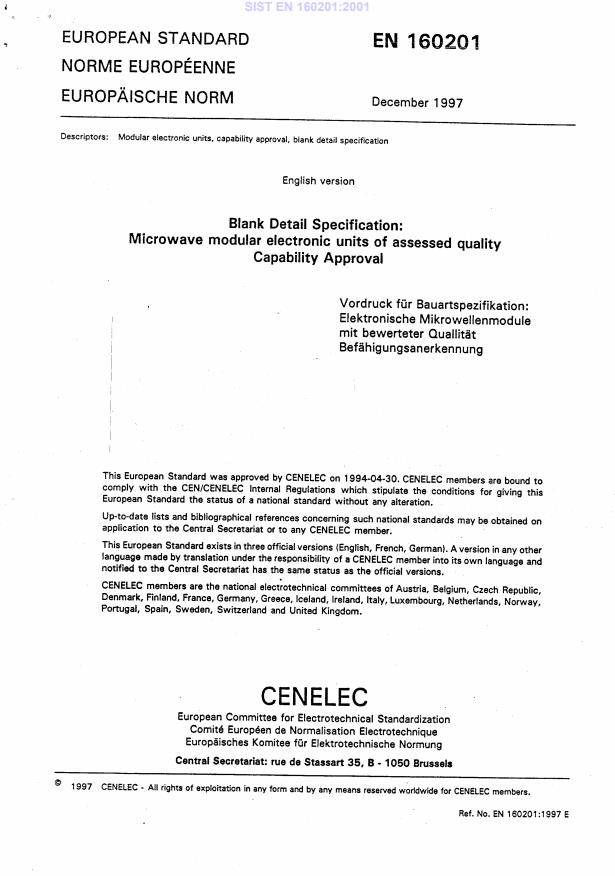
(Main)Blank Detail Specification: Microwave modular electronic units of assessed quality - Capability Approval
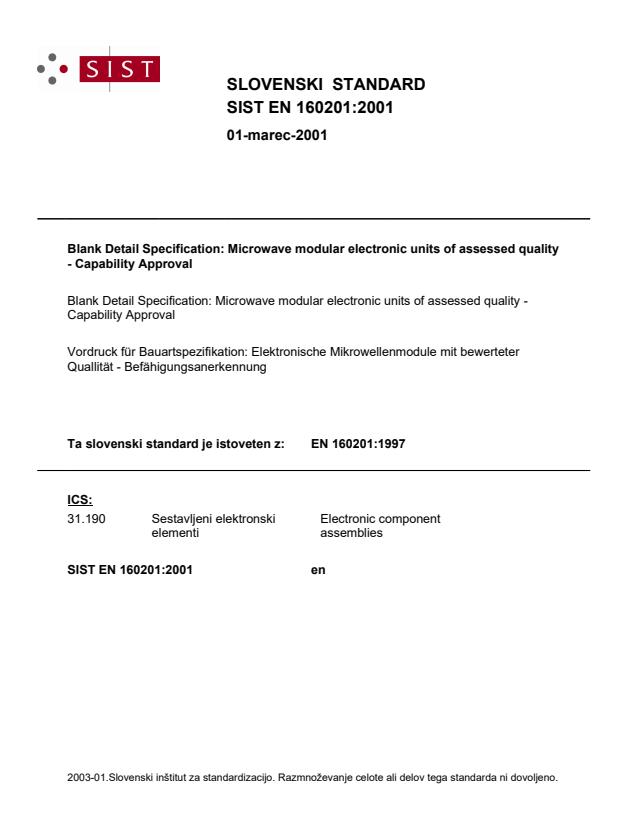
Blank Detail Specification: Microwave modular electronic units of assessed quality - Capability Approval
Withdrawal confirmed
Vordruck für Bauartspezifikation: Elektronische Mikrowellenmodule mit bewerteter Quallität - Befähigungsanerkennung
Blank Detail Specification: Microwave modular electronic units of assessed quality - Capability Approval
General Information
- Status
- Withdrawn
- Publication Date
- 17-Dec-1997
- Withdrawal Date
- 31-Aug-2004
- Technical Committee
- CLC/NC BSI/BEC - British National Committee
- Drafting Committee
- IEC/TC 91 - IEC_TC_91
- Parallel Committee
- IEC/TC 52 - IEC_TC_52
- Current Stage
- 9960 - Withdrawal effective - Withdrawal
- Start Date
- 01-Sep-2004
- Completion Date
- 01-Sep-2004

Frequently Asked Questions
EN 160201:1997 is a standard published by CLC. Its full title is "Blank Detail Specification: Microwave modular electronic units of assessed quality - Capability Approval". This standard covers: Withdrawal confirmed
Withdrawal confirmed
EN 160201:1997 is available in PDF format for immediate download after purchase. The document can be added to your cart and obtained through the secure checkout process. Digital delivery ensures instant access to the complete standard document.
Standards Content (Sample)
2003-01.Slovenski inštitut za standardizacijo. Razmnoževanje celote ali delov tega standarda ni dovoljeno.Blank Detail Specification: Microwave modular electronic units of assessed quality - Capability ApprovalVordruck für Bauartspezifikation: Elektronische Mikrowellenmodule mit bewerteter Quallität - BefähigungsanerkennungBlank Detail Specification: Microwave modular electronic units of assessed quality - Capability Approval31.190Sestavljeni elektronski elementiElect
...
This May Also Interest You
This International Standard specifies the minimum operational and performance requirements, methods of testing and required test results conforming to performance standards not inferior to those adopted by the IMO in Resolution MSC.192(79). (MSC.192/2) The radar installation, in addition to meeting the general requirements as set out in resolution A.694(17) and the related standard IEC 60945, should comply with the performance standards of MSC.192(79). When a requirement of this standard is different from IEC 60945, the requirement in this standard takes precedence.
- Corrigendum1 pageEnglish languagee-Library read for×1 day
- Corrigendum1 pageEnglish and French languagee-Library read for×1 day
- 09-Feb-2026
- 33.180.20
- CLC/TC 86BXA
This part of IEC 61996 specifies the minimum performance requirements, technical characteristics, methods of testing and required test results, for shipborne voyage data recorder (VDR) installations as required by Chapter V of the International Convention for Safety of Life at Sea (SOLAS), as amended. It takes account of IMO resolution A.694(17) and is associated with IEC 60945. When a requirement in this standard is different from IEC 60945, the requirement in this standard takes precedence. This standard incorporates the applicable parts of the performance standards included in IMO Resolution MSC.333(90).
- Corrigendum1 pageEnglish languagee-Library read for×1 day
IEC 62541-10:2025 is available as IEC 62541-10:2025 RLV which contains the International Standard and its Redline version, showing all changes of the technical content compared to the previous edition.IEC 62541-10:2025 defines the Information Model associated with Programs in OPC Unified Architecture (OPC UA). This includes the description of the NodeClasses, standard Properties, Methods and Events and associated behaviour and information for Programs. The complete AddressSpace model including all NodeClasses and Attributes is specified in IEC 62541-3. The Services such as those used to invoke the Methods used to manage Programs are specified in IEC 62541-4. An example for a DomainDownload Program is defined in Annex A. This fourth edition cancels and replaces the third edition published in 2020. This edition constitutes a technical revision. This edition includes the following significant technical changes with respect to the previous edition: - StateMachine table format has been aligned.
- Draft44 pagesEnglish languagee-Library read for×1 day
- 05-Feb-2026
- 25.040.40
- 35.100.05
- M/490
- CLC/TC 65X
- Draft2 pagesEnglish languagee-Library read for×1 day
- 05-Feb-2026
- 33.180.20
- CLC/TC 86BXA
IEC 62541-17:2025 provides a definition of AliasNames functionality. AliasNames provide a manner of configuring and exposing an alternate well-defined name for any Node in the system. This is analogous to the way domain names are used as an alias to IP addresses in IP networks. Like a DNS Server, an OPC UA Server that supports AliasNames provides a lookup Method that will translate an AliasName to a NodeId of the related Node on a Server. An aggregating Server can collect these AliasNames from multiple Servers and provide a lookup Method to allow Client applications to discover NodeIds on a system wide basis. An aggregating Server could also define AliasNames for Nodes in other Servers that do not support AliasNames. A GDS can be constructed that would automatically aggregate all AliasNames that are defined on any Server that has registered with the GDS. In this case, the GDS also provides the lookup mechanism for Clients at a well-known endpoint and address.
- Draft24 pagesEnglish languagee-Library read for×1 day
- 05-Feb-2026
- 25.040
- CLC/TC 65X
IEC 62541-7: 2025 specifies value and structure of Profiles in the OPC Unified Architecture. OPC UA Profiles are used to segregate features with regard to testing of OPC UA products and the nature of the testing. The scope of this document includes defining functionality that can only be tested. The definition of actual TestCases is not within the scope of this document, but the general categories of TestCases are covered by this document. Most OPC UA applications will conform to several, but not all of the Profiles. This fourth edition cancels and replaces the third edition published in 2020. This edition constitutes a technical revision. This edition includes the following significant technical changes with respect to the previous edition: a) Profiles and ConformanceUnits are not part of this document, but are solely managed in a public database as described in Clause 1.
- Draft9 pagesEnglish languagee-Library read for×1 day
- 05-Feb-2026
- 25.040.40
- 35.100.05
- M/490
- CLC/TC 65X
IEC 61300-3-14:2025 provides a method to measure the error and repeatability of the attenuation value settings of a variable optical attenuator (VOA). There are two control technologies for VOAs: manually controlled and electrically controlled. This document covers both VOA control technologies and also both single-mode fibres and multimode fibres VOAs. For electrically controlled VOAs, the hysteresis characteristics of attenuation are sometimes important. The hysteresis characteristics can be measured as stated in Annex B. This fourth edition cancels and replaces the third edition published in 2014. This edition constitutes a technical revision. This edition includes the following significant technical changes with respect to the previous edition: a) addition of IEC 61315, Calibration of fibre-optic power meters as normative reference; b) addition of Clause 3 containing terms, definitions and abbreviated terms; c) addition of notes for permission of repeatability definition with 2σ; d) correction of error in Figure 1 a) and Figure 1 b); e) addition of a clear statement on EF launch condition requirement for MM source; f) change of “Detector” to “Power meter”; g) combination of Clause 7 and Clause 8 into a new Clause 8 titled “Details to be specified and reported”; h) addition of uncertainty considerations in Clause 7; i) correction of error in Formula (B.3).
- Draft13 pagesEnglish languagee-Library read for×1 day
- 05-Feb-2026
- 33.180.20
- CLC/TC 86BXA
IEC 62541-100:2025 defines the information model associated with Devices. This document describes three models which build upon each other as follows: • The (base) Device Model is intended to provide a unified view of devices and their hardware and software parts irrespective of the underlying device protocols. • The Device Communication Model adds Network and Connection information elements so that communication topologies can be created. • The Device Integration Host Model finally adds additional elements and rules required for host systems to manage integration for a complete system. It enables reflecting the topology of the automation system with the devices as well as the connecting communication networks. This document also defines AddIns that can be used for the models in this document but also for models in other information models. They are: • Locking model – a generic AddIn to control concurrent access, • Software update model – an AddIn to manage software in a Device. This second edition cancels and replaces the first edition published in 2015. This edition constitutes a technical revision. This edition includes the following significant technical changes with respect to the previous edition: a a ComponentType that can be used to model any HW or SW element of a device has been defined and a SoftwareType has been added as subtype of ComponentType; b the new OPC UA interface concept and defined interfaces for Nameplate, DeviceHealth, and SupportInfo has been added. c) a new model for Software Update (Firmware Update) has been added; d) a new entry point for documents where each document is represented by a FileType instance has been specified; e) a model that provides information about the lifetime, related limits and semantic of the lifetime of things like tools, material or machines has been added.
- Draft143 pagesEnglish languagee-Library read for×1 day
- 05-Feb-2026
- 25.040.40
- 35.100.05
- M/490
- CLC/TC 65X
IEC 62541-13:2025 is available as IEC 62541-13:2025 RLV which contains the International Standard and its Redline version, showing all changes of the technical content compared to the previous edition.IEC 62541-13:2025 defines the information model associated with Aggregates. Programmatically produced aggregate examples are listed in Annex A. This third edition cancels and replaces the second edition published in 2020. This edition constitutes a technical revision. This edition includes the following technical changes with respect to the previous edition: a) Multiple fixes for the computation of aggregates • The Raw status bit is always set for non-bad StatusCodes for the Start and End aggregates. • Entries in the Interpolative examples Tables A2.2 Historian1, Historian2, and Historian3 have been changed from Good to Good, Raw status codes when the timestamp matches with the timestamp of the data source. • Missing tables have been added for DurationInStateZero and DurationInStateNonZero. • The value of zero has been removed for results with a StatusCode of bad. • Data Type was listed as "Status Code" when it is "Double" for both Standard Deviation and both Variance Aggregates. • Rounding Error in TimeAverage and TimeAverage2 have been corrected. • The status codes have been corrected for the last two intervals and the value has been corrected in the last interval. • The wording has been changed to be more consistent with the certification testing tool. • UsedSlopedExtrapolation set to true for Historian2 and all examples locations needed new values or status' are modified. • Values affected by percent good and percent bad have been updated. • PercentGood/PercentBad are now accounted for in the calculation. • TimeAverage uses SlopedInterpolation but the Time aggregate is incorrectly allowed to used Stepped Interpolation. • Partial bit is now correctly calculated. • Unclear sentence was removed. • Examples have been moved to a CSV. • The value and status code for Historian 3 have been updated. • TimeAverage2 Historian1 now takes uncertain regions into account when calculating StatusCodes. • TimeAverage2 Historian2 now takes uncertain regions into account when calculating StatusCodes. • Total2 Historian1 now takes uncertain regions into account when calculating StatusCodes • Total2 Historian2 now takes uncertain regions into account when calculating StatusCodes • Maximum2 Historian1 now takes uncertain regions into account when calculating StatusCodes • MaximumActualTime2 Historian1 now takes uncertain regions into account when calculating StatusCodes • Minimum2 Historian1 now takes uncertain regions into account when calculating StatusCodes • MinimumActualTime2 Historian1 now has the StatusCodes calculated while using the TreatUncertainAsBad flag. • Range2 Historian1 now looks at TreatUncertainAsBad in the calculation of the StatusCodes. • Clarifications have been made to the text defining how PercentGood/PercentBad are used. The table values and StatusCodes of the TimeAverage2 and Total2 aggregates have been corrected.
- Draft53 pagesEnglish languagee-Library read for×1 day
- 05-Feb-2026
- 25.040.40
- 35.100.05
- M/490
- CLC/TC 65X
Questions, Comments and Discussion
Ask us and Technical Secretary will try to provide an answer. You can facilitate discussion about the standard in here.
Loading comments...