


FprEN IEC 60216-1:2025
(Main)Electrical insulating materials - Thermal endurance properties - Part 1: Ageing procedures and evaluation of test results
Electrical insulating materials - Thermal endurance properties - Part 1: Ageing procedures and evaluation of test results
IEC 60216-1:2025 specifies the general ageing conditions and procedures to be used for deriving thermal endurance characteristics and gives guidance in using the detailed instructions and guidelines in the other parts of IEC 60216. Although originally developed for use with electrical insulating materials and simple combinations of such materials, the procedures are considered to be of more general applicability and are widely used in the assessment of materials not intended for use as electrical insulation. In the application of this document, it is assumed that a practically linear relationship exists between the logarithm of the time required to cause the predetermined property change and the reciprocal of the corresponding absolute temperature (Arrhenius relationship). For the valid application of this document, no transition, in particular no first-order transition, is expected to occur in the temperature range under study. This edition includes the following significant technical changes with respect to the previous edition: a) the definition for temperature index (TI) has been updated; b) requirements for selection of related materials used, e.g. in different colours (5.1.2), have been added; c) test procedure for thickness sensitivity (5.5 et 6.6) has been added; d) Annex C "Concepts in earlier editions" has been deleted.
Elektroisolierstoffe - Eigenschaften hinsichtlich des thermischen Langzeitverhaltens - Teil 1: Warmlagerungsverfahren und Auswertung von Prüfergebnissen
Matériaux isolants électriques - Propriétés d'endurance thermique - Partie 1: Méthodes de vieillissement et évaluation des résultats d'essai
L'IEC 60216-1:2025 spécifie les conditions générales de vieillissement et les méthodes à utiliser pour en extraire les caractéristiques d'endurance thermique, et donne des recommandations pour l'utilisation des instructions détaillées et des lignes directrices dans les autres parties de l'IEC 60216. Même si à l'origine elles ont été développées pour être utilisées sur les matériaux isolants électriques et des combinaisons simples de tels matériaux, ces méthodes sont considérées comme étant applicables plus généralement et sont largement utilisées pour vérifier des matériaux non destinés à être utilisés comme isolants électriques. Dans l'application du présent document, il est estimé qu'une relation pratiquement linéaire existe entre le logarithme du temps exigé pour provoquer la modification prédéterminée de la propriété, et l'inverse de la température absolue correspondante (relation d'Arrhenius). Pour que le présent document soit valable, il est prévu qu'il n'y ait pas de transition, en particulier de transition du premier ordre, dans la plage de températures à l'étude. Cette édition inclut les modifications techniques majeures suivantes par rapport à l'édition précédente: - la définition de l'indice de température (IT) a été mise à jour; - des exigences pour le choix des matériaux connexes utilisés, par exemple, en différentes couleurs (5.1.2), ont été ajoutées; - des méthodes d'essai pour la sensibilité à l'épaisseur (5.5 et 6.6) ont été ajoutées; - l'Annexe C "Concepts existant dans les éditions précédentes" a été supprimée.
Električni izolacijski materiali - Lastnosti toplotne vzdržljivosti - 1. del: Postopki staranja in vrednotenje rezultatov preskušanja
General Information
- Status
- Not Published
- Publication Date
- 29-Jan-2026
- Technical Committee
- CLC/SR 112 - Evaluation and qualification of electrical insulating materials and systems (to be defined)
- Drafting Committee
- IEC/TC 112 - IEC_TC_112
- Current Stage
- 5060 - Voting results sent to TC, SR - Formal Approval
- Start Date
- 21-Nov-2025
- Completion Date
- 21-Nov-2025
Relations
- Effective Date
- 14-Dec-2021
Overview
FprEN IEC 60216-1:2025 (also published as IEC 60216-1:2025) is the international procedure standard for assessing the thermal endurance properties of electrical insulating materials. It specifies general ageing conditions, experimental procedures and statistical evaluation methods to derive thermal endurance characteristics such as the Temperature Index (TI) and the halving interval. Although developed for electrical insulation, the ageing procedures are widely applicable to other polymeric and insulating materials.
Key topics and technical requirements
- Scope and assumptions
- Uses accelerated ageing and assumes an Arrhenius-type (log time vs 1/T) relationship between degradation rate and absolute temperature.
- Requires that no first‑order transitions (e.g., phase changes) occur in the tested temperature range for validity.
- Test planning and selection
- Selection of test specimens, related materials (including different colours), and test properties used to determine TI.
- Guidance for choosing end‑points (property loss criteria) and times (e.g., the common 20 000 h reference).
- Ageing procedures
- Detailed instructions for specimen preparation, number of specimens, exposure temperatures/times, ovens and environmental control.
- Procedures for non‑destructive, proof and destructive testing approaches.
- New in this edition: thickness sensitivity test procedure to assess dependence of thermal endurance on specimen thickness.
- Data evaluation and statistics
- Numerical analysis, regression methods, handling of complete and censored (incomplete) data.
- Calculation and reporting of TI, halving interval and thermal endurance graphs.
- Statistical tests and data requirements to validate the Arrhenius model and derived characteristics.
- Reporting
- Required content for a test report and formats for presenting thermal endurance characteristics.
Practical applications and users
This standard is used by:
- Materials manufacturers to compare formulations, validate thermal stability and assign TI values.
- Test laboratories and R&D teams for accelerated ageing programs, thickness sensitivity studies and quality control.
- Design and electrical engineers for material selection and lifetime estimation of insulation in electrical equipment.
- Certification bodies and procurement to verify manufacturer claims and ensure compliance with thermal endurance criteria.
Practical outcomes include reliable TI determination, thermal endurance graphs for product datasheets, and defensible lifetime estimates for components exposed to elevated temperatures.
Related standards
- IEC 60216 series (other parts provide detailed instructions for specific materials and tests)
- Statistical guidance referenced in the text (e.g., IEC 60493‑1) for confidence and variance analysis
Keywords: IEC 60216-1, FprEN IEC 60216-1:2025, thermal endurance, temperature index, ageing procedures, insulating materials, accelerated ageing, Arrhenius relationship, thickness sensitivity.
Frequently Asked Questions
FprEN IEC 60216-1:2025 is a draft published by CLC. Its full title is "Electrical insulating materials - Thermal endurance properties - Part 1: Ageing procedures and evaluation of test results". This standard covers: IEC 60216-1:2025 specifies the general ageing conditions and procedures to be used for deriving thermal endurance characteristics and gives guidance in using the detailed instructions and guidelines in the other parts of IEC 60216. Although originally developed for use with electrical insulating materials and simple combinations of such materials, the procedures are considered to be of more general applicability and are widely used in the assessment of materials not intended for use as electrical insulation. In the application of this document, it is assumed that a practically linear relationship exists between the logarithm of the time required to cause the predetermined property change and the reciprocal of the corresponding absolute temperature (Arrhenius relationship). For the valid application of this document, no transition, in particular no first-order transition, is expected to occur in the temperature range under study. This edition includes the following significant technical changes with respect to the previous edition: a) the definition for temperature index (TI) has been updated; b) requirements for selection of related materials used, e.g. in different colours (5.1.2), have been added; c) test procedure for thickness sensitivity (5.5 et 6.6) has been added; d) Annex C "Concepts in earlier editions" has been deleted.
IEC 60216-1:2025 specifies the general ageing conditions and procedures to be used for deriving thermal endurance characteristics and gives guidance in using the detailed instructions and guidelines in the other parts of IEC 60216. Although originally developed for use with electrical insulating materials and simple combinations of such materials, the procedures are considered to be of more general applicability and are widely used in the assessment of materials not intended for use as electrical insulation. In the application of this document, it is assumed that a practically linear relationship exists between the logarithm of the time required to cause the predetermined property change and the reciprocal of the corresponding absolute temperature (Arrhenius relationship). For the valid application of this document, no transition, in particular no first-order transition, is expected to occur in the temperature range under study. This edition includes the following significant technical changes with respect to the previous edition: a) the definition for temperature index (TI) has been updated; b) requirements for selection of related materials used, e.g. in different colours (5.1.2), have been added; c) test procedure for thickness sensitivity (5.5 et 6.6) has been added; d) Annex C "Concepts in earlier editions" has been deleted.
FprEN IEC 60216-1:2025 is classified under the following ICS (International Classification for Standards) categories: 17.220.99 - Other standards related to electricity and magnetism; 29.035.01 - Insulating materials in general. The ICS classification helps identify the subject area and facilitates finding related standards.
FprEN IEC 60216-1:2025 has the following relationships with other standards: It is inter standard links to EN 60216-1:2013. Understanding these relationships helps ensure you are using the most current and applicable version of the standard.
FprEN IEC 60216-1:2025 is available in PDF format for immediate download after purchase. The document can be added to your cart and obtained through the secure checkout process. Digital delivery ensures instant access to the complete standard document.
Standards Content (Sample)
SLOVENSKI STANDARD
oSIST prEN IEC 60216-1:2024
01-november-2024
Električni izolacijski materiali - Lastnosti toplotne vzdržljivosti - 1. del: Postopki
staranja in vrednotenje rezultatov preskušanja
Electrical insulating materials - Thermal endurance properties - Part 1: Ageing
procedures and evaluation of test results
Elektroisolierstoffe - Eigenschaften hinsichtlich des thermischen Langzeitverhaltens - Teil
1: Warmlagerungsverfahren und Auswertung von Prüfergebnissen
Matériaux isolants électriques - Propriétés d'endurance thermique - Partie 1: Méthodes
de vieillissement et évaluation des résultats d'essai
Ta slovenski standard je istoveten z: prEN IEC 60216-1:2024
ICS:
17.220.99 Drugi standardi v zvezi z Other standards related to
elektriko in magnetizmom electricity and magnetism
29.035.01 Izolacijski materiali na Insulating materials in
splošno general
oSIST prEN IEC 60216-1:2024 en
2003-01.Slovenski inštitut za standardizacijo. Razmnoževanje celote ali delov tega standarda ni dovoljeno.
oSIST prEN IEC 60216-1:2024
Export made on 2024-09-27 Not to be - 1 - DRAFT
used for official purposes © IEC 2024
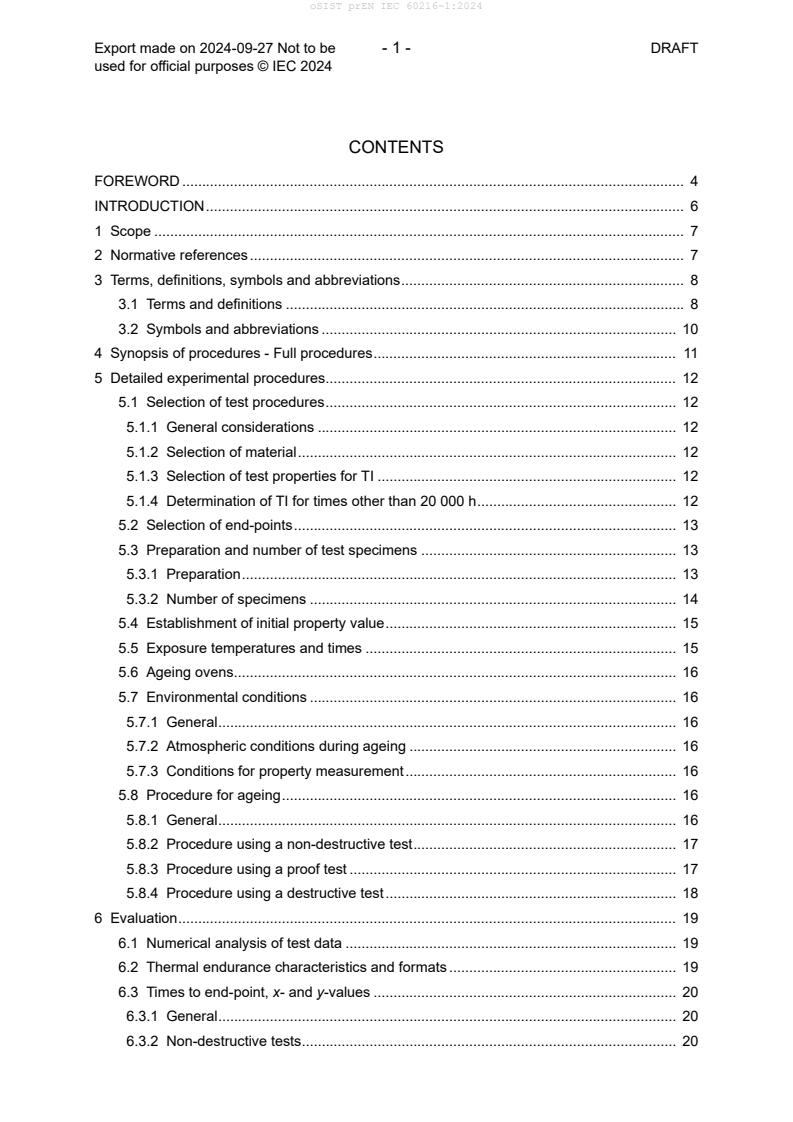
CONTENTS
FOREWORD . 4
INTRODUCTION. 6
1 Scope . 7
2 Normative references. 7
3 Terms, definitions, symbols and abbreviations. 8
3.1 Terms and definitions . 8
3.2 Symbols and abbreviations . 10
4 Synopsis of procedures - Full procedures. 11
5 Detailed experimental procedures. 12
5.1 Selection of test procedures. 12
5.1.1 General considerations . 12
5.1.2 Selection of material. 12
5.1.3 Selection of test properties for TI . 12
5.1.4 Determination of TI for times other than 20 000 h. 12
5.2 Selection of end-points. 13
5.3 Preparation and number of test specimens . 13
5.3.1 Preparation. 13
5.3.2 Number of specimens . 14
5.4 Establishment of initial property value. 15
5.5 Exposure temperatures and times . 15
5.6 Ageing ovens. 16
5.7 Environmental conditions . 16
5.7.1 General. 16
5.7.2 Atmospheric conditions during ageing . 16
5.7.3 Conditions for property measurement. 16
5.8 Procedure for ageing. 16
5.8.1 General. 16
5.8.2 Procedure using a non-destructive test. 17
5.8.3 Procedure using a proof test . 17
5.8.4 Procedure using a destructive test. 18
6 Evaluation. 19
6.1 Numerical analysis of test data . 19
6.2 Thermal endurance characteristics and formats . 19
6.3 Times to end-point, x- and y-values . 20
6.3.1 General. 20
6.3.2 Non-destructive tests. 20
oSIST prEN IEC 60216-1:2024
Export made on 2024-09-27 Not to be - 2 - DRAFT
used for official purposes © IEC 2024
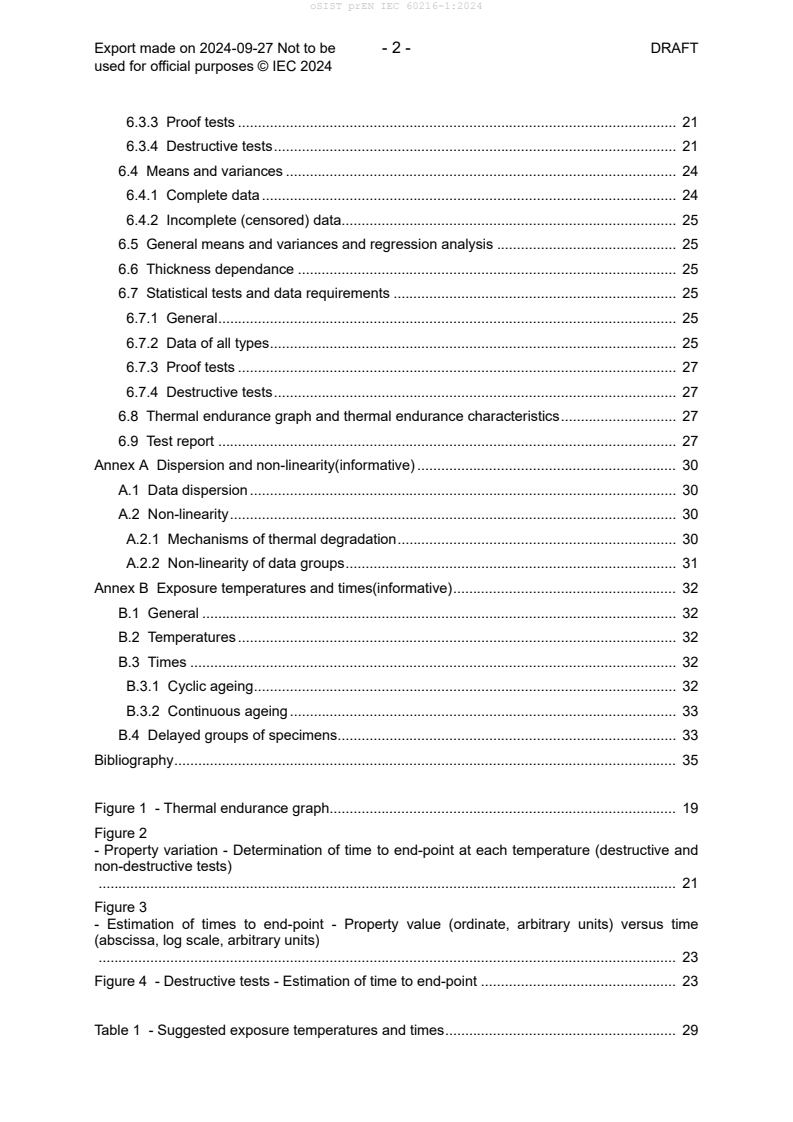
6.3.3 Proof tests . 21
6.3.4 Destructive tests. 21
6.4 Means and variances . 24
6.4.1 Complete data . 24
6.4.2 Incomplete (censored) data. 25
6.5 General means and variances and regression analysis . 25
6.6 Thickness dependance . 25
6.7 Statistical tests and data requirements . 25
6.7.1 General. 25
6.7.2 Data of all types. 25
6.7.3 Proof tests . 27
6.7.4 Destructive tests. 27
6.8 Thermal endurance graph and thermal endurance characteristics. 27
6.9 Test report . 27
Annex A Dispersion and non-linearity(informative) . 30
A.1 Data dispersion . 30
A.2 Non-linearity. 30
A.2.1 Mechanisms of thermal degradation. 30
A.2.2 Non-linearity of data groups. 31
Annex B Exposure temperatures and times(informative). 32
B.1 General . 32
B.2 Temperatures . 32
B.3 Times . 32
B.3.1 Cyclic ageing. 32
B.3.2 Continuous ageing. 33
B.4 Delayed groups of specimens. 33
Bibliography. 35
Figure 1 - Thermal endurance graph. 19
Figure 2
- Property variation - Determination of time to end-point at each temperature (destructive and
non-destructive tests)
................................................................................................................................................. 21
Figure 3
- Estimation of times to end-point - Property value (ordinate, arbitrary units) versus time
(abscissa, log scale, arbitrary units)
................................................................................................................................................. 23
Figure 4 - Destructive tests - Estimation of time to end-point . 23
Table 1 - Suggested exposure temperatures and times. 29
oSIST prEN IEC 60216-1:2024
Export made on 2024-09-27 Not to be - 3 - DRAFT
used for official purposes © IEC 2024
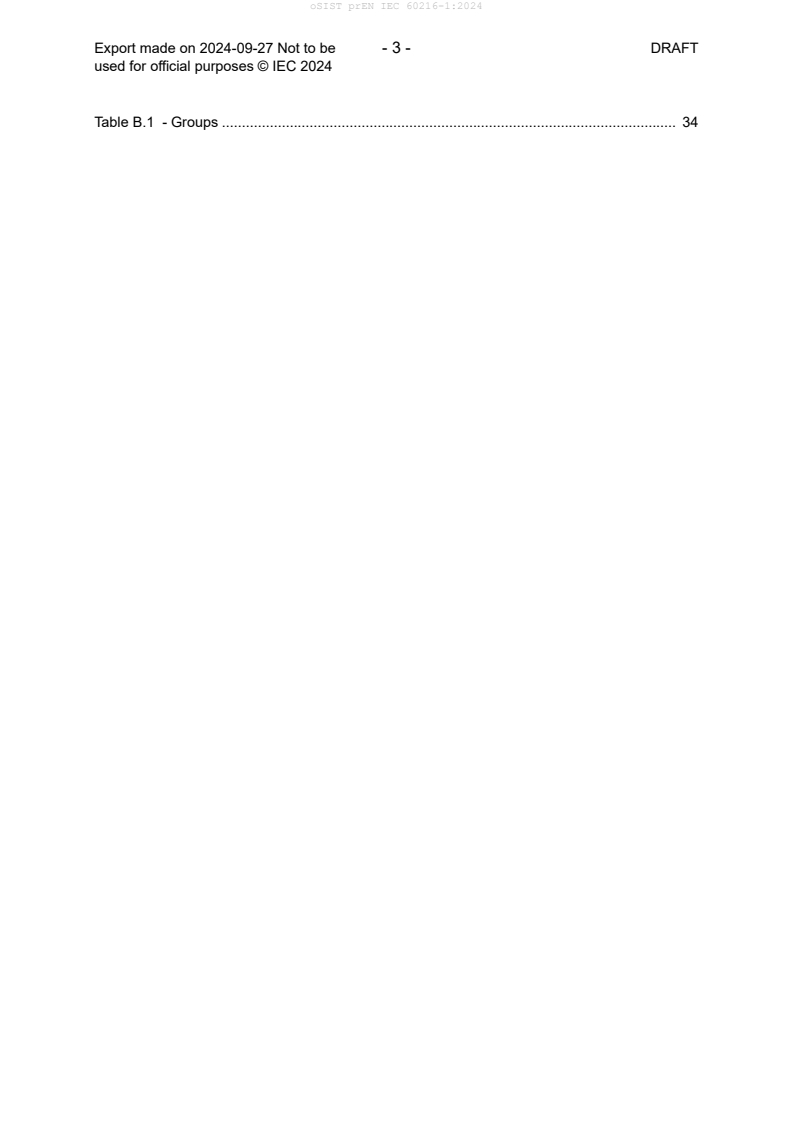
Table B.1 - Groups . 34
oSIST prEN IEC 60216-1:2024
Export made on 2024-09-27 Not to be - 4 - DRAFT
used for official purposes © IEC 2024
INTERNATIONAL ELECTROTECHNICAL COMMISSION
____________
ELECTRICAL INSULATING MATERIALS - THERMAL ENDURANCE
PROPERTIES - PART 1: AGEING PROCEDURES AND EVALUATION OF
TEST RESULTS –
FOREWORD
1) The International Electrotechnical Commission (IEC) is a worldwide organization for
standardization comprising all national electrotechnical committees (IEC National Committees).
The object of IEC is to promote international co-operation on all questions concerning
standardization in the electrical and electronic fields. To this end and in addition to other
activities, IEC publishes International Standards, Technical Specifications, Technical Reports,
Publicly Available Specifications (PAS) and Guides (hereafter referred to as “IEC
Publication(s)”). Their preparation is entrusted to technical committees; any IEC National
Committee interested in the subject dealt with may participate in this preparatory work.
International, governmental and non-governmental organizations liaising with the IEC also
participate in this preparation. IEC collaborates closely with the International Organization for
Standardization (ISO) in accordance with conditions determined by agreement between the
two organizations.
2) The formal decisions or agreements of IEC on technical matters express, as nearly as
possible, an international consensus of opinion on the relevant subjects since each technical
committee has representation from all interested IEC National Committees.
3) IEC Publications have the form of recommendations for international use and are accepted
by IEC National Committees in that sense. While all reasonable efforts are made to ensure that
the technical content of IEC Publications is accurate, IEC cannot be held responsible for the
way in which they are used or for any misinterpretation by any end user.
4) In order to promote international uniformity, IEC National Committees undertake to apply
IEC Publications transparently to the maximum extent possible in their national and regional
publications. Any divergence between any IEC Publication and the corresponding national or
regional publication shall be clearly indicated in the latter.
5) IEC itself does not provide any attestation of conformity. Independent certification bodies
provide conformity assessment services and, in some areas, access to IEC marks of
conformity. IEC is not responsible for any services carried out by independent certification
bodies.
6) All users should ensure that they have the latest edition of this publication.
7) No liability shall attach to IEC or its directors, employees, servants or agents including
individual experts and members of its technical committees and IEC National Committees for
any personal injury, property damage or other damage of any nature whatsoever, whether
direct or indirect, or for costs (including legal fees) and expenses arising out of the publication,
use of, or reliance upon, this IEC Publication or any other IEC Publications.
8) Attention is drawn to the Normative references cited in this publication. Use of the
referenced publications is indispensable for the correct application of this publication.
oSIST prEN IEC 60216-1:2024
Export made on 2024-09-27 Not to be - 5 - DRAFT
used for official purposes © IEC 2024
9) IEC draws attention to the possibility that the implementation of this document may involve
the use of (a) patent(s). IEC takes no position concerning the evidence, validity or applicability
of any claimed patent rights in respect thereof. As of the date of publication of this document,
IEC [had/had not] received notice of (a) patent(s), which may be required to implement this
document. However, implementers are cautioned that this may not represent the latest
information, which may be obtained from the patent database available at https://
patents.iec.ch. IEC shall not be held responsible for identifying any or all such patent rights.
IEC 60216-1 has been prepared by IEC technical committee 112: Evaluation and qualification
of electrical insulating materials and systems. It is an International Standard.
This seventh edition cancels and replaces the sixth edition published in 2013. This edition
constitutes a technical revision.
This edition includes the following significant technical changes with respect to the previous
edition:
a) Update the definition for temperature index (3.1.1)
b) Add requirements for selection of related materials used e.g. in different colors (5.1.2)
c) Test procedure for thickness sensitivity (5.5 and 6.6)
d) Removal of Annex C "Concepts in earlier editions"
The text of this International Standard is based on the following documents:
Draft Report on voting
XX/XX/FDIS XX/XX/RVD
Full information on the voting for its approval can be found in the report on voting indicated in
the above table.
The language used for the development of this International Standard is English.
A list of all parts in the IEC 60216 series, published under the general title Electrical insulating
materials - Thermal endurance properties, can be found on the IEC website.
This document was drafted in accordance with ISO/IEC Directives, Part 2, and developed in
accordance with ISO/IEC Directives, Part 1 and ISO/IEC Directives, IEC Supplement, available
at www.iec.ch/members_experts/refdocs. The main document types developed by IEC are
described in greater detail at www.iec.ch/publications.
The committee has decided that the contents of this document will remain unchanged until the
stability date indicated on the IEC website under webstore.iec.ch in the data related to the
specific document. At this date, the document will be
• reconfirmed,
• withdrawn, or
• revised.
oSIST prEN IEC 60216-1:2024
Export made on 2024-09-27 Not to be - 6 - DRAFT
used for official purposes © IEC 2024
INTRODUCTION
The listing of the thermal capabilities of electrical insulating materials, based on service
experience, was found to be impractical, owing to the rapid development of polymer and
insulation technologies and the long time necessary to acquire appropriate service experience.
Accelerated ageing and test procedures were therefore required to obtain the necessary
information. The IEC 60216 series has been developed to formalize these procedures and the
interpretation of their results.
Physico-chemical models postulated for the ageing processes led to the almost universal
assumption of the Arrhenius equations to describe the rate of ageing. Out of this arose the
concept of the temperature index (3.1.1) as a single-point characteristic based upon
accelerated ageing data. This is the numerical value of the temperature in °C at which the time
taken for deterioration of a selected property to reach an accepted end-point is that specified
(usually 20 000 h).
NOTE: The term Arrhenius is widely used (and understood) to indicate a linear relationship between the logarithm of a
time and the reciprocal of the thermodynamic (absolute or Kelvin) temperature. The correct usage is restricted to such a
relationship between a reaction rate constant and the thermodynamic temperature. The common usage is employed
throughout this standard.
The large statistical scatter of test data which was found, together with the frequent occurrence
of substantial deviations from the ideal behavior, demonstrated the need for tests to assess the
validity of the basic physico-chemical model. The application of conventional statistical tests,
as set out in IEC 60493-1, fulfilled this requirement, resulting in the "confidence limit (3.1.14) ",
of temperature index (3.1.1) , but the simple, single-point temperature index (3.1.1) was found
inadequate to describe the capabilities of materials. This led to the concept of the "Thermal
Endurance Profile" (TEP), incorporating the temperature index, its variation with specified
ageing time, and a confidence limit.
A complicating factor is that the properties of a material subjected to thermal ageing may not all
deteriorate at the same rate, and different end-points may be relevant for different applications.
Consequently, a material may be assigned more than one temperature index, derived, for
example, from the measurement of different properties and the use of different end-point times.
It was subsequently found that the statistical confidence index included in the TEP was not
widely understood or used. However, the statistical tests were considered essential,
particularly after minor modifications to make them relate better to practical circumstances: the
concept of the halving interval (3.1.2) was introduced to indicate the rate of change of ageing
time with temperature. TEP was then abandoned, with the temperature index (3.1.1) and
halving interval (3.1.2) being reported in a way which indicated whether or not the statistical
tests had been fully satisfied. At the same time, the calculation procedures were made more
comprehensive, enabling full statistical testing of data obtained using a diagnostic property of
any type, including the particular case of partially incomplete data. Simultaneously with the
development of the IEC 60216 series, other standards were being developed in ISO, intended
to satisfy a similar requirement for plastics and rubber materials. These are [1: ISO 2578:1993]
and [2: ISO 11346] respectively, which use less rigorous statistical procedures and more
restricted experimental techniques. A simplified calculation procedure is described in IEC
60216-8.
Further reading:
IEC 60216-1:1974, Guide for the determination of thermal endurance properties of electrical
insulating materials - Part 1: General procedures for the determination of thermal endurance
properties, temperature indices and thermal endurance profiles
ISO 291:2008, Plastics — Standard atmospheres for conditioning and testing
oSIST prEN IEC 60216-1:2024
Export made on 2024-09-27 Not to be - 7 - DRAFT
used for official purposes © IEC 2024
ELECTRICAL INSULATING MATERIALS - THERMAL ENDURANCE
PROPERTIES - PART 1: AGEING PROCEDURES AND EVALUATION OF
TEST RESULTS –
1 Scope
This part of IEC 60216 specifies the general ageing conditions and procedures to be used for
deriving thermal endurance characteristics and gives guidance in using the detailed
instructions and guidelines in the other parts of the standard.
Although originally developed for use with electrical insulating materials and simple
combinations of such materials, the procedures are considered to be of more general
applicability and are widely used in the assessment of materials not intended for use as
electrical insulation.
In the application of this standard, it is assumed that a practically linear relationship exists
between the logarithm of the time required to cause the predetermined property change and
the reciprocal of the corresponding absolute temperature (Arrhenius relationship).
For the valid application of the standard, no transition, in particular no first-order transition
should occur in the temperature range under study.
Throughout the rest of this standard the term "insulating materials" is always taken to mean
"insulating materials and simple combinations of such materials".
2 Normative references
The following documents are referred to in the text in such a way that some or all of their
content constitutes requirements of this document. For dated references, only the edition cited
applies. For undated references, the latest edition of the referenced document (including any
amendments) applies.
IEC 60212, Standard conditions for use prior to and during the testing of solid electrical
insulating materials
IEC 60216-2, Electrical insulating materials - Thermal endurance properties - Part 2:
Determination of thermal endurance properties of electrical insulating materials - Choice of test
criteria
IEC 60216-3:2021, Electrical insulating materials - Thermal endurance properties - Part 3:
Instructions for calculating thermal endurance characteristics
IEC 60216-4-1, Electrical insulating materials - Thermal endurance properties - Part 4-1:
Ageing ovens - Single-chamber ovens
IEC 60216-4 (all Parts 4), Electrical insulating materials - Thermal endurance properties - Part
4: Ageing ovens
IEC 60216-8, Electrical insulating materials - Thermal endurance properties - Part 8:
Instructions for calculating thermal endurance characteristics using simplified procedures
IEC 60493-1:2011, Guide for the statistical analysis of ageing test data - Part 1: Methods
based on mean values of normally distributed test results
oSIST prEN IEC 60216-1:2024
Export made on 2024-09-27 Not to be - 8 - DRAFT
used for official purposes © IEC 2024
3 Terms, definitions, symbols and abbreviations
3.1 Terms and definitions
For the purposes of this document, the following terms and definitions apply.
ISO and IEC maintain terminology databases for use in standardization at the following
addresses:
• IEC Electropedia: available at https://www.electropedia.org/
• ISO Online browsing platform: available at https://www.iso.org/obp
3.1.1
temperature index
TI
numerical value of the temperature in degrees Celsius determined by test by itself
Note 1 to entry: This rating is based on 20 000 h life, unless otherwise specified, based on one of the
end-of-life criteria listed in IEC 60216-2.
3.1.2
halving interval
HIC
numerical value of the temperature interval in Kelvin which expresses the halving of the time to
end-point taken at the temperature equal to temperature index (3.1.1)
[SOURCE: IEC 60050-212:2010, definition 212-12-13, modified - "equal to TI" replaces
"corresponding to the temperature index or the relative temperature index"]
3.1.3
thermal endurance graph
graph in which the logarithm of the time to reach a specified end-point in a thermal endurance
test is plotted against the reciprocal thermodynamic (absolute) test temperature
[SOURCE: [3: IEC 60050-212:2010], definition 212-12-10, modified - "insertion of word
"(absolute)"]
3.1.4
thermal endurance graph paper
graph paper having a logarithmic time scale as the ordinate, graduated in powers of ten (from
10 h to 100 000 h is often a convenient range)
Note 1 to entry: Values of the abscissa are proportional to the reciprocal of the thermodynamic (absolute)
temperature. The abscissa is usually graduated in a non-linear (Celsius) temperature scale oriented with
temperature increasing from left to right.
3.1.5
ordered data
set of data arranged in sequence so that, in the appropriate direction through the sequence,
each member is greater than, or equal to, its predecessor
oSIST prEN IEC 60216-1:2024
Export made on 2024-09-27 Not to be - 9 - DRAFT
used for official purposes © IEC 2024
Note 1 to entry: Ascending order in this standard implies that the data is ordered in this way, the first
order-statistic being the smallest.
3.1.6
order-statistics
each individual value in a set of ordered data is referred to as an order-statistics identified by
its numerical position in the sequence
3.1.7
incomplete data
ordered data, where the values above and/or below defined points are not known
3.1.8
censored data
incomplete data, where the number of unknown values is known
Note 1 to entry: If the censoring is begun above/below a specified numerical value, the censoring is of
type 1. If above/below a specified order-statistic, it is of type 2. This standard is concerned only with type
2.
3.1.9
degrees of freedom
number of data values minus the number of parameter values
3.1.10
variance of a data set
sum of the squares of the deviations of the data from a reference level defined by one or more
parameters, divided by the number of degrees of freedom
Note 1 to entry: The reference level may for example, be a mean value (one parameter) or a line (two
parameters, slope and intercept).
3.1.11
covariance of data sets
for two sets of data with equal numbers of elements where each element in one set
corresponds to one in the other, the sum of the products of the deviations of the corresponding
members from their set means, divided by the number of degrees of freedom
3.1.12
regression analysis
process of deducing the best-fit line expressing the relation of corresponding members of two
data groups by minimizing the sum of squares of deviations of members of one of the groups
from the line
Note 1 to entry: The parameters are referred to as the regression coefficients.
3.1.13
correlation coefficient
number expressing the completeness of the relation between members of two data sets, equal
to the covariance divided by the square root of the product of the variances of the sets
Note 1 to entry: The value of its square is between 0 (no correlation) and 1 (complete correlation).
3.1.14
oSIST prEN IEC 60216-1:2024
Export made on 2024-09-27 Not to be - 10 - DRAFT
used for official purposes © IEC 2024
confidence limit
TC
statistical parameter, calculated from the test data, which with 95 % confidence constitutes a
lower limit for the true value of the temperature index estimated by temperature index (3.1.1)
Note 1 to entry: 95 % confidence implies that there is only 5 % probability that the true value of the
temperature index is actually smaller than confidence limit (3.1.14) .
Note 2 to entry: In other connections, confidence values other than 95 % may sometimes be used; for
example, in the linearity test for destructive test data.
3.1.15
destructive test
diagnostic property test, where the test specimen is irreversibly changed by the property
measurement, in a way which precludes a repeated measurement on the same specimen
3.1.16
non-destructive test
diagnostic property test, where the properties of the test specimen are not permanently
changed by the measurement, so that a further measurement on the same specimen may be
made after appropriate treatment
3.1.17
proof test
diagnostic property test, where each test specimen is, at the end of each ageing cycle,
subjected to a specified stress, further ageing cycles being conducted until the specimen fails
on testing
3.1.18
temperature group
test group of specimens
number of specimens being exposed together to the same temperature ageing in the same
oven
Note 1 to entry: Where there is no risk of ambiguity, either temperature groups or test groups may be
referred to simply as groups.
3.1.19
test group
test group of specimens
number of specimens removed together from a temperature group (as above) for destructive
testing
3.1.20
end point
property level that is effected by practical application to the equipment in the thermal
endurance test
3.2 Symbols and abbreviations
a, b Regression coefficients
n Numbers of specimens for destructive tests
a,b,c,d
n Number of y-values
oSIST prEN IEC 60216-1:2024
Export made on 2024-09-27 Not to be - 11 - DRAFT
used for official purposes © IEC 2024
N Total number of test specimens
m Number of specimens in temperature group i (censored data)
i
F Fisher distributed stochastic variable
x Reciprocal thermodynamic temperature (1/Θ)
y Logarithm of time to end-point
ϑ Temperature, °C
Θ Temperature, thermodynamic (Kelvin)
Θ Value in Kelvin (0 °C = 273,15 K)
τ Time (to end-point)
2 2
χ χ -distributed stochastic variable
TI Temperature index
TC Lower 95 % confidence limit of TI
HIC Halving interval at temperature equal to TI
4 Synopsis of procedures - Full procedures
The standardized procedure for the evaluation of thermal properties of a material consists of a
sequence of steps, as follows.
It is strongly recommended that the full evaluation procedure, as described below and in 5.1 to
5.8, be used.
a) Prepare suitable specimens appropriate for the intended property measurements (see
5.3).
b) Subject groups of specimens to ageing at several fixed levels of elevated temperature,
either continuously, or cyclically for a number of periods between which the specimens are
normally returned to room temperature or another standard temperature (see 5.5).
c) Subject specimens to a diagnostic procedure in order to reveal the degree of ageing.
Diagnostic procedures may be non-destructive or destructive determinations of a property
or potentially destructive proof tests (see 5.1 and 5.2).
d) Extend the continuous heat exposure or the thermal cycling until the specified end-point,
i.e. failure of specimens or a specified degree of change in the measured property, is
reached (see 5.1, 5.2 and 5.5).
e) Report the test results, showing the kind of ageing procedure (continuous or cyclic) and
diagnostic procedure (see under item c) above); the ageing curves, or time or number of
cycles to reach the end-point, for each specimen.
f) Evaluate these data numerically and present them graphically, as explained in 6.1 and 6.9.
g) Express the complete information in abbreviated numerical form, as described in 6.2 by
means of the temperature index and halving interval.
The full experimental and evaluation procedures are given in Clause 5 and as far as 6.9.
oSIST prEN IEC 60216-1:2024
Export made on 2024-09-27 Not to be - 12 - DRAFT
used for official purposes © IEC 2024
A simplified procedure is given in IEC 60216-8.
5 Detailed experimental procedures
5.1 Selection of test procedures
5.1.1 General considerations
Each test procedure should specify the shape, dimensions and number of the test specimens,
the temperatures and times of exposure, the property to which TI is related, the methods of its
determination, the end-point, and the derivation of the thermal endurance characteristics from
the experimental data.
The chosen property should reflect, in a significant fashion if possible, a function of the material
in practical use. A choice of properties is given in IEC 60216-2.
To provide uniform conditions, the conditioning of specimens after removal from the oven and
before measurement may need to be specified.
5.1.2 Selection of material
Commercially available brands of insulating materials are usually obtainable in different
molecular weights and colors, and with differing types and quantities of fillers and additives. A
separate analysis of each of these variations is not necessary to an evaluation in a thermal-
endurance program. The least favorable performance of the unfilled and maximum-level filled
or reinforced material shall be considered representative of intermediate levels of filler or
reinforcement without additional testing.
5.1.3 Selection of test properties for TI
If IEC material specifications are available, property requirements in terms of acceptable lower
limits of TI values are usually given. If such material specifications are not available, a
selection of properties and methods for the evaluation of thermal endurance is given in IEC
60216-2. (If such a method cannot be found, an international, national, or institution standard,
or a specially devised method should be used, and in that order of preference.)
5.1.4 Determination of TI for times other than 20 000 h
In the majority of cases, the required thermal endurance characteristics are for a projected
duration of 20 000 h. However, there is often a need for such information related to other
longer or shorter times. In cases of longer times, for example, the times given as requirements
or recommendations in the text of this standard (for example, 5 000 h for the minimum value of
the longest time to end-point) shall be increased in the ratio of the actual specification time to
20 000 h. In the same way, the ageing cycle durations should be changed in approximately the
same ratio. The temperature extrapolation again shall not exceed 25 K. In cases of shorter
specification times, the related times may be decreased in the same ratio if necessary.
oSIST prEN IEC 60216-1:2024
Export made on 2024-09-27 Not to be - 13 - DRAFT
used for official purposes © IEC 2024
Particular care will be needed for very short specification times, since the higher ageing
temperatures may lead into temperature regions which include transition points, for example,
glass transition temperature or partial melting, with consequent non-linearity. Very long
specification times may also lead to non-linearity (see also Annex A).
5.2 Selection of end-points
The thermal endurance of materials may need to be characterized by different endurance data
(derived using different properties and/or end-points), in order to facilitate the adequate
selection of the material in respect of its particular application in an insulation system. See IEC
60216-2.
There are two alternative ways in which the end-point may be defined:
a) As a percentage increase or decrease in the measured value of the property from the
original level. This approach will provide comparisons among materials but bears a poorer
relationship than item b) to the property values required in normal service. For the
determination of the initial value, see 5.4.
b) As a fixed value of the property. This value might be selected with respect to usual service
requirements. End-points of proof tests are predominantly given in the form of fixed values
of the property.
The end-point should be selected to indicate a degree of deterioration of the insulating material
which has reduced its ability to withstand a stress encountered in actual service in an
insulation system. The degree of degradation indicated as the end-point of the test should be
related to the allowable safe value for the material property which is desired in practice.
5.3 Preparation and number of test specimens
5.3.1 Preparation
The specimens used for the ageing test should constitute a random sample from the
population investigated and are to be treated uniformly.
The material specifications or the test standards will contain all necessary instructions for the
preparation of specimens.
The thickness of specimens is in some cases specified in the list of property measurements for
the determination of thermal endurance. See IEC 60216-2. If not, the thickness shall be
reported. Some physical properties are sensitive even to minor variations of specimen
thickness. In such cases, the thickness after each ageing period may need to be determined
and reported if required in the relevant specification.
Consequently, a material may be assigned more than one thermal endurance characteristic
derived from the measurement of properties at different thicknesses.
The tolerances of specimen dimensions should be the same as those normally used for
general testing; where specimen dimensions need smaller tolerances than those normally
used, these special tolerances should be given. Screening measurements ensure that
specimens are of uniform quality and typical of the material to be tested.
oSIST prEN IEC 60216-1:2024
Export made on 2024-09-27 Not to be - 14 - DRAFT
used for official purposes © IEC 2024
Since processing conditions may significantly affect the ageing characteristics of some
materials, it shall be ensured that, for example, sampling, cutting sheet from the supply roll,
cutting of anisotropic material in a given direction, molding, curing, pre-conditioning, are
performed in the same manner for all specimens.
5.3.2 Number of specimens
5.3.2.1 General
The accuracy of endurance test results depends largely on the number of specimens aged at
each temperature. Instructions for an adequate number of specimens are given in IEC
60216-3. Generally, the following instructions (5.3.2.1 to 5.3.2.3), which influence the testing
procedure given in 5.8, shall apply.
It is good practice to prepare additional specimens, or at least to provide a reserve of the
original material batch from which such specimens may subsequently be prepared. In this way,
any required ageing of additional specimens in case of unforeseen complications will introduce
a minimum risk of producing systematic differences between groups of specimens. Such
complications may arise, for example, if the thermal endurance relationship turns out to be
non-linear, or if specimens are lost due to thermal runaway of an oven.
Where the test criterion for non-destructive or proof tests is based upon the initial value of the
property, this should be determined from a group of specimens of at least twice the number of
specimens in each temperature group. For destructive tests, see 5.3.2.4.
5.3.2.2 Number of specimens for non-destructive tests
For each exposure temperature, in most cases a group of five specimens will be adequate.
However, further guidance will be found in IEC 60216-3.
5.3.2.3 Number of specimens for proof tests
In most cases a group of at least 11 specimens for each exposure temperature will be
required. For graphical derivation and in some other cases the treatment of data may be
simpler if the number of specimens in each group is odd. Further guidance will be found in IEC
60216-3.
5.3.2.4 Number of specimens for destructive tests
This number (N) is derived as follows:
n is the number of specimens in a test group undergoing identical treatment at one
a
temperature and discarded after determination of the property (usually five);
n is the number of treatments, i.e. total number of exposure times, at one temperature;
b
n is the number of ageing temperature levels;
c
oSIST prEN IEC 60216-1:2024
Export made on 2024-09-27 Not to be - 15 - DRAFT
used for official purposes © IEC 2024
n is the number of specimens in the group used to establish the initial value of the property.
d
Normal practice is to select n = 2n when the diagnostic criterion is a percentage change
d a
of the property from its initial level. When the criterion is an absolute property level, n is
d
usually given the value of zero, unless reporting of the initial value is required.
5.4 Establishment of initial property value
Select the specimens for the determination of the initial value of the property to constitute a
random subset of those prepared for ageing. Before determining the property value, these
specimens shall be conditioned by exposure to the lowest level of ageing temperature of the
test (see 5.5) for two days (48 h ± 6 h).
In some cases (for example, very thick specimens), times greater than two days may be
necessary to establish a stable value.
Unless otherwise stated in the method for determining the diagnostic property (for example,
parts of material specifications dealing with methods of test, or a method listed in IEC
60216-2), the initial value is the arithmetic mean of the test results.
5.5 Exposure temperatures and times
For TI determinations, test specimens should be exposed to not less than three, preferably at
least four, temperatures covering a sufficient range to demonstrate a linear relationship
between time to end-point and reciprocal thermodynamic (absolute) temperature.
To reduce the uncertainties in calculating the appropriate thermal endurance characteristic, the
overall temperature range of thermal exposure needs to be carefully selected, observing the
following requirements (if the required thermal endurance characteristics are for a projected
duration of 20 000: see also 5.1.3):
a) the lowest exposure temperature shall be one which will result in a mean or median time
to end-point of more than 5 000 h when determining TI (see also 5.1.3);
b) the extrapolation necessary to establish TI shall not be more than 25 K;
c) the highest exposure temperature shall be one which will result in a mean or median time
to end-point of more than 100 h (if possible, less than 500 h).
For some materials, it is not possible to achieve a time to end-point of less than 500 h while
retaining satisfactory linearity. However, it is important that a smaller range of mean times to
end-point will lead to a larger confidence interval of the result for the same data dispersion.
If the sensitivity to thickness is to be evaluated, additional test specimens of reduced thickness
shall be exposed to at least two temperatures. Requirement c) from above applies as well.
Relevant and detailed instructions on how to proceed using non-destructive, proof or
destructive test criteria are provided in 5.8.
Table 1 gives guidance in making initial selections.
A number of recommendations and suggestions, useful in establishing times and
temperatures, will be found in Annex B.
oSIST prEN IEC 60216-1:2024
Export made on 2024-09-27 Not to be - 16 - DRAFT
used for official purposes © IEC 2024
5.6 Ageing ovens
Throughout the heat ageing period, ageing ovens shall maintain, in that part of the working
space where specimens are placed, a temperature with tolerances as given in the IEC
60216-4 series. Unless otherwise specified, IEC 60216-4-1 shall apply.
The circulation of the air within the oven and the exchange of the air content should be
adequate to ensure that the rate of thermal degradation is not influenced by accumulation of
decomposition products or oxygen depletion (see 5.7).
5.7 Environmental conditions
5.7.1 General
The effects of special environmental conditions such as extreme humidity, chemical
contamination or vibration in many cases may be more appropriately evaluated by insulation
systems tests. However, environmental conditioning, the influence of atmospheres other than
air and immersion in liquids such as oil may be important, but these are not the concern of this
standard.
5.7.2 Atmospheric conditions during ageing
Unless otherwise specified, ageing shall be carried out in ovens operating in the normal
laboratory atmosphere. However, for some materials very sensitive to the humidity in the
ovens, more reliable results are obtained when the absolute humidity in the ageing oven room
is controlled and equal to the absolute humidity corresponding to standard
...
Questions, Comments and Discussion
Ask us and Technical Secretary will try to provide an answer. You can facilitate discussion about the standard in here.
Loading comments...