


FprEN IEC 62541-7:2025
(Main)OPC Unified Architecture - Part 7: Profiles
OPC Unified Architecture - Part 7: Profiles
IEC 62541-7: 2025 specifies value and structure of Profiles in the OPC Unified Architecture. OPC UA Profiles are used to segregate features with regard to testing of OPC UA products and the nature of the testing. The scope of this document includes defining functionality that can only be tested. The definition of actual TestCases is not within the scope of this document, but the general categories of TestCases are covered by this document. Most OPC UA applications will conform to several, but not all of the Profiles. This fourth edition cancels and replaces the third edition published in 2020. This edition constitutes a technical revision. This edition includes the following significant technical changes with respect to the previous edition: a) Profiles and ConformanceUnits are not part of this document, but are solely managed in a public database as described in Clause 1.
OPC Unified Architecture - Teil 7: Profile
Architecture unifiée OPC - Partie 7: Profils
IEC 62541-7: 2025 spécifie la valeur et la structure des Profils dans l'Architecture unifiée OPC. Les Profils OPC UA document permettent de classer les caractéristiques en fonction des essais de produits OPC UA et de la nature des essais. Le domaine d'application du présent document inclut la définition d'une fonctionnalité qui peut seulement être soumise à l'essai. La définition des TestCases réels ne relève pas du domaine d'application du présent document, mais les catégories de TestCases générales sont couvertes par le présent document. La plupart des applications OPC UA sont conformes à plusieurs Profils, mais pas à l'ensemble des Profils. Cette quatrième édition annule et remplace la troisième édition parue en 2020. Cette édition constitue une révision technique. Cette édition inclut les modifications techniques majeures suivantes par rapport à l'édition précédente: a) les Profils et les ConformanceUnits ne font pas partie du présent document, mais sont uniquement gérés dans une base de données publique, comme cela est décrit à l'Article 1.
Enotna arhitektura OPC - 7. del: Profili
General Information
- Status
- Not Published
- Publication Date
- 05-Feb-2026
- Technical Committee
- CLC/TC 65X - Industrial-process measurement, control and automation
- Current Stage
- 5060 - Voting results sent to TC, SR - Formal Approval
- Start Date
- 24-Oct-2025
- Completion Date
- 24-Oct-2025
Relations
- Effective Date
- 31-Jan-2023
Overview
FprEN IEC 62541-7:2025 - OPC Unified Architecture (OPC UA) Part 7: Profiles specifies the value and structure of OPC UA Profiles used to group OPC UA features for conformance testing and certification. It defines how functionality is organized into ConformanceUnits, ConformanceGroups, Facets, and ProfileCategories, and clarifies which features require lab-based testing versus automated tool-based testing. The actual Profiles and ConformanceUnits are maintained in a public online database (https://profiles.opcfoundation.org/). This edition (4th) replaces the 2020 edition and constitutes a technical revision.
Key Topics
- Profile model and structure
- How Profiles are composed from ConformanceUnits and Facets.
- Use of ProfileCategories (e.g., Server, Client, Application Profiles) to group related Profiles.
- ConformanceUnits and ConformanceGroups
- ConformanceUnits represent testable feature sets (services, portions of services, information models).
- ConformanceGroups organize ConformanceUnits for clarity and test planning.
- Testing scope and categories
- Distinction between automated (tool-based) testing (e.g., OPC UA Compliance Test Tool - CTT) and lab-based testing performed by TestLabs.
- The standard defines which functionality can only be validated in a lab; TestCases themselves are not included in this document.
- Profile conformance and versioning
- Rules and conventions for declaring compliance with Profiles and handling Profile versions.
- References to test specifications
- Links between ConformanceUnits and test specifications (see Compliance Part 8 - UA Server, and Part 9 - UA Client).
Applications
Who uses this standard and why:
- OPC UA product developers (Server/Client) - to understand which Features and Profiles they must implement and certify.
- Test labs and certification bodies - to plan lab-based testing, interpret ConformanceUnits, and report Profile conformance.
- System integrators and QA teams - to select appropriate Profiles that match application needs (HMI, DA, HA, industrial process control).
- Tool vendors - to align automated testing tools (CTT and others) with Profile definitions stored in the public database.
Practical benefits:
- Simplifies certification planning by grouping related functionality.
- Enables consistent, repeatable conformance testing across vendors and labs.
- Helps implementers identify minimal and extended feature sets for specific use cases.
Related standards
- IEC 62541-1: Overview and Concepts
- IEC 62541-2: Security Model
- IEC 62541-3: Address Space Model
- IEC 62541-4: Services
- OPC Foundation Compliance Part 8 (UA Server) and Part 9 (UA Client) - TestCases and TestLab specifications
Keywords: OPC Unified Architecture, OPC UA Profiles, ConformanceUnits, TestCases, OPC UA Certification, Compliance Test Tool, OPC Foundation, Profile database.

Frequently Asked Questions
FprEN IEC 62541-7:2025 is a draft published by CLC. Its full title is "OPC Unified Architecture - Part 7: Profiles". This standard covers: IEC 62541-7: 2025 specifies value and structure of Profiles in the OPC Unified Architecture. OPC UA Profiles are used to segregate features with regard to testing of OPC UA products and the nature of the testing. The scope of this document includes defining functionality that can only be tested. The definition of actual TestCases is not within the scope of this document, but the general categories of TestCases are covered by this document. Most OPC UA applications will conform to several, but not all of the Profiles. This fourth edition cancels and replaces the third edition published in 2020. This edition constitutes a technical revision. This edition includes the following significant technical changes with respect to the previous edition: a) Profiles and ConformanceUnits are not part of this document, but are solely managed in a public database as described in Clause 1.
IEC 62541-7: 2025 specifies value and structure of Profiles in the OPC Unified Architecture. OPC UA Profiles are used to segregate features with regard to testing of OPC UA products and the nature of the testing. The scope of this document includes defining functionality that can only be tested. The definition of actual TestCases is not within the scope of this document, but the general categories of TestCases are covered by this document. Most OPC UA applications will conform to several, but not all of the Profiles. This fourth edition cancels and replaces the third edition published in 2020. This edition constitutes a technical revision. This edition includes the following significant technical changes with respect to the previous edition: a) Profiles and ConformanceUnits are not part of this document, but are solely managed in a public database as described in Clause 1.
FprEN IEC 62541-7:2025 is classified under the following ICS (International Classification for Standards) categories: 25.040.40 - Industrial process measurement and control; 35.100.05 - Multilayer applications. The ICS classification helps identify the subject area and facilitates finding related standards.
FprEN IEC 62541-7:2025 has the following relationships with other standards: It is inter standard links to EN IEC 62541-7:2020. Understanding these relationships helps ensure you are using the most current and applicable version of the standard.
FprEN IEC 62541-7:2025 is associated with the following European legislation: Standardization Mandates: M/490. When a standard is cited in the Official Journal of the European Union, products manufactured in conformity with it benefit from a presumption of conformity with the essential requirements of the corresponding EU directive or regulation.
FprEN IEC 62541-7:2025 is available in PDF format for immediate download after purchase. The document can be added to your cart and obtained through the secure checkout process. Digital delivery ensures instant access to the complete standard document.
Standards Content (Sample)
SLOVENSKI STANDARD
oSIST prEN IEC 62541-7:2024
01-marec-2024
Enotna arhitektura OPC - 7. del: Profili
OPC Unified Architecture - Part 7: Profiles
OPC Unified Architecture - Teil 7: Profile
Architecture unifiée OPC - Partie 7: Profils
Ta slovenski standard je istoveten z: prEN IEC 62541-7:2024
ICS:
25.040.40 Merjenje in krmiljenje Industrial process
industrijskih postopkov measurement and control
35.240.50 Uporabniške rešitve IT v IT applications in industry
industriji
oSIST prEN IEC 62541-7:2024 en,fr,de
2003-01.Slovenski inštitut za standardizacijo. Razmnoževanje celote ali delov tega standarda ni dovoljeno.
oSIST prEN IEC 62541-7:2024
oSIST prEN IEC 62541-7:2024
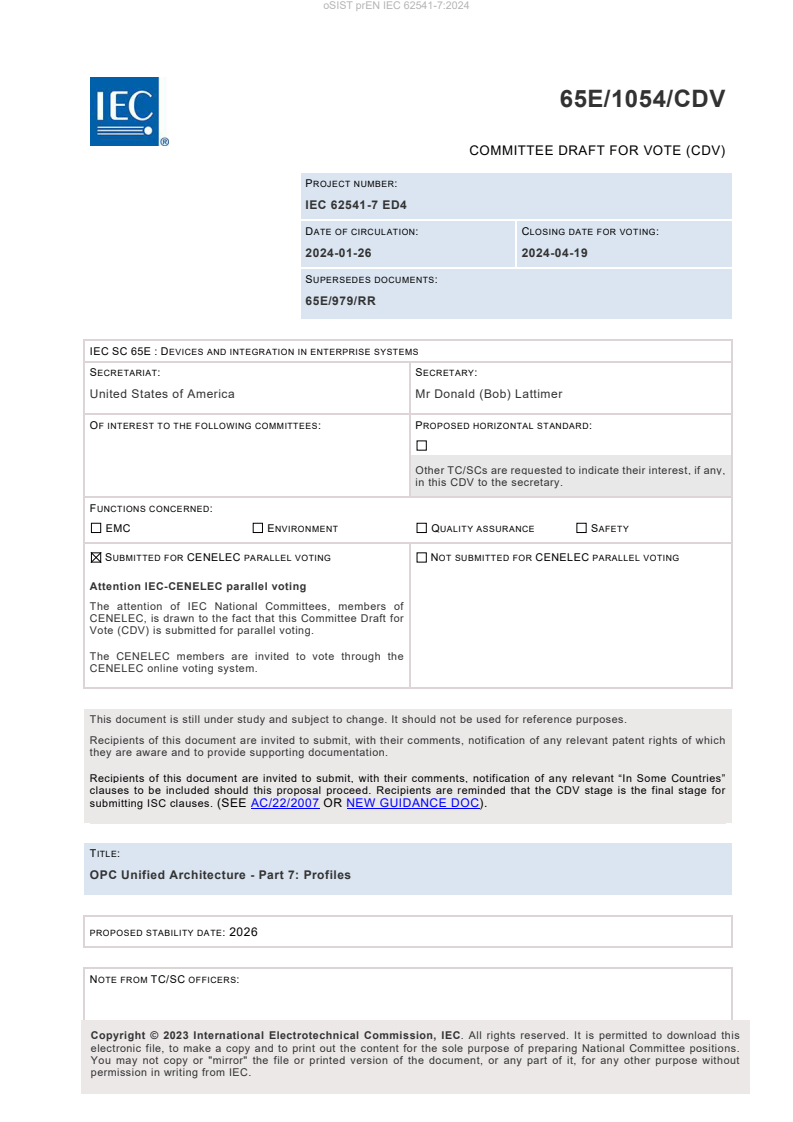
65E/1054/CDV
COMMITTEE DRAFT FOR VOTE (CDV)
PROJECT NUMBER:
IEC 62541-7 ED4
DATE OF CIRCULATION: CLOSING DATE FOR VOTING:
2024-01-26 2024-04-19
SUPERSEDES DOCUMENTS:
65E/979/RR
IEC SC 65E : DEVICES AND INTEGRATION IN ENTERPRISE SYSTEMS
SECRETARIAT: SECRETARY:
United States of America Mr Donald (Bob) Lattimer
OF INTEREST TO THE FOLLOWING COMMITTEES: PROPOSED HORIZONTAL STANDARD:
Other TC/SCs are requested to indicate their interest, if any,
in this CDV to the secretary.
FUNCTIONS CONCERNED:
EMC ENVIRONMENT QUALITY ASSURANCE SAFETY
SUBMITTED FOR CENELEC PARALLEL VOTING NOT SUBMITTED FOR CENELEC PARALLEL VOTING
Attention IEC-CENELEC parallel voting
The attention of IEC National Committees, members of
CENELEC, is drawn to the fact that this Committee Draft for
Vote (CDV) is submitted for parallel voting.
The CENELEC members are invited to vote through the
CENELEC online voting system.
This document is still under study and subject to change. It should not be used for reference purposes.
Recipients of this document are invited to submit, with their comments, notification of any relevant patent rights of which
they are aware and to provide supporting documentation.
Recipients of this document are invited to submit, with their comments, notification of any relevant “In Some Countries”
clauses to be included should this proposal proceed. Recipients are reminded that the CDV stage is the final stage for
submitting ISC clauses. (SEE AC/22/2007 OR NEW GUIDANCE DOC).
TITLE:
OPC Unified Architecture - Part 7: Profiles
PROPOSED STABILITY DATE: 2026
NOTE FROM TC/SC OFFICERS:
electronic file, to make a copy and to print out the content for the sole purpose of preparing National Committee positions.
You may not copy or "mirror" the file or printed version of the document, or any part of it, for any other purpose without
permission in writing from IEC.
oSIST prEN IEC 62541-7:2024
IEC CDV 62541-7 © IEC 2023
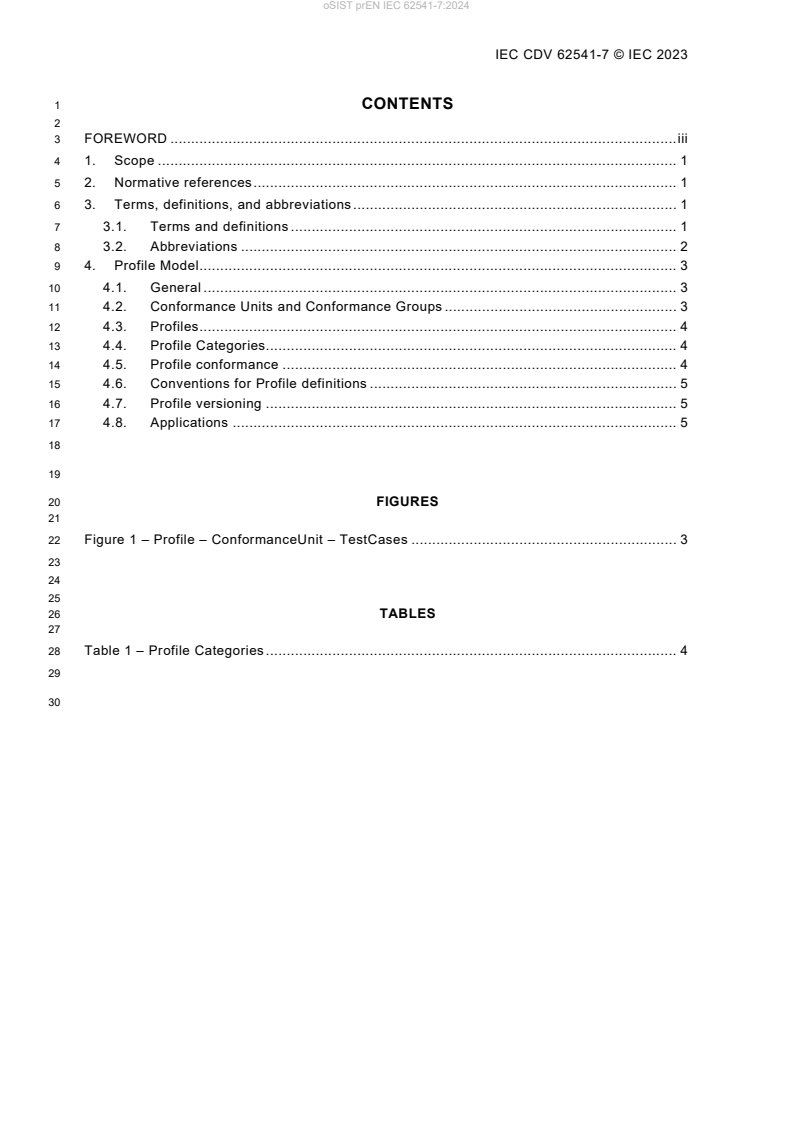
1 CONTENTS
3 FOREWORD . iii
4 1. Scope . 1
5 2. Normative references . 1
6 3. Terms, definitions, and abbreviations . 1
7 3.1. Terms and definitions . 1
8 3.2. Abbreviations . 2
9 4. Profile Model . 3
10 4.1. General . 3
11 4.2. Conformance Units and Conformance Groups . 3
12 4.3. Profiles . 4
13 4.4. Profile Categories. 4
14 4.5. Profile conformance . 4
15 4.6. Conventions for Profile definitions . 5
16 4.7. Profile versioning . 5
17 4.8. Applications . 5
20 FIGURES
22 Figure 1 – Profile – ConformanceUnit – TestCases . 3
26 TABLES
28 Table 1 – Profile Categories . 4
oSIST prEN IEC 62541-7:2024
iii IEC CDV 62541-7 © IEC 2023
31 INTERNATIONAL ELECTROTECHNICAL COMMISSION
32 ____________
34 OPC UNIFIED ARCHITECTURE –
36 Part 7: Profiles
38 FOREWORD
39 1) The International Electrotechnical Commission (IEC) is a worldwide organization for standardization comprising all
40 national electrotechnical committees (IEC National Committees). The object of IEC is to promote international co-
41 operation on all questions concerning standardization in the electrical and electronic fields. To this end and in addition to
42 other activities, IEC publishes International Standards, Technical Specifications, Technical Reports, Publicly Available
43 Specifications (PAS) and Guides (hereafter referred to as "IEC Publication(s)"). Their preparation is entrusted to technical
44 committees; any IEC National Committee interested in the subject dealt with may participate in this preparatory work.
45 International, governmental and non-governmental organizations liaising with the IEC also participate in this preparation.
46 IEC collaborates closely with the International Organization for Standardization (ISO) in accordance with conditions
47 determined by agreement between the two organizations.
48 2) The formal decisions or agreements of IEC on technical matters express, as nearly as possible, an international
49 consensus of opinion on the relevant subjects since each technical committee has representation from all interested IEC
50 National Committees.
51 3) IEC Publications have the form of recommendations for international use and are accepted by IEC National Committees
52 in that sense. While all reasonable efforts are made to ensure that the technical content of IEC Publications is accurate,
53 IEC cannot be held responsible for the way in which they are used or for any misinterpretation by any end user.
54 4) In order to promote international uniformity, IEC National Committees undertake to apply IEC Publications transparently
55 to the maximum extent possible in their national and regional publications. Any divergence between any IEC Publication
56 and the corresponding national or regional publication shall be clearly indicated in the latter.
57 5) IEC itself does not provide any attestation of conformity. Independent certification bodies provide conformity assessment
58 services and, in some areas, access to IEC marks of conformity. IEC is not responsible for any services carried out by
59 independent certification bodies.
60 6) All users should ensure that they have the latest edition of this publication.
61 7) No liability shall attach to IEC or its directors, employees, servants or agents including individual experts and members
62 of its technical committees and IEC National Committees for any personal injury, property damage or other damage of
63 any nature whatsoever, whether direct or indirect, or for costs (including legal fees) and expenses arising out of the
64 publication, use of, or reliance upon, this IEC Publication or any other IEC Publications.
65 8) Attention is drawn to the Normative references cited in this publication. Use of the referenced publications is indispensable
66 for the correct application of this publication.
67 9) Attention is drawn to the possibility that some of the elements of this IEC Publication may be the subject of patent rights.
68 IEC shall not be held responsible for identifying any or all such patent rights.
69 International Standard IEC 62541-7 has been prepared by subcommittee 65E: Devices and integration
70 in enterprise systems, of IEC technical committee 65: Industrial-process measurement, control and
71 automation.
72 This fourth edition cancels and replaces the third edition published in 2020. This edition constitutes a
73 technical revision.
74 This edition includes the following significant technical changes with respect to the previous edition:
75 • Profiles and Conformance Units are not part of this part but are solely managed in a public
76 database as described in Clause 1.
77 The text of this International Standard is based on the following documents:
CDV Report on voting
65E/XX/CDV 65E/XX/RVC
79 Full information on the voting for the approval of this International Standard can be found in the report
80 on voting indicated in the above table.
81 This document has been drafted in accordance with the ISO/IEC Directives, Part 2.
oSIST prEN IEC 62541-7:2024
IEC CDV 62541-7 © IEC 2023 – iv –
Throughout this document and the other parts of the IEC 62541 series, certain document conventions
83 are used:
84 Italics are used to denote a defined term or definition that appears in the "Terms and definition" clause
85 in one of the parts of the IEC 62541 series.
86 Italics are also used to denote the name of a service input or output parameter or the name of a
87 structure or element of a structure that are usually defined in tables.
88 The italicized terms and names are, with a few exceptions, written in camel-case (the practice of
89 writing compound words or phrases in which the elements are joined without spaces, with each
90 element's initial letter capitalized within the compound). For example the defined term is AddressSpace
91 instead of Address Space. This makes it easier to understand that there is a single definition for
92 AddressSpace, not separate definitions for Address and Space.
93 A list of all parts of the IEC 62541 series, published under the general title OPC Unified Architecture,
94 can be found on the IEC website.
95 The committee has decided that the contents of this document will remain unchanged until the stability
96 date indicated on the IEC website under "http://webstore.iec.ch" in the data related to the specific
97 document. At this date, the document will be
98 • reconfirmed,
99 • withdrawn,
100 • replaced by a revised edition, or
101 • amended.
IMPORTANT – The 'colour inside' logo on the cover page of this publication indicates
that it contains colours which are considered to be useful for the correct understanding
of its contents. Users should therefore print this document using a colour printer.
oSIST prEN IEC 62541-7:2024
1 IEC CDV 62541-7 © IEC 2023
106 OPC Unified Architecture Specification
108 Part 7: Profiles
112 1. Scope
113 This document specifies value and structure of Profiles in the OPC Unified Architecture.
114 The actual Profiles are maintained in an online database and accessible via
115 https://profiles.opcfoundation.org/.
116 OPC UA Profiles are used to segregate features with regard to testing of OPC UA products and
117 the nature of the testing (tool based or lab based). This includes the testing performed by the
118 OPC Foundation provided OPC UA CTT (a self-test tool) and by the OPC Foundation provided
119 independent certification test labs. This could equally as well refer to test tools provided by
120 another organization or a test lab provided by another organization. What is important is the
121 concept of automated tool based testing versus lab based testing. The scope of this standard
122 includes defining functionality that can only be tested in a lab and defining the grouping of
123 functionality that is to be used when testing OPC UA products either in a lab or using automated
124 tools. The definition of actual TestCases is not within the scope of this document, but the
125 general categories of TestCases are within the scope of this document.
126 Most OPC UA applications will conform to several, but not all of the Profiles.
127 2. Normative references
128 The following documents, in wh
...
Questions, Comments and Discussion
Ask us and Technical Secretary will try to provide an answer. You can facilitate discussion about the standard in here.
Loading comments...