

EN 15649-3:2009
(Main)Floating leisure articles for use on and in the water - Part 3: Additional specific safety requirements and test methods for Class A devices
- Abstract
This European Standard is applicable for CLASS A classified floating leisure articles for use on or in water according to EN 15649-1 regardless whether the buoyancy is achieved by inflation or inherent buoyant material.
This document (EN 15649-3) is applicable with EN 15649-1 and EN 15649-2.
NOTE 1 Typical products forming Class A:
- "Floating Islands" in near round or square shaped forms decorated with palm tree, sun shade, etc. high superstructure;
- large floats/rafts in various forms from round to square;
- large floating tubes, giant tubes (inflatable or inherently buoyant);
- floating arm chairs, seats and sun beds;
- air mattresses for use on the water;
- large animal shaped inflatable or inherent buoyant devices, buoyant structures with animal like decorations, imitations;
- recreational rafts / floating platforms / pontoons.
NOTE 2 Typical places for application:
- pools;
- protected areas of lakes, ponds;
- protected area sea shore (no offshore winds, no currents).
- Status
- Withdrawn
- Publication Date
- 10-Nov-2009
- Withdrawal Date
- 10-Jan-2012
- Technical Committee
- CEN/TC 136 - Sports, playground and other recreational equipment
- Drafting Committee
- CEN/TC 136/WG 13 - Floating leisure articles for use on water
- Current Stage
- 9960 - Withdrawal effective - Withdrawal
- Start Date
- 11-Jan-2012
- Completion Date
- 11-Jan-2012
- Directive
- 2001/95/EC - General product safety

Relations
- Effective Date
- 18-Jan-2023
- Effective Date
- 28-Jan-2026
- Effective Date
- 28-Jan-2026
- Effective Date
- 28-Jan-2026
- Effective Date
- 28-Jan-2026
- Effective Date
- 28-Jan-2026
- Effective Date
- 28-Jan-2026
- Referred By
EN 1744-1:2009+A1:2012 - Tests for chemical properties of aggregates - Part 1: Chemical analysis - Effective Date
- 28-Jan-2026
- Effective Date
- 28-Jan-2026
- Effective Date
- 28-Jan-2026
- Effective Date
- 28-Jan-2026
- Effective Date
- 28-Jan-2026
- Effective Date
- 28-Jan-2026
- Effective Date
- 28-Jan-2026
- Effective Date
- 28-Jan-2026
Frequently Asked Questions
EN 15649-3:2009 is a standard published by the European Committee for Standardization (CEN). Its full title is "Floating leisure articles for use on and in the water - Part 3: Additional specific safety requirements and test methods for Class A devices". This standard covers: This European Standard is applicable for CLASS A classified floating leisure articles for use on or in water according to EN 15649-1 regardless whether the buoyancy is achieved by inflation or inherent buoyant material. This document (EN 15649-3) is applicable with EN 15649-1 and EN 15649-2. NOTE 1 Typical products forming Class A: - "Floating Islands" in near round or square shaped forms decorated with palm tree, sun shade, etc. high superstructure; - large floats/rafts in various forms from round to square; - large floating tubes, giant tubes (inflatable or inherently buoyant); - floating arm chairs, seats and sun beds; - air mattresses for use on the water; - large animal shaped inflatable or inherent buoyant devices, buoyant structures with animal like decorations, imitations; - recreational rafts / floating platforms / pontoons. NOTE 2 Typical places for application: - pools; - protected areas of lakes, ponds; - protected area sea shore (no offshore winds, no currents).
This European Standard is applicable for CLASS A classified floating leisure articles for use on or in water according to EN 15649-1 regardless whether the buoyancy is achieved by inflation or inherent buoyant material. This document (EN 15649-3) is applicable with EN 15649-1 and EN 15649-2. NOTE 1 Typical products forming Class A: - "Floating Islands" in near round or square shaped forms decorated with palm tree, sun shade, etc. high superstructure; - large floats/rafts in various forms from round to square; - large floating tubes, giant tubes (inflatable or inherently buoyant); - floating arm chairs, seats and sun beds; - air mattresses for use on the water; - large animal shaped inflatable or inherent buoyant devices, buoyant structures with animal like decorations, imitations; - recreational rafts / floating platforms / pontoons. NOTE 2 Typical places for application: - pools; - protected areas of lakes, ponds; - protected area sea shore (no offshore winds, no currents).
EN 15649-3:2009 is classified under the following ICS (International Classification for Standards) categories: 97.200.50 - Toys. The ICS classification helps identify the subject area and facilitates finding related standards.
EN 15649-3:2009 has the following relationships with other standards: It is inter standard links to EN 15649-3:2009+A1:2012, EN ISO 18465:2017, EN ISO 24181-1:2025, EN ISO 28706-1:2011, EN ISO 21676:2021, EN 15649-6:2009+A1:2013, EN ISO 10714:2024, EN 1744-1:2009+A1:2012, EN ISO 4938:2016, ENV 14029:2001, EN ISO 14673-1:2004, EN ISO 14673-3:2004, EN ISO 8655-7:2005, EN ISO 9647:2022, EN ISO 12311:2023. Understanding these relationships helps ensure you are using the most current and applicable version of the standard.
EN 15649-3:2009 is associated with the following European legislation: EU Directives/Regulations: 2001/95/EC; Standardization Mandates: M/372. When a standard is cited in the Official Journal of the European Union, products manufactured in conformity with it benefit from a presumption of conformity with the essential requirements of the corresponding EU directive or regulation.
EN 15649-3:2009 is available in PDF format for immediate download after purchase. The document can be added to your cart and obtained through the secure checkout process. Digital delivery ensures instant access to the complete standard document.
Standards Content (Sample)
2003-01.Slovenski inštitut za standardizacijo. Razmnoževanje celote ali delov tega standarda ni dovoljeno.$Schwimmende Freizeitartikel zum Gebrauch auf und im Wasser - Teil 3: Zusätzliche spezifische sicherheitstechnische Anforderungen und Prüfverfahren für Klasse A-GeräteArticles de loisirs flottants a utiliser sur ou dans l'eau - Partie 3: Exigences de sécurité et méthodes d'essai complémentaires propres aux dispositifs de Classe AFloating leisure articles for use on and in the water - Part 3: Additional specific safety requirements and test methods for Class A devices97.220.40Oprema za športe na prostem in vodne športeOutdoor and water sports equipmentICS:Ta slovenski standard je istoveten z:EN 15649-3:2009SIST EN 15649-3:2010en,fr,de01-februar-2010SIST EN 15649-3:2010SLOVENSKI
STANDARD
EUROPEAN STANDARD NORME EUROPÉENNE EUROPÄISCHE NORM
EN 15649-3
November 2009 ICS 97.200.50 English Version
Floating leisure articles for use on and in the water - Part 3: Additional specific safety requirements and test methods for Class A devices
Articles de loisirs flottants à utiliser sur ou dans l'eau - Partie 3 : Exigences de sécurité et méthodes d'essai complémentaires propres aux dispositifs de Classe A
Schwimmende Freizeitartikel zum Gebrauch auf und im Wasser - Teil 3: Zusätzliche besondere sicherheitstechnische Anforderungen und Prüfverfahren für Artikel der Klasse A This European Standard was approved by CEN on 11 September 2009.
CEN members are bound to comply with the CEN/CENELEC Internal Regulations which stipulate the conditions for giving this European Standard the status of a national standard without any alteration. Up-to-date lists and bibliographical references concerning such national standards may be obtained on application to the CEN Management Centre or to any CEN member.
This European Standard exists in three official versions (English, French, German). A version in any other language made by translation under the responsibility of a CEN member into its own language and notified to the CEN Management Centre has the same status as the official versions.
CEN members are the national standards bodies of Austria, Belgium, Bulgaria, Cyprus, Czech Republic, Denmark, Estonia, Finland, France, Germany, Greece, Hungary, Iceland, Ireland, Italy, Latvia, Lithuania, Luxembourg, Malta, Netherlands, Norway, Poland, Portugal, Romania, Slovakia, Slovenia, Spain, Sweden, Switzerland and United Kingdom.
EUROPEAN COMMITTEE FOR STANDARDIZATION
COMITÉ EUROPÉEN DE NORMALISATION EUROPÄISCHES KOMITEE FÜR NORMUNG
Management Centre:
Avenue Marnix 17,
B-1000 Brussels © 2009 CEN All rights of exploitation in any form and by any means reserved worldwide for CEN national Members. Ref. No. EN 15649-3:2009: ESIST EN 15649-3:2010
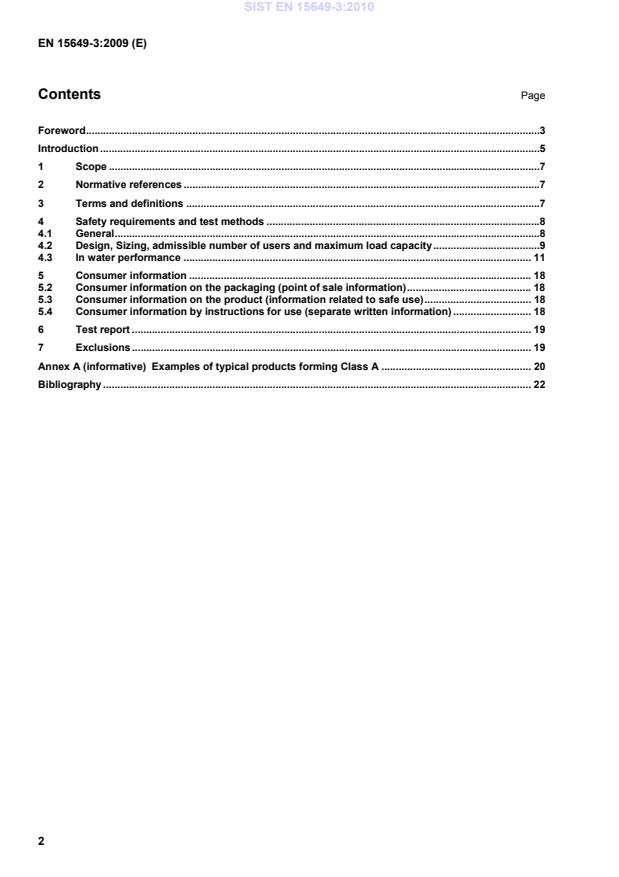
Examples of typical products forming Class A . 20Bibliography . 22 SIST EN 15649-3:2010
Compliance of a product to this standard requires that the requirements of the relevant specific part and
additionally, the requirements of EN 15649-1 and EN 15649-2 shall be met. If a product includes multiple use related to several classes it has to meet the requirements of all these classes. Annex A is informative.
According to the CEN/CENELEC Internal Regulations, the national standards organizations of the following countries are bound to implement this European Standard: Austria, Belgium, Bulgaria, Cyprus, Czech Repub-lic, Denmark, Estonia, Finland, France, Germany, Greece, Hungary, Iceland, Ireland, Italy, Latvia, Lithuania, SIST EN 15649-3:2010
usage Function; range of usage; target / age group Type of movement / propulsion Position of user regarding
equipment and
elevation above water Predictable
misuse Partial risk related to waterenvironment Final risk 1.1 Protection aims; 1.2 Related
standard /
regulation A1 floating fantasy shaped inflatable islands; recrea-tional raft;animal shaped raft; plat-form/ pon-toon, etc. sea shore, close to shore; lakes; smoothly running rivers; public / private pools; ponds relaxing, resting on the water; sunbath-ing; basis for bath-ing and
swimming / playing; device providing high level of floating stability; single and collective use; all age groups, swim-mers static use within limited area; little action; movement by push-ing through swim-ming strokes only;
no mechanical means of propul-sion
on or in (side walls) the device, laying, sitting, no direct body fit;
grab handles might exist but resting does not depend on gripping / balancing; no dangerous height of fall dangerous distance from the bank / shore; use in cur-rents and/or dan-gerous offshore winds;
use by non-swimmers; fall over board; no diving platform! unnoticed drifting to open waters; falling asleep and conse-quently extreme sunburn, etc.; cap-sizing; skin irritation due to long duration of skin contact / dangerous sub-stances in contact with skin; climbing back?; hypothermia; cold shock D
R
O
W
N
I
N
G floating stability; minimum buoyancy; residual buoyancy; space, safety han-dles/ lines; anchor-age; warning notes, labelling, swimmers only, age restriction according to
EN ISO 6185-1, EN ISO 6185-2 and EN ISO 6185-3
A2 large, animal shaped and
otherwise designed buoyant structures: "Ride on", etc. sea shore / close to shore, lakes, public / private pools; ponds action, playing in the water; balancing children;
collective and single use; all age groups, swimmers drifting; propulsion only by swimming strokes or third party on the device; loose fit via handles; no dangerous height use by non-swimmers; use In current, canal, lack of supervision drifting away in open waters due to wind and/or current; devices provokes use in deep; used by non-swimmers; falling into deep water labelling, residual buoyancy, grab han-dles, supervision; warnings
1/2 air mat-tress for use in water; floatable pool loungers; floating seating structures;giant rings / tubes sea shore
close to the shore; lakes, public / private pools; ponds sea resting on the water; observation of under water
environment;
play; mainly single use; floating stabil-ity depends on de-sign; all age groups, swimmers normally no me-chanical means of
propulsion but pos-sible;
drifting or propul-sion by swimming strokes; seats might be equipped with ped-als (wheel propul-sion) On/in the device; device is clung on;
device is held; mainly a near hori-zontal posture sit-ting; no relevant eleva-tion above water level see above see above
See A1/A2
no rule is known to provide technical substance SIST EN 15649-3:2010
This document (EN 15649-3) is applicable with EN 15649-1 and EN 15649-2.
NOTE 1 Typical products forming Class A:
"Floating Islands" in near round or square shaped forms decorated with palm tree, sun shade, etc. high superstruc-ture;
large floats/rafts in various forms from round to square; large floating tubes, giant tubes (inflatable or inherently buoyant); floating arm chairs, seats and sun beds; air mattresses for use on the water; large animal shaped inflatable or inherent buoyant devices, buoyant structures with animal like decorations, imita-tions; recreational rafts / floating platforms / pontoons. NOTE 2 Typical places for application: pools; protected areas of lakes, ponds; protected area sea shore (no offshore winds, no currents). 2 Normative references The following referenced documents are indispensable for the application of this document. For dated refer-ences, only the edition cited applies. For undated references, the latest edition of the referenced document (including any amendments) applies. EN 15649-1:2009, Floating leisure articles for use on and in the water — Part 1: Classification, materials, general requirements and test methods EN 15649-2, Floating leisure articles for use on and in the water — Part 2: Consumer information 3 Terms and definitions For the purposes of this document, the terms and definitions given in EN 15649-1:2009 and the following ap-ply. 3.1 residual buoyancy provision of remaining buoyancy in case of a defect of any buoyancy chamber SIST EN 15649-3:2010
device providing static floating stability product so designed that the user needs not to care about floating stability by his own skills
NOTE One or several users may be safely on or in the device even if the weight is not evenly distributed. 3.31 device to be balanced by the user upright floating of device depends on user's skill and sense to balance it 3.4 escape easy and complete separation between the user and the device in case of capsizing of the device or system without hindrance through any part or feature of the floating device 3.5 available area area on or inside a floating article which can be used unrestrictedly for user accommodation when taking the intended posture(s) 3.6 multiple use product any product intended to be used for more than one purpose (jumping, resting, climbing, etc.) 3.7 inherent buoyant material non-crosslinked (closed-cell) foam or other materials enclosed in (a) sealed compartment(s) in the hull which have a specific weight less than fresh water NOTE Inflatables made from inherent buoyant material are considered a buoyant structure (hull) achieving all or parts of its intended shape and buoyancy resulting from soft foam, hard foam or sealed chambers filled with air, gas or granules. 4 Safety requirements and test methods 4.1 General Construction of a floating leisure article shall be such that it corresponds in terms of design, dimensions, safety, strength and durability for its intended use. The requirements set out in this standard were chosen to ensure compliance with these considerations. If inflatable floating leisure articles shall provide buoyancy in several components then requirements apply to all components. Floating leisure articles shall provide residual buoyancy if one air chamber fails. This residual buoyancy shall maintain the safety of the device even if its function is lost. The following safety requirements are therefore related to: design; sizing; materials; strength; performance;
1 In accordance with intended use. SIST EN 15649-3:2010
EN 15649-1:2009, A.1.2. In cases of combined use (sitting and lying), the template for a lying person shall be applied to determine the available area. Templates may exceed the outer circumference of the device to a total amount of 30 %. This amount is di-vided in 15 % of template length for the head area and 15 % of template length for the leg area (see shaded area of templates in EN 15649-1:2009, Annex A). The angle between centre line of the template and tangen-tial of a possible back rest, board wall, etc. shall be greater than 60° (see Figure 1). The total amount of users determined by the templates shall not contradict to the load capacity and floating stability of the device. Space requirement using templates is not applicable for ride-on devices where distinct upright seats and/or seating positions are imposed by the device. 4.2.3.2 Test method Testing shall be done by applying the relevant templates as specified in EN 15649-1:2009, A.1 and shown in Figure 1. Templates shall be stretched out over the area available to the user without overlapping. Templates may be arrayed to optimise the amount of users and the mix of adults and children without contradicting to the load capacity of the device. Blank areas of templates shall be completely inside the outer circumference. Check by visual inspection for appropriate labelling in accordance with safety information symbols "Number of users, adult/children" and/or "Maximum load capacity" as specified in EN 15649-2. SIST EN 15649-3:2010
a) A1, "Big raft": 3,8 m in diameter/4,8 m ×××× 2,8 m
b) A1, "Small raft": 2,5 m in diameter/3 m ×××× 2 m Key 1 Template space per person, adult 2 Template Space per person, child Figure 1 — Available space per person, determination of number of users 4.2.4 A2-products, space per person and admissible number of users 4.2.4.1 Requirements A-2 products shall provide distinct seat(s) or sitting areas or recognisable space where the user is to be posi-tioned in the intended posture. Seats, etc. of ride-on devices shall be equipped with at least one grab handle for each permissible user.
If the device implies sitting in line of more than one user, the sitting space for each user shall be at least a length of: Child = 30 cm if the legs hang down; Child = 60 cm if the thighs follow the seat surface. Adult = 35 cm if the legs hang down; Adult = 70 cm if the thighs follow the seat surface. 4.2.4.2 Test method Visual inspection and measurement. SIST EN 15649-3:2010
If a floating article deviates from the shown types a) to h) test positions and postures as shown in Figure 2 shall be applied in consideration of the foreseeable uneven load distribution. The basic posture of test subjects shall be in accordance with manufacturers declaration (lying/sitting) and in detail in accordance with EN 15649-1:2009, 5.6.5. If a device allows for several postures, the one most likely to cause failure shall be chosen from the standardised range. The test shall be repeated with the minimum and maximum load applicable (one child test subject or one adult test subject) if the intended floating position depends by design, e.g. teeter-totter, on a distinct balanced weight distribution in pairs or other even-numbered groups of users. Floating arm chairs, loungers with arm rests, etc. shall be tested so that the test subject(s) is positioned on the determined seat/sitting area but at the utmost side of the seat's sitting area (left or right hand side) as provided by
...