


EN 2549:2006
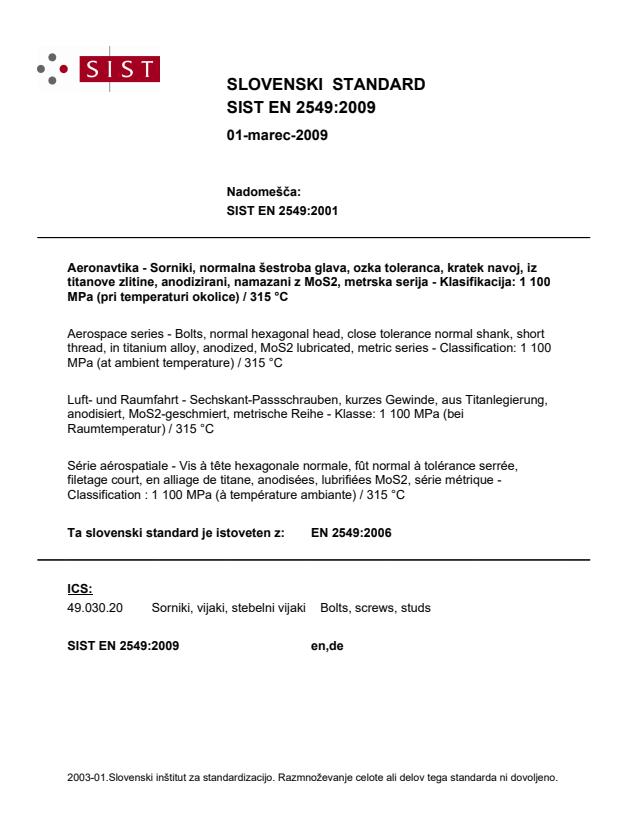
(Main)Aerospace series - Bolts, normal hexagonal head, close tolerance normal shank, short thread, in titanium alloy, anodized, MoS2 lubricated, metric series - Classification: 1 100 MPa (at ambient temperature) / 315 °C
Aerospace series - Bolts, normal hexagonal head, close tolerance normal shank, short thread, in titanium alloy, anodized, MoS2 lubricated, metric series - Classification: 1 100 MPa (at ambient temperature) / 315 °C
This standard specifies the characteristics of bolts, normal hexagonal head, close tolerance normal shank, short thread, in titanium alloy, anodized, MoS2 lubricated.
Classification: 1 100 MPa / 315 °C
Luft- und Raumfahrt - Sechskant-Passschrauben, kurzes Gewinde, aus Titanlegierung, anodisiert, MoS2-geschmiert, metrische Reihe - Klasse: 1 100 MPa (bei Raumtemperatur) / 315 °C
Diese Norm legt die Eigenschaften für Sechskant-Passschrauben, kurzes Gewinde, aus Titanlegierung, ano¬disiert, MoS2-geschmiert, metrische Reihe, fest.
Klasse: 1 100 MPa )/315 °C )
Série aérospatiale - Vis à tête hexagonale normale, fût normal à tolérance serrée, filetage court, en alliage de titane, anodisées, lubrifiées MoS2, série métrique - Classification : 1 100 MPa (à température ambiante) / 315 °C
Aeronavtika - Sorniki, normalna šestroba glava, ozka toleranca, kratek navoj, iz titanove zlitine, anodizirani, namazani z MoS2, metrska serija - Klasifikacija: 1 100 MPa (pri temperaturi okolice) / 315 °C
General Information
Relations
Overview
EN 2549:2006 is a European aerospace standard published by CEN that specifies the characteristics and technical requirements for titanium alloy bolts with a normal hexagonal head, close tolerance normal shank, and short thread. These bolts are anodized and lubricated with molybdenum disulphide (MoS2), classified for use in metric series applications with a minimum tensile strength of 1,100 MPa at ambient temperature and a maximum service temperature of 315 °C. This standard is essential for manufacturers and engineers working in the aerospace sector who require high-performance fasteners that meet stringent safety, durability, and performance criteria.
Key Topics
Bolt Characteristics
EN 2549 covers bolts with the following features:- Normal hexagonal head and normal shank with close tolerance dimensions
- Short thread length suitable for aerospace assembly needs
- Titanium alloy material selected for high strength-to-weight ratio
- Surface treatment with anodizing followed by MoS2 dry lubrication to enhance corrosion resistance and reduce friction.
Mechanical Classification
- Minimum tensile strength: 1,100 MPa at ambient temperature
- Maximum operational temperature: 315 °C without degradation of mechanical properties.
Dimensional and Tolerance Specifications
- Detailed metric series size codes, dimensions, and tolerances as per ISO 3193 and ISO 7913
- Defined thread profiles and surface finish criteria ensuring compatibility with aerospace assemblies.
Marking and Designation
- Clear marking system per EN 2424 for traceability and identification
- Classification codes for hole types (lockwire, split pin, or none) and lubricant application.
Related Quality and Procurement Requirements
- Manufacturer approval in accordance with EN 9100 quality management system
- Bolt qualification procedures following EN 9133 to guarantee consistent performance.
Applications
EN 2549 bolts are tailored for aerospace industry applications requiring lightweight, high-strength fasteners capable of withstanding harsh environments. Typical uses include:
- Aircraft structural assemblies where weight reduction without compromising strength is critical
- Engine and airframe components exposed to elevated temperatures up to 315 °C
- Aerospace manufacturing and maintenance operations that demand precise bolt tolerances and reliable lubricated surfaces
- Components requiring excellent corrosion resistance and friction performance due to anodizing and MoS2 coating
The standard ensures that aerospace fasteners made according to EN 2549 deliver optimal safety, durability, and performance, especially in demanding temperature and mechanical stress conditions.
Related Standards
- ISO 3193 – Aerospace bolts with hexagonal heads, normal shank dimensions, and thread specifications
- ISO 3353-1 – Specifications for rolled external threads for aerospace applications
- ISO 7913 – Tolerances of form and position for bolts and screws in aerospace
- EN 2424 – Marking protocols for aerospace products
- EN 2491 – Specifications and application methods for MoS2 dry lubricants in aerospace coatings
- EN 9100 – Aerospace quality management systems based on ISO 9001
- EN 9133 – Qualification procedures for aerospace standard parts
- EN 4016 – Specifications for oversized aerospace bolts
- TR 3775 & TR 4070 – Technical reports covering titanium materials and MoS2 coating products
By adhering to EN 2549 alongside these related standards, manufacturers and users ensure the highest level of quality, safety, and interoperability in aerospace fastener components.
Keywords: EN 2549, aerospace bolts, titanium alloy bolts, hexagonal head bolts, MoS2 lubrication, anodized bolts, aerospace fasteners, close tolerance shank, short thread bolts, aerospace standards, CEN aerospace standard, aerospace bolt specifications, aerospace quality management, metric bolt series, high strength aerospace bolt, aerospace temperature classification
Frequently Asked Questions
EN 2549:2006 is a standard published by the European Committee for Standardization (CEN). Its full title is "Aerospace series - Bolts, normal hexagonal head, close tolerance normal shank, short thread, in titanium alloy, anodized, MoS2 lubricated, metric series - Classification: 1 100 MPa (at ambient temperature) / 315 °C". This standard covers: This standard specifies the characteristics of bolts, normal hexagonal head, close tolerance normal shank, short thread, in titanium alloy, anodized, MoS2 lubricated. Classification: 1 100 MPa / 315 °C
This standard specifies the characteristics of bolts, normal hexagonal head, close tolerance normal shank, short thread, in titanium alloy, anodized, MoS2 lubricated. Classification: 1 100 MPa / 315 °C
EN 2549:2006 is classified under the following ICS (International Classification for Standards) categories: 49.030.20 - Bolts, screws, studs. The ICS classification helps identify the subject area and facilitates finding related standards.
EN 2549:2006 has the following relationships with other standards: It is inter standard links to EN 2549:1995. Understanding these relationships helps ensure you are using the most current and applicable version of the standard.
You can purchase EN 2549:2006 directly from iTeh Standards. The document is available in PDF format and is delivered instantly after payment. Add the standard to your cart and complete the secure checkout process. iTeh Standards is an authorized distributor of CEN standards.
Standards Content (Sample)
2003-01.Slovenski inštitut za standardizacijo. Razmnoževanje celote ali delov tega standarda ni dovoljeno.Aeronavtika - Sorniki, normalna šestroba glava, ozka toleranca, kratek navoj, iz titanove zlitine, anodizirani, namazani z MoS2, metrska serija - Klasifikacija: 1 100 MPa (pri temperaturi okolice) / 315 °CLuft- und Raumfahrt - Sechskant-Passschrauben, kurzes Gewinde, aus Titanlegierung, anodisiert, MoS2-geschmiert, metrische Reihe - Klasse: 1 100 MPa (bei Raumtemperatur) / 315 °CSérie aérospatiale - Vis à tête hexagonale normale, fût normal à tolérance serrée, filetage court, en alliage de titane, anodisées, lubrifiées MoS2, série métrique - Classification : 1 100 MPa (à température ambiante) / 315 °CAerospace series - Bolts, normal hexagonal head, close tolerance normal shank, short thread, in titanium alloy, anodized, MoS2 lubricated, metric series - Classification: 1 100 MPa (at ambient temperature) / 315 °C49.030.20Sorniki, vijaki, stebelni vijakiBolts, screws, studsICS:Ta slovenski standard je istoveten z:EN 2549:2006SIST EN 2549:2009en,de01-marec-2009SIST EN 2549:2009SLOVENSKI
STANDARDSIST EN 2549:20011DGRPHãþD
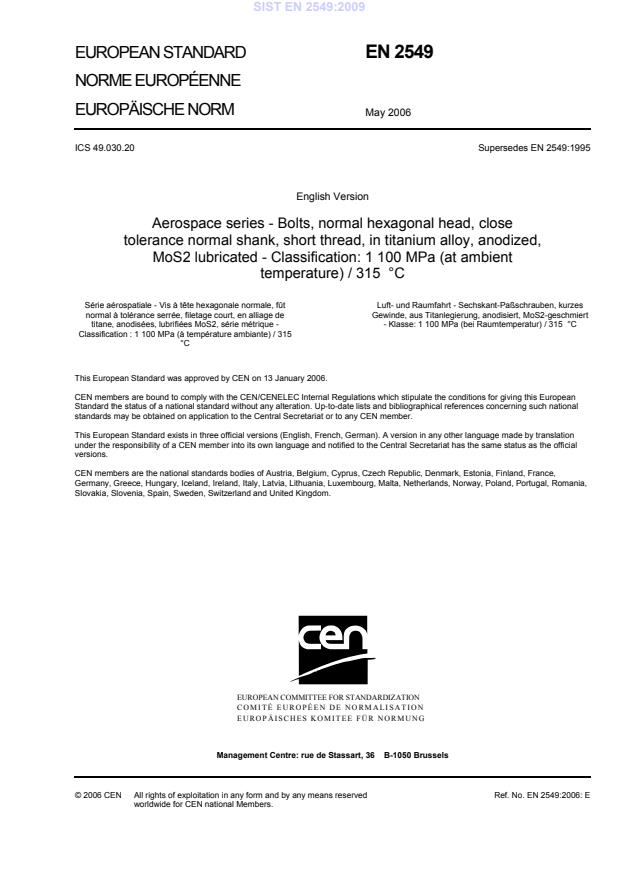
EUROPEAN STANDARD NORME EUROPÉENNE EUROPÄISCHE NORM
EN 2549
May 2006 ICS 49.030.20 Supersedes EN 2549:1995 English Version
Aerospace series - Bolts, normal hexagonal head, close tolerance normal shank, short thread, in titanium alloy, anodized, MoS2 lubricated - Classification: 1 100 MPa (at ambient temperature) / 315
°C
Série aérospatiale - Vis à tête hexagonale normale, fût normal à tolérance serrée, filetage court, en alliage de titane, anodisées, lubrifiées MoS2, série métrique - Classification : 1 100 MPa (à température ambiante) / 315
°C
Luft- und Raumfahrt - Sechskant-Paßschrauben, kurzes Gewinde, aus Titanlegierung, anodisiert, MoS2-geschmiert - Klasse: 1 100 MPa (bei Raumtemperatur) / 315
°C This European Standard was approved by CEN on 13 January 2006.
CEN members are bound to comply with the CEN/CENELEC Internal Regulations which stipulate the conditions for giving this European Standard the status of a national standard without any alteration. Up-to-date lists and bibliographical references concerning such national standards may be obtained on application to the Central Secretariat or to any CEN member.
This European Standard exists in three official versions (English, French, German). A version in any other language made by translation under the responsibility of a CEN member into its own language and notified to the Central Secretariat has the same status as the official versions.
CEN members are the national standards bodies of Austria, Belgium, Cyprus, Czech Republic, Denmark, Estonia, Finland, France, Germany, Greece, Hungary, Iceland, Ireland, Italy, Latvia, Lithuania, Luxembourg, Malta, Netherlands, Norway, Poland, Portugal, Romania, Slovakia, Slovenia, Spain, Sweden, Switzerland and United Kingdom.
EUROPEAN COMMITTEE FOR STANDARDIZATION
COMITÉ EUROPÉEN DE NORMALISATION EUROPÄISCHES KOMITEE FÜR NORMUNG
Management Centre: rue de Stassart, 36
B-1050 Brussels © 2006 CEN All rights of exploitation in any form and by any means reserved worldwide for CEN national Members. Ref. No. EN 2549:2006: ESIST EN 2549:2009
...
Questions, Comments and Discussion
Ask us and Technical Secretary will try to provide an answer. You can facilitate discussion about the standard in here.
Loading comments...