

EN 450-1:2005+A1:2007
(Main + Amendment)Fly ash for concrete - Part 1: Definition, specifications and conformity criteria
General Information
- Abstract
This European Standard specifies requirements for the chemical and physical properties as well as quality control procedures for fly ash, as defined in clause 3.2, for use as a type II addition for preparation of concrete, mortar and grout, including in particular cast-in-situ or prefabricated structural concrete conforming to EN 206-1. )
It is, however, beyond the scope of this standard to specify provisions governing the practical application of fly ash in the production of concrete, i.e. requirements concerning composition, mixing, placing, curing etc. of concrete containing fly ash. As regards such provisions, reference should be made to other European or national standards for concrete, such as EN 206-1.
Fly ash for use in the manufacture of cements according to EN 197-1 is outside the scope of this standard.
- Status
- Withdrawn
- Publication Date
- 16-Oct-2007
- Withdrawal Date
- 07-Aug-2012
- Technical Committee
- CEN/TC 104 - Concrete ( performance, production, placing and compliance criteria )
- Drafting Committee
- CEN/TC 104/WG 4 - EN 450 fly ash for concrete
- Current Stage
- 9960 - Withdrawal effective - Withdrawal
- Start Date
- 08-Aug-2012
- Completion Date
- 08-Aug-2012
89/106/EEC - Construction productsOJ Ref: C, C 321 OJ Date: 16-Dec-2008

Relations
- Merged From
EN 450-1:2005 - Fly ash for concrete - Part 1: Definition, specifications and conformity criteria - Effective Date
- 22-Dec-2008
- Replaced By
EN 450-1:2012 - Fly ash for concrete - Part 1: Definition, specifications and conformity criteria - Effective Date
- 15-Aug-2012
- Referred By
CEN/TR 16443:2013 - Backgrounds to the revision of EN 450-1:2005+A1:2007 - Fly ash for concrete - Effective Date
- 28-Jan-2026
Get Certified
Connect with accredited certification bodies for this standard

DIBt (Deutsches Institut für Bautechnik)
German Institute for Building Technology.
DIN CERTCO
DIN Group product certification.

Aboma Certification B.V.
Specialized in construction, metal, and transport sectors.
Sponsored listings
Frequently Asked Questions
EN 450-1:2005+A1:2007 is a standard published by the European Committee for Standardization (CEN). Its full title is "Fly ash for concrete - Part 1: Definition, specifications and conformity criteria". This standard covers: This European Standard specifies requirements for the chemical and physical properties as well as quality control procedures for fly ash, as defined in clause 3.2, for use as a type II addition for preparation of concrete, mortar and grout, including in particular cast-in-situ or prefabricated structural concrete conforming to EN 206-1. ) It is, however, beyond the scope of this standard to specify provisions governing the practical application of fly ash in the production of concrete, i.e. requirements concerning composition, mixing, placing, curing etc. of concrete containing fly ash. As regards such provisions, reference should be made to other European or national standards for concrete, such as EN 206-1. Fly ash for use in the manufacture of cements according to EN 197-1 is outside the scope of this standard.
This European Standard specifies requirements for the chemical and physical properties as well as quality control procedures for fly ash, as defined in clause 3.2, for use as a type II addition for preparation of concrete, mortar and grout, including in particular cast-in-situ or prefabricated structural concrete conforming to EN 206-1. ) It is, however, beyond the scope of this standard to specify provisions governing the practical application of fly ash in the production of concrete, i.e. requirements concerning composition, mixing, placing, curing etc. of concrete containing fly ash. As regards such provisions, reference should be made to other European or national standards for concrete, such as EN 206-1. Fly ash for use in the manufacture of cements according to EN 197-1 is outside the scope of this standard.
EN 450-1:2005+A1:2007 is classified under the following ICS (International Classification for Standards) categories: 91.100.30 - Concrete and concrete products. The ICS classification helps identify the subject area and facilitates finding related standards.
EN 450-1:2005+A1:2007 has the following relationships with other standards: It is inter standard links to EN 450-1:2005, EN 450-1:2012, CEN/TR 16443:2013. Understanding these relationships helps ensure you are using the most current and applicable version of the standard.
EN 450-1:2005+A1:2007 is associated with the following European legislation: EU Directives/Regulations: 305/2011, 89/106/EEC; Standardization Mandates: M/128. When a standard is cited in the Official Journal of the European Union, products manufactured in conformity with it benefit from a presumption of conformity with the essential requirements of the corresponding EU directive or regulation.
EN 450-1:2005+A1:2007 is available in PDF format for immediate download after purchase. The document can be added to your cart and obtained through the secure checkout process. Digital delivery ensures instant access to the complete standard document.
Standards Content (Sample)
2003-01.Slovenski inštitut za standardizacijo. Razmnoževanje celote ali delov tega standarda ni dovoljeno.Fly ash for concrete - Part 1: Definition, specifications and conformity criteriaElektrofiltrski pepel - 1. del: Definicije, specifikacije in merila skladnostiCendres volantes pour béton - Partie 1: Définition, spécifications et criteres de conformitéFlugasche für Beton - Teil 1: Definition, Anforderungen und KonformitätskriterienTa slovenski standard je istoveten z:EN 450-1:2005+A1:2007SIST EN 450-1:2005+A1:2008en,fr91.100.30Beton in betonski izdelkiConcrete and concrete productsICS:SLOVENSKI
STANDARDSIST EN 450-1:2005+A1:200801-januar-2008
EUROPEAN STANDARD NORME EUROPÉENNE EUROPÄISCHE NORM
EN 450-1:2005+A1
October 2007 ICS 91.100.30 Supersedes EN 450-1:2005 English Version
Fly ash for concrete - Part 1: Definition, specifications and conformity criteria
Cendres volantes pour béton - Partie 1: Définition, spécifications et critères de conformité
Flugasche für Beton - Teil 1: Definition, Anforderungen und Konformitätskriterien This European Standard was approved by CEN on 22nd December 2004 and includes Amendment 1 approved by CEN on 10 September 2007.
CEN members are bound to comply with the CEN/CENELEC Internal Regulations which stipulate the conditions for giving this European Standard the status of a national standard without any alteration. Up-to-date lists and bibliographical references concerning such national standards may be obtained on application to the CEN Management Centre or to any CEN member.
This European Standard exists in three official versions (English, French, German). A version in any other language made by translation under the responsibility of a CEN member into its own language and notified to the CEN Management Centre has the same status as the official versions.
CEN members are the national standards bodies of Austria, Belgium, Bulgaria, Cyprus, Czech Republic, Denmark, Estonia, Finland, France, Germany, Greece, Hungary, Iceland, Ireland, Italy, Latvia, Lithuania, Luxembourg, Malta, Netherlands, Norway, Poland, Portugal, Romania, Slovakia, Slovenia, Spain, Sweden, Switzerland and United Kingdom.
EUROPEAN COMMITTEE FOR STANDARDIZATION
COMITÉ EUROPÉEN DE NORMALISATION EUROPÄISCHES KOMITEE FÜR NORMUNG
Management Centre: rue de Stassart, 36
B-1050 Brussels © 2007 CEN All rights of exploitation in any form and by any means reserved worldwide for CEN national Members. Ref. No. EN 450-1:2005+A1:2007: E
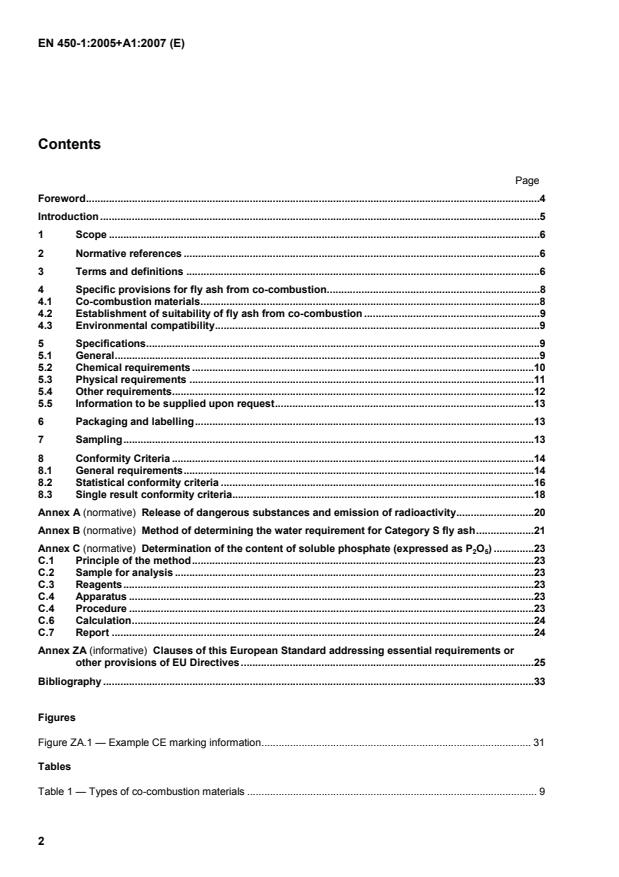
Release of dangerous substances and emission of radioactivity.20 Annex B (normative)
Method of determining the water requirement for Category S fly ash.21 Annex C (normative)
Determination of the content of soluble phosphate (expressed as P2O5).23 C.1 Principle of the method.23 C.2 Sample for analysis.23 C.3 Reagents.23 C.4 Apparatus.23 C.4 Procedure.23 C.6 Calculation.24 C.7 Report.24 Annex ZA (informative)
Clauses of this European Standard addressing essential requirements or other provisions of EU Directives.25 Bibliography.33
Figures Figure ZA.1 — Example CE marking information.31 Tables Table 1 — Types of co-combustion materials.9
M
is the proportion of co-combustion ash in total fly ash in % by mass; Ai
is the ash content of co-combustion material No. i, in % by mass; n
is the number of co-combustion materials being used;
Ac
is the ash content of coal in % by mass;
Ki and Kc are the proportions of co-combustion material(s) and coal being fired, respectively; and where
(Kc + K1+ K2 + … Kn) = 1 and Kc ≥ 0,80. Virtually ash free liquid and gaseous fuels can not be considered in accordance with Formula (1). For that reason the maximum percentage of such fuels shall be determined on the basis of their calorific contribution which shall not exceed 20 % of the total calorific energy.
1 Vegetable material like wood chips, straw, olive shells and other vegetable fibres 2 Green wood and cultivated biomass 3 Animal meal 4 Municipal sewage sludge 5 Paper sludge 6 Petroleum coke 7 Virtually ash free liquid and gaseous fuels
4.2 Establishment of suitability of fly ash from co-combustion The suitability of fly ash obtained from combustion of coal with co-combustion materials given in Table 1 shall be established and documented by the producer. An initial co-combustion in the furnace using the highest intended amount of co-combustion material shall be performed. A representative sample of fly ash taken from this co-combustion (see 7) shall be used to establish the suitability.
Suitability of fly ash obtained from co-combustion with one of the co-combustion materials in Table 1 is established if conformity to the requirements in 5.2, 5.3 and 5.4 has been proven. Other co-combustion materials than those listed in Table 1 may be used if permitted by national laws, regulations or administrative provisions valid in the place of use of fly ash produced from such co-combustion materials and provided that such fly ash conforms to the requirements in 5.2, 5.3 and 5.4.
4.3 Environmental compatibility Should there be any additional requirements resulting from national laws, regulations and administrative provisions in the place of use of the fly ash regarding e.g.
a) the fly ash, b) the leachate of concrete produced with fly ash, c) the co-combustion material, these are to be considered with respect to environmental compatibility, and conformity to the relevant regulations has, where required, to be evaluated before production. 5 Specifications 5.1 General The chemical and physical requirements in 5.2 and 5.3 are specified as characteristic values. Conformity to a characteristic value is assessed by means of a statistical quality control procedure as described in 8.
The purpose of this requirement is to limit the residue of unburnt carbon in the fly ash. It is sufficient, therefore, to show, through direct measurement of unburnt carbon residue, that the content of unburnt carbon falls within the limits of the categories specified above. The content of unburnt carbon shall be determined in accordance with ISO 10694. NOTE As the magnitude of the loss on ignition may have an influence on the effect of air-entraining admixtures used for the manufacture of concrete resistant to freezing and thawing, the three loss on ignition categories defined in this document allow the user to take this into account by choosing the appropriate category for each particular application and exposure class, thus following the standards and/or regulations for concrete valid in the place of use. 5.2.3 Chloride The content of chloride, expressed as Cl–, shall be determined in accordance with !EN 196-2" and shall not be greater than 0,10 % by mass. 5.2.4 Sulfuric anhydride The content of sulfuric anhydride, SO3, shall be determined in accordance with EN 196-2 and shall not be greater than 3,0 % by mass.
The content of soluble phosphate (P2O5) shall be determined in accordance with the method described in Annex C (normative) and shall not be greater than 100 mg/kg. Fly ash obtained from combustion of pulverised coal only shall be deemed to satisfy this requirement. 5.3 Physical requirements 5.3.1 Fineness The fineness of fly ash shall be expressed as the mass proportion in percent of the ash retained when wet sieved on a 0,045 mm mesh sieve and determined in accordance with EN 451-2, and shall fall within the limits of the categories specified below: Category N: The fineness shall not exceed 40 % by mass, and it shall not vary by more than ± 10 percentage points from the declared value.
For fly ash of fineness category N this requirement does not apply. 5.4 Other requirements 5.4.1 Durability requirements The composition and the performance of the fly ash shall be such that durable concrete (see EN 206-1) may be produced when using the fly ash. Fly ash conforming to the definition in 3.2 and fulfilling the chemical requirements in 5.2 and the physical requirements in 5.3 shall be deemed to satisfy the durability requirements.
In certain applications, particularly for concrete in severe environmental conditions, the choice of fly ash category may have an influence on the durability of concrete, e.g. frost resistance and resistance to alkali aggregate reactions. In such cases the choice of fly ash category shall follow the appropriate standards and/or regulations valid in the place of use.
...