

prEN 806-2
(Main)Specification for installations inside buildings conveying water intended for human consumption - Part 2: Design
- Abstract
This document specifies requirements for and gives recommendations on the design of potable water installations according to EN 806-1.
- Status
- Not Published
- Publication Date
- 07-Jun-2026
- Technical Committee
- CEN/TC 164 - Water supply
- Drafting Committee
- CEN/TC 164/WG 2 - Internal systems and components
- Current Stage
- 4060 - Closure of enquiry - Enquiry
- Start Date
- 12-Dec-2024
- Due Date
- 15-Aug-2024
- Completion Date
- 12-Dec-2024

Overview
The European standard prEN 806-2:2024, titled "Specification for installations inside buildings conveying water intended for human consumption - Part 2: Design," is published by CEN (European Committee for Standardization). This standard supersedes the previous EN 806-2:2005 and provides essential requirements and recommendations specifically focused on the design of potable water installation systems within buildings. It aligns with the broader EN 806 series, building on foundational principles outlined in Part 1 to provide detailed guidance for maximizing water quality, system efficiency, safety, and sustainability.
The scope covers multiple aspects of potable water systems, including pipework design, components, materials selection, maintenance planning, and fire protection, ensuring that water supply systems meet health and safety regulations throughout the European Union and other adopting countries.
Key Topics
Design Principles and Optimization
- Emphasis on optimized design techniques to ensure reliable, hygienic, and efficient potable water distribution.
- Guidance on preserving potable water quality during system design and installation.
- Integration of maintenance plans and documentation such as system manuals and room manuals to support operational reliability.
Pipework and Components
- Detailed requirements about pipe materials, joint types, and installation techniques.
- Specifications for flexible hoses, pipe supports, penetration methods, and heat traps.
- Recommendations on corrosion prevention, including internal and external considerations.
- Guidance on acoustics related to pipework to maintain noise control within buildings.
Safety and Hygiene
- Protocols for scald protection through control of pipe surface temperatures.
- Structural fire protection measures specifically for potable water installations to ensure system integrity during emergencies.
- Hygiene-focused design to minimize contamination risks and maintain water quality.
Materials Selection
- Criteria for selecting appropriate materials such as copper, stainless steel, and specific plastics based on their suitability for potable water systems.
- Consideration of corrosion resistance and compatibility with system design needs.
Insulation and Frost Protection
- Recommendations for pipe insulation to prevent heat loss and protect against frost damage.
- Details on layout and trace heating methodologies to maintain temperature control and protect system integrity.
Additional Components and Systems
- Inclusion of protection units, safety devices, pressure reducing valves, boosting systems, leakage protection, and water meters.
- Options for water conditioning and storage systems to ensure consistent water supply and quality.
Applications
Residential Buildings
- Designing potable water systems that meet health safety, comfort, and noise control requirements in homes and apartment complexes.
Commercial and Public Buildings
- Ensuring efficient and hygienic water distribution in offices, schools, hospitals, and public facilities.
Industrial Installations
- Applying potable water installation design principles compatible with industrial standards and special system needs.
Renovations and Upgrades
- Assisting engineers, architects, and contractors in modernizing existing water installations to comply with updated European standards.
Water Safety Management
- Enabling systematic planning to prevent contamination, control temperature, and maintain overall system reliability in potable water networks.
Related Standards
- EN 806-1: Basic requirements for design, materials, and workmanship of water installations.
- EN 1717: Protection against pollution of potable water systems.
- EN 12380: Standards for plumbing fixtures and fittings.
- ISO 30500: Non-sewered sanitation systems related to water management.
- Local Building and Plumbing Codes: To ensure compliance with national legislation adopting and implementing CEN standards.
By adhering to prEN 806-2:2024, professionals involved in building design and water installation ensure compliance with latest regulations, improve water hygiene safety, and optimize the performance and durability of potable water systems inside buildings. This standard is essential for designers, engineers, manufacturers, and installers focused on high-quality, safe, and sustainable potable water infrastructure.
Relations
- Effective Date
- 30-Aug-2023
Get Certified
Connect with accredited certification bodies for this standard

DIBt (Deutsches Institut für Bautechnik)
German Institute for Building Technology.
DIN CERTCO
DIN Group product certification.

Aboma Certification B.V.
Specialized in construction, metal, and transport sectors.
Sponsored listings
Frequently Asked Questions
prEN 806-2 is a draft published by the European Committee for Standardization (CEN). Its full title is "Specification for installations inside buildings conveying water intended for human consumption - Part 2: Design". This standard covers: This document specifies requirements for and gives recommendations on the design of potable water installations according to EN 806-1.
This document specifies requirements for and gives recommendations on the design of potable water installations according to EN 806-1.
prEN 806-2 is classified under the following ICS (International Classification for Standards) categories: 91.140.60 - Water supply systems. The ICS classification helps identify the subject area and facilitates finding related standards.
prEN 806-2 has the following relationships with other standards: It is inter standard links to EN 806-2:2005. Understanding these relationships helps ensure you are using the most current and applicable version of the standard.
prEN 806-2 is associated with the following European legislation: EU Directives/Regulations: 305/2011; Standardization Mandates: M/BC/CEN/88/15. When a standard is cited in the Official Journal of the European Union, products manufactured in conformity with it benefit from a presumption of conformity with the essential requirements of the corresponding EU directive or regulation.
prEN 806-2 is available in PDF format for immediate download after purchase. The document can be added to your cart and obtained through the secure checkout process. Digital delivery ensures instant access to the complete standard document.
Standards Content (Sample)
SLOVENSKI STANDARD
01-november-2024
Specifikacija za napeljave za pitno vodo v stavbah - 2. del: Načrtovanje
Specification for installations inside buildings conveying water intended for human
consumption - Part 2: Design
Technische Regeln für Trinkwasser-Installationen - Teil 2: Planung
Spécifications techniques relatives aux installations pour l’eau destinée à la
consommation humaine à l’intérieur des bâtiments - Partie 2 : Conception
Ta slovenski standard je istoveten z: prEN 806-2
ICS:
13.060.20 Pitna voda Drinking water
91.140.60 Sistemi za oskrbo z vodo Water supply systems
2003-01.Slovenski inštitut za standardizacijo. Razmnoževanje celote ali delov tega standarda ni dovoljeno.
DRAFT
EUROPEAN STANDARD
NORME EUROPÉENNE
EUROPÄISCHE NORM
September 2024
ICS 91.140.60 Will supersede EN 806-2:2005
English Version
Specification for installations inside buildings conveying
water intended for human consumption - Part 2: Design
Spécifications techniques relatives aux installations Technische Regeln für Trinkwasser-Installationen -
d'eau destinée à la consommation humaine à Teil 2: Planung
l'intérieur des bâtiments - Partie 2: Conception
This draft European Standard is submitted to CEN members for enquiry. It has been drawn up by the Technical Committee
CEN/TC 164.
If this draft becomes a European Standard, CEN members are bound to comply with the CEN/CENELEC Internal Regulations
which stipulate the conditions for giving this European Standard the status of a national standard without any alteration.
This draft European Standard was established by CEN in three official versions (English, French, German). A version in any other
language made by translation under the responsibility of a CEN member into its own language and notified to the CEN-CENELEC
Management Centre has the same status as the official versions.
CEN members are the national standards bodies of Austria, Belgium, Bulgaria, Croatia, Cyprus, Czech Republic, Denmark, Estonia,
Finland, France, Germany, Greece, Hungary, Iceland, Ireland, Italy, Latvia, Lithuania, Luxembourg, Malta, Netherlands, Norway,
Poland, Portugal, Republic of North Macedonia, Romania, Serbia, Slovakia, Slovenia, Spain, Sweden, Switzerland, Türkiye and
United Kingdom.
Recipients of this draft are invited to submit, with their comments, notification of any relevant patent rights of which they are
aware and to provide supporting documentation.
Warning : This document is not a European Standard. It is distributed for review and comments. It is subject to change without
notice and shall not be referred to as a European Standard.
EUROPEAN COMMITTEE FOR STANDARDIZATION
COMITÉ EUROPÉEN DE NORMALISATION
EUROPÄISCHES KOMITEE FÜR NORMUNG
CEN-CENELEC Management Centre: Rue de la Science 23, B-1040 Brussels
© 2024 CEN All rights of exploitation in any form and by any means reserved Ref. No. prEN 806-2:2024 E
worldwide for CEN national Members.
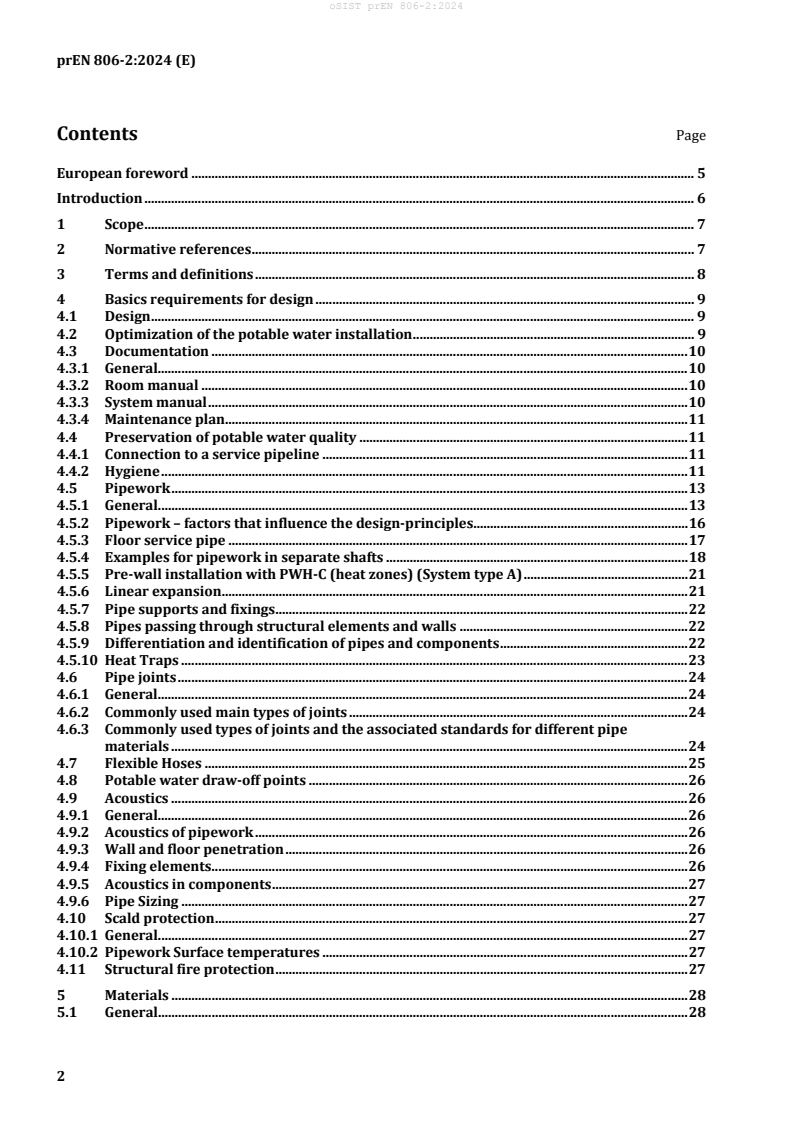
Contents Page
European foreword . 5
Introduction . 6
1 Scope . 7
2 Normative references . 7
3 Terms and definitions . 8
4 Basics requirements for design . 9
4.1 Design . 9
4.2 Optimization of the potable water installation . 9
4.3 Documentation . 10
4.3.1 General. 10
4.3.2 Room manual . 10
4.3.3 System manual . 10
4.3.4 Maintenance plan. 11
4.4 Preservation of potable water quality . 11
4.4.1 Connection to a service pipeline . 11
4.4.2 Hygiene . 11
4.5 Pipework . 13
4.5.1 General. 13
4.5.2 Pipework – factors that influence the design-principles . 16
4.5.3 Floor service pipe . 17
4.5.4 Examples for pipework in separate shafts . 18
4.5.5 Pre-wall installation with PWH-C (heat zones) (System type A) . 21
4.5.6 Linear expansion . 21
4.5.7 Pipe supports and fixings . 22
4.5.8 Pipes passing through structural elements and walls . 22
4.5.9 Differentiation and identification of pipes and components . 22
4.5.10 Heat Traps . 23
4.6 Pipe joints . 24
4.6.1 General. 24
4.6.2 Commonly used main types of joints . 24
4.6.3 Commonly used types of joints and the associated standards for different pipe
materials . 24
4.7 Flexible Hoses . 25
4.8 Potable water draw-off points . 26
4.9 Acoustics . 26
4.9.1 General. 26
4.9.2 Acoustics of pipework . 26
4.9.3 Wall and floor penetration . 26
4.9.4 Fixing elements . 26
4.9.5 Acoustics in components . 27
4.9.6 Pipe Sizing . 27
4.10 Scald protection . 27
4.10.1 General. 27
4.10.2 Pipework Surface temperatures . 27
4.11 Structural fire protection . 27
5 Materials . 28
5.1 General. 28
5.2 Choice of materials . 28
5.2.1 Selection of material . 28
5.2.2 Aspects for the selection of materials . 29
5.3 Corrosion . 29
5.3.1 Internal corrosion . 29
5.3.2 External corrosion. 30
5.4 Characteristics of commonly used materials . 30
5.4.1 General . 30
5.4.2 Copper and copper alloys . 31
5.4.3 Stainless steel . 31
5.4.4 Plastics . 31
6 Components . 32
6.1 Basic aspects . 32
6.1.1 General . 32
6.1.2 Appliance . 32
6.2 Basic components . 32
6.2.1 Stop valves . 32
6.2.2 Expansion joints . 32
6.2.3 Draw-off taps . 32
6.2.4 Protection unit . 32
6.2.5 Safety device . 33
6.2.6 Pressure reducing valves . 34
6.3 Components for specific installations . 36
6.3.1 PWH systems . 36
6.3.2 Potable water installations and firefighter services . 40
6.3.3 Water conditioning . 41
6.3.4 Boosting . 45
6.4 Other components . 51
6.4.1 Leakage protection systems . 51
6.4.2 Electrical isolators . 51
6.4.3 Water meters. 52
6.4.4 PWC storage systems . 54
7 Insulation . 55
7.1 General . 55
7.2 Effects of frost . 56
7.2.1 Layout of pipes, pipeline parts and devices . 56
7.2.2 Lines laid in the ground . 56
7.2.3 Pipes entering buildings . 56
7.2.4 Local or trace heating . 56
7.2.5 Draining . 56
7.3 Insulation of PWC pipelines . 57
7.4 Insulation of PWH pipelines . 57
7.5 Further requirements for insulation . 58
7.5.1 External protection layers for corrosion protection . 58
7.5.2 Compatibility with pipe materials . 58
Annex A (informative) Requirements for the vented potable water installations . 59
A.1 General . 59
A.2 Vented System. 59
A.3 Method of supply . 59
A.4 Direct and indirect heated systems . 59
A.5 Double feed vented primary circuits . 59
A.6 Single feed primary circuits . 60
A.7 Cold feed pipe . 60
A.8 Open vent pipe . 60
Annex B (informative) Discharge times . 61
Annex C (informative) Specification of pressure zones . 62
C.1 General. 62
C.2 Configuration A . 62
C.3 Configuration B . 63
C.4 Configuration C . 64
C.5 Configuration D . 65
Bibliography . 68
European foreword
This document (prEN 806-2:2024) has been prepared by Technical Committee CEN/TC 164 “Water
supply”, the secretariat of which is held by AFNOR.
This document is currently submitted to the CEN Enquiry.
This document will supersede EN 806-2:2005.
— the document has been fundamentally revised across all chapters;
— the structure has been modified;
— normative references have been updated.
This is the second part of the European Standard EN 806 consisting of 5 parts as follows:
— EN 806-1, General
— EN 806-2, Design
— EN 806-3, Pipe sizing – simplified method
— EN 806-4, Installation
— EN 806-5, Operation and maintenance
This document has been prepared under a standardization request addressed to CEN by the European
Commission. The Standing Committee of the EFTA States subsequently approves these requests for its
Member States.
EN 806-3 is currently being revised and could appear under a new title with the same EN number.
Introduction
Key objectives of the design and installation process for installations inside buildings conveying water
intended for human consumption (hereafter referred to as “potable water installations”) have been the
functional accomplishment of the water load profiles for hot and cold water while maintaining the quality
of “water intended for human consumption” (in the sense of the corresponding European legislative act
Directive (EU) 2020/2184 [1]. Lately, further requirements have been added, which can be summarized
by the term “sustainability”. They comprise, economic, ecologic and social issues. More precisely, they
cover, for example, energy and material efficiency, conservation of resources and life cycle assessment
(LCA).
In principle, there’s also the possibility of complying with the intended protection goals of this document
by applying other technical measures, technologies, and procedures. In these cases, the resulting
conditions shall be verified through tests and/or compliance with relevant standard(s).
NOTE Attention is drawn to national requirements and regulations that can apply.
1 Scope
This document specifies requirements for and gives recommendations on the design of potable water
installations according to EN 806-1.
2 Normative references
The following documents are referred to in the text in such a way that some or all of their content
constitutes requirements of this document. For dated references, only the edition cited applies. For
undated references, the latest edition of the referenced document (including any amendments) applies.
EN 26, Gas-fired instantaneous water heaters for the production of domestic hot water
EN 89, Gas-fired storage water heaters for the production of domestic hot water
EN 200, Sanitary tapware - Single taps and combination taps for water supply systems of type 1 and type 2
- General technical specification
EN 805, Water supply - Requirements for systems and components outside buildings
prEN 806-1:2024, Specification for installations inside buildings conveying water intended for human
consumption — Part 1: General
EN 817, Sanitary tapware - Mechanical mixing valves (PN 10) - General technical specifications
EN 1111, Sanitary tapware - Thermostatic mixing valves (PN 10) - General technical specification
EN 1287, Sanitary tapware - Low pressure thermostatic mixing valves - General technical specification
EN 1487, Building valves - Hydraulic safety groups - Tests and requirements
EN 1488, Building valves - Expansion groups - Tests and requirements
EN 1489, Building valves - Pressure safety valves - Tests and requirements
EN 1490, Building valves - Combined temperature and pressure relief valves - Tests and requirements
EN 1491, Building valves - Expansion valves - Tests and requirements
EN 1567, Building valves - Water pressure reducing valves and combination water pressure reducing valves
- Requirements and tests
EN 1717 , Protection against pollution of water intended for human consumption in potable water
installations and general requirements for devices to prevent pollution by backflow
EN 12056 (all parts), Gravity drainage systems inside buildings
EN 12502 (all parts), Protection of metallic materials against corrosion - Guidance on the assessment of
corrosion likelihood in water distribution and storage systems
EN 12976-1, Thermal solar systems and components - Factory made systems - Part 1: General requirements
Currently under revision at Formal Vote stage: FprEN 1717:2024.
EN 12977-1, Thermal solar systems and components - Custom built systems - Part 1: General requirements
for solar water heaters and combisystems
EN 13618, Flexible hose assemblies in drinking water installations - Functional requirements and test
methods
EN 14652, Water conditioning equipment inside buildings — Membrane separation devices —
Requirements for performance, safety and testing
EN 14743, Water conditioning equipment inside buildings — Softeners — Requirements for performance,
safety and testing
EN 14812, Water conditioning equipment inside buildings — Chemical dosing systems — Pre-set dosing
systems — Requirements for performance, safety and testing
EN 14897, Water conditioning equipment inside buildings — Devices using mercury low-pressure
ultraviolet radiators — Requirements for performance, safety and testing
EN 15219, Water conditioning equipment inside buildings — Nitrate removal devices — Requirements for
performance, safety and testing
EN 15502-1, Gas-fired heating boilers — Part 1: General requirements and tests
EN 60335-2-21, Household and similar electrical appliances — Safety — Part 2-21: Particular
requirements for storage water heaters (IEC 60335-2-21)
EN 60335-2-35, Household and similar electrical appliances - Safety - Part 2-35: Particular requirements
for instantaneous water heaters (IEC 60335-2-35)
EN IEC 60730-1, Automatic electrical controls — Part 1: General requirements IEC 60730-1)
EN IEC 60730-2-9, Automatic electrical controls — Part 2-9: Particular requirements for temperature
sensing control (IEC 60730-2-9)
EN 61770, Electric appliances connected to the water mains - Avoidance of backsiphonage and failure of
hose-sets (IEC 61770)
EN ISO 4064-5, Water meters for cold potable water and hot water - Part 5: Installation requirements (ISO
4064-5)
3 Terms and definitions
For the purposes of this document, the terms and definitions given in EN 806-1 apply.
ISO and IEC maintain terminology databases for use in standardization at the following addresses:
— ISO Online browsing platform: available at https://www.iso.org/obp
— IEC Electropedia: available at https://www.electropedia.org/
4 Basics requirements for design
4.1 Design
For design and construction of a potable water installation two types of installation are considered:
— installation type A: Unvented potable water installations;
— installation type B: Vented potable water installations (see Annex A).
Installation types A and B may be combined.
Potable water installations shall be designed such that the quality of water intended for human
consumption can be ensured at any draw-off point for potable water, cold (PWC) and potable water, hot
(PWH) and that normal operation of the potable water installation is possible. Therefore, the
requirements of EN 806 series and EN 1717 should be fulfilled.
NOTE Attention is draw to the corresponding European legislative act Directive (EU) 2020/2184 [1] or
national requirements that can apply.
4.2 Optimization of the potable water installation
Design, construction and operation of potable water installations shall be compatible with the expected
occupation of the corresponding building type, and the essential parameters needed for design,
installation and operation of potable water installations shall be adapted accordingly. Examples of
essential parameters are:
— environmental protection and climate protection;
— potable water hygiene (see 4.4.2);
— specific water consumption (water use and equipment)/habits of usage (peak demand, usage
profiles);
— specific energy consumption in buildings;
— economic considerations;
— minimizing water volume in the installation;
— sustainability.
Any potable water installation shall be designed in accordance with its relevant parameters. If
foreseeable, design concepts should make allowance for possible changes of building occupation – viewed
over the entire lifecycle. Methodological bases of integral design and building information modelling
(BIM) are recommended as a basis for design to support compliance of later occupation in practice with
the data of anticipated water consumption (specification sheet).
NOTE Attention is drawn to national or local regulations in respect to the prevention of proliferation of
legionella spez.
The hot potable water installation shall not be used for space heating purposes.
For hygiene, energy efficiency and economic reasons, PWH storage devices and draw-off points should
be placed at locations that minimize the total length of the distribution pipework. Such considerations
need to be made at the very beginning of the design procedure, in co-operation with the architect.
Using shorter supply lines should not lead to longer circulation lines. The optimization of the pipes’ length
shall be performed under consideration of all distribution lines altogether.
4.3 Documentation
4.3.1 General
It is indispensable to exchange suitable design documents (e.g. usage agreement) for coordination of the
construction progress and for communication between the relevant disciplines.
Designing documents should comprise at least:
— room manuals;
— implementation plans as layouts, and pipe schemes as well as sections with dimension data;
— wall and ceiling cutting and breakthrough plans;
— calculations of pipework, pump designs and designs of other components;
— the essential energy-relevant attributes shall be taken in account;
— performance data for components in the potable water installation, in particular also those
components that are manufactured by other disciplines, e.g. potable water heaters.
Optionally or mandatory according to national rules, data can be added for risk analysis regarding water
hygiene (see the guidelines for water safety plan concept in buildings according to CEN/TR 17801 [2]).
The graphic symbols according to EN 806-1 shall be applicable for the drawing depiction of the line
diagrams.
4.3.2 Room manual
The room manual should contain a description of use and a concept for potable water installation.
A room manual comprises a list of all necessary data that describe the rooms in a building.
The following should be indicated for the potable water installation as a minimum:
— use of the room;
— use of the draw-off points;
— stop valves and automatic control devices;
— draw-off points;
— room temperatures.
Data and information for the required maintenance measures, the sampling points and the necessary
measures in case of malfunctions within the potable water installation should be listed in a maintenance
plan.
4.3.3 System manual
The system manual consists of documentation regarding design, implementation, operation and
maintenance.
The system manual is compiled not later than the time of commissioning.
4.3.4 Maintenance plan
Proper maintenance is necessary for fault-free technical functioning in order to protect the health and
safety of the consumers. Each component of the potable water installation requires individual measures
in order to ensure a sustainable function. Inspections, maintenance, improvements and repairs are
available as measures. The resultant tasks should be considered individually for each single component.
Specifications and intervals can be found in EN 806-5 and the relevant manufacturer documents. It is
necessary to include requisite maintenance measures for the selected components when designing a
potable water installation. In particular, access points, intervals and space requirement for later
interventions should be considered during the design. Information on the necessary measures should be
gathered and summarized in a maintenance plan. This maintenance plan shall be validated regularly.
4.4 Preservation of potable water quality
4.4.1 Connection to a service pipeline
Potable water installations shall not have any negative impact on potable water supply – in particular on
the public water supply – e.g. in form of impairment or pressure surges. (see EN 1717)
Where a private water supply is to be used in addition to water supplied by a statutory water supplier
there shall be no cross connection of these systems, without suitable backflow protection in accordance
with EN 1717.
Where pipelines are laid within the premises but outside of buildings, requirements from this document
and EN 805 shall be observed where applicable (see also prEN 806-1:2024, Figure 1 and
prEN 806-1:2024, Clause 6).
4.4.2 Hygiene
4.4.2.1 General
The requirements on the quality of water intended for human consumption shall be met at any draw-off
point of the potable water installation.
NOTE The Directive (EU) 2020/2184 [1] contains information on the quality of water intended for human
consumption. For nations not covered by the directive national regulations contain this information.
Adverse changes to potable water quality shall be avoided. These include excessive microbial
proliferation or the proliferation of pathogens. In order to prevent unacceptable support of microbial
proliferation in potable water installations, the following principles shall be observed:
1) prevent temperatures that promote microbial proliferation;
2) prevent stagnation periods;
3) minimize nutrient input.
Key
1 temperature
2 time/stagnation
3 nutrients
Figure 1 — Factors influencing bacterial proliferation
Hygiene rules are considered together with other design rules regarding users’ comfort and energy
efficiency. Optimal balance has to be found keeping hygiene with highest priority.
4.4.2.2 Operating temperature
Potable water installations shall be designed and installed such that the PWC temperature does not
exceed 25 °C at any point during normal operation. Therefore, cold and hot water supply pipework shall
be laid such that unacceptable external heating of PWC can be avoided (see 4.5). If necessary other
appropriate measures (e.g. PWC circulation, flushing or a process combination of cooling and flushing)
shall be applied.
30 s after fully opening any draw-off fitting or 3 l discharged, whichever occurs first (for PWH, see
Annex B), the water temperature should not exceed 25 °C for PWC at the draw-off points and should not
be less than 55 °C for the PWH system.
NOTE 1 Attention is drawn to local or national regulations that can apply.
NOTE 2 It is emphasized that national residual standards can contain stricter requirements.
PWH systems shall have the facility to enable the temperature at the extremities and all draw-off points
of the installation to be raised to 70 °C for at least 5 minutes for disinfection purposes. If the heating
system installed cannot reach the required temperature, an external heating source can be connected
temporarily.
In normal operation the temperature of the water heater shall be set such that the PWH temperature
does not fall below 55 °C at any point within the whole PWH-system. All supply pipelines of the PWH
installation which are not included in a PWH-C installation shall not exceed a volume of 3 l. These should
not be thermally insulated in order to cool down as quickly as possible, (see also 6.3.1)
4.4.2.3 Minimizing Stagnation
The potable water installation shall be designed such that regular water exchange occurs in all supply
pipes, especially in main branch and branch pipes. To ensure that water volumes are completely
exchanged during expected use, pipe dimensions and flow paths shall be selected as small as possible in
relation with the calculation (see EN 806-3). . When infrequently used draw-off points (e.g. protection
unit for heating system supply connections, single taps, garden taps) are installed, the pipe shall be
connected as short as possible to the distributing pipe.
Safety valves and thermal discharge safety devices shall be connected as short as possible. The connection
pipeline is limited to a maximum of 10 × DN or 150 mm whichever is shorter.
Parallel installation shall be designed for flowing through at the same time.
4.4.2.4 Appropriate materials to minimize nutrient input
Materials that come into contact with potable water shall be suitable for use with potable water and shall
comply with European and national provisions as well as with the criteria for the evaluation of suitability
of materials for use with potable water. (See Clause 5.)
4.4.2.5 Sampling points
Potable water installations should be provided with at least the following sampling points for
microbiological analysis according to EN ISO 19458. The number and position of sampling points shall be
documented.
The sampling points shall be accessible.
Arrangement of sampling points for PWC:
— at the building entrance immediately downstream of the building/unit water meter;
— in the PWC distribution pipeline to the water heater.
Arrangement of sampling points for PWH/PWH-C:
— at the outlet of the water heater;
— at the inlet of the circulation pipe into the water heater (in the direction of flow upstream of the
circulation pump);
— in the individual circulation pipes prior to re-entry into the circulation manifold.
A list of recommended peripheral sampling points of the potable water installation should be defined to
obtain a representative overview of the microbiological conditions inside the single feed-pipeline of the
potable water installation. They should be arranged in parts of the installation where aerosol formation
is to be expected (e.g. shower units).
4.5 Pipework
4.5.1 General
The pipework shall be designed in a way that the requirements according to 4.3.2 can be fulfilled.
Where access is difficult pipework, such as in walls or solid floors, pipework should be located in a sleeve,
duct or dedicated pipework shafts where it can be easily removed and replaced.
Pipework shall not compromise the building construction. Therefore it should be mounted open or as
front-wall installation if necessary.
Pipework shall be protected against frost, heat gain and if needed against chemical and mechanical
hazards.
When pipework is installed in installation shafts, removable connections and valves shall be accessible
without damaging of structural elements.
Pipes shall not be installed in the following types of shafts still used for their original purpose, e.g.:
— in smoke shafts;
— in ventilation shafts;
— in elevator shafts;
— in domestic garbage shafts.
The pipework of the potable water installation shall not be laid through drains or sewers.
Supply and distributing pipes shall be capable of being insulated and drained. Facilities shall be provided
for draining the pipework inside the building. It should be possible to empty the pipework even in the
lowest point of the potable water installation.
Pipe systems shall be designed for the operating conditions according to Table 1 as a minimum. The pipe
design shall be planned according to 4.4.2.
Table 1 — Requirements in respect to PWH and PWH-C pipe systems for manufacturers when
designing pipe systems
Maximum Time with Time with Temperature
Design Maximum Time with
design operating maximum for
temperature temperature malfunction
pressure temperature temperature malfunction
p T t T t T T
max D D max max mal mal
kPa °C a °C a °C h
1 000 70 49 80 1 95 100
All pipes and fittings which are in line with the conditions specified in Table 1 shall also be suitable for
the conveyance of PWC for a period of 50 years at a temperature of 20 °C and a maximum design pressure
of 1 000 kPa.
In addition, all parts of the potable water installation shall be planned so that they correspond to the
requirements of the pressure test during the commissioning (see EN 806-4).
NOTE 1 Attention is drawn to local and national laws and regulations that can apply.
In every building or part of a building to which a separately chargeable supply of water is provided and
in all premises occupied as a dwelling, whether or not separately charged for a supply of water, a stop
valve shall be provided that controls the whole of the supply to the premises concerned without shutting
off the supply to any other premises. This stop valve shall, so far as is practicable, be installed within the
building or premises concerned in an accessible position above floor level and close to the point of entry
of the pipeline supplying water to that premises, whether this be a service pipe or a supply pipe.
The supply pipes for each floor and those in the individual flats shall be capable of being shut off
separately.
A stop valve shall be provided on the inlet connection to appliances e.g. flushing cistern (FC), storage
cisterns, water heaters, washing machines.
A stop valve shall be installed in every pipeline supplying water to any structure erected within the
curtilage of a building but having no access from the main building.
PWH taps shall be on the left, PWC taps on the right.
In a dwelling divided into a number of flats, where rising pipes are centrally located, stop valves shall be
installed in a room near the rising pipe or space to which access is possible.
All pipelines and joints of a potable water installation shall be designed for a service life of 50 years taking
into account appropriate maintenance and specific operating conditions.
In all cases of horizontal pipelines laid over one another, PWC pipelines shall be designed below PWH
and PWH-C pipelines.
When designing a potable water installation as an unvented installation see as an example Figure 2 When
designing a potable water installation as a vented system see as an example figure (prEN 806-1:2024,
A.2, Figure A2).
Draining taps should be fixed over a drain or have provision for discharging the water to the nearest
convenient point for disposal.
Key
1 service pipeline
2 supply pipelines
3 main distribution pipeline
4 distribution pipeline to water heater
5 horizontal distribution pipeline
6 return pipeline
7 vertical distribution pipelin
...