


EN 13832-2:2018
(Main)Footwear protecting against chemicals - Part 2: Requirements for limited contact with chemicals
Footwear protecting against chemicals - Part 2: Requirements for limited contact with chemicals
This European Standard specifies requirements for footwear to protect the user against limited contact in time with specific chemicals.
The following risks are covered: splashing and degradation by chemical.
Schuhe zum Schutz gegen Chemikalien - Teil 2: Anforderungen für begrenzten Kontakt mit Chemikalien
Diese Europäische Norm legt Anforderungen für Schuhe zum Schutz gegen zeitlich begrenzten Kontakt mit spezifischen Chemikalien fest.
Folgende Risiken sind abgedeckt: Spritzen und Materialermüdung durch die Chemikalie.
Chaussure protégeant contre les produits chimiques - Partie 2 : Exigences pour les contacts limités avec les produits chimiques
La présente Norme européenne spécifie les exigences relatives aux chaussures destinées à protéger l'utilisateur en cas de contact limité dans le temps avec les produits chimiques spécifiques.
Elle couvre les risques de projections et de dégradation par des produits chimiques.
Obutev za varovanje pred kemikalijami - 2. del: Zahteve za omejen stik s kemikalijami
Ta evropski standard določa zahteve za obutev, ki varuje uporabnika pred omejenim stikom
s specifičnimi kemikalijami.
Zajeta so naslednja tveganja: brizganje in razgradnja s kemikalijami.
General Information
- Status
- Published
- Publication Date
- 27-Nov-2018
- Withdrawal Date
- 30-May-2019
- Technical Committee
- CEN/TC 161 - Foot and leg protectors
- Current Stage
- 9092 - Decision on results of review/2YR ENQ - revise - Review Enquiry
- Start Date
- 04-Jun-2024
- Completion Date
- 14-Apr-2025
Relations
- Effective Date
- 05-Dec-2018
- Effective Date
- 31-Jan-2024
Overview - EN 13832-2:2018 (Footwear protecting against chemicals)
EN 13832-2:2018 is a CEN European Standard that specifies requirements for chemical-resistant footwear intended for limited contact with chemicals. It covers protection against two main risks: splashing of chemicals onto the upper and degradation of footwear materials by chemical exposure. Limited contact means contact that is intermittent or continuous for up to one hour.
This part (Part 2) is one of three in the EN 13832 series and is intended to be used together with test-method and terminology guidance in EN 13832-1 and with general protective-footwear standards such as EN ISO 20345 / 20346 / 20347.
Key topics and technical requirements
- Scope of protection: footwear designed for limited contact (≤ 1 hour) with chemicals; two product types are defined:
- Type U - protects the upper from splashes (intermittent contact, ≤ 1 hour).
- Type US - protects upper and outsole from splashes/contact (continuous or intermittent, ≤ 1 hour).
- Design constraints: only certain boot/shoe designs are permitted (designs B, C, D, E in the standard - ankle to thigh boots).
- Classification:
- Class I: leather and other materials (excluding fully moulded rubber/polymeric).
- Class II: all-rubber or all-polymeric footwear.
- Chemical testing: at least two test chemicals must be chosen from the standard’s list (examples include methanol, acetone, sulphuric acid, sodium hydroxide, hydrogen peroxide, hydrofluoric acid). Other representative chemicals may be used for specific applications.
- Material & performance tests: requirements include resistance of whole footwear, outsole abrasion and flexing, upper and lining properties (tear, pH, chromium VI), bond strengths, slip resistance, water penetration and other durability factors.
- Marking & user information: mandatory marking rules, instructions for use, and special information such as electrical properties, insole/insock guidance and chemical-resistance limits.
- Updates: references the permeation standard EN 16523-1 and includes a new splashing test and slip-resistance guidance.
Applications and who uses EN 13832-2
- Intended for manufacturers designing chemical-resistant safety footwear and for compliance testing.
- Used by conformity assessment bodies and test laboratories to verify performance.
- Useful for safety managers, procurement officers, and occupational health professionals selecting footwear for workplaces with incidental chemical exposure (laboratories, maintenance, cleaning, light chemical handling).
- Supports compliance with PPE Regulation (EU) 2016/425 for limited-contact chemical protection.
Related standards
- EN 13832-1:2018 - Terminology and test methods
- EN 13832-3:2018 - Requirements for prolonged contact with chemicals
- EN 16523-1 - Chemical permeation testing
- EN ISO 20345 / 20346 / 20347 - General safety/protective/occupational footwear standards
Keywords: EN 13832-2:2018, footwear protecting against chemicals, limited contact with chemicals, chemical-resistant footwear, splashing, degradation, CEN, PPE.

Frequently Asked Questions
EN 13832-2:2018 is a standard published by the European Committee for Standardization (CEN). Its full title is "Footwear protecting against chemicals - Part 2: Requirements for limited contact with chemicals". This standard covers: This European Standard specifies requirements for footwear to protect the user against limited contact in time with specific chemicals. The following risks are covered: splashing and degradation by chemical.
This European Standard specifies requirements for footwear to protect the user against limited contact in time with specific chemicals. The following risks are covered: splashing and degradation by chemical.
EN 13832-2:2018 is classified under the following ICS (International Classification for Standards) categories: 13.340.50 - Leg and foot protection. The ICS classification helps identify the subject area and facilitates finding related standards.
EN 13832-2:2018 has the following relationships with other standards: It is inter standard links to EN 13832-2:2006, prEN 13832-2. Understanding these relationships helps ensure you are using the most current and applicable version of the standard.
EN 13832-2:2018 is associated with the following European legislation: EU Directives/Regulations: 2016/425, 89/686/EEC; Standardization Mandates: M/031. When a standard is cited in the Official Journal of the European Union, products manufactured in conformity with it benefit from a presumption of conformity with the essential requirements of the corresponding EU directive or regulation.
You can purchase EN 13832-2:2018 directly from iTeh Standards. The document is available in PDF format and is delivered instantly after payment. Add the standard to your cart and complete the secure checkout process. iTeh Standards is an authorized distributor of CEN standards.
Standards Content (Sample)
2003-01.Slovenski inštitut za standardizacijo. Razmnoževanje celote ali delov tega standarda ni dovoljeno.Obutev za varovanje pred kemikalijami - 2. del: Zahteve za omejen stik s kemikalijamiSchuhe zum Schutz gegen Chemikalien - Teil 2: Anforderungen für begrenzten Kontakt mit ChemikalienChaussure protégeant contre les produits chimiques - Partie 2 : Exigences en cas de contact limité avec des produits chimiquesFootwear protecting against chemicals - Part 2: Requirements for limited contact with chemicals13.340.50Varovanje nog in stopalLeg and foot protectionICS:Ta slovenski standard je istoveten z:EN 13832-2:2018SIST EN 13832-2:2019en,fr,de01-februar-2019SIST EN 13832-2:2019SLOVENSKI
STANDARDSIST EN 13832-2:20061DGRPHãþD
EUROPEAN STANDARD NORME EUROPÉENNE EUROPÄISCHE NORM
EN 13832-2
November
t r s z ICS
s uä u v rä w r Supersedes EN
s u z u tæ tã t r r xEnglish Version
Footwear protecting against chemicals æ Part
tã Requirements for limited contact with chemicals Chaussure protégeant contre les produits chimiques æ Partie
t ã Exigences pour les contacts limités avec les produits chimiques
Schuhe zum Schutz gegen Chemikalien æ Teil
tã Anforderungen für begrenzten Kontakt mit Chemikalien This European Standard was approved by CEN on
t y May
t r s zä
egulations which stipulate the conditions for giving this European Standard the status of a national standard without any alterationä Upætoædate lists and bibliographical references concerning such national standards may be obtained on application to the CENæCENELEC Management Centre or to any CEN memberä
translation under the responsibility of a CEN member into its own language and notified to the CENæCENELEC Management Centre has the same status as the official versionsä
CEN members are the national standards bodies of Austriaá Belgiumá Bulgariaá Croatiaá Cyprusá Czech Republicá Denmarká Estoniaá Finlandá Former Yugoslav Republic of Macedoniaá Franceá Germanyá Greeceá Hungaryá Icelandá Irelandá Italyá Latviaá Lithuaniaá Luxembourgá Maltaá Netherlandsá Norwayá Polandá Portugalá Romaniaá Serbiaá Slovakiaá Sloveniaá Spainá Swedená Switzerlandá Turkey and United Kingdomä
EUROPEAN COMMITTEE FOR STANDARDIZATION COMITÉ EUROPÉEN DE NORMALISATION EUROPÄISCHES KOMITEE FÜR NORMUNG
CEN-CENELEC Management Centre:
Rue de la Science 23,
B-1040 Brussels
t r s z CEN All rights of exploitation in any form and by any means reserved worldwide for CEN national Membersä Refä Noä EN
s u z u tæ tã t r s z ESIST EN 13832-2:2019
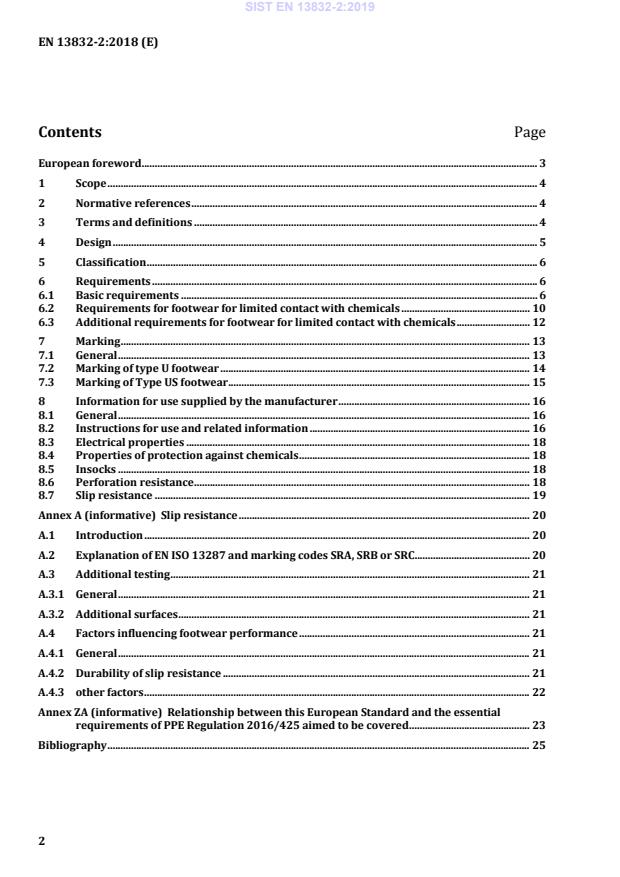
Slip resistance . 20 A.1 Introduction . 20 A.2 Explanation of EN ISO 13287 and marking codes SRA, SRB or SRC. 20 A.3 Additional testing . 21 A.3.1 General . 21 A.3.2 Additional surfaces . 21 A.4 Factors influencing footwear performance . 21 A.4.1 General . 21 A.4.2 Durability of slip resistance . 21 A.4.3 other factors . 22 Annex ZA (informative)
Relationship between this European Standard and the essential requirements of PPE Regulation 2016/425 aimed to be covered . 23 Bibliography . 25
IEC Electropedia: available at http://www.electropedia.org/
ISO Online browsing platform: available at http://www.iso.org/obp 3.1 footwear for limited contact with chemicals Type U footwear designed and manufactured to protect the wearer from splashing of chemicals on the upper. The upper contact can be intermittent, not exceeding one hour. 3.2 footwear for limited contact with chemicals Type US footwear designed and manufactured to protect the wearer from splashing of chemicals on the upper and contact with the outsole. The upper and outsole contact can be continuous or intermittent , not exceeding one hour. SIST EN 13832-2:2019
Key 1 Variable extension that can be adapted to the wearer
A Low shoe
B Ankle boot
C Half-knee boot
D knee-height boot
E Thigh boot
NOTE Design E is a knee-height boot (design D) equipped with a thin impermeable material that extends the upper and that can be cut to adapt the boot to the wearer. Figure 1 — Designs of footwear SIST EN 13832-2:2019
4 and 5 X X Height of upper 5.2.2 5.2.2 5.2.2
X X Specific ergonomic features 5.3.4 5.3.4 5.3.3
X X Leakproofness 5.3.3 5.3.3 5.3.2
X Water resistance
6.2.3 X
Seat region Designs B, C and D (Figure 1) 5.2.3 5.2.3 5.2.3
X X Design E (Figure 1) 5.2.3 5.2.3 5.2.3
X Whole footwear Outsole performance Construction 5.3.1.1 5.3.1.1 5.3.1.1
X
Upper/outsole bond strength 5.3.1.2 5.3.1.2 5.3.1.2
X
Slip resistance 5.3.5 5.3.5 5.3.4
X X Toe Protection General 5.3.2.1 5.3.2.1
X X Toe cap length 5.3.2.2 5.3.2.2
X X Impact resistance 5.3.2.3 5.3.2.3
X X Compression resistance 5.3.2.4 5.3.2.4
X X Behaviour of toecap 5.3.2.5 5.3.2.5
X X Resistance of footwear for limited contact with chemicals
6.2.1 X X Innocuousness
6.2.4
X X Thickness 5.4.2 5.4.2 5.4.2
X Tear strength 5.4.3 5.4.3 5.4.3
X
Tensile properties 5.4.4 5.4.4 5.4.4
X X Flexing resistance 5.4.5 5.4.5 5.4.5
X pH value 5.4.7 5.4.7 5.4.7
X
Chromium VI 5.4.9 5.4.9 5.4.9
X
Water penetration and water absorption 6.3 6.3 6.3
X
hydrolysis 5.4.8 5.4.8 5.4.8
X Upper construction 6.3.2 6.3.2 6.3.2
X
Vamp lining Tear strength 5.5.1 5.5.1 5.5.1
O
Abrasion resistance 5.5.2 5.5.2 5.5.2
O
pH value 5.5.4 5.5.4 5.5.4
O
Chromium VI 5.5.5 5.5.5 5.5.5
O
Quarter lining Tear strength 5.5.1 5.5.1 5.5.1
O
Abrasion resistance 5.5.2 5.5.2 5.5.2
O
pH value 5.5.4 5.5.4 5.5.4
O
Chromium VI 5.5.5 5.5.5 5.5.5
O
Tongue Tear strength 5.6.1 5.6.1 5.6.1
O
pH value 5.6.2 5.6.2 5.6.2
O
Chromium VI 5.6.3 5.6.3 5.6.3
O
Insole/insocks See Table 3 Outsole Thickness 5.8.1 5.8.1 5.8.1
X X Tear strength 5.8.2 5.8.2 5.8.2
X
Abrasion resistance
6.2.2 X X Flexing resistance 5.8.4 5.8.4 5.8.4
X X hydrolysis 5.8.5 5.8.5 5.8.5
X X Interlayer bond strength 5.8.6 5.8.6 5.8.6
O O SIST EN 13832-2:2019
indicates that the requirement shall be met. In some cases the requirement relates only to particular materials within the classification, e.g. pH value of leather components. This does not mean that other materials are precluded from use. O
indicates that if the component part exists, the requirement shall be met. Note1 The absence of X or O indicates that no requirement is met. Note2 For class II footwear, it is usual to have no insole present. However, if a removable insock is used, table 3 is applicable, only chromium VI and pH requirements are fulfilled for leather materials. Note3 Stockings covering the last before the moulding process are not considered as a lining.
Table 3 — Basic requirements for insoles and/or insocks Options Component to be assessed Requirements to fulfil in EN ISO 20345:2011, EN ISO 20346:2014 and EN ISO 20347:2012 Thickness 5.7.1 pH 5.7.2 Water absorption desorption 5.7.3 Abrasion 5.7.4.1 Chromium VI 5.7.5 Abrasion 5.7.4.2 1 No insole or if present not fulfilling the requirements Non-removable insock Insock X X X
X X 2 Insole present No insock Insole X X X X X
Seat sock present
3 Full insock,
non-removable Insock and insole together X
X
Insock
X
X X 4 Full insock, removable and water-permeableÕ Insole X X X X X
Insock
X
X X 5 Full insock, removable, not water-permeable Insole X X X X X
Insock
X X
X X NOTE For removable insocks see 8.5. X
indicates that the requirement shall be met. Õ indicates a water permeable insock which, when tested in accordance with EN ISO 20344:2011, 7.2, lets water through in 60 s or less.
Indicates those requirements that are only for leather. SIST EN 13832-2:2019
25 % 1336–21–6 Organic base P Hydrogen peroxide 30 % 7722–84–1 Peroxide Q isopropanol 67–63–0 Aliphatic alcohol R Sodium hypochlorite
(13 ± 1)% (active chloride) 7681–52–9 hypochlorite S Hydrofluoric acid 40 % 7664–39–3 Inorganic mineral acid T Formaldehyde 37 % 50–00–0 Aldehyde Safety precautions — Person using this standard should be familiar with normal laboratory practice. This standard does not purport to address all the safety problems, if any, associated with its use. It is SIST EN 13832-2:2019
Type US x x The splashing and degradation shall be tested both with the same chemicals. 6.2.1.2 Splashing resistance For footwear for limited contact with chemicals resisting to splashing, when they are tested according to EN 13832-1:2018, Clause 4. — No major defects defined in Annex B of EN 13832-1:2018 shall be detected after the first (10 min) and the second (60 min) assessment. — No penetration inside the footwear of chemical shall be detected — No spilt liquid shall be trapped 6.2.1.3 Degradation resistance 6.2.1.3.1 General For footwear for limited contact with chemicals, the degradation shall be tested according to EN 13832-1:2018, 4.3 with a degradation time of 8 h, for each chemical claimed (see Table 4) in the marking and reported in the user instruction. The outsole and upper shall both be tested with the same chemicals. After the tests, the tests pieces shall be inspected. If any test pieces is very affected (see EN 13832-1:2018, 4.3.4.3) after testing, it is considered that they fail the test. 6.2.1.3.2 Tests to be performed after the degradation test 6.2.1.3.2.1 Mass variation EN 13832-1:2018, 4.3.4.3 requires the measurements of the mass variation on the upper and outsole samples. They shall be given in the test report. There is no requirement on the mass variation. It is used only as information to assess the samples changes during the test. 6.2.1.3.2.2 Requirements after the degradation test The requirements to fulfil after the degradation test are given in Table 6. SIST EN 13832-2:2019
II:EN ISO 20344:2011, 8.2 Elongation at break EN ISO 20344:2011, 6.4 Applicable for all type of outsole material prepared according 4.3.3.2 of EN 13832-1:2018 Applicable for all type of upper material prepared according to 4.3.3.1 of
EN 13832-1:2018 Not applicable for:
class I
class II with a non-removable lining.
Greater or equal to
6,4 kN/m for material with density greater than 0,9 g/cm3
Greater or equal to
4,0 kN/m for material with density smaller or equal to 0,9 g/cm3 Minimum:
30 shore A Maximum: (value before degradation ± 10 shore A) For class I textile, greater or equal to 48 N For class I leather, greater or equal to 96 N For class II Minimum 80 % of value before degradation for class II with a removable lining, Minimum 80 % of value before degradation 6.2.2 Outsole When outsole
...
The EN 13832-2:2018 standard, titled "Footwear protecting against chemicals - Part 2: Requirements for limited contact with chemicals," is essential for ensuring the safety of individuals exposed to hazardous chemicals in various work environments. This European Standard outlines precise requirements for protective footwear designed to guard against limited chemical exposure, particularly focusing on risks associated with splashing and degradation caused by chemicals. One of the key strengths of the EN 13832-2:2018 standard is its specificity in addressing various chemical exposures. By defining criteria for limited contact with specific chemicals, the standard provides comprehensive guidelines that help in selecting appropriate footwear for various industries, thereby enhancing workplace safety. This targeted approach ensures that users are adequately protected while maintaining functionality and comfort. The scope of this standard is particularly relevant in today’s industries where chemical handling is prevalent. Many sectors, including manufacturing, healthcare, and laboratories, require footwear that minimizes the risk of chemical injuries. The EN 13832-2:2018 standard directly addresses this need by setting forth requirements that footwear must meet to mitigate the harmful effects of chemicals-thereby underscoring its importance in occupational safety regulations. Moreover, the document’s emphasis on performance can lead to the development and use of higher-quality protective footwear, ultimately fostering advancements in design and materials used in the production of safety footwear. The standard serves not only as a guideline for manufacturers but also as a benchmark for compliance and quality assurance, creating a safer working environment. By focusing on limited chemical exposure and providing stringent requirements for footwear, the EN 13832-2:2018 standard significantly contributes to the overall well-being of employees, making it a critical standard in the field of occupational safety. This relevance ensures that businesses can meet legal obligations while prioritizing worker protection against chemical hazards.
EN 13832-2:2018は、化学物質に対しての保護を目的としたフットウェアの標準規格であり、特に限られた時間の接触に関する要求事項を定めています。この標準は、化学物質によるスプラッシュや劣化のリスクに対応しており、使用者が安全に作業できる環境を提供します。 この基準の強みは、具体的な化学物質に対するリスクを明確に特定し、そのリスクに対して適切な保護を提供するための要件を設けている点です。また、ユーザーが特定の状況下でフットウェアを選択する際に、どのような基準を満たすべきかを明示しているため、業界内での適切な判断を助ける重要な手助けとなります。 さらに、EN 13832-2:2018は、ヨーロッパ市場における関連法令とも整合性があり、企業がコンプライアンスを維持しやすい環境を整えていることも大きな利点です。これにより、消費者は安心して商品を選ぶことができ、業務の安全性を高めることができます。 この標準の要件は、化学物質に接触する可能性があるさまざまな業界において必要不可欠であり、労働者の安全を守るための基盤を提供しています。したがって、EN 13832-2:2018は、化学物質からの保護を必要とするフットウェアにおいて、大変重要な役割を果たす標準です。
EN 13832-2:2018 표준은 화학 물질로부터 사용자를 보호하기 위한 요구 사항을 규정하고 있으며, 특히 특정 화학 물질과의 제한된 접촉에 대한 요구 사항을 명시하고 있습니다. 이 표준은 사용자의 안전을 최우선으로 하여 설계되었으며, 화학 물질의 튀김 및 분해로 인한 위험을 다루고 있습니다. 이 표준의 강점 중 하나는 화학 물질과의 접촉 시간이 제한된 상황에서도 효과적으로 보호할 수 있도록 요구 사항을 나열한다는 점입니다. 또한, 이 문서는 실질적인 적용 가능성을 고려하여, 다양한 산업 분야에서 사용되는 신발의 설계 및 제조에 필요한 가이드라인을 제공합니다. EN 13832-2:2018의 요구 사항은 화학물질과의 접촉이 빈번하도록 설계된 보호 장비에 적용 가능하며, 이를 통해 사용자에게 필요한 보호 수준을 보장합니다. 따라서 이 표준은 작업장에서의 안전성을 크게 향상시킬 수 있는 중요한 기준이라 할 수 있습니다. 이 문서(SIST EN 13832-2:2019)는 화학 물질과의 제한된 접촉을 고려한 신발의 필요성을 인식한 결과물로, 사용자 연구 및 실험을 통해 수집된 데이터를 바탕으로 하여 실질적이고 신뢰할 수 있는 결과를 제공합니다. EN 13832-2:2018 표준은 화학 보호 신발의 필요성과 중요성을 강조하며, 현대 산업 환경에서 필수적으로 요구되는 문서입니다.
Die Norm EN 13832-2:2018 legt spezifische Anforderungen an Fußbekleidung fest, die den Träger vor zeitlich begrenztem Kontakt mit bestimmten Chemikalien schützt. Diese europäische Norm ist von großer Relevanz für zahlreiche Branchen, in denen Mitarbeiter potenziell mit chemischen Substanzen in Berührung kommen können. Durch die Festlegung klarer Standards für Schutzkunststoffe gewährleistet die Norm EN 13832-2:2018, dass die Fußbekleidung nicht nur den Sicherheitsanforderungen entspricht, sondern auch angemessen gegen das Risiko von Spritzern und chemischer Zersetzung geschützt ist. Ein herausragendes Merkmal dieser Norm ist die umfassende Berücksichtigung der unterschiedlichen chemischen Risiken, die bei der Arbeit mit verschiedenen Materialien auftreten können. Der Fokus auf den Kontakt mit Chemikalien ermöglicht es Herstellern, Produkte zu entwickeln, die speziell auf die Bedürfnisse der Benutzer abgestimmt sind. Dies stärkt nicht nur das Sicherheitsbewusstsein am Arbeitsplatz, sondern fördert auch eine proaktive Haltung zur Risikominderung. Die Norm ist besonders wichtig für Unternehmen, die in Bereichen wie der chemischen Industrie, im Gesundheitswesen oder im Bauwesen tätig sind. Die gewährte Schutzwirkung dürfte nicht nur die Sicherheit der Mitarbeiter erhöhen, sondern auch Haftungsrisiken für die Unternehmen verringern. Insgesamt bietet die SIST EN 13832-2:2019 eine wertvolle Grundlage für die Entwicklung und den Einsatz von Sicherheitsfußbekleidung, die auf den begrenzten Kontakt mit Chemikalien ausgerichtet ist. Ihre Stärken liegen in der klaren Definition der Anforderungen und deren Anwendbarkeit in der Praxis, was sie zu einem unverzichtbaren Dokument für alle, die im Bereich des Arbeitsschutzes tätig sind, macht.
La norme EN 13832-2:2018, intitulée "Chaussures protégeant contre les produits chimiques - Partie 2 : Exigences pour un contact limité avec des produits chimiques", établit des spécifications cruciales pour la sécurité des utilisateurs de chaussures exposés à des produits chimiques spécifiques. Le champ d'application de cette norme européenne est clairement défini, englobant les exigences nécessaires pour assurer une protection adéquate contre les risques de projections et de dégradation causés par des substances chimiques. L'un des points forts de la norme EN 13832-2:2018 réside dans son approche approfondie des risques liés à l'exposition aux produits chimiques. Elle spécifie non seulement les critères de performance que doivent respecter les chaussures, mais elle permet également une évaluation précise de leur capacité à résister à des contacts limités avec des agents chimiques. Cela garantit une protection adéquate pour les travailleurs dans divers secteurs, où les éclaboussures et la dégradation peuvent poser des dangers significatifs. La norme est donc hautement pertinente pour les industries où les travailleurs interagissent régulièrement avec des matériaux chimiques, comme le secteur de la santé, de la construction ou de la chimie. En fournissant un cadre normatif fiable, EN 13832-2:2018 aide à renforcer les pratiques de sécurité au travail et à minimiser les risques pour la santé des utilisateurs. SIST EN 13832-2:2019, en tant que version adoptée de cette norme, assure que les exigences et les recommandations sont accessibles et respectées. Cela favorise non seulement la conformité à la législation en matière de santé et de sécurité, mais contribue également à l'amélioration continue des équipements de protection individuelle.
Questions, Comments and Discussion
Ask us and Technical Secretary will try to provide an answer. You can facilitate discussion about the standard in here.
Loading comments...