

prEN 13832-2
(Main)Footwear protecting against chemicals - Part 2: Requirements for limited contact with chemicals
- Abstract
This document specifies requirements for footwear to protect the user against limited contact in time with specific chemicals.
The following risks are covered: splashing and degradation by chemical.
- Status
- Not Published
- Publication Date
- 30-Mar-2026
- Technical Committee
- CEN/TC 161 - Foot and leg protectors
- Current Stage
- 4060 - Closure of enquiry - Enquiry
- Start Date
- 18-Dec-2025
- Due Date
- 11-Mar-2025
- Completion Date
- 18-Dec-2025

Overview
The upcoming European Standard prEN 13832-2:2025, developed by CEN Technical Committee CEN/TC 161, specifies essential requirements for footwear protecting against chemicals with a focus on limited contact duration. This standard targets protective footwear designed to shield users from chemical splashes and material degradation caused by limited-time exposure to hazardous substances. It updates and will supersede the EN 13832-2:2018 standard, enhancing alignment with recent ISO standards for safety footwear (EN ISO 20345:2022, EN ISO 20346:2022, and EN ISO 20347:2022).
The standard defines performance and design criteria particularly for footwear used in environments where intermittent contact with chemicals poses risks, emphasizing practical protection against splashing and degradation within a timeframe typically not exceeding one hour.
Key Topics
Scope & Application
Covers footwear intended for limited contact with chemicals, emphasizing protection from splashes on uppers and/or outsole, and chemical-induced degradation.
Designed for users in professional or industrial settings where chemical exposure is brief but potentially harmful.Footwear Types
- Type U: Protects against chemical splashes on the upper part only (intermittent contact ≤1 hour).
- Type US: Protects against chemical splashes on both the upper and outsole (continuous or intermittent contact ≤1 hour).
Design Specifications
Footwear designs adhere to specific forms (B, C, D, E) mainly covering ankle boots to thigh-high boots, accommodating varying degrees of coverage and protection. Design E includes an extendable impermeable layer adaptable to wearer needs.Classification
Footwear is classified by construction material into leather/other materials (Class I), all-rubber or polymeric (Class II), and hybrid footwear, influencing the application of specific performance requirements.Performance Requirements
- Structural integrity (seam strength, outsole bonding)
- Resistance to chemical exposure from at least two test chemicals representing common hazardous classes (e.g., alcohols, ketones, acids, bases).
- Leakproofness and water resistance where applicable
- Innocuousness, ensuring safety of materials in prolonged skin contact
- Outsole slip resistance and flexing strength
- Compliance with toxicity and pH limits for leather and other organic materials
Testing Chemicals List
Includes commonly encountered hazardous chemicals such as Methanol, Acetone, Dichloromethane, Sulphuric acid, Nitric acid, and others categorized across organic and inorganic chemical classes.Marking and User Information
Provides guidance on standardized marking of protective footwear to indicate compliance and usage instructions to promote safe and effective use.
Applications
Industrial and Laboratory Safety
Footwear compliant with prEN 13832-2:2025 is essential for industries involving chemical handling, including manufacturing, pharmaceuticals, research laboratories, and cleaning services. The standard ensures protection during brief chemical exposure situations such as splash incidents or quick transfers where prolonged exposure is unlikely.Maintenance and Cleaning Operations
Suitable for personnel exposed to chemical splashes during maintenance, cleaning, or spill response where footwear must resist chemical degradation and maintain protection during intermittent contact.Agriculture and Pest Control
Protects workers dealing with agrochemicals and fertilizers applied intermittently, ensuring chemical resistance without compromising comfort or flexibility.Healthcare and Emergency Services
Supports protective gear standards where chemical exposure risk is limited but critical, for example during sanitization or hazardous material handling.
This standard enables manufacturers to design footwear with appropriate protective capabilities against chemical hazards while maintaining ergonomic and comfort features demanded by users.
Related Standards
prEN 13832-1:2025 – Terminology and test methods for chemical protective footwear. Essential companion for defining terms and uniform testing protocols referenced in prEN 13832-2.
prEN 13832-3:2025 – Requirements for footwear intended for prolonged contact with chemicals, for use in scenarios involving continuous or extended chemical exposure.
EN ISO 20345:2022 – Safety footwear standards incorporating general requirements such as impact and compression resistance, to be used conjointly with prEN 13832-2.
EN ISO 20346:2022 and EN ISO 20347:2022 – Standards for protective and occupational footwear, complementing chemical resistance requirements with occupational safety and comfort features.
ISO 37:2024 – Test methods for tensile stress-strain properties of rubber materials, informing footwear outsole and upper material durability assessments.
Keywords: prEN 13832-2, chemical protective footwear, limited chemical contact, splash resistance, chemical degradation, CEN standard, safety boots, industrial footwear, chemical splash protection, prEN 13832 series, EN ISO 20345, chemical hazard footwear, European PPE standard.
Relations
- Effective Date
- 31-Jan-2024
Get Certified
Connect with accredited certification bodies for this standard

CIS Institut d.o.o.
Personal Protective Equipment (PPE) certification body. Notified Body NB-2890 for EU Regulation 2016/425 PPE.

Kiwa BDA Testing
Building and construction product certification.
Kmetijski inštitut Slovenije
Agricultural Institute of Slovenia. Soil testing, plant health, agricultural product analysis.
Sponsored listings
Frequently Asked Questions
prEN 13832-2 is a draft published by the European Committee for Standardization (CEN). Its full title is "Footwear protecting against chemicals - Part 2: Requirements for limited contact with chemicals". This standard covers: This document specifies requirements for footwear to protect the user against limited contact in time with specific chemicals. The following risks are covered: splashing and degradation by chemical.
This document specifies requirements for footwear to protect the user against limited contact in time with specific chemicals. The following risks are covered: splashing and degradation by chemical.
prEN 13832-2 is classified under the following ICS (International Classification for Standards) categories: 13.340.50 - Leg and foot protection. The ICS classification helps identify the subject area and facilitates finding related standards.
prEN 13832-2 has the following relationships with other standards: It is inter standard links to EN 13832-2:2018. Understanding these relationships helps ensure you are using the most current and applicable version of the standard.
prEN 13832-2 is associated with the following European legislation: EU Directives/Regulations: 2016/425; Standardization Mandates: M/571, M/571 AMD 1, M/571 AMD 2. When a standard is cited in the Official Journal of the European Union, products manufactured in conformity with it benefit from a presumption of conformity with the essential requirements of the corresponding EU directive or regulation.
prEN 13832-2 is available in PDF format for immediate download after purchase. The document can be added to your cart and obtained through the secure checkout process. Digital delivery ensures instant access to the complete standard document.
Standards Content (Sample)
SLOVENSKI STANDARD
01-december-2025
Obutev za varovanje pred kemikalijami - 2. del: Zahteve za omejen stik s
kemikalijami
Footwear protecting against chemicals - Part 2: Requirements for limited contact with
chemicals
Schuhe zum Schutz gegen Chemikalien - Teil 2: Anforderungen für begrenzten Kontakt
mit Chemikalien
Chaussure protégeant contre les produits chimiques - Partie 2 : Exigences pour les
contacts limités avec les produits chimiques
Ta slovenski standard je istoveten z: prEN 13832-2
ICS:
13.340.50 Varovanje nog in stopal Leg and foot protection
2003-01.Slovenski inštitut za standardizacijo. Razmnoževanje celote ali delov tega standarda ni dovoljeno.
DRAFT
EUROPEAN STANDARD
NORME EUROPÉENNE
EUROPÄISCHE NORM
September 2025
ICS 13.340.50 Will supersede EN 13832-2:2018
English Version
Footwear protecting against chemicals - Part 2:
Requirements for limited contact with chemicals
Chaussure protégeant contre les produits chimiques - Schuhe zum Schutz gegen Chemikalien - Teil 2:
Partie 2 : Exigences pour les contacts limités avec les Anforderungen für begrenzten Kontakt mit
produits chimiques Chemikalien
This draft European Standard is submitted to CEN members for enquiry. It has been drawn up by the Technical Committee
CEN/TC 161.
If this draft becomes a European Standard, CEN members are bound to comply with the CEN/CENELEC Internal Regulations
which stipulate the conditions for giving this European Standard the status of a national standard without any alteration.
This draft European Standard was established by CEN in three official versions (English, French, German). A version in any other
language made by translation under the responsibility of a CEN member into its own language and notified to the CEN-CENELEC
Management Centre has the same status as the official versions.
CEN members are the national standards bodies of Austria, Belgium, Bulgaria, Croatia, Cyprus, Czech Republic, Denmark, Estonia,
Finland, France, Germany, Greece, Hungary, Iceland, Ireland, Italy, Latvia, Lithuania, Luxembourg, Malta, Netherlands, Norway,
Poland, Portugal, Republic of North Macedonia, Romania, Serbia, Slovakia, Slovenia, Spain, Sweden, Switzerland, Türkiye and
United Kingdom.
Recipients of this draft are invited to submit, with their comments, notification of any relevant patent rights of which they are
aware and to provide supporting documentation.
Warning : This document is not a European Standard. It is distributed for review and comments. It is subject to change without
notice and shall not be referred to as a European Standard.
EUROPEAN COMMITTEE FOR STANDARDIZATION
COMITÉ EUROPÉEN DE NORMALISATION
EUROPÄISCHES KOMITEE FÜR NORMUNG
CEN-CENELEC Management Centre: Rue de la Science 23, B-1040 Brussels
© 2025 CEN All rights of exploitation in any form and by any means reserved Ref. No. prEN 13832-2:2025 E
worldwide for CEN national Members.
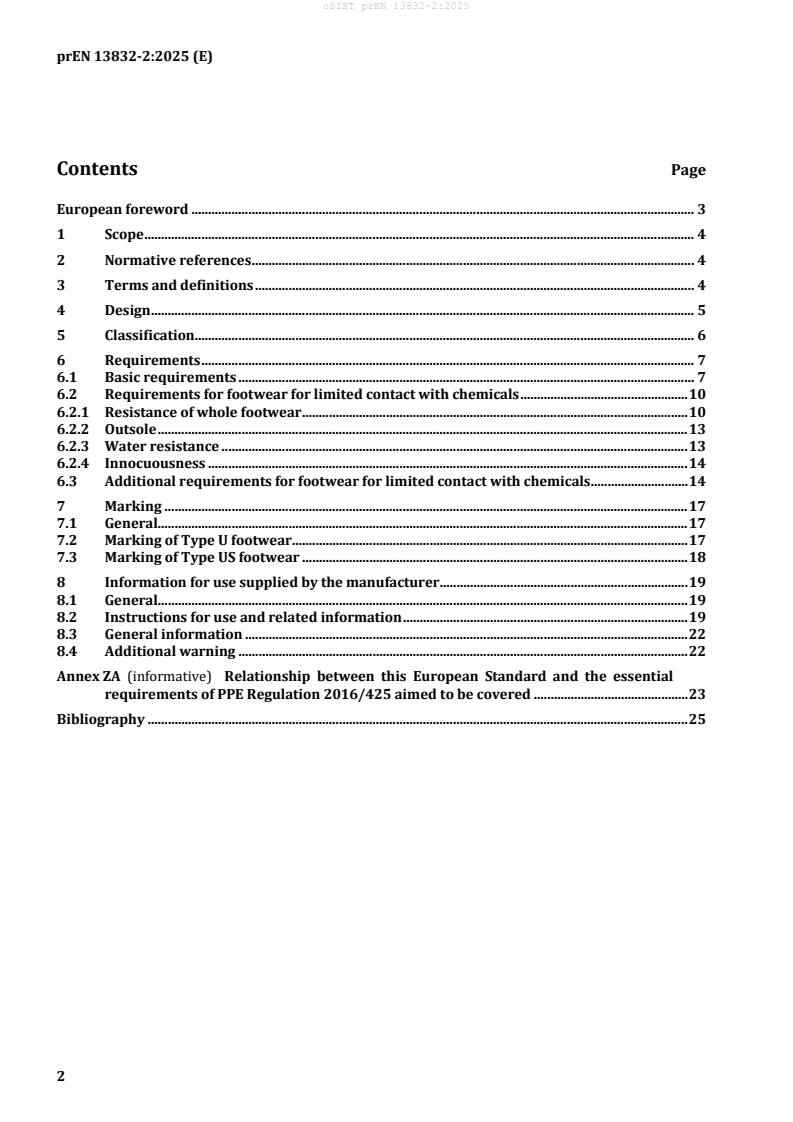
Contents Page
European foreword . 3
1 Scope . 4
2 Normative references . 4
3 Terms and definitions . 4
4 Design . 5
5 Classification. 6
6 Requirements . 7
6.1 Basic requirements . 7
6.2 Requirements for footwear for limited contact with chemicals . 10
6.2.1 Resistance of whole footwear . 10
6.2.2 Outsole . 13
6.2.3 Water resistance . 13
6.2.4 Innocuousness . 14
6.3 Additional requirements for footwear for limited contact with chemicals . 14
7 Marking . 17
7.1 General. 17
7.2 Marking of Type U footwear . 17
7.3 Marking of Type US footwear . 18
8 Information for use supplied by the manufacturer . 19
8.1 General. 19
8.2 Instructions for use and related information . 19
8.3 General information . 22
8.4 Additional warning . 22
Annex ZA (informative) Relationship between this European Standard and the essential
requirements of PPE Regulation 2016/425 aimed to be covered . 23
Bibliography . 25
European foreword
This document (prEN 13832-2:2025) has been prepared by Technical Committee CEN/TC 161 “Foot
and leg protectors”, the secretariat of which is held by BSI.
This document is currently submitted to the CEN Enquiry.
This document will supersede EN 13832-2:2018.
This document has been prepared under a standardization request addressed to CEN by the European
Commission. The Standing Committee of the EFTA States subsequently approves these requests for its
Member States.
For the relationship with EU Legislation, see informative Annex ZA, which is an integral part of this
document.
EN 13832, Footwear protecting against chemicals, is published in three parts:
— Part 1: Terminology and test methods
— Part 2: Requirements for limited contact with chemicals
— Part 3: Requirements for prolonged contact with chemicals
This standard is intended for use in conjunction with EN ISO 20345:2022, EN ISO 20346:2022 and
EN ISO 20347:2022.
Overview of major technical changes compared to the previous edition:
— reference to the new versions (as impacted by related amendments) of EN ISO 20344:2021,
EN ISO 20345:2022, EN ISO 20346:2022 and EN ISO 20347:2022;
— new Table 6 with reference to ISO 37;
— new requirement on seam (Table 6);
— new Tables 2 and 7 (inclusion of hybrid footwear).
1 Scope
This document specifies requirements for footwear to protect the user against limited contact in time
with specific chemicals.
The following risks are covered: splashing and degradation by chemical.
2 Normative references
The following documents are referred to in the text in such a way that some or all of their content
constitutes requirements of this document. For dated references, only the edition cited applies. For
undated references, the latest edition of the referenced document (including any amendments) applies.
EN ISO 868:2003, Plastics and ebonite — Determination of indentation hardness by means of a durometer
(Shore hardness) (ISO 868:2003)
ISO 7000:2019, Graphical symbols for use on equipment — Registered symbols
prEN 13832-1:2025, Footwear protecting against chemicals — Part 1: Terminology and test methods
prEN 13832-3:2025, Footwear protecting against chemicals — Part 3: Requirements for prolonged
contact with chemicals
EN ISO 20344:2021, Personal protective equipment — Test methods for footwear (ISO 20344:2021)
EN ISO 20345:2022, Personal protective equipment — Safety footwear (ISO 20345:2021)
EN ISO 20346:2022, Personal protective equipment — Protective footwear (ISO 20346:2021)
EN ISO 20347:2022, Personal protective equipment — Occupational footwear (ISO 20347:2021)
ISO 37:2024, Rubber, vulcanized or thermoplastic — Determination of tensile stress-strain properties
3 Terms and definitions
For the purposes of this document, the terms and definitions given in prEN 13832-1:2025,
EN ISO 20345:2022 and the following apply.
ISO and IEC maintain terminology databases for use in standardization at the following addresses:
— ISO Online browsing platform: available at https://www.iso.org/obp
— IEC Electropedia: available at https://www.electropedia.org/
3.1
footwear for limited contact with chemicals Type U
footwear designed and manufactured to protect the wearer from splashing of chemicals on the upper
Note 1 to entry: The upper contact can be intermittent, not exceeding one hour.
As impacted by EN ISO 20344:2021/A1:2024.
As impacted by EN ISO 20345:2022/A1:2024.
As impacted by EN ISO 20346:2022/A1:2024.
As impacted by EN ISO 20347:2022/A1:2024.
3.2
footwear for limited contact with chemicals Type US
footwear designed and manufactured to protect the wearer from splashing of chemicals on the upper
and contact with the outsole
Note 1 to entry: The upper and outsole contact can be continuous or intermittent, not exceeding one hour.
3.3
footwear for prolonged contact with chemicals
footwear designed and manufactured to protect the wearer from contact with chemicals. The contact
can be continuous or intermittent
Note 1 to entry: Prolonged means that it can be more than one hour in permanent contact.
Note 2 to entry: See prEN 13832-3:2025.
4 Design
For footwear for limited contact with chemicals, only designs B, C, D or E in Figure 1 as defined in
EN ISO 20345:2022, Table 4, shall be used.
Key
1 variable extension that can be adapted to the wearer
A low shoe
B ankle boot
C half-knee boot
D knee-height boot
E thigh boot
NOTE Design E is a knee-height boot (design D) equipped with a thin impermeable material that extends the
upper and that can be cut to adapt the boot to the wearer.
Figure 1 — Designs of footwear
5 Classification
Footwear for limited contact with chemicals shall be classified in accordance with Table 1.
Table 1 — Classification of footwear
Classification Description
Footwear made from leather and other materials, excluding all-rubber
I
and all-polymeric footwear
All-rubber (i.e. entirely vulcanized) and all-polymeric footwear (i.e.
II
entirely moulded) footwear
Hybrid
As defined in EN ISO 20345:2022, 3.19
footwear
6 Requirements
6.1 Basic requirements
Footwear for limited contact with chemical shall conform to the requirements specified in Table 2.
Footwear for limited contact with chemical may or may not include a toe cap. The choice shall be made
from one of the three columns according to EN ISO 20345:2022, EN ISO 20346:2022 or
EN ISO 20347:2022 in Table 2.
Table 2 — Basic requirements for footwear for limited contact with chemicals
Reference Classification
EN EN EN Hybrid Hybrid
Requirements
prEN 13832–
ISO 20345:2022+A ISO 20346:2022+ ISO 20347:2022+ I II mounted moulded
2:2025
1:2024 A1:2024 A1:2024
Design and classifications 4 and 5 X X X X
Height of upper 5.2.2 5.2.2 5.2.2 X X X X
Whole
Specific ergonomic features 5.3.4 5.3.4 5.3.3 X X X X
footwear
General Leakproofness 5.3.3 5.3.3 5.3.2 X
Water resistance 6.2.3 X X X
Designs B, C and D (Figure 1) 5.2.3 5.2.3 5.2.3 X X X X
Seat region
Design E (Figure 1) 5.2.3 5.2.3 5.2.3 X
Construction performance 5.3.1.1 5.3.1.1 5.3.1.1 X X
Outsole Upper/outsole bond strength 5.3.1.2 5.3.1.2 5.3.1.2 X X
Slip resistance 5.3.5 5.3.5 5.3.4 X X X X
General 5.3.2.1 5.3.2.1 X X X X
Toe cap length 5.3.2.2 5.3.2.2 X X X X
Whole
Toe
footwear
Impact resistance 5.3.2.3 5.3.2.3 X X X X
protection
Compression resistance 5.3.2.4 5.3.2.4 X X X X
Behaviour of toecap 5.3.2.5 5.3.2.5 X X X X
Resistance for limited contact with chemicals 6.2.1 X X X X
Innocuousness 5.3.6 5.3.6 5.3.5 6.2.4 X X X X
General 5.4.1 5.4.1 5.4.1 X X X X
Thickness 5.4.2 5.4.2 5.4.2 X X X
Tear strength 5.4.3 5.4.3 5.4.3 X X X
Upper
Tensile properties 5.4.4 5.4.4 5.4.4 X X X X
Flexing resistance 5.4.5 5.4.5 5.4.5 X X X
Water penetration and water absorption 6.3 6.3 6.3 X
Reference Classification
EN EN EN Hybrid Hybrid
Requirements
prEN 13832–
ISO 20345:2022+A ISO 20346:2022+ ISO 20347:2022+ I II mounted moulded
2:2025
1:2024 A1:2024 A1:2024
Hydrolysis 5.4.7 5.4.7 5.4.7 X X X
Tear strength 5.5.1 5.5.1 5.5.1 O
Vamp lining
Abrasion resistance 5.5.2 5.5.2 5.5.2 O
Tear strength 5.5.1 5.5.1 5.5.1 O
Quarter
lining
Abrasion resistance 5.5.2 5.5.2 5.5.2 O
Tongue Tear strength 5.6.1 5.6.1 5.6.1 O
Insole/insocks See Table 3
Thickness 5.8.1 5.8.1 5.8.1 X X X X
Tear strength 5.8.2 5.8.2 5.8.2 X X X X
Abrasion resistance 6.2.2 X X X X
Outsole
Flexing resistance 5.8.4 5.8.4 5.8.4 X X X X
hydrolysis 5.8.5 5.8.5 5.8.5 X X X X
Interlayer bond strength 5.8.6 5.8.6 5.8.6 O O O O
The applicability of a requirement to a particular classification is indicated in the table by the following.
X indicates that the requirement shall be met. In some cases, the requirement relates only to particular materials within the classification, e.g. pH value of leather components. This does not
mean that other materials are precluded from use.
O indicates that if the component part exists, the requirement shall be met.
NOTE 1 The absence of X or O indicates that no requirement is met.
NOTE 2 For class II footwear, it is usual to have no insole present. However, if a removable insock is used, Table 3 is applicable, only chromium VI and pH requirements are fulfilled for leather
materials.
NOTE 3 Stockings covering the last before the moulding process are not considered as a lining.
Table 3— Basic requirements for insoles and/or insocks
Requirements to fulfil in
EN ISO 20345:2022+A1:2024, EN ISO 20346:2022+A1:2024 and
EN ISO 20347:2022+A1:2024
Component
Options to be Water
Chromium VI
assessed Thickness pH absorption Abrasion Abrasion
desorption
5.7.1 5.7.2 5.7.3 5.7.4.1 5.7.5 5.7.4.2
No insole or if
Non-
present not
1 removable Insock X X X X X
fulfilling the
insock
requirements
No insock
2 Insole X X X X X
Seat sock
present
Insock and
Full insock,
insole X X
3 non-
together
removable
Insock X X X
Insole present
Full insock,
Insole X X X X X
removable
4 and water-
permeable
Insock X X X
♦
Full insock,
Insole X X X X X
removable,
not water-
Insock X X X X
permeable
NOTE For removable insocks see 8.5.
X indicates that the requirement shall be met.
♦ indicates a water permeable insock which, when tested in accordance with EN ISO 20344:2021, 7.2, lets water through in 60 s or less.
indicates those requirements that are only for leather.
6.2 Requirements for footwear for limited contact with chemicals
6.2.1 Resistance of whole footwear
6.2.1.1 General
At least two test chemicals shall be taken from the list given in Table 4. Other testing chemicals not
listed could be used if they are representative for the intended use of the footwear.
According to their performance, footwear for limited contact with chemicals are classified into two
types: Type U, and Type US as describe in Table 5.
The splashing and degradation shall be tested both with the same chemicals.
Table 4 — List of test chemicals
CODE
CHEMICAL CAS NUMBER CLASS (informative)
LETTER
A Methanol 67–56–1 Primary alcohol
B Acetone 67–64–1 Ketone
C Acetonitrile 75–05–8 Nitrile compound
D Dichloromethane 75–09–2 Chlorinated hydrocarbon
E Carbon disulphide 75–15–0 Sulphur containing organic compound
F Toluene 108–88–3 Aromatic hydrocarbon
G Diethylamine 109–89–7 Amine
H Tetrahydrofuran 109–99–9 Heterocyclic and ether compound
I Ethyl acetate 141–78–6 Ester
J n-Heptane 142–82–5 Saturated hydrocarbon
K Sodium hydroxide 40 % 1310–73–2 Inorganic base
L Sulphuric acid 96 % 7664–93–9 Inorganic mineral acid, oxidizing
M Nitric acid 65 % 7697–37–2 Inorganic mineral acid, oxidizing
N Acetic acid 99 % 64–19–7 Organic acid
O Ammonium hydroxide 25 % 1336–21–6 Organic base
P Hydrogen peroxide 30 % 7722–84–1 Peroxide
Q isopropanol 67–63–0 Aliphatic alcohol
Sodium hypochlorite
R 7681–52–9 hypochlorite
(13 ± 1) % (active chloride)
S Hydrofluoric acid 40 % 7664–39–3 Inorganic mi
...