

EN 1555-3:2021
(Main)Plastics piping systems for the supply of gaseous fuels - Polyethylene (PE) - Part 3: Fittings
- Abstract
This document specifies the characteristics of fusion fittings made from polyethylene (PE) as well as of mechanical fittings for piping systems in the field of the supply of gaseous fuels.
It also specifies the test parameters for the test methods referred to in this document.
In conjunction with Parts 1, 2, 4 and 5 of EN 1555, it is applicable to PE fittings, their joints and to joints with components of PE and other materials intended to be used under the following conditions:
a) a maximum operating pressure, MOP, up to and including 10 bar1 at a reference temperature of 20 °C for design purposes;
b) an operating temperature between −20 °C and 40 °C.
NOTE 1 For operating temperatures between 20 °C and 40 °C, derating coefficients are defined in EN 1555-5:2021.
EN 1555 (all parts) covers a range of maximum operating pressures and gives requirements concerning colours.
NOTE 2 It is the responsibility of the purchaser or specifier to make the appropriate selections from these aspects, taking into account their particular requirements and any relevant national regulations and installation practices or codes.
This document is applicable for fittings of the following types:
a) electrofusion socket fittings;
b) electrofusion saddle fittings;
c) spigot end fittings (for butt fusion using heated tools and electrofusion socket fusion);
d) mechanical fittings.
NOTE 3 The fittings can be, for example, in the form of couplers, equal and reduced tees, reducers, saddles, elbows or caps.
- Status
- Withdrawn
- Publication Date
- 06-Jul-2021
- Withdrawal Date
- 06-Oct-2026
- Technical Committee
- CEN/TC 155 - Plastics piping systems and ducting systems
- Current Stage
- 9960 - Withdrawal effective - Withdrawal
- Start Date
- 08-Oct-2025
- Completion Date
- 07-Oct-2026

Relations
- Effective Date
- 14-Jul-2021
- Effective Date
- 26-Apr-2023
- Effective Date
- 08-Apr-2026
- Effective Date
- 08-Apr-2026
- Effective Date
- 08-Apr-2026
- Effective Date
- 08-Apr-2026
- Effective Date
- 09-Feb-2026
- Effective Date
- 09-Feb-2026
- Effective Date
- 09-Feb-2026
- Effective Date
- 09-Feb-2026
- Effective Date
- 28-Jan-2026
- Effective Date
- 28-Jan-2026
- Effective Date
- 28-Jan-2026
- Effective Date
- 28-Jan-2026
- Effective Date
- 28-Jan-2026
Get Certified
Connect with accredited certification bodies for this standard

Institut za varilstvo d.o.o. (Welding Institute)
Slovenia's leading welding institute since 1952. ISO 3834, EN 1090, pressure equipment certification, NDT personnel, welder qualification. Only IIW Au
Sponsored listings
Frequently Asked Questions
EN 1555-3:2021 is a standard published by the European Committee for Standardization (CEN). Its full title is "Plastics piping systems for the supply of gaseous fuels - Polyethylene (PE) - Part 3: Fittings". This standard covers: This document specifies the characteristics of fusion fittings made from polyethylene (PE) as well as of mechanical fittings for piping systems in the field of the supply of gaseous fuels. It also specifies the test parameters for the test methods referred to in this document. In conjunction with Parts 1, 2, 4 and 5 of EN 1555, it is applicable to PE fittings, their joints and to joints with components of PE and other materials intended to be used under the following conditions: a) a maximum operating pressure, MOP, up to and including 10 bar1 at a reference temperature of 20 °C for design purposes; b) an operating temperature between −20 °C and 40 °C. NOTE 1 For operating temperatures between 20 °C and 40 °C, derating coefficients are defined in EN 1555-5:2021. EN 1555 (all parts) covers a range of maximum operating pressures and gives requirements concerning colours. NOTE 2 It is the responsibility of the purchaser or specifier to make the appropriate selections from these aspects, taking into account their particular requirements and any relevant national regulations and installation practices or codes. This document is applicable for fittings of the following types: a) electrofusion socket fittings; b) electrofusion saddle fittings; c) spigot end fittings (for butt fusion using heated tools and electrofusion socket fusion); d) mechanical fittings. NOTE 3 The fittings can be, for example, in the form of couplers, equal and reduced tees, reducers, saddles, elbows or caps.
This document specifies the characteristics of fusion fittings made from polyethylene (PE) as well as of mechanical fittings for piping systems in the field of the supply of gaseous fuels. It also specifies the test parameters for the test methods referred to in this document. In conjunction with Parts 1, 2, 4 and 5 of EN 1555, it is applicable to PE fittings, their joints and to joints with components of PE and other materials intended to be used under the following conditions: a) a maximum operating pressure, MOP, up to and including 10 bar1 at a reference temperature of 20 °C for design purposes; b) an operating temperature between −20 °C and 40 °C. NOTE 1 For operating temperatures between 20 °C and 40 °C, derating coefficients are defined in EN 1555-5:2021. EN 1555 (all parts) covers a range of maximum operating pressures and gives requirements concerning colours. NOTE 2 It is the responsibility of the purchaser or specifier to make the appropriate selections from these aspects, taking into account their particular requirements and any relevant national regulations and installation practices or codes. This document is applicable for fittings of the following types: a) electrofusion socket fittings; b) electrofusion saddle fittings; c) spigot end fittings (for butt fusion using heated tools and electrofusion socket fusion); d) mechanical fittings. NOTE 3 The fittings can be, for example, in the form of couplers, equal and reduced tees, reducers, saddles, elbows or caps.
EN 1555-3:2021 is classified under the following ICS (International Classification for Standards) categories: 23.040.45 - Plastics fittings. The ICS classification helps identify the subject area and facilitates finding related standards.
EN 1555-3:2021 has the following relationships with other standards: It is inter standard links to EN 1555-3:2010+A1:2012, EN 1555-3:2025, ISO 13954:1997, ISO 13955:1997, ISO 18488:2015, ISO 17885:2021, ISO 13956:2010, ISO 13951:2015, ISO 13953:2001, ISO 13950:2007, EN 1555-1:2021, EN 1716:1997, EN 682:2002, EN 16905-3:2024, EN ISO 1133-1:2022. Understanding these relationships helps ensure you are using the most current and applicable version of the standard.
EN 1555-3:2021 is available in PDF format for immediate download after purchase. The document can be added to your cart and obtained through the secure checkout process. Digital delivery ensures instant access to the complete standard document.
Standards Content (Sample)
SLOVENSKI STANDARD
01-september-2021
Nadomešča:
SIST EN 1555-3:2010+A1:2013
Cevni sistemi iz polimernih materialov za oskrbo s plinastimi gorivi - Polietilen
(PE) - 3. del: Fitingi
Plastics piping systems for the supply of gaseous fuels - Polyethylene (PE) - Part 3:
Fittings
Kunststoff-Rohrleitungssysteme für die Gasversorgung - Polyethylen (PE) - Teil 3:
Formstücke
Systèmes de canalisations en plastique pour la distribution de combustibles gazeux -
Polyéthylène (PE) - Partie 3 : Raccords
Ta slovenski standard je istoveten z: EN 1555-3:2021
ICS:
83.140.30 Polimerne cevi in fitingi za Plastics pipes and fittings for
snovi, ki niso tekočine non fluid use
91.140.40 Sistemi za oskrbo s plinom Gas supply systems
2003-01.Slovenski inštitut za standardizacijo. Razmnoževanje celote ali delov tega standarda ni dovoljeno.
EN 1555-3
EUROPEAN STANDARD
NORME EUROPÉENNE
July 2021
EUROPÄISCHE NORM
ICS 23.040.45 Supersedes EN 1555-3:2010+A1:2012
English Version
Plastics piping systems for the supply of gaseous fuels -
Polyethylene (PE) - Part 3: Fittings
Systèmes de canalisations en plastique pour la Kunststoff-Rohrleitungssysteme für die Gasversorgung
distribution de combustibles gazeux - Polyéthylène - Polyethylen (PE) - Teil 3: Formstücke
(PE) - Partie 3 : Raccords
This European Standard was approved by CEN on 7 June 2021.
CEN members are bound to comply with the CEN/CENELEC Internal Regulations which stipulate the conditions for giving this
European Standard the status of a national standard without any alteration. Up-to-date lists and bibliographical references
concerning such national standards may be obtained on application to the CEN-CENELEC Management Centre or to any CEN
member.
This European Standard exists in three official versions (English, French, German). A version in any other language made by
translation under the responsibility of a CEN member into its own language and notified to the CEN-CENELEC Management
Centre has the same status as the official versions.
CEN members are the national standards bodies of Austria, Belgium, Bulgaria, Croatia, Cyprus, Czech Republic, Denmark, Estonia,
Finland, France, Germany, Greece, Hungary, Iceland, Ireland, Italy, Latvia, Lithuania, Luxembourg, Malta, Netherlands, Norway,
Poland, Portugal, Republic of North Macedonia, Romania, Serbia, Slovakia, Slovenia, Spain, Sweden, Switzerland, Turkey and
United Kingdom.
EUROPEAN COMMITTEE FOR STANDARDIZATION
COMITÉ EUROPÉEN DE NORMALISATION
EUROPÄISCHES KOMITEE FÜR NORMUNG
CEN-CENELEC Management Centre: Rue de la Science 23, B-1040 Brussels
© 2021 CEN All rights of exploitation in any form and by any means reserved Ref. No. EN 1555-3:2021 E
worldwide for CEN national Members.
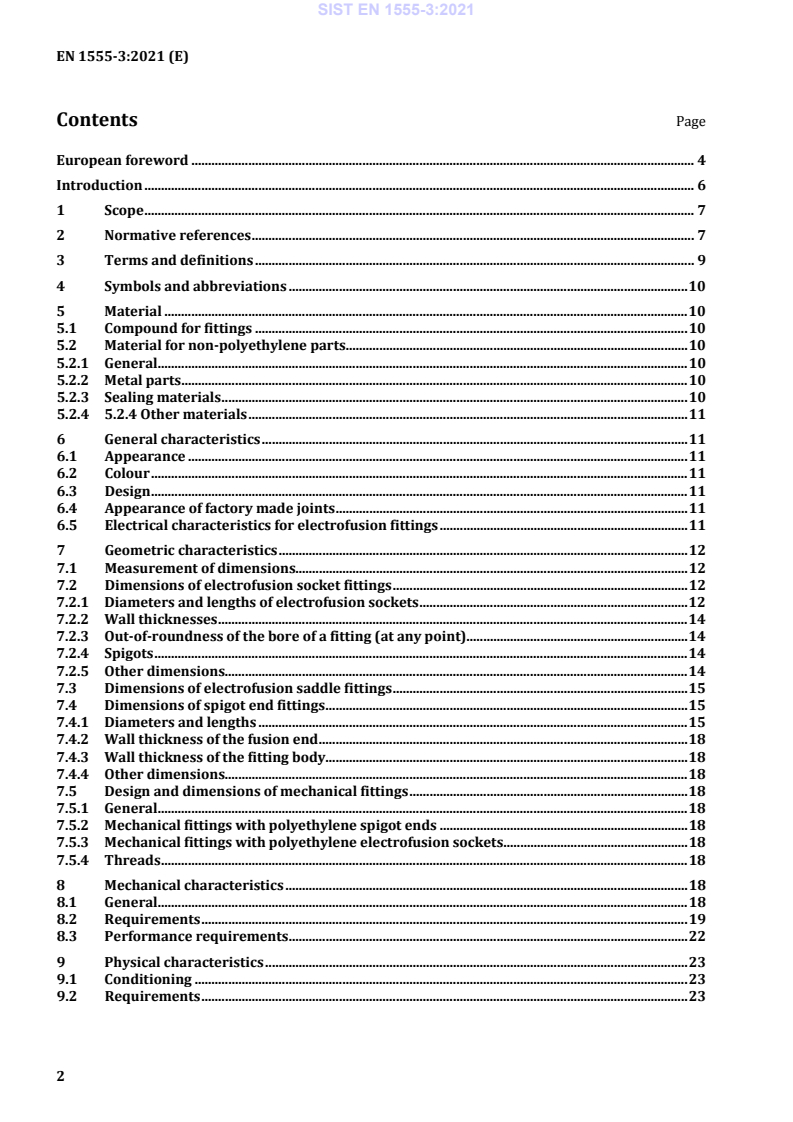
Contents Page
European foreword . 4
Introduction . 6
1 Scope . 7
2 Normative references . 7
3 Terms and definitions . 9
4 Symbols and abbreviations . 10
5 Material . 10
5.1 Compound for fittings . 10
5.2 Material for non-polyethylene parts . 10
5.2.1 General . 10
5.2.2 Metal parts . 10
5.2.3 Sealing materials . 10
5.2.4 5.2.4 Other materials . 11
6 General characteristics . 11
6.1 Appearance . 11
6.2 Colour . 11
6.3 Design . 11
6.4 Appearance of factory made joints . 11
6.5 Electrical characteristics for electrofusion fittings . 11
7 Geometric characteristics . 12
7.1 Measurement of dimensions. 12
7.2 Dimensions of electrofusion socket fittings . 12
7.2.1 Diameters and lengths of electrofusion sockets . 12
7.2.2 Wall thicknesses . 14
7.2.3 Out-of-roundness of the bore of a fitting (at any point). 14
7.2.4 Spigots . 14
7.2.5 Other dimensions. 14
7.3 Dimensions of electrofusion saddle fittings . 15
7.4 Dimensions of spigot end fittings . 15
7.4.1 Diameters and lengths . 15
7.4.2 Wall thickness of the fusion end . 18
7.4.3 Wall thickness of the fitting body. 18
7.4.4 Other dimensions. 18
7.5 Design and dimensions of mechanical fittings . 18
7.5.1 General . 18
7.5.2 Mechanical fittings with polyethylene spigot ends . 18
7.5.3 Mechanical fittings with polyethylene electrofusion sockets . 18
7.5.4 Threads . 18
8 Mechanical characteristics . 18
8.1 General . 18
8.2 Requirements . 19
8.3 Performance requirements . 22
9 Physical characteristics . 23
9.1 Conditioning . 23
9.2 Requirements . 23
10 Performance requirements . 23
11 Technical file . 24
12 Marking . 24
12.1 General . 24
12.2 Minimum required marking of fittings . 25
12.3 Additional marking . 25
12.4 Fusion system recognition . 25
13 Delivery conditions . 26
Annex A (informative) Examples of typical terminal connection for electrofusion fittings . 27
Annex B (normative) Short-term pressure test method . 30
Annex C (normative) Tensile test for fitting/pipe assemblies . 32
Bibliography . 33
European foreword
This document (EN 1555-3:2021) has been prepared by Technical Committee CEN/TC 155 “Plastics
piping systems and ducting systems”, the secretariat of which is held by NEN.
This European Standard shall be given the status of a national standard, either by publication of an
identical text or by endorsement, at the latest by January 2022, and conflicting national standards shall
be withdrawn at the latest by January 2022.
Attention is drawn to the possibility that some of the elements of this document may be the subject of
patent rights. CEN shall not be held responsible for identifying any or all such patent rights.
This document supersedes EN 1555-3:2010+A1:2012.
In comparison with the previous version, the following technical modifications have been introduced:
— PE 100-RC type materials with enhanced resistance to slow crack growth have been added.
— Annex A of EN 1555-1:2021 now discusses the performance of this type of material and gives
additional information for non-conventional installation techniques.
— Additional information for non-conventional installation techniques has been added.
— The size range has been increased to 800 mm diameter.
— Test methods have been updated.
System Standards are based on the results of the work being undertaken in ISO/TC 138 “Plastics pipes,
fittings and valves for the transport of fluids”, which is a Technical Committee of the International
Organization for Standardization (ISO).
They are supported by separate standards on test methods to which references are made throughout the
System Standard.
The System Standards are consistent with general standards on functional requirements and on
recommended practice for installation.
EN 1555 consists of the following parts:
— EN 1555-1, Plastics piping systems for the supply of gaseous fuels — Polyethylene (PE) —
Part 1: General;
— EN 1555-2, Plastics piping systems for the supply of gaseous fuels — Polyethylene (PE) — Part 2: Pipes;
— EN 1555-3, Plastics piping systems for the supply of gaseous fuels — Polyethylene (PE) —
Part 3: Fittings (this standard);
— EN 1555-4, Plastics piping systems for the supply of gaseous fuels — Polyethylene (PE) — Part 4: Valves;
— EN 1555-5, Plastics piping systems for the supply of gaseous fuels — Polyethylene (PE) — Part 5: Fitness
for purpose of the system;
— CEN/TS 1555-7, Plastics piping systems for the supply of gaseous fuels — Polyethylene (PE) —
Part 7: Guidance for assessment of conformity.
NOTE EN 12007-2 [1], prepared by CEN/TC 234 “Gas infrastructure”, deals with the recommended practice
for installation of plastics pipes system in accordance with EN 1555 (all parts).
Any feedback and questions on this document should be directed to the users’ national standards body.
A complete listing of these bodies can be found on the CEN website.
According to the CEN-CENELEC Internal Regulations, the national standards organisations of the
following countries are bound to implement this European Standard: Austria, Belgium, Bulgaria, Croatia,
Cyprus, Czech Republic, Denmark, Estonia, Finland, France, Germany, Greece, Hungary, Iceland, Ireland,
Italy, Latvia, Lithuania, Luxembourg, Malta, Netherlands, Norway, Poland, Portugal, Republic of North
Macedonia, Romania, Serbia, Slovakia, Slovenia, Spain, Sweden, Switzerland, Turkey and the United
Kingdom.
Introduction
This document, specifies the requirements for a piping system and its components made from
polyethylene (PE) and which is intended to be used for the supply of gaseous fuels.
Requirements and test methods for material and components, other than fittings, are specified in
EN 1555-1:2021, EN 1555-2:2021 and EN 1555-4:2021.
Characteristics for fitness for purpose are covered in EN 1555-5:2021. CEN/TS 1555-7 [2] gives guidance
for assessment of conformity. Recommended practice for installation is given in EN 12007-2 [1] prepared
by CEN/TC 234.
This part of EN 1555 covers the characteristics of fittings.
1 Scope
This document specifies the characteristics of fusion fittings made from polyethylene (PE) as well as of
mechanical fittings for piping systems in the field of the supply of gaseous fuels.
It also specifies the test parameters for the test methods referred to in this document.
In conjunction with Parts 1, 2, 4 and 5 of EN 1555, it is applicable to PE fittings, their joints and to joints
with components of PE and other materials intended to be used under the following conditions:
a) a maximum operating pressure, MOP, up to and including 10 bar at a reference temperature of 20 °C
for design purposes;
b) an operating temperature between −20 °C and 40 °C.
NOTE 1 For operating temperatures between 20 °C and 40 °C, derating coefficients are defined in
EN 1555-5:2021.
EN 1555 (all parts) covers a range of maximum operating pressures and gives requirements concerning
colours.
NOTE 2 It is the responsibility of the purchaser or specifier to make the appropriate selections from these
aspects, taking into account their particular requirements and any relevant national regulations and installation
practices or codes.
This document is applicable for fittings of the following types:
a) electrofusion socket fittings;
b) electrofusion saddle fittings;
c) spigot end fittings (for butt fusion using heated tools and electrofusion socket fusion);
d) mechanical fittings.
NOTE 3 The fittings can be, for example, in the form of couplers, equal and reduced tees, reducers, saddles,
elbows or caps.
2 Normative references
The following documents are referred to in the text in such a way that some or all of their content
constitutes requirements of this document. For dated references, only the edition cited applies. For
undated references, the latest edition of the referenced document (including any amendments) applies.
EN 682, Elastomeric Seals - Materials requirements for seals used in pipes and fittings carrying gas and
hydrocarbon fluids
EN 1555-1:2021, Plastics piping systems for the supply of gaseous fuels - Polyethylene (PE) - Part 1: General
EN 1555-2:2021, Plastics piping systems for the supply of gaseous fuels - Polyethylene (PE) - Part 2: Pipes
EN 1555-5:2021, Plastics piping systems for the supply of gaseous fuels - Polyethylene (PE) - Part 5: Fitness
for purpose of the system
1 5 2
1 bar = 0,1 MPa. = 10 Pa; 1 MPa = 1 N/mm .
EN 1716, Plastics piping systems - Polyethylene (PE) tapping tees - Test method for impact resistance of an
assembled tapping tee
EN 10226-1, Pipe threads where pressure tight joints are made on the threads - Part 1: Taper external
threads and parallel internal threads - Dimensions, tolerances and designation
EN 10226-2, Pipe threads where pressure tight joints are made on the threads - Part 2: Taper external
threads and taper internal threads - Dimensions, tolerances and designation
EN ISO 228-1, Pipe threads where pressure-tight joints are not made on the threads - Part 1: Dimensions,
tolerances and designation (ISO 228-1)
EN ISO 1133-1, Plastics - Determination of the melt mass-flow rate (MFR) and melt volume-flow rate (MVR)
of thermoplastics - Part 1: Standard method (ISO 1133-1)
EN ISO 1167-1:2006, Thermoplastics pipes, fittings and assemblies for the conveyance of fluids -
Determination of the resistance to internal pressure - Part 1: General method (ISO 1167-1:2006)
EN ISO 1167-4, Thermoplastics pipes, fittings and assemblies for the conveyance of fluids - Determination
of the resistance to internal pressure - Part 4: Preparation of assemblies (ISO 1167-4)
EN ISO 3126, Plastics piping systems - Plastics components - Determination of dimensions (ISO 3126)
EN ISO 11357-6, Plastics - Differential scanning calorimetry (DSC) - Part 6: Determination of oxidation
induction time (isothermal OIT) and oxidation induction temperature (dynamic OIT) (ISO 11357-6)
EN ISO 17778, Plastics piping systems - Fittings, valves and ancillaries - Determination of gaseous flow
rate/pressure drop relationships (ISO 17778)
ISO 13950, Plastics pipes and fittings - Automatic recognition systems for electrofusion joints
ISO 13951, Plastics piping systems - Test method for the resistance of plastic pipe/pipe or pipe/fitting
assemblies to tensile loading
ISO 13953, Polyethylene (PE) pipes and fittings - Determination of the tensile strength and failure mode of
test pieces from a butt-fused joint
ISO 13954, Plastics pipes and fittings - Peel decohesion test for polyethylene (PE) electrofusion assemblies
of nominal outside diameter greater than or equal to 90 mm
ISO 13955, Plastics pipes and fittings - Crushing decohesion test for polyethylene (PE) electrofusion
assemblies
ISO 13956, Plastics pipes and fittings - Decohesion test of polyethylene (PE) saddle fusion joints - Evaluation
of ductility of fusion joint interface by tear test
ISO 17885, Plastics piping systems - Mechanical fittings for pressure piping systems – Specification
ISO 18488, Polyethylene (PE) materials for piping systems - Determination of Strain Hardening Modulus in
relation to slow crack growth - Test method
3 Terms and definitions
For the purposes of this document, the terms and definitions, symbols and abbreviations given in
EN 1555-1:2021 and the following apply.
ISO and IEC maintain terminological databases for use in standardization at the following addresses:
• IEC Electropedia: available at https://www.electropedia.org/
• ISO Online browsing platform: available at https://www.iso.org/obp
3.1
electrofusion socket fitting
polyethylene (PE) fitting which contains one or more integral heating elements, that are capable of
transforming electrical energy into heat to realize a fusion joint with a spigot end or a pipe
3.2
electrofusion saddle fitting
polyethylene (PE) fitting which contains one or more integral heating elements, that are capable of
transforming electrical energy into heat to realise a fusion joint onto a pipe
3.2.1
tapping tee
electrofusion saddle fitting (top loading or wrap round) which contains an integral cutter, to cut through
the wall of the main pipe, which remains in the body of this fitting
3.2.2
branch saddle
electrofusion saddle fitting (top loading or wrap round) which requires an ancillary cutting tool for
drilling a hole in the adjoining main pipe
3.3
mechanical fitting
fitting, that generally includes a compression part to provide pressure integrity, leak tightness and
resistance to end loads, for assembling polyethylene (PE) pipe to another PE pipe or any other element
of the piping system
Note 1 to entry: A pipe-supporting sleeve providing a permanent support for a polyethylene (PE) pipe to prevent
creep in the pipe wall under radial compressive forces, is applicable. The metallic parts of the fitting can be
assembled to metallic pipes by screw-threads, compression joints, welded or flanged connections. In some cases the
supporting sleeve at the same time constitutes a grip ring.
Note 2 to entry: The fitting can allow either a dismountable or permanently assembled joint.
Note 3 to entry: The mechanical fitting can be supplied for field assembly, typically as a material transition fitting,
or pre-assembled by the manufacturer.
3.4
spigot end fitting
polyethylene (PE) fitting where the outside diameter of the spigot end is equal to the nominal outside
diameter, d , of the corresponding pipe
n
4 Symbols and abbreviations
For the purpose of this document the symbols and abbreviations given in EN 1555-1:2021 apply.
5 Material
5.1 Compound for fittings
The PE compound from which the fittings are made shall be in accordance with EN 1555-1:2021.
The stress bearing parts shall only be made from virgin material conforming to EN 1555-1:2021.
Non-stress bearing PE parts shall be made from virgin material or reworked material from a compound
with the same MRS or a mixture of both materials.
5.2 Material for non-polyethylene parts
5.2.1 General
All components shall conform to the relevant EN standard(s). Alternative standards may be applied in
cases where the suitable EN standard(s) do not exist. In all cases, fitness for purpose of the components
shall be demonstrated.
The materials and the constituent elements used in making the fitting (including elastomers and any
metal parts as may be used) shall be as resistant to the external and internal environments as the other
elements of the piping system, and shall have an expected lifetime under the following conditions at least
equal to that of the PE pipes conforming to EN 1555-2:2021 with which they are intended to be used:
a) during storage;
b) under the effect of the gas conveyed therein;
c) with respect to the service environment and operating conditions.
The requirements for the level of material performance of non-polyethylene parts shall be at least as
stringent as that of the PE compound for the piping system. Reworked materials shall not be used for
stress bearing polymeric parts.
Non-stress bearing fitting parts, e.g. clamps for electrofusion saddle fittings, that only maintain a function
during installation, are made from other materials or polyethylene.
Other materials used in fittings in contact with the PE pipe shall not adversely affect pipe performance or
initiate stress cracking.
5.2.2 Metal parts
All metal parts susceptible to corrosion shall be adequately protected, providing this is necessary for the
durability and function of the system.
When dissimilar metallic materials are used which can be in contact with moisture, steps shall be taken
to avoid the possibility of galvanic corrosion.
5.2.3 Sealing materials
Elastomeric seals shall conform to EN 682.
If other sealing materials are used, they need to be proven for gas supply systems.
5.2.4 5 Other materials
Greases or lubricants shall not exude onto fusion areas, and shall not affect the long-term performance of
fitting materials.
6 General characteristics
6.1 Appearance
When viewed without magnification, the internal and external surfaces of fittings shall be clean and shall
have no scoring, cavities and other surface defects to an extent that would prevent conformity to this
document.
No component of the fitting shall show any signs of damage, scratches, pitting, bubbles, blisters,
inclusions or cracks to an extent that would prevent conformity of the fittings to the requirements of this
document.
6.2 Colour
The colour of the PE parts of fittings shall be either black, yellow, or orange.
6.3 Design
The design of the fitting shall be such that, when assembling the fitting onto the pipe or other component,
electrical coils and/or seals are not displaced.
Tapping tees may be provided with upper and lower end stops for the drill, or other means of indicating
the drill position according to manufacturer’s instructions.
Tapping tees may be provided with a means to prevent uncontrolled gas release during tapping.
6.4 Appearance of factory made joints
The internal and external surfaces of the pipe and fitting after fusion jointing, examined visually without
magnification, shall be free from melt exudation outside the confines of the fitting, apart from that which
may be declared acceptable by the fitting manufacturer or used deliberately as a fusion marker.
Any melt exudation shall not cause wire movement in electrofusion fittings such that it leads to short-
circuiting, when jointed in accordance with the manufacturer's instructions. There shall be no excessive
creasing of the internal surfaces of the adjoining pipes.
6.5 Electrical characteristics for electrofusion fittings
The electrical protection that shall be provided by the fusion process depends on the voltage and the
current used and on the characteristics of the electricity power source.
For voltages greater than 25 V, direct human contact with energized parts shall not be possible when the
fitting is in the fusion cycle during assembly in accordance with the instructions of the manufacturers of
the fittings and of the assembly equipment, as applicable.
NOTE 1 The fitting is part of an electrical system during the fusion process as defined in EN 60335-1 [3],
HD 60364-1 [4] and IEC 61140 [5].
The tolerance on the electrical resistance of the fitting at 23 °C shall be stated by the manufacturer. The
resistance shall be between nominal resistance (−10 %) and nominal resistance [(+10 %) + 0,1 Ω].
NOTE 2 0,1 Ω is the assumed value of the contact resistance.
The surface finish of the terminal pins shall allow a minimum contact resistance in order to satisfy the
resistance tolerance requirements.
NOTE 3 See Annex A, for examples of typical electrofusion terminal connections.
7 Geometric characteristics
7.1 Measurement of dimensions
The dimensions of the fitting shall be measured in accordance with EN ISO 3126, and rounded to the next
0,1 mm. In case of dispute, the measurement shall not be made less than 24 h after manufacture, and after
being conditioned for at least 4 h at (23 ± 2) °C.
Additionally, for spigot end fittings provided with temporary supports, perform dimensional
measurement at least 1 h after removal of the supports.
Indirect measurement at the stage of production is allowed at shorter time periods providing evidence is
shown of correlation.
7.2 Dimensions of electrofusion socket fittings
7.2.1 Diameters and lengths of electrofusion sockets
For electrofusion sockets (see Figure 1) having a nominal diameter given in Table 1, the socket diameter
and lengths shall be given by the manufacturer and shall conform to Table 1 with the following
conditions:
a) L ≥ 5 mm;
b) D ≥ d − 2 e .
2 n min
Key
D is the mean inside diameter in the fusion zone measured in a plane parallel to the plane of the mouth at
a distance of L + 0,5L2 from that face;
D
is the bore, which is the minimum diameter of the flow channel through the body of the fitting;
L is the depth of penetration of the pipe or male end of a spigot fitting; in case of a coupling without stop,
it is not greater than half the total length of the fitting;
L is the heated length within a socket as declared by the manufacturer to be the nominal length of the
fusion zone;
L is the distance between the mouth of the fitting and the start of the fusion zone as declared by the
manufacturer to be the nominal unheated entrance length of the fitting.
Figure 1 — Dimensions of electrofusion socket fittings
Table 1 — Dimensions of electrofusion socket fittings
Dimensions in millimetres
Nominal Depth of penetration Fusion
diameter zone
a
d L L
L
n 1,min 2,min
1,max
16 25 41 10
20 25 41 10
25 25 41 10
32 25 44 10
40 25 49 10
50 28 55 10
63 31 63 11
75 35 70 12
90 40 79 13
110 53 82 15
125 58 87 16
140 62 92 18
160 68 98 20
180 74 105 21
200 80 112 23
225 88 120 26
250 95 129 33
280 104 139 35
315 115 150 39
355 127 164 42
400 140 179 47
450 155 195 51
500 170 212 56
560 188 235 61
630 209 255 67
710 220 280 74
800 230 300 82
a
An extended L may be agreed between the end user and manufacturer. In
this case compatibility of such fittings is not given with components with a
tubular length of spigots L according to Table 3.
2,min
The mean inside diameter of the fitting in the middle of the fusion zone (see D in Figure 1) shall not be
less than d .
n
In the case of a fitting having sockets of differing nominal diameters, each one shall conform to the
requirements for the nominal diameter of the corresp
...