


prEN 15090
(Main)Footwear for firefighters
Footwear for firefighters
This document specifies minimum requirements and test methods for the performance of three types (see 4.3) of footwear for use by firefighters for fire suppression, general-purpose rescue, fire rescue and hazardous materials emergencies. It also specifies requirements for footwear for firefighters equipped with customized insocks and customized footwear for firefighters. This document does not cover the property of high visibility because of interaction with the clothing (e.g. trousers cover the footwear and vice versa) and work area conditions (e.g. dirt, mud).
Special risks are covered by complementary job-related standards (e.g. electrically insulating footwear, protection against chain saw injuries, protection against molten metal splash).
Schuhe für die Feuerwehr
Dieses Dokument legt Mindestanforderungen und Prüfverfahren für die Leistung von drei Typen von Schuhen für Feuerwehrleute (siehe 4.3) fest: Schuhe für Brandunterdrückung, für allgemeine Nutzung im Feuerwehrdienst, Schuhe für die Brandbekämpfung und für Gefahrstoffeinsätze. Es legt zudem Anforderungen an Schuhe für Feuerwehrleute mit zugerichteten Einlegesohlen und zugerichtete Schuhe für Feuerwehrleute fest. Dieses Dokument befasst sich nicht mit der Eigenschaft hoher Sichtbarkeit aufgrund des Zusammenwirkens mit der Kleidung (z. B. die Schuhe bedeckende Hosen oder umgekehrt) und den Arbeitsplatzbedingungen (z. B. Schmutz, Schlamm).
Besondere Risiken werden in ergänzenden, auf einzelne Tätigkeiten bezogenen Normen behandelt (z. B. elektrisch isolierende Schuhe, Schutzschuhe gegen Schnitte durch Kettensägen, Schuhe zum Schutz gegen flüssige Metallspritzer).
Chaussures pour pompiers
Le présent document fixe les exigences minimales et les méthodes d'essai permettant de déterminer les performances de trois types de chaussures destinées aux pompiers (voir 4.3), dans le cadre de l'extinction d'un feu, d'opérations générales de sauvetage, de la lutte contre les incendies et de situations d'urgence en présence de matériaux dangereux. Il spécifie également les exigences relatives aux chaussures pour pompiers équipées de premières de propreté personnalisées et aux chaussures pour pompiers personnalisées. Le présent document ne couvre pas la propriété de haute visibilité en raison de l'interaction avec les vêtements (par exemple, le pantalon recouvre la chaussure et inversement) et les conditions du lieu de travail (par exemple, saleté, boue).
Les risques particuliers sont couverts par des normes complémentaires relatives au travail (par exemple, chaussures isolantes, chaussures résistantes aux coupures de scies à chaîne, protection contre les projections de métal fondu).
Obutev za gasilce
General Information
- Status
- Not Published
- Publication Date
- 22-Jul-2026
- Technical Committee
- CEN/TC 161 - Foot and leg protectors
- Drafting Committee
- CEN/TC 161/WG 2 - Specifications for footwear for professional use
- Current Stage
- 4599 - Dispatch of FV draft to CMC - Finalization for Vote
- Start Date
- 23-Jan-2026
- Due Date
- 09-Jan-2024
- Completion Date
- 23-Jan-2026
Relations
- Effective Date
- 28-Jan-2023
Overview
The prEN 15090:2024 standard, developed by CEN (European Committee for Standardization), sets forth comprehensive minimum performance requirements and test methods for firefighter footwear. It covers three distinct types of footwear designed for use in fire suppression, general-purpose rescue, fire rescue, and hazardous materials emergencies. This standard ensures firefighter boots meet stringent safety and durability criteria while accommodating specialized needs such as customized insocks and custom-fitted footwear.
This updated version supersedes the EN 15090:2012 and introduces notable enhancements in testing parameters, chemical resistance, thermal performance, and outsole design. While the standard does not address high-visibility properties due to clothing and work conditions interference, it aligns with complementary standards covering specialized risks like electrical insulation or protection against chainsaw injuries.
Key Topics
Classification and Types:
- Class I: Leather and other traditional materials (excluding all-rubber/polymeric boots)
- Class II: Fully polymeric or vulcanized all-rubber footwear
- Type 1: Suitable for outdoor and rescue interventions
- Type 2: Designed for all fire suppression, including wildland firefighting, with toe protection and puncture resistance
- Type 3: Fire suppression including wildland firefighting with additional chemical hazards protection (Class II only)
Design Requirements:
Footwear must comply with designs specified in EN ISO 20345:2022, with Design A prohibited.Thermal Behavior:
Includes testing for insulation against heat, radiant heat resistance, and flame resistance to ensure footwear withstands high temperatures during firefighting operations.Mechanical Protection:
Toe puff compression resistance and outsole cleat design are standardized for protection and grip in challenging terrain.Chemical and Electrical Safety:
Resistance to chemical degradation and permeation is defined along with electrical insulating properties to protect against electrocution risks.Customized Solutions:
Annex A specifies requirements for firefighter footwear adapted for individual anatomical fit with customized insocks, enhancing comfort and safety.Testing Protocols:
Detailed methods for heat insulation, flame resistance, chemical resistance, compression resistance, and zipper strength ensure consistent quality across all products.Marking and Instructions:
Clear marking requirements and manufacturer’s guidance are outlined to support correct use, maintenance, and understanding of footwear limitations.
Applications
This standard is essential for:
- Firefighter Footwear Manufacturers: Ensuring products meet safety performance criteria relevant to firefighting and rescue operations.
- Fire Departments and Rescue Services: Selecting suitable protective footwear that aligns with operational risks and compliance requirements.
- Safety Equipment Distributors: Providing certified and tested firefighter boots that comply with European regulations.
- Occupational Safety Professionals: Performing risk assessments and recommending personal protective equipment (PPE) for firefighting personnel.
- Training and Maintenance Teams: Educating firefighters on appropriate footwear usage, care, and inspection protocols to maximize longevity and protection.
The clear classification into types and classes helps organizations tailor footwear choices according to specific firefighting activities-whether wildland fire suppression, hazardous materials incidents, or general rescue tasks. Customized footwear provisions further improve ergonomic fit and protection for individual users.
Related Standards
- EN ISO 20344:2021 – Test methods for footwear
- EN ISO 20345:2022 – Safety footwear requirements
- EN ISO 6942:2022 – Protection against radiant heat test methods
- EN ISO 15025:2016 – Flame spread protection testing
- EN 50321-1:2018 – Electrically insulating footwear for live working
- prEN 13832 Series – Footwear protection against chemicals
Complementary specialized standards address unique firefighter hazards such as electrical insulation, chainsaw protection, or molten metal splash resistance. Together, these documents provide a holistic framework for firefighter PPE.
Adherence to prEN 15090:2024 strengthens safety, durability, and functional performance of firefighter footwear, contributing to enhanced protection during critical rescue and fire suppression operations. This standard is a vital reference for all stakeholders involved in the design, manufacturing, certification, and deployment of emergency response footwear.


Get Certified
Connect with accredited certification bodies for this standard

NSF International
Global independent organization facilitating standards development and certification.

CIS Institut d.o.o.
Personal Protective Equipment (PPE) certification body. Notified Body NB-2890 for EU Regulation 2016/425 PPE.

Kiwa BDA Testing
Building and construction product certification.
Sponsored listings
Frequently Asked Questions
prEN 15090 is a draft published by the European Committee for Standardization (CEN). Its full title is "Footwear for firefighters". This standard covers: This document specifies minimum requirements and test methods for the performance of three types (see 4.3) of footwear for use by firefighters for fire suppression, general-purpose rescue, fire rescue and hazardous materials emergencies. It also specifies requirements for footwear for firefighters equipped with customized insocks and customized footwear for firefighters. This document does not cover the property of high visibility because of interaction with the clothing (e.g. trousers cover the footwear and vice versa) and work area conditions (e.g. dirt, mud). Special risks are covered by complementary job-related standards (e.g. electrically insulating footwear, protection against chain saw injuries, protection against molten metal splash).
This document specifies minimum requirements and test methods for the performance of three types (see 4.3) of footwear for use by firefighters for fire suppression, general-purpose rescue, fire rescue and hazardous materials emergencies. It also specifies requirements for footwear for firefighters equipped with customized insocks and customized footwear for firefighters. This document does not cover the property of high visibility because of interaction with the clothing (e.g. trousers cover the footwear and vice versa) and work area conditions (e.g. dirt, mud). Special risks are covered by complementary job-related standards (e.g. electrically insulating footwear, protection against chain saw injuries, protection against molten metal splash).
prEN 15090 is classified under the following ICS (International Classification for Standards) categories: 13.340.50 - Leg and foot protection. The ICS classification helps identify the subject area and facilitates finding related standards.
prEN 15090 has the following relationships with other standards: It is inter standard links to EN 15090:2012. Understanding these relationships helps ensure you are using the most current and applicable version of the standard.
prEN 15090 is associated with the following European legislation: EU Directives/Regulations: 2016/425; Standardization Mandates: M/571, M/571 AMD 1. When a standard is cited in the Official Journal of the European Union, products manufactured in conformity with it benefit from a presumption of conformity with the essential requirements of the corresponding EU directive or regulation.
prEN 15090 is available in PDF format for immediate download after purchase. The document can be added to your cart and obtained through the secure checkout process. Digital delivery ensures instant access to the complete standard document.
Standards Content (Sample)
SLOVENSKI STANDARD
01-oktober-2024
Obutev za gasilce
Footwear for firefighters
Schuhe für die Feuerwehr
Chaussures pour pompiers
Ta slovenski standard je istoveten z: prEN 15090
ICS:
13.220.10 Gašenje požara Fire-fighting
13.340.50 Varovanje nog in stopal Leg and foot protection
2003-01.Slovenski inštitut za standardizacijo. Razmnoževanje celote ali delov tega standarda ni dovoljeno.
DRAFT
EUROPEAN STANDARD
NORME EUROPÉENNE
EUROPÄISCHE NORM
July 2024
ICS 13.340.50 Will supersede EN 15090:2012
English Version
Footwear for firefighters
Chaussures pour pompiers Schuhe für die Feuerwehr
This draft European Standard is submitted to CEN members for enquiry. It has been drawn up by the Technical Committee
CEN/TC 161.
If this draft becomes a European Standard, CEN members are bound to comply with the CEN/CENELEC Internal Regulations
which stipulate the conditions for giving this European Standard the status of a national standard without any alteration.
This draft European Standard was established by CEN in three official versions (English, French, German). A version in any other
language made by translation under the responsibility of a CEN member into its own language and notified to the CEN-CENELEC
Management Centre has the same status as the official versions.
CEN members are the national standards bodies of Austria, Belgium, Bulgaria, Croatia, Cyprus, Czech Republic, Denmark, Estonia,
Finland, France, Germany, Greece, Hungary, Iceland, Ireland, Italy, Latvia, Lithuania, Luxembourg, Malta, Netherlands, Norway,
Poland, Portugal, Republic of North Macedonia, Romania, Serbia, Slovakia, Slovenia, Spain, Sweden, Switzerland, Türkiye and
United Kingdom.
Recipients of this draft are invited to submit, with their comments, notification of any relevant patent rights of which they are
aware and to provide supporting documentation.
Warning : This document is not a European Standard. It is distributed for review and comments. It is subject to change without
notice and shall not be referred to as a European Standard.
EUROPEAN COMMITTEE FOR STANDARDIZATION
COMITÉ EUROPÉEN DE NORMALISATIO N
EUROPÄISCHES KOMITEE FÜR NOR M UN G
CEN-CENELEC Management Centre: Rue de la Science 23, B-1040 Brussels
© 2024 CEN All rights of exploitation in any form and by any means reserved Ref. No. prEN 15090:2024 E
worldwide for CEN national Members.
FprEN 15090:2024 (E)
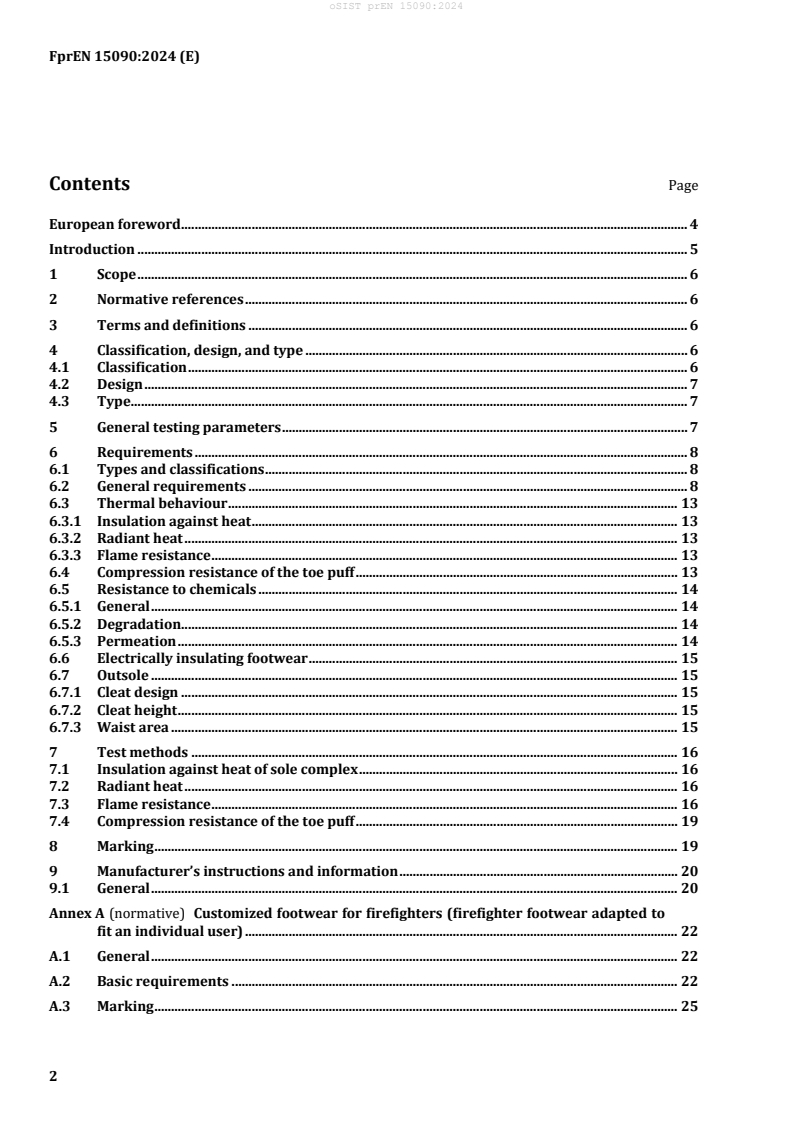
Contents Page
European foreword . 4
Introduction . 5
1 Scope . 6
2 Normative references . 6
3 Terms and definitions . 6
4 Classification, design, and type . 6
4.1 Classification . 6
4.2 Design . 7
4.3 Type . 7
5 General testing parameters . 7
6 Requirements . 8
6.1 Types and classifications . 8
6.2 General requirements . 8
6.3 Thermal behaviour . 13
6.3.1 Insulation against heat . 13
6.3.2 Radiant heat . 13
6.3.3 Flame resistance . 13
6.4 Compression resistance of the toe puff . 13
6.5 Resistance to chemicals . 14
6.5.1 General . 14
6.5.2 Degradation . 14
6.5.3 Permeation . 14
6.6 Electrically insulating footwear . 15
6.7 Outsole . 15
6.7.1 Cleat design . 15
6.7.2 Cleat height . 15
6.7.3 Waist area . 15
7 Test methods . 16
7.1 Insulation against heat of sole complex . 16
7.2 Radiant heat . 16
7.3 Flame resistance . 16
7.4 Compression resistance of the toe puff . 19
8 Marking . 19
9 Manufacturer’s instructions and information . 20
9.1 General . 20
Annex A (normative) Customized footwear for firefighters (firefighter footwear adapted to
fit an individual user) . 22
A.1 General . 22
A.2 Basic requirements . 22
A.3 Marking . 25
FprEN 15090:2024 (E)
A.4 Manufacturer’s instructions and information . 25
Annex B (informative) Example of guidelines and considerations for performing a risk
assessment . 26
B.1 General . 26
B.2 General approach for conducting a risk assessment . 26
B.3 Recommended factors for identifying and evaluating fire fighter risks . 27
B.4 Description of the Types of footwear for firefighters . 29
Annex C (normative) Assessment of the footwear by the laboratory during testing of
thermal behaviour . 30
C.1 General . 30
C.2 Criteria for the assessment of the state of footwear . 30
Annex D (informative) Assessment of the footwear by the wearer . 32
D.1 General . 32
D.2 Criteria for the assessment of the state of footwear . 32
Annex E (informative) Contamination during use . 34
E.1 General . 34
E.2 Contamination . 34
E.3 Cleaning . 34
E.4 Other actions to reduce human exposure . 34
Annex ZA (informative) Relationship between this European Standard and the essential
requirements of Regulation (EU) 2016/425 aimed to be covered . 36
Bibliography . 39
FprEN 15090:2024 (E)
European foreword
This document (prEN 15090:2024) has been prepared by Technical Committee CEN/TC 161 “Foot and
leg protectors”, the secretariat of which is held by BSI.
This document is currently submitted to CEN Enquiry.
This document will supersede EN 15090:2012.
a) General testing parameters revised, Clause 5;
b) Table 4 revised: requirements re-ordered, innocuousness reference added,
insole/insocks/footbeds/seat socks reference changed to Table 3 of EN ISO 20345:2022;
c) Table 5 insole/insocks/footbeds/seat socks deleted;
d) Tolerances added, new Table 5;
e) Chemical resistance, Table 8 revised;
f) Outsole requirements revised, Clause 6.7 and Figure 1;
g) Radiant heat revised, Clause 7.2;
h) Flame resistance revised, Clause 7.3;
i) Marking revised, Clause 8;
j) Manufacturer’s instruction and information revised, Clause 9;
k) Annex A (normative) Customized footwear for firefighters added.
This document has been prepared under a standardization request addressed to CEN by the European
Commission. The Standing Committee of the EFTA States subsequently approves these requests for its
Member States.
For the relationship with EU Legislation, see informative Annex ZA, which is an integral part of this
document.
FprEN 15090:2024 (E)
Introduction
The purpose of this document is to provide minimum performance requirements and test methods for
footwear for firefighters which is intended for use for firefighting and associated activities. A risk
assessment should be used to determine whether the footwear covered by this document is suitable for
the intended use for the expected exposure. Firefighters should be trained in the use, care and
maintenance of the footwear covered by this document, including an understanding of its limitations.
FprEN 15090:2024 (E)
1 Scope
This document specifies minimum requirements and test methods for the performance of three types
(see 4.3) of footwear for use by firefighters for fire suppression, general-purpose rescue, fire rescue and
hazardous materials emergencies. It also specifies requirements for footwear for firefighters equipped
with customized insocks and customized footwear for firefighters. This document does not cover the
property of high visibility because of interaction with the clothing (e.g. trousers cover the footwear and
vice versa) and work area conditions (e.g. dirt, mud).
Special risks are covered by complementary job-related standards (e.g. electrically insulating footwear,
protection against chain saw injuries, protection against molten metal splash).
2 Normative references
The following documents are referred to in the text in such a way that some or all of their content
constitutes requirements of this document. For dated references, only the edition cited applies. For
undated references, the latest edition of the referenced document (including any amendments) applies.
prEN 13832-1:2024, Footwear protecting against chemicals — Part 1: Terminology and test methods
prEN 13832-3:2024, Footwear protecting against chemicals — Part 3: Requirements for prolonged
contact with chemicals
EN 50321-1:2018, Live working — Footwear for electrical protection — Insulating footwear and
overboots
EN ISO 6942:2022, Protective clothing — Protection against heat and fire — Method of test: Evaluation of
materials and material assemblies when exposed to a source of radiant heat (ISO 6942:2022)
EN ISO 15025:2016, Protective clothing — Protection against flame — Method of test for limited flame
spread (ISO 15025:2016)
EN ISO 20344:2021, Personal protective equipment — Test methods for footwear (ISO 20344:2021)
EN ISO 20345:2022, Personal protective equipment — Safety footwear (ISO 20345:2021)
3 Terms and definitions
For the purposes of this document, the terms and definitions given in EN ISO 20345:2022 apply.
ISO and IEC maintain terminology databases for use in standardization at the following addresses:
— ISO Online browsing platform: available at https://www.iso.org/obp
— IEC Electropedia: available at https://www.electropedia.org/
4 Classification, design, and type
4.1 Classification
Footwear for firefighters shall be classified in accordance with Table 1.
As impacted by EN ISO 20344:2021/A1:2024.
As impacted by EN ISO 20345:2022/A1:2024.
FprEN 15090:2024 (E)
Table 1 — Classification of footwear
Classification Description
Footwear made from leather and other
Class I materials, excluding all-rubber or all-
polymeric footwear
All-polymeric (i.e. entirely moulded) including
Class II
all-rubber (i.e. entirely vulcanized) footwear
4.2 Design
Footwear for firefighters shall conform to one of the designs B to E of Figure 4 of EN ISO 20345:2022
depending on their type (see Table 4 of this document).
4.3 Type
A distinction is made between three types of firefighter footwear featuring the following main
differences:
— Type 1: Outdoor and rescue interventions;
— Type 2: All fire suppression including wildland firefighting; with protection against perforation and
toe protection;
— Type 3: All fire suppression including wildland firefighting ; with protection against perforation, toe
protection, and protection against chemical hazards.
5 General testing parameters
The requirements of Table 2 of this document and EN ISO 20344:2021, Clause 4 apply.
Table 2 — Minimum number of samples and test pieces
Number of test
Property to be Clause of this Number of Test only on the
pieces from each
determined document samples final footwear
sample
Insulation against 2 samples in
6.3.1 see 7.1 Yes
heat different sizes
Radiant heat 6.3.2 1 pair See 7.2 No
Flame resistance 6.3.3 1 pair See 7.3 Yes
Compression
1 pair from each
resistance of 6.4 1 pair Yes
of three sizes
footwear toe puff
Zipper puller
attachment 6.8.2 3 zippers See 7.5.1.3 No
strength
Zipper lateral
6.8.3 3 zippers See 7.5.2.4 No
strength
FprEN 15090:2024 (E)
6 Requirements
6.1 Types and classifications
The permitted combinations of types of footwear for firefighters (see 4.3) and classes I and II (see 4.1)
shall be as given in Table 3. As specified in 4.2, design A shall not be used.
Table 3 — Relationship between types of footwear and classes of Table 1
Types of
Class I Class II
footwear
1 Possible Possible
2 Possible Possible
3 Not possible Possible
NOTE Type 3 footwear for firefighters are suitable for use with chemical protective clothing in accordance
with EN 943-2:2019 [7], where appropriate.
6.2 General requirements
Footwear for firefighters shall conform to the requirements specified in Table 4. Footwear for
firefighter’s equipped with customized insocks shall fulfil in addition the requirements of Annex A of
this document.
FprEN 15090:2024 (E)
Table 4 — General requirements
Reference Type 1 Type 2 Type 3 Marking symbol
Requirements Class Class Class
EN ISO 20345:2022 EN 15090:20xx
I II I II II
Whole footwear
General
Type and classifications 4.1 and 4.3 X X X X X
Specific ergonomic features 5.3.4 X X X X X
Leak proofness 5.3.3 X X X
Water resistance 6.2.5 X X
a
Slip resistance “Not tested “ ceramic tile ⌀ No additional
5.3.5 X X X X X
a
floor with NaLS marking
Slip resistance ceramic tile floor with
6.2.10.1 * * * * * SR
glycerine
Innocuousness 5.3.6 X X X X X
Energy absorption of seat region 6.2.4 X X X X X
Metatarsal protection 6.2.6 * * * * * M
Ankle protection 6.2.7 * * * * * AN
Cut resistance 6.2.8 * * * * * CR
Scuff cap 6.2.9 * * * * * SC
Design
Design B Figure 4 of EN ISO 20345:2022 5.2.2 X X
Design C or D Figure 4 of
5.2.2 X X X X X
EN ISO 20345:2022
Design E Figure 4 of EN ISO 20345:2022 5.2.2 X X
Height of upper 5.2.1 X X X X X
Constructional performance
Construction 5.3.1.1 X X
FprEN 15090:2024 (E)
Reference Type 1 Type 2 Type 3 Marking symbol
Requirements Class Class Class
EN ISO 20345:2022 EN 15090:20xx
I II I II II
Upper/outsole bond strength 5.3.1.2 X X
Perforation resistance
Perforation resistance (metal insert type
b
P)
P
Perforation resistance (non-metal insert)
6.2.1 O O X X X PL
b
Type PL
PS
b
Type PS
Toe protection
General 5.3.2.1 O O X X X
Internal length of toe caps 5.3.2.2 O O X X X
Width of toe cap flange 5.3.2.3 O O X X X
Corrosion resistance of metallic toe caps 5.3.2.4 O O X X X
T (only for type 1)
Behaviour of toe caps (thermal and
5.3.2.5. O O X X X
chemical)
Impact resistance 5.3.2.6 O O X X X
Compression resistance 5.3.2.7 O O X X X
Compression resistance of toe puff 6.4 O O R (only for Type 1)
Electrical properties
See
a
Electrically insulating footwear 6.6.
EN 50321-1:2018
X X X X X
a
Antistatic footwear 6.2.2.2 A
Thermal behaviour
At least At least At least At least At least
Insulation against heat 6.3.1 HI , HI or HI
1 2 3
HI HI HI HI HI
1 1 2 2 2
Radiant heat 6.3.2 X X X X X
FprEN 15090:2024 (E)
Reference Type 1 Type 2 Type 3 Marking symbol
Requirements Class Class Class
EN ISO 20345:2022 EN 15090:20xx
I II I II II
Flame resistance 6.3.3 X X X X X
Resistance to imicial environment
Insulation against cold of sole complex 6.2.3.2 * * * * * Cl
Resistance to chemicals 6.5 * * X CH
Upper Thickness 5.4.2 X X X
Tear strength 5.4.3 X X
Tensile properties 5.4.4 X X X X X
Flexing resistance 5.4.5 X X X
Water vapour permeability and
5.4.6 X X
coefficient
Hydrolysis 5.4.7 X X X
Water penetration and water absorption 6.3.1 X X
Lining Vamp Tear strength 5.5.2 X X
Abrasion resistance 5.5.3 X X
Water vapour permeability and
5.5.4 X X
coefficient
Quarter Tear strength 5.5.2 O O
Abrasion resistance 5.5.3 O O
Water vapour permeability and
5.5.4 O O
coefficient
Tongue Tear strength 5.6.2 O O
Insole/insocks/footbeds/seat
Table 3 X O X O O
socks
FprEN 15090:2024 (E)
Reference Type 1 Type 2 Type 3 Marking symbol
Requirements Class Class Class
EN ISO 20345:2022 EN 15090:20xx
I II I II II
Outsole Thickness 5.8.2.1 X X X X X
Cleated area 5.8.2.2 X X X X X
Cleat design 6.7.1 X X X X X
Cleat height 6.7.2 X X X X X
Waist area 6.7.3 X X X X X
Tear strength 5.8.3 X X X X X
Abrasion resistance 5.8.4 X X X X X
Flexing resistance 5.8.5 X X X X X
Hydrolysis 5.8.6 X X X X X
Interlayer bond strength 5.8.7 O O O O O
Resistance to fuel oil 6.4.2 X X X X X
Resistance to hot contacts 6.4.1 X X X X X
The applicability of a requirement to a particular classification is indicated in the table by the following:
X means that the requirement shall be met. In some cases, the requirement relates only to single materials within the classification. This does not mean that other materials are
precluded from use.
O means that, if the component parts exist, the requirement shall be met:
* means that, if the property is claimed, the requirement given in the appropriate clause shall be met.
a
means that one of the two requirements shall be chosen.
b
means that one only of the three properties is possible.
The absence of X or O means that this requirement is not applicable.
FprEN 15090:2024 (E)
6.3 Thermal behaviour
6.3.1 Insulation against heat
When tested in accordance with the method described in 7.1 the footwear shall meet at least one of the
levels specified in Table 5.
After the test duration specified in Table 6, the footwear shall conform to C.2.1.
Table 5 — Insulation against heat: Requirements for the temperature rise inside the footwear
HI HI
Level of performance HI1 2 3
T (°C) 150 ± 5 250 ± 5 250 ± 5
hp
Temperature rise inside
≤ 22 after (30 ± 1) min ≤ 22 after (10 ± 0,5) min
the footwear (°C)
Table 6 — Insulation against heat: Test duration for footwear degradation
Level of performance HI HI HI
1 2 3
T (°C) 150 ± 5 250 ± 5 250 ± 5
hp
Total duration of the test
30 ± 1 20 ± 1 40 ± 1
(min)
6.3.2 Radiant heat
When tested in accordance with the method described in 7.2, the temperature increase for each
material combination (final temperature T minus initial temperature T) shall be equal or less than
f i
24 °C. The result is the highest single value of ΔT rounded to 0,1 °C.
After testing, the footwear shall also conform to C.2.2.
6.3.3 Flame resistance
When tested in accordance with the method described in 7.3, the footwear shall neither flame for more
than 2 s (after-flame time) nor glow more than 2 s (after-glow time).
After testing, the footwear shall also conform to C.2.3.
6.4 Compression resistance of the toe puff
When Type 1 footwear is tested in accordance with the method described in 7.4, the clearance under
the toe puff at a compression load of (500 + 10) N shall be not less than the appropriate value given in
Table 7.
FprEN 15090:2024 (E)
Table 7 — Minimum clearance under the toe puff at compression
Size of footwear
Minimum internal clearance
mm
Paris points English
36 and below 3 and below 12,5
37 and 38 4 and 5 13,0
39 and 40 6 13,5
41 and 42 7 and 8 14,0
43 and 44 9 and 10 14,5
45 and above 11 and above 15,0
6.5 Resistance to chemicals
6.5.1 General
For the test of firefighter footwear highly resistant to degradation and permeation of chemicals at least
three of the chemicals given in prEN 13832-3:2024, 6.2.1 Table 4 using the same chemicals for both
tests. Other chemicals shall be used additionally, if claimed by the manufacturer.
6.5.2 Degradation
The outsole and upper of firefighter footwear of class II shall be tested according to
prEN 13832-3:2024, 6.2.1.2. with the following deviations according to Table 8 of this document:
Table 8 — Tests and requirements for basic properties
Outsole Upper
Tear strength Hardness
Tensile strength EN ISO 20344:2021, 6.4
EN ISO 20344:2021, 8.2 EN ISO 868:2003
Applicable for upper
Not applicable for
material prepared
Applicable for all type of outsole material prepared upper material with
according to
according to prEN 13832-1:2024, 4.3.3.2 a non-removable
prEN 13832-1:2024,
lining.
4.3.3.1
— Greater or equal to
6,4 kN/m for material
with a density
At least: 30 shore A With a removable
of ≥ 0,9 g/cm
At most: (value At least 80 % of value lining: At least 80 %
before degradation + before degradation of value before
— Greater or equal to
10) shore A degradation
4,0 kN/m for material
with a density
of ≤ 0,9 g/cm
6.5.3 Permeation
The outsole and upper of firefighter footwear shall be tested according to prEN 13832-3:2024, 6.2.1.3.
The minimum performance level 1 shall be fulfilled.
FprEN 15090:2024 (E)
6.6 Electrically insulating footwear
Electrically insulating footwear for firefighters class II shall fully comply with EN 50321-1:2018:
6.7 Outsole
6.7.1 Cleat design
With exception of the region under the flange of the toe cap or toe puff, at least the shaded area as
shown in Figure 36 of EN ISO 20344:2021, 8.2.2 shall have cleats. The cleat design of the outsole
(excluding waist area) shall be such that there are no continuous linear transverse valleys across the
outsole.
6.7.2 Cleat height
When tested in accordance with EN ISO 20344:2021, 8.1, the cleat height d shall be not less than 3 mm.
6.7.3 Waist area
The cleat height ‘d’ in the waist area shall be at least 1,5 mm, see Figure 1.
The outsole shall have an inclined breast heel (see Figure 1) with the following dimensions:
— ‘a’ length of waist area at least 35 mm;
— angle α between 90° and 120° and
— ‘b’ heel breast height at least 10 mm.
Key
a Length of waist area
b Heel breast height
α angle of the heel breast
d Cleat height in the waist area
Figure 1 — Example of outsole dimensions
FprEN 15090:2024 (E)
7 Test methods
7.1 Insulation against heat of sole complex
Two test samples in different sizes shall be tested according to the procedure described in
EN ISO 20344:2021, 5.15.
7.2 Radiant heat
Two test pieces shall be tested from all different material combinations including seams, label, and any
closing mechanism. Take the samples from the upper of at least one pair of footwear. If it is not possible
to obtain a large enough test piece from the footwear, then a sample of the material from which the
component has been manufactured may be used instead and this should be noted in the report. This
test piece shall include the same arrangement of layers, e.g. padding and lining, as found in the
footwear.
Test the test pieces according to EN ISO 6942:2022, method B with the following deviation:
— heat flux density of 20 kW/m ;
— the outer surface shall be exposed to radiant heat for 40 s.
7.3 Flame resistance
All different external materials, including external seams, label and closing mechanism, shall be tested.
Test the test pieces according to EN ISO 15025:2016, Method B with the following deviation:
— Test the complete footwear as provided.
— A simple clamp commonly used for holding test tubes on a metal stand or a sample carrier can be
used to hold the footwear.
— The sample carrier has a square flame application aperture size of [(50 × 50) ± 1] mm.
— The angle between the sample area to be tested and the horizontal plane is (45 ± 5)° (see Figure 2).
— Clamp the part of the footwear to be tested so that the minimum distance from the top of the
burner to the footwear surface is (17 ± 1) mm (see Figure 2 and Figure 3). The flame shall strike the
footwear in an upward direction (see Figure 3).
FprEN 15090:2024 (E)
All dimension in millimetres
a) Plan view — sample carrier
b) Before the test (test setup)
c) During the test
Key
1 Burner
2 Sample carrier
3 Footwear being tested
4 Flame application aperture
Figure 2 — Example of equipment for flame resistance tests
FprEN 15090:2024 (E)
a) Outsole
b) Outsole/upper connection
c) collar
d) Closing mechanism
FprEN 15090:2024 (E)
e) seams
Figure 3 — Examples of flame direction
7.4 Compression resistance of the toe puff
Test in accordance with the method described in EN ISO 20344:2021, 5.5 with the following deviation:
compress with a load of 500 N.
8 Marking
Each item of footwear for firefighters shall be clearly and permanently marked, for example by
embossing or branding, with the following:
a) size;
b) manufacturer’s name and postal address;
c) manufacturer’s type designation;
d) at least year and month of footwear manufacture;
e) number and year of this document, i.e. EN 15090:202x;
f) marking symbol(s) from Table 4 appropriate to the protection provided ;
g) graphical symbol shown in Figure 5, at a size of at least 30 mm × 30 mm, attached in a visible
position on the outside of the footwear (left and right); one of the symbols given in Table 9 shall be
marked in the bottom right-hand corner of the pictogram.
Figure 5 — Example of graphical symbol 2418 of ISO 7000:2004 [6] for Type 1 [6]
FprEN 15090:2024 (E)
Table 9 — Marking symbols
a
Footwear type Symbol Properties signified
1 F1 All normative requirements of Table 4
2 F2 All normative requirements of Table 4
3 F3 All normative requirements of Table 4
a
The normative requirements of Table 4 are those signified by ‘(X)’.
9 Manufacturer’s instructions and information
9.1 General
Footwear for firefighters shall be supplied to the end user with at least the following unambiguous
information:
a) Name and full address of the manufacturer;
b) Reference to this document, i.e. EN 15090:202x;
c) explanation of any graphic symbols, markings and levels of perfor
...
Questions, Comments and Discussion
Ask us and Technical Secretary will try to provide an answer. You can facilitate discussion about the standard in here.
Loading comments...