


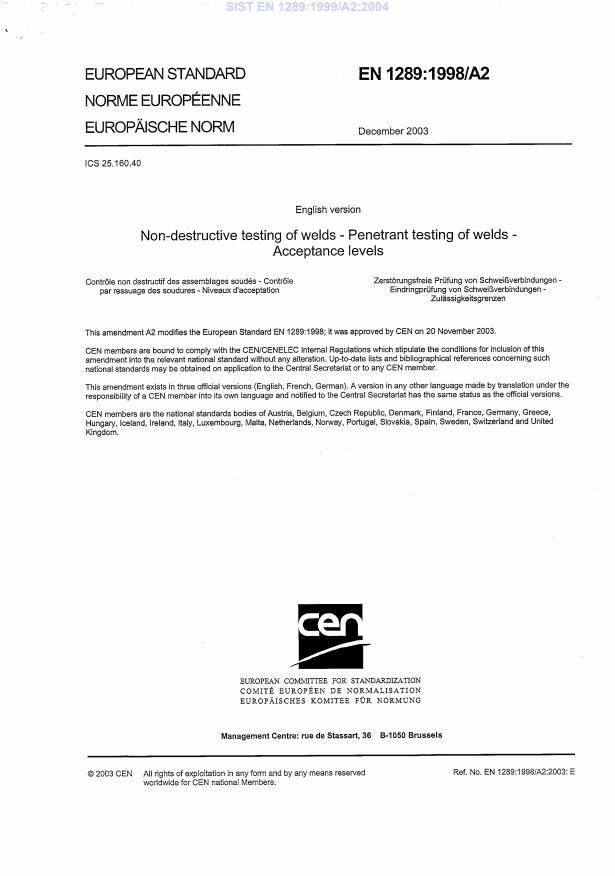
EN 1289:1998/A2:2003
(Amendment)Non-destructive testing of welds - Penetrant testing of welds - Acceptance levels
Non-destructive testing of welds - Penetrant testing of welds - Acceptance levels
This European Standard specifies acceptance levels for indications from surface breaking imperfections in metallic welds detected by penetrant testing. The acceptance levels are primarily intended for use during manufacture examination, but where appropriate they can be used for in service inspection. The acceptance levels in this standard are based on detection capabilities that can be expected when using techniques specified in EN 571-1 and parameters recommended in Annex A. The acceptance levels can be related to welding standards, application standards, specifications or codes. Such a relationship is shown in EN 12062 for EN 25817 and EN 30042.
Zerstörungsfreie Prüfung von Schweißverbindungen - Eindringprüfung von Schweißverbindungen - Zulässigkeitsgrenzen
Diese Norm legt Zulässigkeitsgrenzen für Oberflächenunregelmäßigkeiten in metallischen Schweißverbindungen fest, die mit der Eindringprüfung nachgewiesen werden. Die Zulässigkeitsgrenzen sind hauptsächlich für die Anwendung während der Herstellung vorgesehen, können aber auch bei der Betriebsprüfung angewendet werden, wenn es angemessen ist. Die Zulässigkeitsgrenzen in dieser Norm beruhen auf der Auffindbarkeit, die erwartet werden kann, wenn die Techniken nach EN 571-1 und die im Anhang A empfohlenen Prüfparameter verwendet werden.
Contrôle non destructif des assemblages soudés - Contrôle par ressuage des soudures - Niveaux d'acceptation
La présente norme européenne spécifie les niveaux d'acceptation pour les indications des défauts débouchants observés sur des soudures sur matériaux métalliques lors du contrôle par ressuage. Les niveaux d'acceptation sont essentiellement destinés à être utilisés pour le contrôle de fabrication, mais, le cas échéant, ils peuvent également servir pour le contrôle en service. Les niveaux d'acceptation indiqués dans la présente norme sont basés sur les capacités de détection inhérentes aux techniques décrites dans l'EN 571-1 et les paramètres recommandés dans l'annexe A.
Neporušitvena preiskava zvarov - Preskušanje zvarov s penetranti - Stopnje sprejemljivosti
General Information
- Status
- Withdrawn
- Publication Date
- 09-Dec-2003
- Withdrawal Date
- 10-Nov-2009
- Technical Committee
- CEN/TC 121 - Welding
- Drafting Committee
- CEN/TC 121/SC 5 - Testing of welds (destructive and non-destructive)
- Current Stage
- 9960 - Withdrawal effective - Withdrawal
- Start Date
- 11-Nov-2009
- Completion Date
- 11-Nov-2009
- Directive
- 97/23/EC - Pressure equipment
Relations
- Effective Date
- 14-Nov-2009
- Effective Date
- 09-Feb-2026
- Effective Date
- 28-Jan-2026
- Amends
EN 1289:1998 - Non-destructive examination of welds - Penetrant testing of welds - Acceptance levels - Effective Date
- 08-Jun-2022
Get Certified
Connect with accredited certification bodies for this standard

National Aerospace and Defense Contractors Accreditation Program (NADCAP)
Global cooperative program for special process quality in aerospace.
CARES (UK Certification Authority for Reinforcing Steels)
UK certification for reinforcing steels and construction.
DVS-ZERT GmbH
German welding certification society.
Sponsored listings
Frequently Asked Questions
EN 1289:1998/A2:2003 is a amendment published by the European Committee for Standardization (CEN). Its full title is "Non-destructive testing of welds - Penetrant testing of welds - Acceptance levels". This standard covers: This European Standard specifies acceptance levels for indications from surface breaking imperfections in metallic welds detected by penetrant testing. The acceptance levels are primarily intended for use during manufacture examination, but where appropriate they can be used for in service inspection. The acceptance levels in this standard are based on detection capabilities that can be expected when using techniques specified in EN 571-1 and parameters recommended in Annex A. The acceptance levels can be related to welding standards, application standards, specifications or codes. Such a relationship is shown in EN 12062 for EN 25817 and EN 30042.
This European Standard specifies acceptance levels for indications from surface breaking imperfections in metallic welds detected by penetrant testing. The acceptance levels are primarily intended for use during manufacture examination, but where appropriate they can be used for in service inspection. The acceptance levels in this standard are based on detection capabilities that can be expected when using techniques specified in EN 571-1 and parameters recommended in Annex A. The acceptance levels can be related to welding standards, application standards, specifications or codes. Such a relationship is shown in EN 12062 for EN 25817 and EN 30042.
EN 1289:1998/A2:2003 is classified under the following ICS (International Classification for Standards) categories: 25.160.40 - Welded joints and welds. The ICS classification helps identify the subject area and facilitates finding related standards.
EN 1289:1998/A2:2003 has the following relationships with other standards: It is inter standard links to EN ISO 23277:2009, EN 61400-4:2013, EN ISO 13691:2002, EN 1289:1998. Understanding these relationships helps ensure you are using the most current and applicable version of the standard.
EN 1289:1998/A2:2003 is associated with the following European legislation: EU Directives/Regulations: 97/23/EC; Standardization Mandates: M/071. When a standard is cited in the Official Journal of the European Union, products manufactured in conformity with it benefit from a presumption of conformity with the essential requirements of the corresponding EU directive or regulation.
EN 1289:1998/A2:2003 is available in PDF format for immediate download after purchase. The document can be added to your cart and obtained through the secure checkout process. Digital delivery ensures instant access to the complete standard document.
Standards Content (Sample)
SLOVENSKI STANDARD
01-junij-2004
Neporušitvena preiskava zvarov - Preskušanje zvarov s penetranti - Stopnje
sprejemljivosti
Non-destructive testing of welds - Penetrant testing of welds - Acceptance levels
Zerstörungsfreie Prüfung von Schweißverbindungen - Eindringprüfung von
Schweißverbindungen - Zulässigkeitsgrenzen
Contrôle non destructif des assemblages soudés - Contrôle par ressuage des soudures -
Niveaux d'acceptation
Ta slovenski standard je istoveten z: EN 1289:1998/A2:2003
ICS:
25.160.40 Varjeni spoji in vari Welded joints
...
Questions, Comments and Discussion
Ask us and Technical Secretary will try to provide an answer. You can facilitate discussion about the standard in here.
Loading comments...