

EN 14225-1:2005
(Main)Diving suits - Part 1: Wet suits - Requirements and test methods
- Abstract
This document specifies the construction and performance requirements (including thermal) of wet suits for wear by divers for underwater activities where the user is breathing underwater. Marking, labelling, information to be provided at the point of sale, and instructions for use are also specified.
Laboratory and practical performance tests are specified.
Short sleeve jackets, short-leg trousers, under and over-garments, and separate accessories such as gloves, hoods and boots are not within the scope of this document.
- Status
- Withdrawn
- Publication Date
- 29-Mar-2005
- Withdrawal Date
- 06-Oct-2026
- Technical Committee
- CEN/TC 162 - Protective clothing including hand and arm protection and lifejackets
- Drafting Committee
- CEN/TC 162/WG 12 - Diving suits
- Current Stage
- 9960 - Withdrawal effective - Withdrawal
- Start Date
- 06-Dec-2017
- Completion Date
- 07-Oct-2026
89/686/EEC - Personal protective equipment (PPE)OJ Ref: C 247, C 3, C 306, C 91 OJ Date: 06-Oct-2005

Relations
- Effective Date
- 02-Oct-2010
- Effective Date
- 28-Jan-2026
- Effective Date
- 28-Jan-2026
- Effective Date
- 28-Jan-2026
- Effective Date
- 28-Jan-2026
- Effective Date
- 28-Jan-2026
Frequently Asked Questions
EN 14225-1:2005 is a standard published by the European Committee for Standardization (CEN). Its full title is "Diving suits - Part 1: Wet suits - Requirements and test methods". This standard covers: This document specifies the construction and performance requirements (including thermal) of wet suits for wear by divers for underwater activities where the user is breathing underwater. Marking, labelling, information to be provided at the point of sale, and instructions for use are also specified. Laboratory and practical performance tests are specified. Short sleeve jackets, short-leg trousers, under and over-garments, and separate accessories such as gloves, hoods and boots are not within the scope of this document.
This document specifies the construction and performance requirements (including thermal) of wet suits for wear by divers for underwater activities where the user is breathing underwater. Marking, labelling, information to be provided at the point of sale, and instructions for use are also specified. Laboratory and practical performance tests are specified. Short sleeve jackets, short-leg trousers, under and over-garments, and separate accessories such as gloves, hoods and boots are not within the scope of this document.
EN 14225-1:2005 is classified under the following ICS (International Classification for Standards) categories: 97.220.40 - Outdoor and water sports equipment. The ICS classification helps identify the subject area and facilitates finding related standards.
EN 14225-1:2005 has the following relationships with other standards: It is inter standard links to EN 14225-1:2017, EN ISO 13688:2013, EN 250:2014, EN ISO 3758:2023, EN 1809:1997, EN 14225-2:2005. Understanding these relationships helps ensure you are using the most current and applicable version of the standard.
EN 14225-1:2005 is associated with the following European legislation: EU Directives/Regulations: 2016/425, 89/686/EEC, 93/68/EEC, 93/95/EEC, 96/58/EC; Standardization Mandates: M/031. When a standard is cited in the Official Journal of the European Union, products manufactured in conformity with it benefit from a presumption of conformity with the essential requirements of the corresponding EU directive or regulation.
EN 14225-1:2005 is available in PDF format for immediate download after purchase. The document can be added to your cart and obtained through the secure checkout process. Digital delivery ensures instant access to the complete standard document.
Standards Content (Sample)
2003-01.Slovenski inštitut za standardizacijo. Razmnoževanje celote ali delov tega standarda ni dovoljeno.Diving suits - Part 1: Wet suits - Requirements and test methodsPotapljaške obleke – 1. del: Mokre obleke – Zahteve in preskusne metodeVetements de plongée - Combinaisons isothermes - Partie 1:
Exigences et méthodes d'essaiTauchanzüge - Teil 1: Nasstauchanzüge - Anforderungen und Prüfverfahren97.220.40Oprema za športe na prostem in vodne športeOutdoor and water sports equipmentICS:SIST EN 14225-1:2005enTa slovenski standard je istoveten z:EN 14225-1:200501-julij-2005SIST EN 14225-1:2005SLOVENSKI
STANDARD
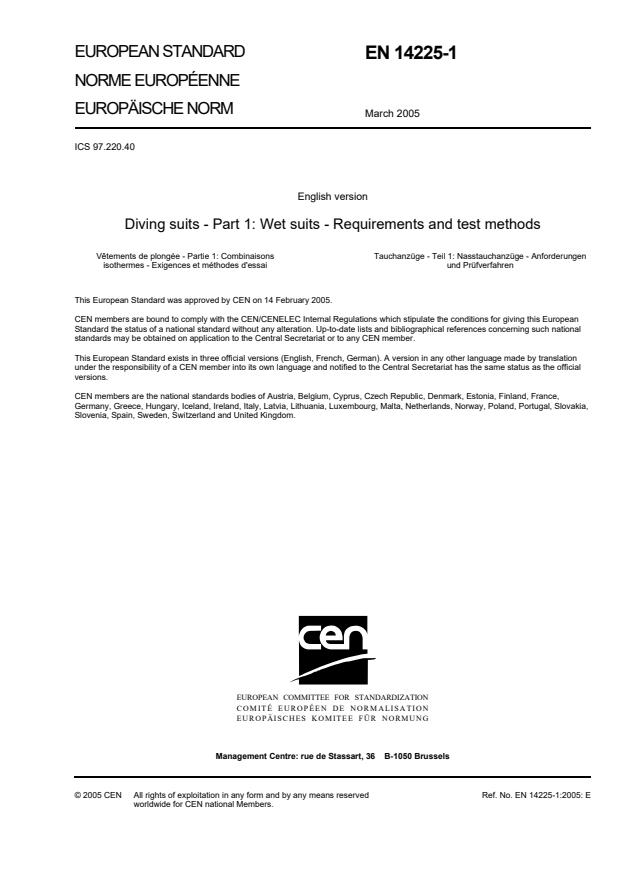
EUROPEAN STANDARDNORME EUROPÉENNEEUROPÄISCHE NORMEN 14225-1March 2005ICS 97.220.40English versionDiving suits - Part 1: Wet suits - Requirements and test methodsVêtements de plongée - Partie 1: Combinaisonsisothermes - Exigences et méthodes d'essaiTauchanzüge - Teil 1: Nasstauchanzüge - Anforderungenund PrüfverfahrenThis European Standard was approved by CEN on 14 February 2005.CEN members are bound to comply with the CEN/CENELEC Internal Regulations which stipulate the conditions for giving this EuropeanStandard the status of a national standard without any alteration. Up-to-date lists and bibliographical references concerning such nationalstandards may be obtained on application to the Central Secretariat or to any CEN member.This European Standard exists in three official versions (English, French, German). A version in any other language made by translationunder the responsibility of a CEN member into its own language and notified to the Central Secretariat has the same status as the officialversions.CEN members are the national standards bodies of Austria, Belgium, Cyprus, Czech Republic, Denmark, Estonia, Finland, France,Germany, Greece, Hungary, Iceland, Ireland, Italy, Latvia, Lithuania, Luxembourg, Malta, Netherlands, Norway, Poland, Portugal, Slovakia,Slovenia, Spain, Sweden, Switzerland and United Kingdom.EUROPEAN COMMITTEE FOR STANDARDIZATIONCOMITÉ EUROPÉEN DE NORMALISATIONEUROPÄISCHES KOMITEE FÜR NORMUNGManagement Centre: rue de Stassart, 36
B-1050 Brussels© 2005 CENAll rights of exploitation in any form and by any means reservedworldwide for CEN national Members.Ref. No. EN 14225-1:2005: E
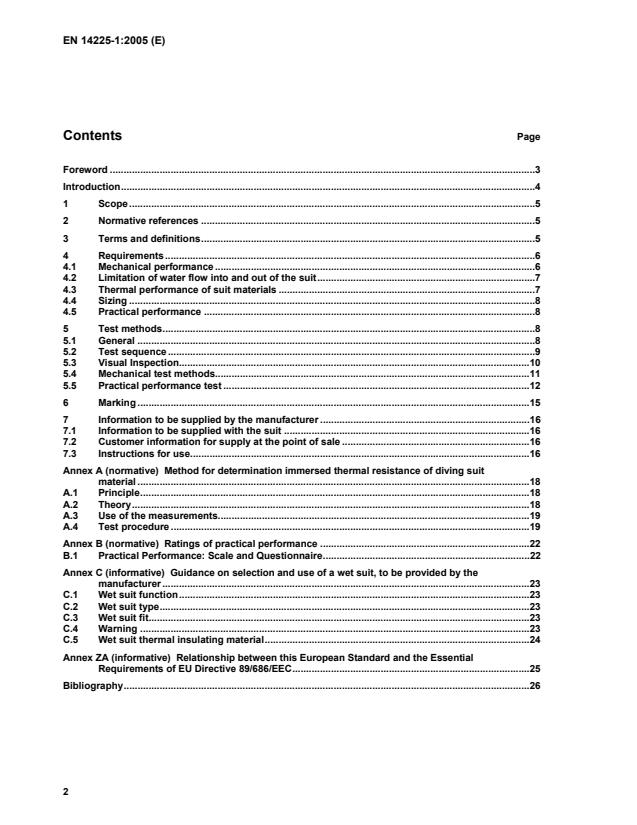
Method for determination immersed thermal resistance of diving suit material.18 A.1 Principle.18 A.2 Theory.18 A.3 Use of the measurements.19 A.4 Test procedure.19 Annex B (normative)
Ratings of practical performance.22 B.1 Practical Performance: Scale and Questionnaire.22 Annex C (informative)
Guidance on selection and use of a wet suit, to be provided by the manufacturer.23 C.1 Wet suit function.23 C.2 Wet suit type.23 C.3 Wet suit fit.23 C.4 Warning.23 C.5 Wet suit thermal insulating material.24 Annex ZA (informative)
Relationship between this European Standard and the Essential Requirements of EU Directive 89/686/EEC.25 Bibliography.26
4.1.3 Resistance to cleaning, disinfection and decontamination The suit, complete with all attachments and samples of suit materials and each suit material combination, shall be subjected to cleaning, disinfection and, where applicable, to decontamination, in accordance with 5.4.1.3 and shall then be visually inspected in accordance with 5.3. There shall be no visible signs of damage or degradation. 4.1.4 Resistance to repeated pressurization in water When tested in accordance with 5.4.2, the thermal insulating material used in the construction of the suit shall not loose more than 5 % of its original thickness. 4.1.5 Tensile strength of material When samples of thermal insulating material that have been subjected to testing in accordance with 5.4.2 are tested in accordance with 5.4.4 the material shall withstand a tensile load of 150 N for 10 s without breaking. 4.1.6 Resistance to permanent deformation After the testing for tensile strength (5.4.4), the permanent elongation of the suit material, when measured in accordance with 5.4.7, shall be less than 5 % of the original length. 4.1.7 Strength of suit seams When tested in accordance with 5.4.5, each type of seam used to manufacture the suit shall withstand a tensile load of 100 N for 10 s without breaking. 4.1.8 Strength of closures When tested in accordance with 5.4.6, each type of closure (including touch and close fasteners and slide fasteners) shall withstand a tensile load of 100 N for 10 s without opening. 4.2 Limitation of water flow into and out of the suit 4.2.1 Seams All seams between thermal insulating material components of the suit shall be provided with means (e.g. glue, weld, tape) to prevent free flow of water through the seam when tested in accordance with 5.3 and 5.4.5. 4.2.2 Closures All closures, including touch and close fasteners and slide fasteners shall be provided with means of reducing the free flow of water through the closure, for example a flap that can be secured over the closure when tested in accordance with 5.3. 4.3 Thermal performance of suit materials The thermal insulating material used for the construction (see 4.1.4) of the suit shall be of one of the thermal performance classes specified in Table 1 when tested in accordance with 5.4.3.
resistance at 1 bar and 6 bar Thermal performance class Immersed thermal resistance at surface m2⋅ K⋅ W−1 Immersed thermal resistance at 6 bar m2⋅ K⋅ W−1 A ≥ 0,15 ≥ 0,03 B 0,10 − 0,149 ≥ 0,02 C 0,07 − 0,099 ≥ 0,01 D 0,05 − 0,069 ≥ 0,01 If materials with a different immersed thermal resistance are used for wrist, ankle and neck openings their surface shall not be larger than 20 % of the total of the suit surface. This will be allowed only as a seal or for comfort purpose. 4.4 Sizing The manufacturer shall use the sizing system specified in EN 340 or another sizing system. If the manufacturer uses a sizing system other than that specified in EN 340, the manufacturer shall state at least two body dimensions including at least the height and chest girth of the intended user. When the suit is donned by a test diver in accordance with 5.5.6.2 the size of the suit shall correspond to the size marked on it by the manufacturer. 4.5 Practical performance When tested in accordance with 5.5.6.2 it shall be possible for the suit to be donned and doffed with the assistance of no more than one person. When wet suits are subjected to practical performance tests in accordance with 5.5 the test divers shall be able to carry out all the procedures listed in 5.5.6.2 and 5.5.6.3 and not report a practical performance score of 5 or more (given in Annex B) for more than 3 of the separate test procedures and no score higher than 8 for any procedure. When tested in accordance with 5.5.6.2 the satisfactory surface condition of the suit in contact with the user shall be confirmed by showing no excessive irritation, abrasions or other skin injuries.
5 Test methods 5.1 General Samples of the material used in the manufacture of the wet suit, where applicable assembled in the same way as in the suit (e.g. in the case of seams), and at least three wet suits, including one of each size if applicable, shall be submitted for visual inspection (see 5.3) and testing. One suit shall undergo laboratory tests in accordance with 5.4.1.1, 5.4.1.2 and 5.4.1.3, the samples of material shall undergo laboratory tests in accordance with 5.4 and all three suits shall undergo practical performance tests under realistic conditions in accordance with 5.5.
0,1 m2. The tank in which the apparatus is immersed shall be at a uniform temperature between 10 °C and 15 °C and the difference between the water temperature within the apparatus and the external water temperature shall be between 25 °C and 30 °C. Each sample shall be tested at pressures of 1 bar absolute and 6 bar absolute.
...