

EN 13804:2013
(Main)Foodstuffs - Determination of elements and their chemical species - General considerations and specific requirements
- Abstract
This European Standard specifies performance criteria for the selection of methods of analysis of elements and their chemical species in foodstuffs and contains performance requirements and characteristics, guidelines for laboratory set-up, sample preparation and test reports.
- Status
- Published
- Publication Date
- 05-Mar-2013
- Withdrawal Date
- 29-Sep-2013
- Technical Committee
- CEN/TC 275 - Food analysis - Horizontal methods
- Drafting Committee
- CEN/TC 275/WG 10 - Trace elements (heavy metals)
- Current Stage
- 9093 - Decision to confirm - Review Enquiry
- Start Date
- 22-Aug-2024
- Completion Date
- 07-Oct-2026

Overview
EN 13804:2013 - Foodstuffs: Determination of elements and their chemical species - defines performance criteria and practical laboratory requirements for selecting and applying analytical methods to determine elements and their chemical species (speciation) in food. Published by CEN (CEN/TC 275, WG 10), this European Standard covers sample handling from receipt to reporting and updates the 2002 edition with clarified scope, sample‑prep guidance and revised performance requirements.
Keywords: EN 13804:2013, foodstuffs determination of elements, element speciation, trace elements analysis, CEN standard.
Key topics and technical requirements
- Scope and intent: Criteria to help analysts choose appropriate validated methods for elemental and species determination in food (Clause 1).
- Sample preparation (Clause 2):
- Analyse the edible part only; remove inedible parts (peel, shell, bones) and surface contamination by rinsing.
- Avoid extra processing (boiling, frying) unless required; homogenise to obtain representative test portions.
- Use only water in sample preparation unless otherwise required; use purified water where necessary.
- Cleaning: detergents + hot water; where needed follow with diluted nitric acid (~6% v/v) and purified water to minimise contamination.
- Equipment selection: prefer apparatus dedicated to trace element work; avoid stainless steel when analysing Cr, Mo, Ni, Fe; use titanium/ceramic/agate where appropriate.
- Storage for speciation (Clause 2.3.2):
- Control temperature, pH, light and storage time to preserve species integrity.
- Examples from the standard: Hg - store ≤ 4 °C in darkness; Sn (organotin) - avoid PVC, use borosilicate glass in the dark at ≤ 4 °C; Cr - use borosilicate/quartz and keep cold; Se - avoid PTFE, store at −20 °C or lower and control acidity; As - store cold and dark, avoid certain glassware that can contaminate arsenate.
- Specific requirements for trace element analysis (Clause 3) and performance requirements & characteristics (Clause 4): criteria for method selection, validation benchmarks and laboratory quality arrangements.
- Result interpretation and test reporting (Clauses 5–6): how to express results and what information to include in reports (e.g., prepared part, storage, methods used).
Practical applications and users
- Laboratories performing routine or official control of trace elements and species in food (regulatory, public health).
- Method developers and validators selecting or comparing analytical techniques (ICP-MS, GC‑MS, HPLC‑ICP‑MS, etc.).
- Food industry QA/QC teams, accreditation bodies and research groups needing standardized procedures for sample prep, storage and reporting.
- Useful for regulatory enforcement referencing EU limits (see related legislation).
Related standards and references
- Supersedes EN 13804:2002.
- References EU legislation for maximum levels and control procedures (e.g., Commission Reg. (EC) No 1881/2006 and Reg. (EC) No 333/2007) and Codex Alimentarius general principles for methods of analysis (CCMAS criteria approach).
EN 13804:2013 is a practical, harmonised guide for consistent, contamination‑aware determination of elements and chemical species in food - essential for reliable trace element analysis and defensible laboratory reporting.
Relations
- Effective Date
- 13-Mar-2013
- Effective Date
- 28-Jan-2026
- Effective Date
- 28-Jan-2026
- Effective Date
- 28-Jan-2026
- Effective Date
- 28-Jan-2026
- Effective Date
- 28-Jan-2026
- Effective Date
- 28-Jan-2026
- Effective Date
- 28-Jan-2026
- Effective Date
- 28-Jan-2026
- Effective Date
- 28-Jan-2026
- Effective Date
- 28-Jan-2026
- Effective Date
- 28-Jan-2026
- Effective Date
- 28-Jan-2026
- Effective Date
- 28-Jan-2026
- Effective Date
- 28-Jan-2026
Get Certified
Connect with accredited certification bodies for this standard

BSI Group
BSI (British Standards Institution) is the business standards company that helps organizations make excellence a habit.

Bureau Veritas
Bureau Veritas is a world leader in laboratory testing, inspection and certification services.

DNV
DNV is an independent assurance and risk management provider.
Sponsored listings
Frequently Asked Questions
EN 13804:2013 is a standard published by the European Committee for Standardization (CEN). Its full title is "Foodstuffs - Determination of elements and their chemical species - General considerations and specific requirements". This standard covers: This European Standard specifies performance criteria for the selection of methods of analysis of elements and their chemical species in foodstuffs and contains performance requirements and characteristics, guidelines for laboratory set-up, sample preparation and test reports.
This European Standard specifies performance criteria for the selection of methods of analysis of elements and their chemical species in foodstuffs and contains performance requirements and characteristics, guidelines for laboratory set-up, sample preparation and test reports.
EN 13804:2013 is classified under the following ICS (International Classification for Standards) categories: 67.050 - General methods of tests and analysis for food products. The ICS classification helps identify the subject area and facilitates finding related standards.
EN 13804:2013 has the following relationships with other standards: It is inter standard links to EN 13804:2002, EN 13806-2:2025, EN 14332:2004, EN 14546:2005, EN 13806-3:2025, EN ISO 13295:2007, CEN/TS 16731:2014, EN 17266:2019, EN 14627:2005, EN ISO 21671:2006, EN 17851:2023, EN 14082:2003, EN 13806:2002, EN 13806-1:2025, EN 14083:2003. Understanding these relationships helps ensure you are using the most current and applicable version of the standard.
EN 13804:2013 is available in PDF format for immediate download after purchase. The document can be added to your cart and obtained through the secure checkout process. Digital delivery ensures instant access to the complete standard document.
Standards Content (Sample)
2003-01.Slovenski inštitut za standardizacijo. Razmnoževanje celote ali delov tega standarda ni dovoljeno.Lebensmittel - Bestimmung von Elementen und ihren Verbindungen - Allgemeines und spezielle FestlegungenDosage des éléments et de leurs espèces chimiques - Considérations générales et exigences spécifiquesFoodstuffs - Determination of elements and their chemical species - General considerations and specific requirements67.050Splošne preskusne in analizne metode za živilske proizvodeGeneral methods of tests and analysis for food productsICS:Ta slovenski standard je istoveten z:EN 13804:2013SIST EN 13804:2013en,fr,de01-junij-2013SIST EN 13804:2013SLOVENSKI
STANDARDSIST EN 13804:20021DGRPHãþD
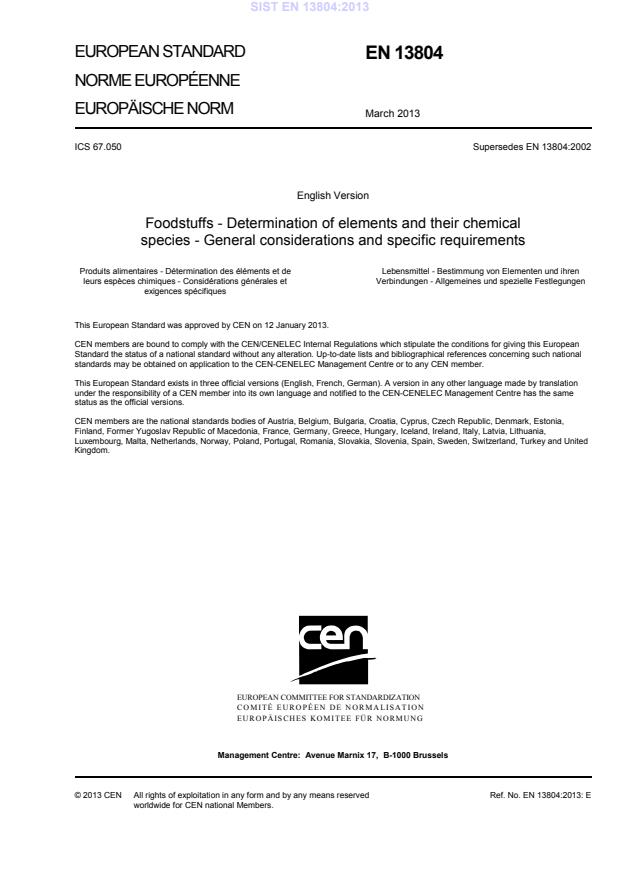
EUROPEAN STANDARD NORME EUROPÉENNE EUROPÄISCHE NORM
EN 13804
March 2013 ICS 67.050 Supersedes EN 13804:2002English Version
Foodstuffs - Determination of elements and their chemical species - General considerations and specific requirements
Produits alimentaires - Détermination des éléments et de leurs espèces chimiques - Considérations générales et exigences spécifiques
Lebensmittel - Bestimmung von Elementen und ihren Verbindungen - Allgemeines und spezielle Festlegungen This European Standard was approved by CEN on 12 January 2013.
CEN members are bound to comply with the CEN/CENELEC Internal Regulations which stipulate the conditions for giving this European Standard the status of a national standard without any alteration. Up-to-date lists and bibliographical references concerning such national standards may be obtained on application to the CEN-CENELEC Management Centre or to any CEN member.
This European Standard exists in three official versions (English, French, German). A version in any other language made by translation under the responsibility of a CEN member into its own language and notified to the CEN-CENELEC Management Centre has the same status as the official versions.
CEN members are the national standards bodies of Austria, Belgium, Bulgaria, Croatia, Cyprus, Czech Republic, Denmark, Estonia, Finland, Former Yugoslav Republic of Macedonia, France, Germany, Greece, Hungary, Iceland, Ireland, Italy, Latvia, Lithuania, Luxembourg, Malta, Netherlands, Norway, Poland, Portugal, Romania, Slovakia, Slovenia, Spain, Sweden, Switzerland, Turkey and United Kingdom.
EUROPEAN COMMITTEE FOR STANDARDIZATION
COMITÉ EUROPÉEN DE NORMALISATION EUROPÄISCHES KOMITEE FÜR NORMUNG
Management Centre:
Avenue Marnix 17,
B-1000 Brussels © 2013 CEN All rights of exploitation in any form and by any means reserved worldwide for CEN national Members. Ref. No. EN 13804:2013: ESIST EN 13804:2013
i) Former Subclause 7.1, "Reagents" was revised and introduced in 3.1; j) Former Clause 8, "Laboratory Quality standards" was completely revised and appears now as Clause 4, "Performance requirements and characteristics"; k) Former Clause 9, "Expression of results" was revised and appears now as Clause 5, "Interpretation and expression of results"; l) Former Clause 10, "Test report" was specified and appears now as Clause 6;
m) the Bibliographic references were completed; n) the whole document was editorially revised. According to the CEN/CENELEC Internal Regulations, the national standards organisations of the following countries are bound to implement this European Standard: Austria, Belgium, Bulgaria, Croatia, Cyprus, Czech Republic, Denmark, Estonia, Finland, Former Yugoslav Republic of Macedonia, France, Germany, Greece, Hungary, Iceland, Ireland, Italy, Latvia, Lithuania, Luxembourg, Malta, Netherlands, Norway, Poland, Portugal, Romania, Slovakia, Slovenia, Spain, Sweden, Switzerland, Turkey and the United Kingdom.
methylated compounds) Avoid the use of poly tetra fluoro ethylene containers [3]. Keep at -20 °C or lower to avoid any change of the inorganic species. Acid media (pH 1,5 to 2) avoid oxidation of Se (IV) to Se (VI). As (As (III), As (V), and organic As-species) Keep samples at 4 °C or lower, in darkness. Avoid the use of glassware as this may cause contamination with arsenate.
2.4 Procedures for sample preparation 2.4.1 General For some trace elements sampling preparation procedures are laid down in EU legislation. Commission Regulation (EC) No 1881/2006 [4] defines the foodstuffs to which the EU maximum levels apply. Further sample preparation methods for official control of the levels of these elements are laid down in Regulation (EC) No 333/2007 [5]. Other specific legislation may also apply to trace elements. Without prejudice to the specific provisions of EU legislation for official control, in food analysis only the edible part should be investigated and the results should refer to this part. Parts which are usually not intended for consumption should be removed, e.g. outer leaves, shell, skin and bones. Surface contamination like soil should be thoroughly removed by rinsing with drinking water or purified water. For preparation of the test portion a sufficient and representative amount should be available from the edible part of the laboratory sample. Please note that the edible part can differ between countries. The prepared and analysed part of the test portion has to be described in the test report (e.g. potatoes peeled or potatoes washed and unpeeled). Rinse samples with water before cutting to avoid leaching from cut surfaces. After rinsing with drinking water samples shall be rinsed with purified water. Excess water should be physically removed, e.g. by shaking, using a sieve or a strainer (e.g. for leafy vegetables). Removing excess water by wiping with a soft tissue paper can cause random sample contamination and should not be used for elemental trace analysis. The washing step can be omitted for samples designated as “ready to eat”. SIST EN 13804:2013
Sausages Remove non-edible parts, e.g. synthetic skin. Fresh Fish Rinse the fish with water. During cutting care should be taken not to damage the abdominal wall in order to avoid contamination of the muscle with the gut content Homogenise only the muscles, without skin and bones. Fish species which are normally intended for eating with bones and skin (scales), e.g. sardines, anchovies, sprats and whitebait, shall be homogenised whole. This shall be clearly noted in the analytical protocol. Canned fish Separate fish from the liquid phase of the product if possible. When the complete content of the can is intended for consumption, homogenise the entire content of the can. Crustacean and molluscan shellfish In crustaceans the visible digestive tract shall be removed prior to analysis. The edible part prepared from the laboratory sample should be free from remaining shell fragments or parts of exoskeleton. If the edible part of cephalopods is investigated, all parts of intestines (hepatopancreas) shall be quantitatively removed. For crabs only the muscle meat from appendages shall be used. Cereals The grain shall be separated from the chaff. If necessary the sample should be ground to a particle size low enough to obtain a homogenous portion for analysis. Legume, oil seeds, nuts Remove damaged or dirty parts. Remove shells from nuts. Legumes can be peeled if it is customary. Potatoes Remove sprouts and rinse with water to remove soil. Peel and wash with water. Leafy vegetables Remove dirty, withered, rotten and decaying parts and stalks, or wash if practical. Shoot vegetables Remove dirty, withered, rotten and decaying leaves. Remove stalks if they are not intended for eating. Rinse the sample. Samples where the peelings are not intended for eating (e.g. onions, kohlrabi) shall be peeled. Root vegetables Remove tops, tips, dirty and decaying parts and rinse with water. Samples where the peelings are not intended for eating (e.g. red beets) shall be scraped or peeled prior to rinsing. Processed vegetables No specific preparation is necessary. Products in liquid where the liquid is not intended for consumption should be drained, e.g. using a strainer. Products in liquid where the liquid is intended for consumption should be homogenised together with the liquid. Mushrooms Remove any rotten and dirty parts. Remove the skin of the cap if appropriate, and rinse with water, if necessary. Fruit and fruiting vegetables Remove stalks, sepals, petals, dirty and rotten parts. Rinse the sample and remove the seeds if necessary. Fruits which are not intended for eating with peel should not be rinsed but peeled and the seeds should be removed (e.g. pumpkin, melon). Processed food (canned food, frozen food) Remove the sauce, brine or other packing medium which is normally not intended to be eaten, by draining. Include the sauce/juice when intended to be eaten. Dried food Generally dried food, e.g. fruits, are intended for direct consumption, therefore selection of the edible part is required only. Wine and alcoholic drinks Re
...