

EN 1794-2:2011
(Main)Road traffic noise reducing devices - Non-acoustic performance - Part 2: General safety and environmental requirements
- Abstract
This European Standard specifies minimum requirements and other criteria for assessing the general safety and environmental performance of road traffic noise reducing devices under typical roadside conditions. Requirements for more onerous conditions are a matter for consideration by the designer. Appropriate test methods are provided where these are necessary, but for some aspects a declaration of material characteristics may be required for the information of designers. The treatment of each topic is covered separately in Annexes A to F.
- Status
- Withdrawn
- Publication Date
- 18-Jan-2011
- Withdrawal Date
- 06-Oct-2026
- Technical Committee
- CEN/TC 226 - Road equipment
- Drafting Committee
- CEN/TC 226/WG 6 - Noise reducing devices
- Current Stage
- 9960 - Withdrawal effective - Withdrawal
- Start Date
- 13-May-2020
- Completion Date
- 07-Oct-2026



Relations
- Effective Date
- 22-Jan-2011
- Effective Date
- 20-May-2020
- Effective Date
- 28-Jan-2026
- Effective Date
- 28-Jan-2026
- Effective Date
- 28-Jan-2026
Get Certified
Connect with accredited certification bodies for this standard

Zavod za gradbeništvo Slovenije (ZAG) - Inšpekcija
ZAG inspection body for construction products, structures, and materials.
Sponsored listings
Frequently Asked Questions
EN 1794-2:2011 is a standard published by the European Committee for Standardization (CEN). Its full title is "Road traffic noise reducing devices - Non-acoustic performance - Part 2: General safety and environmental requirements". This standard covers: This European Standard specifies minimum requirements and other criteria for assessing the general safety and environmental performance of road traffic noise reducing devices under typical roadside conditions. Requirements for more onerous conditions are a matter for consideration by the designer. Appropriate test methods are provided where these are necessary, but for some aspects a declaration of material characteristics may be required for the information of designers. The treatment of each topic is covered separately in Annexes A to F.
This European Standard specifies minimum requirements and other criteria for assessing the general safety and environmental performance of road traffic noise reducing devices under typical roadside conditions. Requirements for more onerous conditions are a matter for consideration by the designer. Appropriate test methods are provided where these are necessary, but for some aspects a declaration of material characteristics may be required for the information of designers. The treatment of each topic is covered separately in Annexes A to F.
EN 1794-2:2011 is classified under the following ICS (International Classification for Standards) categories: 93.080.30 - Road equipment and installations. The ICS classification helps identify the subject area and facilitates finding related standards.
EN 1794-2:2011 has the following relationships with other standards: It is inter standard links to EN 1794-2:2003, EN 1794-2:2020, EN ISO 2813:2014, EN 14388:2015, EN 1794-1:2011. Understanding these relationships helps ensure you are using the most current and applicable version of the standard.
EN 1794-2:2011 is available in PDF format for immediate download after purchase. The document can be added to your cart and obtained through the secure checkout process. Digital delivery ensures instant access to the complete standard document.
Standards Content (Sample)
2003-01.Slovenski inštitut za standardizacijo. Razmnoževanje celote ali delov tega standarda ni dovoljeno.Lärmschutzeinricihtungen an Straßen - Nichtakus - tische Eigenschaften - Teil 2: Allgemeine Sicherheits - und UmweltanforderungenDispositifs de réduction du bruit du trafic routier - Performances non acoustiques - Partie 2: Exigences générales pour la sécurité et l'environnementRoad traffic noise reducing devices - Non-acoustic performance - Part 2: General safety and environmental requirements93.080.30Cestna oprema in pomožne napraveRoad equipment and installations17.140.30Emisija hrupa transportnih sredstevNoise emitted by means of transportICS:Ta slovenski standard je istoveten z:EN 1794-2:2011SIST EN 1794-2:2011en,fr,de01-julij-2011SIST EN 1794-2:2011SLOVENSKI
STANDARDSIST EN 1794-2:20041DGRPHãþD
EUROPEAN STANDARD NORME EUROPÉENNE EUROPÄISCHE NORM
EN 1794-2
January 2011 ICS 93.080.30 Supersedes EN 1794-2:2003English Version
Road traffic noise reducing devices - Non-acoustic performance - Part 2: General safety and environmental requirements
Dispositifs de réduction du bruit du trafic routier - Performances non acoustiques - Partie 2: Exigences générales pour la sécurité et l'environnement
Lärmschutzeinrichtungen an Straßen - Nichtakustische Eigenschaften - Teil 2: Allgemeine Sicherheits- und Umweltanforderungen This European Standard was approved by CEN on 10 December 2010.
CEN members are bound to comply with the CEN/CENELEC Internal Regulations which stipulate the conditions for giving this European Standard the status of a national standard without any alteration. Up-to-date lists and bibliographical references concerning such national standards may be obtained on application to the CEN-CENELEC Management Centre or to any CEN member.
This European Standard exists in three official versions (English, French, German). A version in any other language made by translation under the responsibility of a CEN member into its own language and notified to the CEN-CENELEC Management Centre has the same status as the official versions.
CEN members are the national standards bodies of Austria, Belgium, Bulgaria, Croatia, Cyprus, Czech Republic, Denmark, Estonia, Finland, France, Germany, Greece, Hungary, Iceland, Ireland, Italy, Latvia, Lithuania, Luxembourg, Malta, Netherlands, Norway, Poland, Portugal, Romania, Slovakia, Slovenia, Spain, Sweden, Switzerland and United Kingdom.
EUROPEAN COMMITTEE FOR STANDARDIZATION
COMITÉ EUROPÉEN DE NORMALISATION EUROPÄISCHES KOMITEE FÜR NORMUNG
Management Centre:
Avenue Marnix 17,
B-1000 Brussels © 2011 CEN All rights of exploitation in any form and by any means reserved worldwide for CEN national Members. Ref. No. EN 1794-2:2011: ESIST EN 1794-2:2011
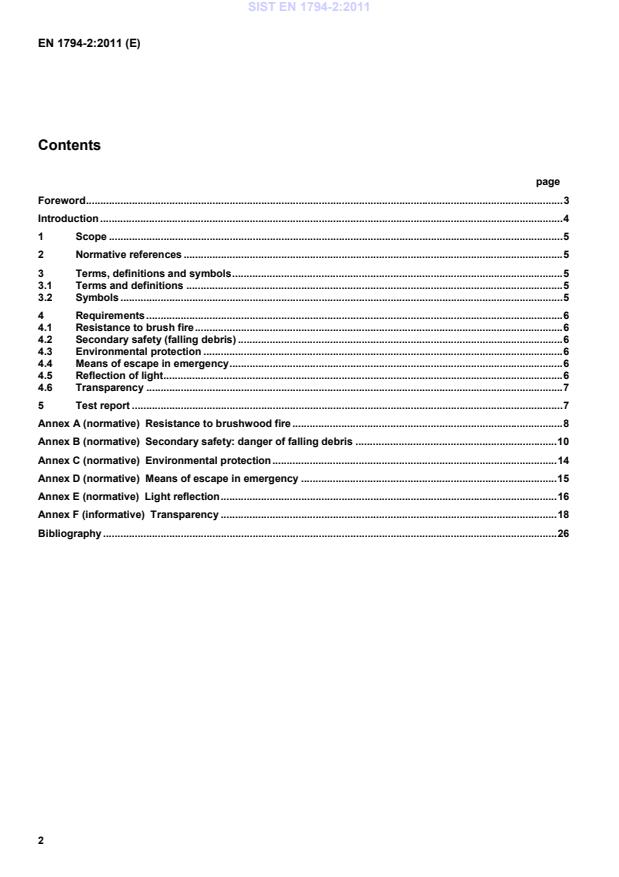
Resistance to brushwood fire . 8Annex B (normative)
Secondary safety: danger of falling debris . 10Annex C (normative)
Environmental protection . 14Annex D (normative)
Means of escape in emergency . 15Annex E (normative)
Light reflection . 16Annex F (informative)
Transparency . 18Bibliography . 26 SIST EN 1794-2:2011
angle of transparency (see Figure F.2), in degrees; SIST EN 1794-2:2011
transparency looking left, in percent; TD dynamic transparency, in percent; TS static transparency, in percent. 4 Requirements 4.1 Resistance to brush fire The noise reducing device shall be classified in accordance with Annex A. NOTE This European Standard permits specifying authorities to indicate that there is no requirement for resistance to brushwood fire. 4.2 Secondary safety (falling debris) When secondary safety has to be assessed, this shall be done in accordance with Annex B. NOTE This European Standard permits specifying authorities to indicate that there is no requirement for secondary safety. 4.3 Environmental protection The constituent materials and their breakdown products shall be identified in accordance with Annex C. 4.4 Means of escape in emergency The acoustic and mechanical performances of doors or other means of escape shall be assessed in accordance with Annex D. NOTE This European Standard permits specifying authorities to indicate that there is no requirement for means of escape in emergency. 4.5 Reflection of light The results of a standard test of reflectivity shall be quoted in accordance with Annex E. NOTE This European Standard permits specifying authorities to indicate that there is no requirement for light reflection. SIST EN 1794-2:2011
Resistance to brushwood fire A.1 General A noise reducing device can be exposed to fire arising from dry vegetation or other material in close proximity. More severe fires from spilt fuel can arise as the result of traffic accidents. Where a noise reducing device is in close proximity to property it can also be necessary to consider the need to ensure that fire is not spread from the highway. Where flammable systems are used, it is recommended that firebreaks of fire-resistant materials or other design are incorporated into the noise reducing device in order to prevent the propagation of fire. This annex is not applicable to such fire resistant material. This annex describes a test for a representative panel of a vertical noise barrier under normal exposure to brushwood fires at the roadside. It does not provide information on the results of exposure to more severe conditions e.g. ignition by burning spilt fuel. The test should not be used to provide information on the fire safety of claddings used for tunnels or partial covers over the highway. A.2 Requirements The noise reducing device, after being tested by the method given in A.3, shall be classified as follows: class 1: if the panel has been damaged to a greater extent than as defined for classes 2 and 3; class 2:
if the damaged area above either source is less than 0,06 m2 and extends to no more than 200 mm above the base of the panel, and the panel has not been burnt through to the other side; class 3: if there is no damage other than discoloration. A.3 Fire test A.3.1 Acoustic elements of at least 2 m long by 1,5 m high shall be tested by exposure to localised sources of fire at its base next to the front and rear faces independently. Panels shall be free of absorbed water before testing; in the case of timber components, the moisture content shall be reduced to 18 % by an approved drying method. The mass and dimensions of the panel to be tested shall be measured and the panel shall be photographed. An identical panel shall be examined to determine its construction; the dimensions of its elements, including wall thickness of hollow sections, shall be measured and noted on a sketch at 1:20 scale. A.3.2 Testing shall be carried out in an enclosed fireproof and draught-free chamber having a volume of at least 150 m3. Fume extraction devices may be installed in or near the ceiling, but shall be prevented from fanning any flames during the test. SIST EN 1794-2:2011
50 mm long. The material shall be free from splinters and have a maximum moisture content of 30 %; it shall be acclimatised at 20 °C and 65 % relative humidity until its weight is constant. 600 g of shavings shall be lightly pressed down into each basket so that it is just filled. A.3.4 The test panel shall be supported in a vertical position corresponding to its orientation in use, on a plinth supporting the full length of the panel. The plinth shall be of masonry or concrete and have a vertical step to a level of 250 mm above the floor of the chamber. The base of the test panel shall be completely in contact with the plinth and the face to be tested shall be flush with the edge. The two sources of fire shall be placed on the floor of the chamber with their longer dimension flush against the plinth and the face of the test panel. Both sources shall be lit simultaneously, and the time taken for the test shall start at this point. A.3.5 The performance of the panel shall be observed during the test and the time at which any significant change takes place recorded. After the sources of fire and any part of the panel which may have ignited have burnt out, the panel shall be examined and the extent of any damage photographed and measured. The opposite face of the panel shall not be tested until it and the floor of the chamber have cooled to below 25 °C. A.4 Test report A.4.1 The test procedure shall be described together with the timing of significant stages, indication of, for example maximum intensity of flames, the incidence of any observed changes to the test panel and the number of samples tested. The test report shall record the nature and extent of any flames and smoke produced during the test. A.4.2 Photographs of the test panel before, during and after the test shall be supplied and shall include an appropriate means of judging scale. SIST EN 1794-2:2011
Secondary safety: danger of falling debris B.1 General Noise reducing devices can be mounted on structures or in such a way that if damaged they could pose a hazard to road users or to others. In particular, even if the noise reducing device is protected by the safety system on an elevated structure, there is a possibility of pieces or whole panels from a noise barrier becoming detached as the result of a violent collision and for the debris to fall, endangering those below. Noise reducing devices which are to be used in a vulnerable position may be required to be restrained by internal or external linkage between panels and/or elements to prevent them from becoming detached and falling. The standard provides some general indications of factors which need to be considered and also provides a method of establishing the resistance of a product to a severe blow. NOTE It is principally the responsibility of specifiers to consider the potential consequences of a barrier becoming damaged and to provide protection accordingly. Alternatively, a means of catching falling pieces detached from vulnerable barriers may be specified for barrier systems which are not so restrained. B.2 Requirements B.2.1 Behaviour under impact Where it is known that any component of a device is liable to shatter if struck or shocked, this shall be clearly stated. NOTE Such a statement can be qualified by further evidence of the effectiveness of any restraining mechanism. B.2.2 Fastening of structural and acoustical elements B.2.2.1 A noise reducing device shall be assumed to be safety fastened if the elements are secured in such a way that they do not fall when they are deformed or broken. The restraint systems shall be designed to withstand the self weight of the relevant falling parts, multiplied by a load factor of 4. The wet self weight shall be used, calculated in accordance with EN 1794-1:2011, Annex B. B.2.2.2 If structural and acoustical elements of this category of noise reducing device are prevented from falling by a system of restraint linking them together, each link shall take the load of all adjoining elements. It shall be assumed that th
...