


FprEN ISO 21809-2
(Main)Oil and gas industries including lower carbon energy - External coatings for buried or submerged pipelines used in pipeline transportation systems - Part 2: Single layer fusion-bonded epoxy coatings (ISO/FDIS 21809-2:2025)
Oil and gas industries including lower carbon energy - External coatings for buried or submerged pipelines used in pipeline transportation systems - Part 2: Single layer fusion-bonded epoxy coatings (ISO/FDIS 21809-2:2025)
ISO 21809-2:2014 specifies the requirements for qualification, application, testing and handling of materials for plant application of single layer fusion-bonded epoxy (FBE) coatings applied externally for the corrosion protection of bare steel pipe for use in pipeline transportation systems for the petroleum and natural gas industries as defined in ISO 13623.
Industries du pétrole et du gaz, y compris les énergies à faible teneur en carbone - Revêtements externes des conduites enterrées ou immergées utilisées dans les systèmes de transport par conduites - Partie 2: Revêtements monocouche à base de résine époxydique appliquée par fusion (ISO/FDIS 21809-2:2025)
L'ISO 21809-2:2014 spécifie les exigences relatives à la qualification, à l'application, aux essais et à la manutention des matériaux pour l'application en usine des revêtements monocouche à base de résine époxydique appliquée par fusion (FBE), appliqués extérieurement pour assurer la protection contre la corrosion des tubes nus en acier, utilisés dans les systèmes de transport par conduites pour les industries du pétrole et du gaz naturel tels que définis dans l'ISO 13623.
Naftna in plinska industrija, vključno z nizkoogljično energijo - Zunanje prevleke za cevovode, zakopane v zemljo ali potopljene v vodo, v sistemih cevovodnega transporta - 2. del: Enoplastne epoksidne prevleke, nataljene na podlago (ISO/FDIS 21809-2:2025)
General Information
Relations
Standards Content (Sample)
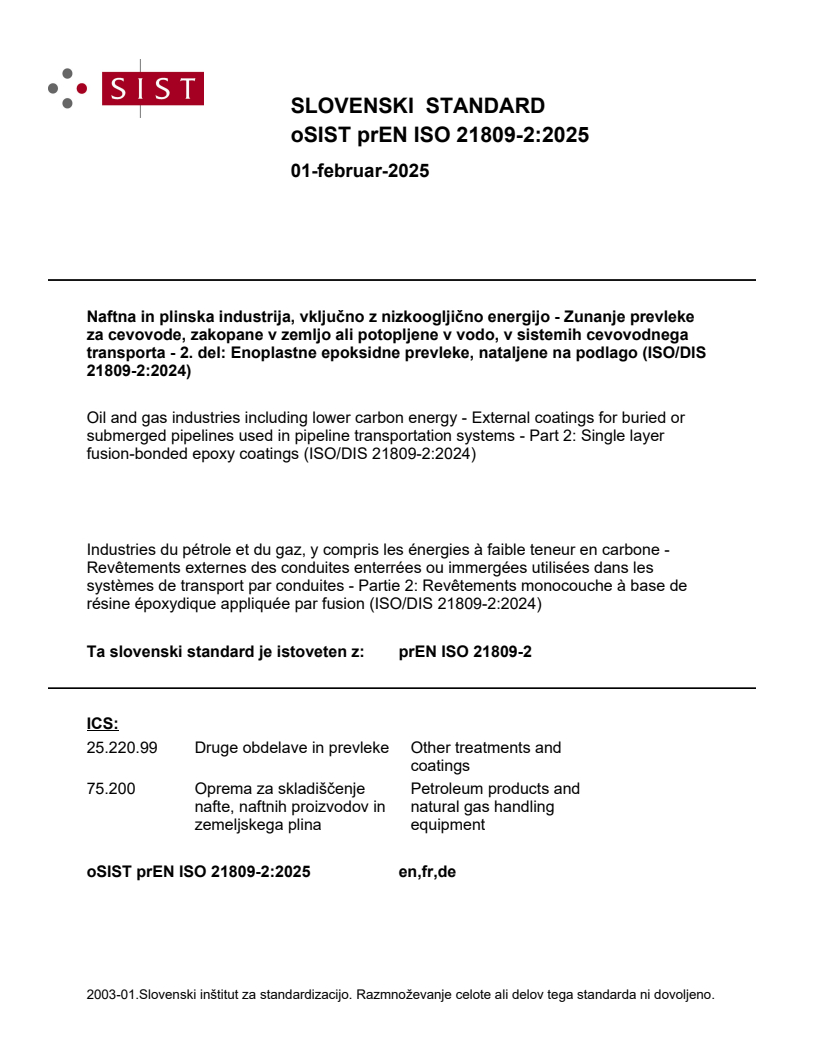
SLOVENSKI STANDARD
oSIST prEN ISO 21809-2:2025
01-februar-2025
Naftna in plinska industrija, vključno z nizkoogljično energijo - Zunanje prevleke
za cevovode, zakopane v zemljo ali potopljene v vodo, v sistemih cevovodnega
transporta - 2. del: Enoplastne epoksidne prevleke, nataljene na podlago (ISO/DIS
21809-2:2024)
Oil and gas industries including lower carbon energy - External coatings for buried or
submerged pipelines used in pipeline transportation systems - Part 2: Single layer
fusion-bonded epoxy coatings (ISO/DIS 21809-2:2024)
Industries du pétrole et du gaz, y compris les énergies à faible teneur en carbone -
Revêtements externes des conduites enterrées ou immergées utilisées dans les
systèmes de transport par conduites - Partie 2: Revêtements monocouche à base de
résine époxydique appliquée par fusion (ISO/DIS 21809-2:2024)
Ta slovenski standard je istoveten z: prEN ISO 21809-2
ICS:
25.220.99 Druge obdelave in prevleke Other treatments and
coatings
75.200 Oprema za skladiščenje Petroleum products and
nafte, naftnih proizvodov in natural gas handling
zemeljskega plina equipment
oSIST prEN ISO 21809-2:2025 en,fr,de
2003-01.Slovenski inštitut za standardizacijo. Razmnoževanje celote ali delov tega standarda ni dovoljeno.
oSIST prEN ISO 21809-2:2025
oSIST prEN ISO 21809-2:2025
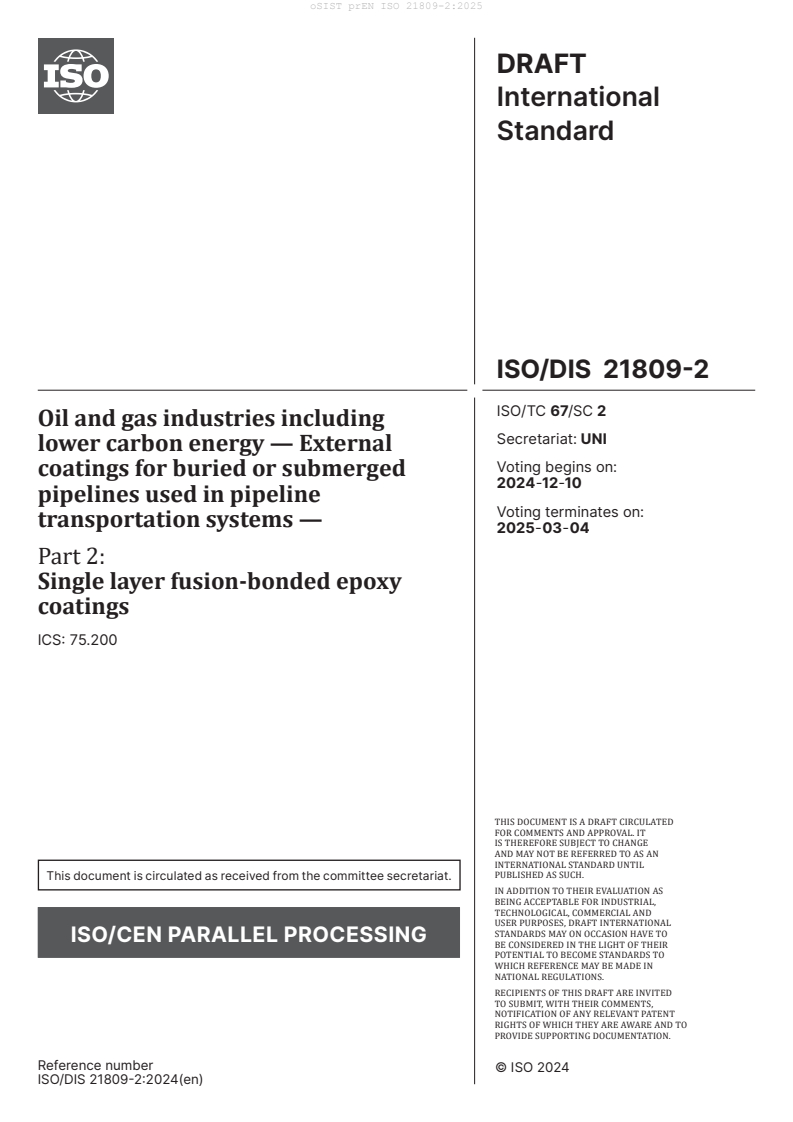
DRAFT
International
Standard
ISO/DIS 21809-2
ISO/TC 67/SC 2
Oil and gas industries including
Secretariat: UNI
lower carbon energy — External
Voting begins on:
coatings for buried or submerged
2024-12-10
pipelines used in pipeline
Voting terminates on:
transportation systems —
2025-03-04
Part 2:
Single layer fusion-bonded epoxy
coatings
ICS: 75.200
THIS DOCUMENT IS A DRAFT CIRCULATED
FOR COMMENTS AND APPROVAL. IT
IS THEREFORE SUBJECT TO CHANGE
AND MAY NOT BE REFERRED TO AS AN
INTERNATIONAL STANDARD UNTIL
PUBLISHED AS SUCH.
This document is circulated as received from the committee secretariat.
IN ADDITION TO THEIR EVALUATION AS
BEING ACCEPTABLE FOR INDUSTRIAL,
TECHNOLOGICAL, COMMERCIAL AND
USER PURPOSES, DRAFT INTERNATIONAL
STANDARDS MAY ON OCCASION HAVE TO
ISO/CEN PARALLEL PROCESSING
BE CONSIDERED IN THE LIGHT OF THEIR
POTENTIAL TO BECOME STANDARDS TO
WHICH REFERENCE MAY BE MADE IN
NATIONAL REGULATIONS.
RECIPIENTS OF THIS DRAFT ARE INVITED
TO SUBMIT, WITH THEIR COMMENTS,
NOTIFICATION OF ANY RELEVANT PATENT
RIGHTS OF WHICH THEY ARE AWARE AND TO
PROVIDE SUPPORTING DOCUMENTATION.
Reference number
ISO/DIS 21809-2:2024(en)
oSIST prEN ISO 21809-2:2025
DRAFT
ISO/DIS 21809-2:2024(en)
International
Standard
ISO/DIS 21809-2
ISO/TC 67/SC 2
Oil and gas industries including
Secretariat: UNI
lower carbon energy — External
Voting begins on:
coatings for buried or submerged
pipelines used in pipeline
Voting terminates on:
transportation systems —
Part 2:
Single layer fusion-bonded epoxy
coatings
ICS: 75.200
THIS DOCUMENT IS A DRAFT CIRCULATED
FOR COMMENTS AND APPROVAL. IT
IS THEREFORE SUBJECT TO CHANGE
AND MAY NOT BE REFERRED TO AS AN
INTERNATIONAL STANDARD UNTIL
PUBLISHED AS SUCH.
This document is circulated as received from the committee secretariat.
IN ADDITION TO THEIR EVALUATION AS
BEING ACCEPTABLE FOR INDUSTRIAL,
© ISO 2024
TECHNOLOGICAL, COMMERCIAL AND
USER PURPOSES, DRAFT INTERNATIONAL
All rights reserved. Unless otherwise specified, or required in the context of its implementation, no part of this publication may
STANDARDS MAY ON OCCASION HAVE TO
ISO/CEN PARALLEL PROCESSING
be reproduced or utilized otherwise in any form or by any means, electronic or mechanical, including photocopying, or posting on
BE CONSIDERED IN THE LIGHT OF THEIR
the internet or an intranet, without prior written permission. Permission can be requested from either ISO at the address below
POTENTIAL TO BECOME STANDARDS TO
WHICH REFERENCE MAY BE MADE IN
or ISO’s member body in the country of the requester.
NATIONAL REGULATIONS.
ISO copyright office
RECIPIENTS OF THIS DRAFT ARE INVITED
CP 401 • Ch. de Blandonnet 8
TO SUBMIT, WITH THEIR COMMENTS,
CH-1214 Vernier, Geneva
NOTIFICATION OF ANY RELEVANT PATENT
Phone: +41 22 749 01 11
RIGHTS OF WHICH THEY ARE AWARE AND TO
PROVIDE SUPPORTING DOCUMENTATION.
Email: copyright@iso.org
Website: www.iso.org
Published in Switzerland Reference number
ISO/DIS 21809-2:2024(en)
ii
oSIST prEN ISO 21809-2:2025
ISO/DIS 21809-2:2024(en)
Contents Page
Foreword .v
Introduction .vi
1 Scope . 1
2 Normative references . 1
3 Terms and definitions . 2
4 Symbols and abbreviated terms. 5
4.1 Symbols .5
4.2 Abbreviated terms .6
5 General requirements . 6
5.1 Rounding .6
5.2 Conformity to requirements .6
6 Information supplied by the purchaser . 6
6.1 General information.6
6.2 Additional information.7
7 Coating classification . 8
8 Qualification processes . 8
8.1 General — Qualification scheme .8
8.2 Coating material Qualification (CQ) .10
8.2.1 General .10
8.2.2 Properties epoxy powder .11
8.2.3 Requirements epoxy powder . 12
8.2.4 Repair material . 13
9 Application of coating .13
9.1 General . 13
9.2 Surface preparation . 13
9.2.1 Initial evaluation and surface preparation . 13
9.2.2 Abrasive blast cleaning . 13
9.2.3 Surface dust contamination .14
9.2.4 Surface cleanliness and pretreatment .14
9.3 Coating application and curing temperature .14
9.3.1 General .14
9.3.2 Recycled powder . 15
9.4 Coating thickness . 15
9.5 Cutback . 15
10 Qualification of coating application .15
10.1 General . 15
10.2 Application procedure specification (APS) . 15
10.3 Inspection and Testing Plan (ITP).16
10.4 Procedure Qualification Trial (PQT) .17
10.5 Pre-production Trial (PPT) .18
10.6 Inspection and testing during production .18
10.7 Minimum requirements for qualification and production .19
11 Coating System Qualification (CSQ).21
12 Inspection and testing .22
12.1 General . 22
12.2 Testing of incoming epoxy powder . 22
12.3 In-process and finished product testing requirements . 23
12.3.1 General . 23
12.3.2 Holiday inspection . 23
12.3.3 Production test rings . 23
iii
oSIST prEN ISO 21809-2:2025
ISO/DIS 21809-2:2024(en)
12.4 Test results .24
13 Repair of coated pipe .24
13.1 General .24
13.2 Repair of holidays .24
13.2.1 Pinholes and Small holiday .24
13.2.2 Large defects .24
13.2.3 Inspection of repaired area .24
13.3 Stripping and recoating .24
14 Markings .25
14.1 General . 25
14.2 Required markings . 25
15 Handling and storage in the coating area .25
15.1 Handling . 25
15.2 Storage . 25
16 Test reports and inspection documents .25
Annex A (normative) Inspection of thickness .27
Annex B (normative) Holiday detection test .29
Annex C (normative) Cure time of the epoxy powder .31
Annex D (normative) Thermal analysis of epoxy powder and cured coating film.34
Annex E (normative) Resistance to impact of the coating .40
Annex F (normative) Dry adhesion test .42
Annex G (normative) Particle size of epoxy powder .44
Annex H (normative) Cathodic disbondment test .45
Annex I (normative) Flexibility of the coating .54
Annex J (normative) Gel time of the epoxy powder .56
Annex K (normative) Total volatile/moisture content of the epoxy powder — Mass loss .58
Annex L (normative) Hot-water adhesion of the coating .60
Annex M (normative) Density of the epoxy powder .62
Annex N (normative) Interface contamination of the coating .64
Annex O (normative) Porosity of the coating .65
Bibliography .68
iv
oSIST prEN ISO 21809-2:2025
ISO/DIS 21809-2:2024(en)
Foreword
ISO (the International Organization for Standardization) is a worldwide federation of national standards
bodies (ISO member bodies). The work of preparing International Standards is normally carried out through
ISO technical committees. Each member body interested in a subject for which a technical committee
has been established has the right to be represented on that committee. International organizations,
governmental and non-governmental, in liaison with ISO, also take part in the work. ISO collaborates closely
with the International Electrotechnical Commission (IEC) on all matters of electrotechnical standardization.
The procedures used to develop this document and those intended for its further maintenance are described
in the ISO/IEC Directives, Part 1. In particular the different approval criteria needed for the different types
of ISO documents should be noted. This document was drafted in accordance with the editorial rules of the
ISO/IEC Directives, Part 2. (see www.iso.org/directives)
Attention is drawn to the possibility that some of the elements of this document may be the subject of patent
rights. ISO shall not be held responsible for identifying any or all such patent rights. Details of any patent
rights identified during the development of the document will be in the Introduction and/or on the ISO list of
patent declarations received. (see www.iso.org/patents)
Any trade name used in this document is information given for the convenience of users and does not
constitute an endorsement.
For an explanation of the voluntary nature of standards, the meaning of ISO specific terms and expressions
related to conformity assessment, as well as information about ISO's adherence to the World Trade
Organization (WTO) principles in the Technical Barriers to Trade (TBT) see www.iso.org/iso/foreword.html
This document was prepared by ISO/TC 67, Materials, equipment and offshore structures for petroleum,
petrochemical and natural gas industries, Subcommittee SC 2, Pipeline transportation systems.
This third edition cancels and replaces the first edition (ISO 21809-2:2014), which has been technically
revised. The main changes compared to the previous edition are as follows:
— Inclusion of new classifications for materials with glass transitions greater than 115 °C.
— Inclusion of a qualification scheme
A list of all the parts in the ISO 21809 series can be found on the ISO website.
Any feedback or questions on this document should be directed to the user’s national standards body. A
complete listing of these bodies can be found at www.iso.org/members.html.
v
oSIST prEN ISO 21809-2:2025
ISO/DIS 21809-2:2024(en)
Introduction
Users of this document should be aware that further or differing requirements might be needed for
individual applications. This document is not intended to inhibit a vendor from offering, or the purchaser
from accepting, alternative equipment or engineering solutions for the individual application. This can be
particularly applicable if there is innovative or developing technology. If an alternative is offered, the vendor
should identify any variations from this document and provide details.
vi
oSIST prEN ISO 21809-2:2025
DRAFT International Standard ISO/DIS 21809-2:2024(en)
Oil and gas industries including lower carbon energy —
External coatings for buried or submerged pipelines used in
pipeline transportation systems —
Part 2:
Single layer fusion-bonded epoxy coatings
1 Scope
This document specifies the requirements for qualification, application, testing and handling of materials
for plant application of single layer fusion-bonded epoxy (FBE) coatings applied externally for the corrosion
protection of bare steel pipe for use in pipeline transportation systems for the petroleum and natural gas
industries as defined in ISO 13623.
NOTE Pipes coated in accordance with this document are considered suitable for additional protection by means
of cathodic protection.
2 Normative references
The following documents are referred to in the text in such a way that some or all of their content constitutes
requirements of this document. For dated references, only the edition cited applies. For undated references,
the latest edition of the referenced document (including any amendments) applies.
ISO 8130-2, Coating powders — Part 2: Determination of density by gas comparison pycnometer (referee method)
ISO 8130-3, Coating powders — Part 3: Determination of density by liquid displacement pycnometer
ISO 8501-1, Preparation of steel substrates before application of paints and related products — Visual
assessment of surface cleanliness — Part 1: Rust grades and preparation grades of uncoated steel substrates and
of steel substrates after overall removal of previous coatings
ISO 8502-3, Preparation of steel substrates before application of paints and related products — Tests for the
assessment of surface cleanliness — Part 3: Assessment of dust on steel surfaces prepared for painting (pressure-
sensitive tape method)
ISO 8502-6, Preparation of steel substrates before application of paints and related products — Tests for the
assessment of surface cleanliness — Part 6: Extraction of water soluble contaminants for analysis (Bresle method)
ISO 8502-9, Preparation of steel substrates before application of paints and related products — Tests for the
assessment of surface cleanliness — Part 9: Field method for the conductometric determination of water-soluble salts
ISO 8503-4, Preparation of steel substrates before application of paints and related products — Surface
roughness characteristics of blast-cleaned steel substrates — Part 4: Method for the calibration of ISO surface
profile comparators and for the determination of surface profile — Stylus instrument procedure
ISO 8503-5, Preparation of steel substrates before application of paints and related products — Surface
roughness characteristics of blast-cleaned steel substrates — Part 5: Replica tape method for the determination
of the surface profile
ISO 10474, Steel and steel products — Inspection documents
ISO 11124 (all parts), Preparation of steel substrates before application of paints and related products —
Specifications for metallic blast-cleaning abrasives
oSIST prEN ISO 21809-2:2025
ISO/DIS 21809-2:2024(en)
ISO 11126 (all parts), Preparation of steel substrates before application of paints and related products —
Specifications for non-metallic blast-cleaning abrasives
ISO 11357-1, Plastics — Differential scanning calorimetry (DSC) — Part 1: General principles
ISO 11357-2, Plastics — Differential scanning calorimetry (DSC) — Part 2: Determination of glass transition
temperature and step height
ISO 13623, Petroleum and natural gas industries — Pipeline transportation systems
ISO 17025, Testing and calibration laboratories
ISO 19840, Paints and varnishes — Corrosion protection of steel structures by protective paint systems —
Measurement of, and acceptance criteria for, the thickness of dry films on rough surfaces
ISO 80000-1, Quantities and units — Part 1: General
EN 10204, Metallic products — Types of inspection documents
ASTM D4285, Standard Test Method for Indicating Oil or Water in Compressed Air
ASTM D4940, Standard Test Method for Conductimetric Analysis of Water Soluble Ionic Contamination of
Blasting Abrasives
SSPC-AB 1, Mineral and Slag Abrasives
SSPC-AB 2, Cleanliness of Recycled Ferrous Metallic Abrasives
SSPC-AB 3, Ferrous Metallic Abrasive
SSPC-PA2, Procedure for Determining Conformance to Dry Coating Thickness Requirements
SSPC-SP 1, Solvent cleaning
SSPC-Guide 15, Field Methods for Extraction and Analysis of Soluble Salts on Steel and Other Nonporous
Substrates
3 Terms and definitions
For the purposes of this document, the following terms and definitions apply.
ISO and IEC maintain terminological databases for use in standardization at the following addresses:
— ISO Online browsing platform: available at https:// www .iso .org/ obp
— IEC Electropedia: available at https:// www .electropedia .org/
3.3
adhesion
bond between coating and substrate
3.1
application procedure specification (APS)
document describing procedures, methods, equipment and tools used for coating application
3.2
applicator
company that undertakes the coating application in accordance with the provisions of this document
Note 1 to entry: The requirements shall be in accordance with this document.
oSIST prEN ISO 21809-2:2025
ISO/DIS 21809-2:2024(en)
3.4
batch
quantity of material produced in a continuous manufacturing operation using raw materials of the same
source and grade
3.5
batch certificate
document provided by the manufacturer which indicates results of specific tests or analysis, including test
methodology, performed on a defined lot of the manufacturer’s product and corresponding conformity ranges
3.6
certificate of compliance
document issued in accordance with ISO 10474 or EN 10204 stating compliance with the purchase order for
coated pipes, but without mention of any test results, issued in accordance with the purchasing requirements
3.7
coating material qualification (CQ)
qualification of the coating materials properties carried out by the manufacturer before the coating system
qualification
3.8
coating system qualification (CSQ)
qualification of application method, applied coating system and subsequent inspection/testing of its
properties, to confirm that the APS is adequate to produce a coating with the specified properties
3.9
cutback
length of pipe left uncoated at each end for joining purposes
3.10
design temperature
temperature, that can be endured by a pipeline (component) and/or pipeline transportation system during
operation, including maximum and minimum temperatures, likely to be reached during transport, storage,
handling, installation, upset conditions and operation
Note 1 to entry: The design temperature range of the coating can be narrower than that specified for the steel pipe
material and/or the pipeline transportation system.
3.11
dummy pipe
pipe having the same outside diameter and wall thickness of the project pipes. Dummy pipes and coated
dummy pipes shall be representative of the production and shall be coated in accordance with approved APS.
3.12
end user
company (or companies) that owns and/or operates pipeline(s)
3.13
glass transition
reversible change in an amorphous polymer or in amorphous regions of a partially crystalline polymer from
(or to) a viscous or rubbery condition to (or from) a hard and relatively brittle one
3.14
glass transition temperature
Tg
characteristic value of the temperature range over which the glass transition takes place
Note 1 to entry: The assigned glass transition temperature, T , can vary, depending on the specific property and on the
g
method and conditions selected to measure it.
[SOURCE: ISO 11357-2:2020, 3.1]
oSIST prEN ISO 21809-2:2025
ISO/DIS 21809-2:2024(en)
3.15
holiday
coating discontinuity that exhibits electrical conductivity when exposed to a specific voltage
3.16
inspection certificate
document declaring that the product supplied conform with the requirements of the order and in which test
results are supplied from specific inspection
document giving the results of the testing of coated pipes, supplied and signed by a representative of the
applicator authorized to issue such documents.
Note 1 to entry: As per ISO 10474 or EN 10204
3.17
inspection and testing plan (ITP)
document providing an overview of the sequence of inspections and tests, including appropriate resources
and procedures
3.18
laboratory-coated test specimen
specimen taken from a laboratory-prepared panel
3.19
manufacturer
company responsible for the manufacture of coating material(s)
3.20
manufacturer’s specification
document that specifies the characteristics, test requirements and application recommendations for the
coating materials
3.21
Maximum, minimum service temperature of a coating system
Tmax , Tmin
Maximum, minimum continuous temperature that the coating can resist based on information from coating
material manufacturer.
3.22
operating temperature
temperature that can be endured by a pipeline (component) and/or pipeline transportation system during
operation, within the design temperature range
3.23
shipment
an individual container received at the site of the applicator with a total weight of epoxy powder not to
exceed 25,000 kg
3.24
pipe diameter length
length along the pipe axis equal to the specified outside diameter of the pipe
3.25
pipeline
those facilities through which fluids are conveyed including pipe, pig traps, components, appurtenances,
isolating valves, and sectionalizing valves
[SOURCE: ISO 13623]
oSIST prEN ISO 21809-2:2025
ISO/DIS 21809-2:2024(en)
3.26
pipeline transportation system
pipelines, stations, supervisory control and data acquisition system (SCADA), safety systems, corrosion
protection systems, and any other equipment, facility or building used in the transportation of fluids
[SOURCE: ISO 13623:2017, 3.1.16]
3.27
pre-production trial (PPT)
application of a coating and subsequent inspection/testing of its properties, to confirm that the application
procedure specification is adequate to produce a coating with the specified properties, carried out in the
coating plant immediately prior to start of production and to verify that the plant's equipment is adequate to
consistently adhere to the APS requirements
3.28
procedure qualification trial (PQT)
application of a coating and subsequent inspection/testing of its properties, to confirm that the coatings
produced in accordance with the APS and ITP are acceptable within the specified properties, carried out in
the coating plant at a specific coating line and to verify that the plant's equipment is adequate to consistently
adhere to the APS requirements
3.29
purchaser
company responsible for providing the purchase order requirements
3.30
sample
sample from a batch of raw material or coating that represents the properties of the complete batch.
3.31
specimen
an object prepared for the purpose of testing specific properties. Specimens may be as follows: the coating
material; a flat panel or similar prepared specifically for testing; a coupon, ring or similar that has been cut
from a pipe; a pipe that has been coated in production or otherwise, in laboratory or plant conditions.
3.32
test report
document that provides the quantitative test results for tests conducted in accordance with document
specific requirements
3.33
test ring
specimen taken from production-coated pipe
4 Symbols and abbreviated terms
4.1 Symbols
C percentage conversion of FBE coating, expressed as a percentage
t effective specimen thickness, expressed in millimetres
ΔH exothermic heat of reaction, expressed in joule per grams
m mass, expressed in grams
R mandrel radius, expressed in millimetres
oSIST prEN ISO 21809-2:2025
ISO/DIS 21809-2:2024(en)
ΔT variation of the glass transition temperature, expressed in degrees Celsius
g
w mass fraction of the epoxy power retained on a sieve, expressed as a percentage of total sample
ep
w mass fraction of moisture, expressed as a percentage
m
4.2 Abbreviated terms
DC direct current
DSC differential scanning calorimetry
FBE fusion-bonded epoxy
HRC Rockwell C scale hardness
ID inner diameter
NPS nominal pipe size
OD outer diameter
ppd per pipe diameter
5 General requirements
5.1 Rounding
Unless otherwise stated in this document, to determine conformance with the specified requirements,
observed or calculated values shall be rounded to the nearest unit in the last right-hand place of figures used
in expressing the limiting value, in accordance with ISO 80000-1.
NOTE For the purposes of this provision, the rounding method of ASTM E29 is equivalent to ISO 80000-1.
5.2 Conformity to requirements
A quality system and an environmental management system should be applied to assist compliance with the
requirements of this document.
NOTE ISO 9001 gives guidance on quality management system and ISO 14001 gives guidance on the selection and
use of an environmental management system.
The applicator shall be responsible for complying with all the applicable requirements for the application of
this document. The purchaser shall be allowed to make any investigation necessary to ensure conformity by
the applicator and to reject any material and/or coating that does not comply.
6 Information supplied by the purchaser
6.1 General information
In advance of the purchase order there shall be agreement between purchaser and applicator on the
following items and laid down in the purchase order:
a) a reference to this document i.e. ISO 21809-2;
b) pipe quantity, outside diameter, length (minimum, maximum and nominal), wall thickness (minimum
and nominal) and grade of steel;
oSIST prEN ISO 21809-2:2025
ISO/DIS 21809-2:2024(en)
c) bare pipe standard or specification designation, e.g. ISO 3183;
d) requested schedule of delivery;
e) requested documentation and schedule for supply of documentation
f) requirements on test reports and (daily) log
g) type and frequency of certificate of compliance
h) requirements for traceability of coating system, repairs and marking of repairs
i) minimum thickness and maximum permissible thickness of the FBE coating and FBE coating classes;
j) cutback and tolerances for both ends of pipe;
k) CSQ (CQ/ PQT)/ PPT/production/ APS/ ITP requirements and/or entire and/or partial approvals;
l) pipeline installation methods
m) purchaser approval of APS/ITP;
6.2 Additional information
If applicable, in advance of the purchase order there shall be agreement between purchaser and applicator
on the following items and laid down in the purchase order:
a) plant and process inspection by the purchaser;
b) increased test ring length;
c) test ring location;
d) test frequency for additional test rings;
e) additional markings;
f) additional handling procedures;
g) additional storage procedures;
h) waiver of test reports;
i) maximum allowable preheating temperature;
j) applicator qualification requirements;
k) other special requirements;
l) pipe tracking and traceability of pipes to coating materials;
m) permissible number coating repairs if different from 11;
n) Additional or deviating CQ, PQT, PPT and/or production test requirements
o) Additional tests originated from specific installation methods
p) inspection of incoming pipe;
q) pipe end protection;
r) surface pretreatments if any;
s) minimum and maximum pipeline design and/or operating temperatures (°C);
t) use of dummy pipe for destructive tests;
oSIST prEN ISO 21809-2:2025
ISO/DIS 21809-2:2024(en)
If further installation processes (e.g. welding processes and field joint coating application) that envisage the
heating of the coated pipe are needed, further testing (e.g. adhesion) may be considered by the purchaser in
order to assess the compatibility of the line pipe coating against the application parameters of the chosen
field joint coating and vice-versa.
7 Coating classification
The coating is classified into two categories, Class 1 and Class 2.
Class 1 has a cured epoxy T ≤ 115 °C while and
g2
Class 2 has a cured epoxy T > 115 °C.
g2
The use of coating classes outside these guidelines is acceptable provided that the applied coating shall be
tested against the requirements specified in Table 4 for each relevant class (i.e. class 1 shall be tested against
requirements for class 1 in Table 4, class 2 shall be tested against requirements for class 2 in Table 4).
Different requirements for coating materials outside these classification systems shall be agreed upon by
the applicator and purchaser.
Use of coating classes outside these guidelines shall be approved by the purchaser.
8 Qualification processes
The Purchaser is either the end user or the representative of the end user.
The Qualification scheme shall be performed per coating line, coating material and application procedure
and in case of modifications to the coating line, coating materials or application procedures qualification
shall be repeated
The applicator shall carry out and report the coating system qualification in accordance with the
requirements of this document. The test report shall contain the results of the qualification tests and data
required in Tables 1, 2, 3 and 4.
8.1 General — Qualification scheme
The qualification process as per this document includes the following qualification steps:
a) Coating material Qualification (CQ), by the manufacturer (Clause 8.2).
Each coating material shall be qualified by the manufacturer in accordance with the requirements of
Tables 1 and 2. The manufacturer shall carry out and report the coating material qualification in accordance
with the requirements of Tables 1 and 2 where applicable. The test report issued by the manufacturer may
be also certified by a certification organization.
b) Procedure Qualification Trial (PQT), by the applicator (Clause 10.4).
An Application Procedure Specification (APS) (see 10.2) and an Inspection and Test Plan (ITP) (see 10.3) shall
be prepared. The applicator shall carry out and report the coating application qualification in accordance
with the requirements of Tables 3 and 4. The test report issued by the applicator may be also certified by a
certification organization.
c) Coating System Qualification (CSQ). (Clause 11).
Each coating system shall be qualified by a CSQ. This qualification is based on the CQ, together with the PQT.
Each step, CQ and PQT shall be approved by the purchaser. The applicator shall prepare an APS (see 10.2) and
ITP (see 10.3) related to the PQT of the specific coating system and both shall be approved by the purchaser.
In the APS and ITP the requirements and conditions of the manufacturers of coating products used, shall
be included. Deviations from these requirements and conditions shall be indicated. Once approved, the APS
shall not be changed without prior written authorisation of the purchaser.
oSIST prEN ISO 21809-2:2025
ISO/DIS 21809-2:2024(en)
The combined test report of the CSQ shall contain the results of the material qualification tests as per table 1
and table 2 (CQ) and the application qualification as per Table 3 and Table 4 (PQT). The combined test report
issued by the applicator shall be approved by the purchaser and may be also certified by a certification
organization.
A generic PQT may be carried out e.g. independently of any project and this results in a generic CSQ. In
case of a generic PQT (and CSQ) the purchaser shall indicate the validity range of the generic qualification
regarding (at least) pipe diameter and pipe wall thickness.
The purchaser can decide to accept parts or the entire content of an existing qualification.
d) Pre-production trial (PPT) (Clause 10.5).
In case a PPT is reque
...
Questions, Comments and Discussion
Ask us and Technical Secretary will try to provide an answer. You can facilitate discussion about the standard in here.
Loading comments...