


EN 12390-1:2021
(Main)Testing hardened concrete - Part 1: Shape, dimensions and other requirements for specimens and moulds
Testing hardened concrete - Part 1: Shape, dimensions and other requirements for specimens and moulds
This document specifies the shapes, dimensions and tolerances of cast concrete test specimens in the form of cubes, cylinders and prisms, and of the moulds required to produce them.
NOTE The tolerances specified in this document are based on the needs of strength testing, but they can be applicable to tests for other properties.
Prüfung von Festbeton - Teil 1: Form, Maße und andere Anforderungen für Probekörper und Formen
Dieses Dokument legt die Formen, Maße und zulässigen Abweichungen von Probekörpern aus Beton in Form von Würfeln, Zylindern und Prismen und von für ihre Herstellung erforderlichen Formen fest.
ANMERKUNG Die in diesem Dokument festgelegten zulässigen Abweichungen basieren auf den Erfordernissen von Festigkeitsprüfungen, sie können jedoch auch für die Prüfungen anderer Eigenschaften angewendet werden.
Essais pour béton durci - Partie 1 : Forme, dimensions et autres exigences aux éprouvettes et aux moules
Le présent document spécifie les formes, les dimensions et tolérances des éprouvettes de béton moulé ayant la forme de cubes, cylindres et prismes ainsi que des moules nécessaires à leur confection.
NOTE Les tolérances spécifiées dans le présent document ont été établies en fonction des besoins des essais de résistance, mais peuvent aussi convenir à des essais de détermination d’autres caractéristiques.
Preskušanje strjenega betona - 1. del: Oblika, mere in druge zahteve za vzorce in kalupe
General Information
- Status
- Published
- Publication Date
- 06-Jul-2021
- Withdrawal Date
- 30-Jan-2022
- Technical Committee
- CEN/TC 104 - Concrete ( performance, production, placing and compliance criteria )
- Drafting Committee
- CEN/TC 104/SC 1 - Revision of ENV 206
- Current Stage
- 6060 - Definitive text made available (DAV) - Publishing
- Start Date
- 07-Jul-2021
- Due Date
- 14-Nov-2021
- Completion Date
- 07-Jul-2021
Relations
- Effective Date
- 03-Oct-2018
Overview
EN 12390-1:2021 is a comprehensive European standard published by CEN that specifies the shape, dimensions, and tolerances for hardened concrete test specimens and their moulds. This document is critical in ensuring reliable and repeatable testing results for concrete by standardizing the physical parameters of test specimens such as cubes, cylinders, and prisms, as well as the moulds used to produce them.
The standard replaces the earlier EN 12390-1:2012 and includes updated tolerances that align with current industry practices. It facilitates conformity in strength testing and other property assessments of hardened concrete, providing clear guidelines for specimen preparation.
Key Topics
Specimen Types
- Cubes: Nominal sizes range between 100 mm and 300 mm, with declared sizes allowed within ±10% of nominal.
- Cylinders: Diameters range from 100 mm to 300 mm, height typically twice the diameter.
- Prisms: Widths from 70 mm to 300 mm, with lengths at least twice the width.
Dimensional Tolerances
- Flatness, perpendicularity, and straightness tolerances are rigorously defined, for example:
- Cube face flatness tolerance: 0.0006 × designated size.
- Cylinder diameter tolerance: ±1%.
- Prisms require perpendicularity within 0.5 mm relative to the base.
- Flatness, perpendicularity, and straightness tolerances are rigorously defined, for example:
Measurement Procedures
- Specimens must be measured unless produced in calibrated moulds.
- Certified calibrated moulds follow stricter tolerances, allowing reduced specimen measurement needs.
Mould Requirements
- Moulds must be watertight, non-absorbent, and robust enough to prevent distortion.
- Calibrated moulds are typically made from steel or cast iron.
- Flatness and perpendicularity tolerances are specified for mould surfaces, aiding accurate specimen formation.
Conformance with Geometrical Standards
- References EN ISO 1101 for geometrical product specifications, emphasizing flatness, perpendicularity, and straightness.
- Annexes provide detailed methods for assessing flatness and applying tolerance requirements.
Applications
Concrete Material Testing
- Ensuring standardized specimen dimensions improves accuracy and repeatability of compressive strength tests, flexural strength tests, tensile splitting strength tests, and other property evaluations.
Quality Control in Construction
- Concrete producers and testing labs use this standard to verify specimen conformity, assuring the quality and performance of concrete batches used in structural engineering projects.
Research & Development
- Laboratories developing new concrete formulations rely on these tolerances and specimen specifications to validate mechanical properties under controlled conditions.
Calibrated Mould Manufacturing
- Mold manufacturers design products meeting EN 12390-1 standards to support concrete testing labs in producing compliant specimens.
Related Standards
- EN 206: Standard for concrete specification, performance, production, and conformity, closely linked as it defines aggregate sizes and material requirements that influence specimen sizing under EN 12390-1.
- EN ISO 1101: Provides geometrical tolerancing principles, applied within EN 12390-1 for precise shape and dimension control.
- Other parts of EN 12390 Series:
- Part 2: Making and curing specimens
- Part 3: Compressive strength testing
- Part 5: Flexural strength of test specimens
- Part 6: Tensile splitting strength tests
- Part 7: Density of hardened concrete
Conclusion
EN 12390-1:2021 plays a crucial role in the standardized testing of hardened concrete by defining the physical characteristics and tolerances for standard test specimens and moulds. Adhering to this standard ensures consistency, reliability, and comparability of concrete strength and property tests across laboratories and industries. Concrete producers, testing facilities, and materials researchers benefit from its detailed guidance on specimen and mould requirements, facilitating better quality control and performance verification in construction materials testing.
Keywords: EN 12390-1, hardened concrete testing, concrete specimen dimensions, concrete mould specifications, concrete test cubes, concrete cylinders, concrete prisms, concrete strength testing, concrete testing standards, CEN concrete standards, calibrated moulds.

Frequently Asked Questions
EN 12390-1:2021 is a standard published by the European Committee for Standardization (CEN). Its full title is "Testing hardened concrete - Part 1: Shape, dimensions and other requirements for specimens and moulds". This standard covers: This document specifies the shapes, dimensions and tolerances of cast concrete test specimens in the form of cubes, cylinders and prisms, and of the moulds required to produce them. NOTE The tolerances specified in this document are based on the needs of strength testing, but they can be applicable to tests for other properties.
This document specifies the shapes, dimensions and tolerances of cast concrete test specimens in the form of cubes, cylinders and prisms, and of the moulds required to produce them. NOTE The tolerances specified in this document are based on the needs of strength testing, but they can be applicable to tests for other properties.
EN 12390-1:2021 is classified under the following ICS (International Classification for Standards) categories: 91.100.30 - Concrete and concrete products. The ICS classification helps identify the subject area and facilitates finding related standards.
EN 12390-1:2021 has the following relationships with other standards: It is inter standard links to EN 12390-1:2012. Understanding these relationships helps ensure you are using the most current and applicable version of the standard.
You can purchase EN 12390-1:2021 directly from iTeh Standards. The document is available in PDF format and is delivered instantly after payment. Add the standard to your cart and complete the secure checkout process. iTeh Standards is an authorized distributor of CEN standards.
Standards Content (Sample)
SLOVENSKI STANDARD
01-september-2021
Nadomešča:
SIST EN 12390-1:2013
Preskušanje strjenega betona - 1. del: Oblika, mere in druge zahteve za vzorce in
kalupe
Testing hardened concrete - Part 1: Shape, dimensions and other requirements for
specimens and moulds
Prüfung von Festbeton - Teil 1: Form, Maße und andere Anforderungen für Probekörper
und Formen
Essais pour béton durci - Partie 1 : Forme, dimensions et autres exigences aux
éprouvettes et aux moules
Ta slovenski standard je istoveten z: EN 12390-1:2021
ICS:
91.100.30 Beton in betonski izdelki Concrete and concrete
products
2003-01.Slovenski inštitut za standardizacijo. Razmnoževanje celote ali delov tega standarda ni dovoljeno.
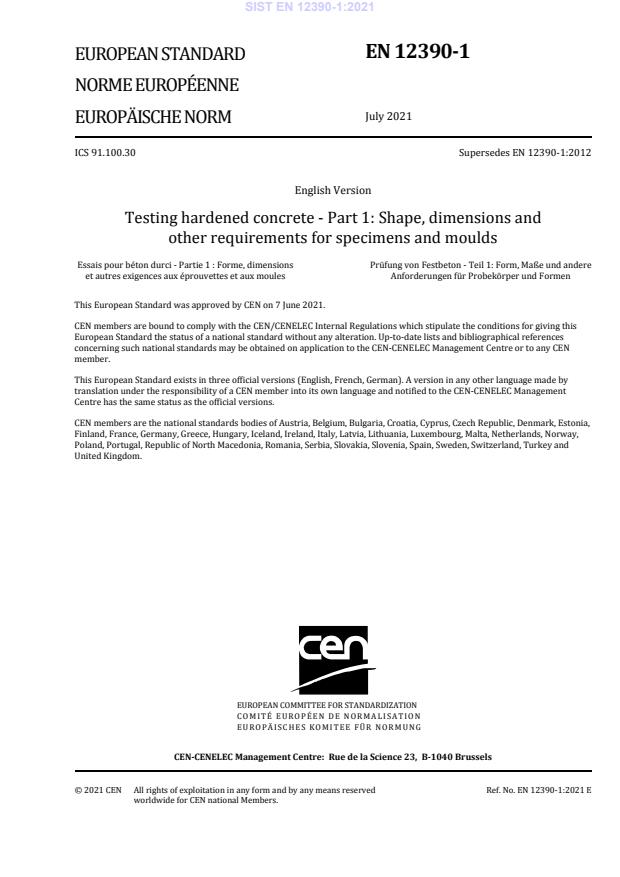
EN 12390-1
EUROPEAN STANDARD
NORME EUROPÉENNE
July 2021
EUROPÄISCHE NORM
ICS 91.100.30 Supersedes EN 12390-1:2012
English Version
Testing hardened concrete - Part 1: Shape, dimensions and
other requirements for specimens and moulds
Essais pour béton durci - Partie 1 : Forme, dimensions Prüfung von Festbeton - Teil 1: Form, Maße und andere
et autres exigences aux éprouvettes et aux moules Anforderungen für Probekörper und Formen
This European Standard was approved by CEN on 7 June 2021.
CEN members are bound to comply with the CEN/CENELEC Internal Regulations which stipulate the conditions for giving this
European Standard the status of a national standard without any alteration. Up-to-date lists and bibliographical references
concerning such national standards may be obtained on application to the CEN-CENELEC Management Centre or to any CEN
member.
This European Standard exists in three official versions (English, French, German). A version in any other language made by
translation under the responsibility of a CEN member into its own language and notified to the CEN-CENELEC Management
Centre has the same status as the official versions.
CEN members are the national standards bodies of Austria, Belgium, Bulgaria, Croatia, Cyprus, Czech Republic, Denmark, Estonia,
Finland, France, Germany, Greece, Hungary, Iceland, Ireland, Italy, Latvia, Lithuania, Luxembourg, Malta, Netherlands, Norway,
Poland, Portugal, Republic of North Macedonia, Romania, Serbia, Slovakia, Slovenia, Spain, Sweden, Switzerland, Turkey and
United Kingdom.
EUROPEAN COMMITTEE FOR STANDARDIZATION
COMITÉ EUROPÉEN DE NORMALISATION
EUROPÄISCHES KOMITEE FÜR NORMUNG
CEN-CENELEC Management Centre: Rue de la Science 23, B-1040 Brussels
© 2021 CEN All rights of exploitation in any form and by any means reserved Ref. No. EN 12390-1:2021 E
worldwide for CEN national Members.
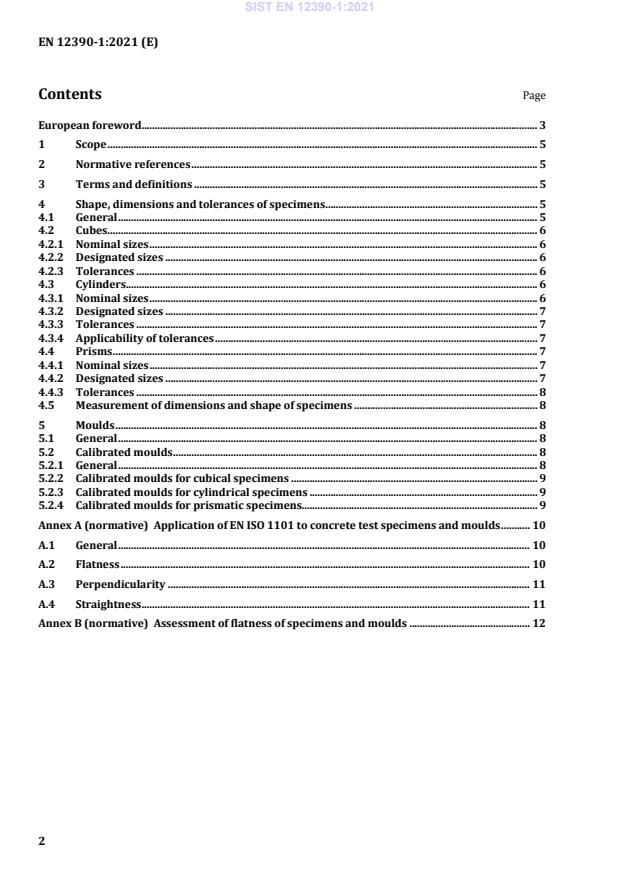
Contents Page
European foreword . 3
1 Scope . 5
2 Normative references . 5
3 Terms and definitions . 5
4 Shape, dimensions and tolerances of specimens . 5
4.1 General . 5
4.2 Cubes . 6
4.2.1 Nominal sizes . 6
4.2.2 Designated sizes . 6
4.2.3 Tolerances . 6
4.3 Cylinders. 6
4.3.1 Nominal sizes . 6
4.3.2 Designated sizes . 7
4.3.3 Tolerances . 7
4.3.4 Applicability of tolerances . 7
4.4 Prisms . 7
4.4.1 Nominal sizes . 7
4.4.2 Designated sizes . 7
4.4.3 Tolerances . 8
4.5 Measurement of dimensions and shape of specimens . 8
5 Moulds . 8
5.1 General . 8
5.2 Calibrated moulds . 8
5.2.1 General . 8
5.2.2 Calibrated moulds for cubical specimens . 9
5.2.3 Calibrated moulds for cylindrical specimens . 9
5.2.4 Calibrated moulds for prismatic specimens. 9
Annex A (normative) Application of EN ISO 1101 to concrete test specimens and moulds . 10
A.1 General . 10
A.2 Flatness . 10
A.3 Perpendicularity . 11
A.4 Straightness . 11
Annex B (normative) Assessment of flatness of specimens and moulds . 12
European foreword
This document (EN 12390-1:2021) has been prepared by Technical Committee CEN/TC 104 “Concrete
and related products”, the secretariat of which is held by SN.
This European Standard shall be given the status of a national standard, either by publication of an
identical text or by endorsement, at the latest by January 2022, and conflicting national standards shall
be withdrawn at the latest by January 2022.
Attention is drawn to the possibility that some of the elements of this document may be the subject of
patent rights. CEN shall not be held responsible for identifying any or all such patent rights.
This document supersedes EN 12390-1:2012.
The following amendments have been made to the former edition:
— editorial revision;
— increases in the allowable tolerances for flatness of moulds and the dimensions of the specimens
which reflect current industry practice.
This document is one of a series on testing concrete.
EN 12390, Testing hardened concrete, consists of the following parts:
— Part 1: Shape, dimensions and other requirements for specimens and moulds;
— Part 2: Making and curing specimens for strength tests;
— Part 3: Compressive strength of test specimens;
— Part 4: Compressive strength – Specification for testing machines;
— Part 5: Flexural strength of test specimens;
— Part 6: Tensile splitting strength of test specimens;
— Part 7: Density of hardened concrete;
— Part 8: Depth of penetration of water under pressure;
— Part 10: Determination of the carbonation resistance of concrete at atmospheric levels of carbon
dioxide;
— Part 11: Determination of the chloride resistance of concrete, unidirectional diffusion;
— Part 12: Determination of the potential carbonation resistance of concrete: Accelerated carbonation
method;
— Part 13: Determination of secant modulus of elasticity in compression;
— Part 14: Semi-adiabatic method for the determination of heat released by concrete during its hardening
process;
— Part 15: Adiabatic method for the determination of heat released by concrete during its hardening
process;
— Part 16: Determination of shrinkage of concrete;
— Part 17: Determination of creep of concrete in compression;
— Part 18: Determination of the chloride migration coefficient (in preparation).
This document recognizes alternative approaches towards obtaining test specimens of the correct sizes
and shapes. The first is to use moulds whose lives are limited and to measure the specimens to ensure
conformity. The second is to cast specimens in calibrated metal moulds which meet tighter tolerances
than for specimens. The use of calibrated moulds allows relaxation on the requirement for measuring the
specimens.
Annex A gives the application of EN ISO 1101 to measuring the shapes of concrete test specimens and
moulds.
Annex B gives a method to measure the flatness of specimens and moulds.
Any feedback and questions on this document should be directed to the users
...
The EN 12390-1:2021 standard provides a comprehensive framework focused on the specification of shapes, dimensions, and tolerances pertinent to cast concrete test specimens, specifically cubes, cylinders, and prisms, as well as the moulds essential for their production. This document plays a crucial role in ensuring the uniformity and reliability of concrete testing, which is fundamental for assessing the performance and durability of hardened concrete. One of the primary strengths of this standard is its meticulous detail regarding dimensional tolerances. By establishing clear parameters, EN 12390-1:2021 minimizes variability in test results, thereby enhancing reproducibility and accuracy in strength testing and other property assessments. This is particularly important in the construction industry, where precise measurements can significantly impact the integrity of structures. Furthermore, the relevance of this standard spans beyond strength testing; it encompasses various tests for other properties, thereby broadening its applicability across multiple concrete evaluations. This flexibility allows engineers and quality control professionals to leverage this standard in diverse scenarios, ensuring compliance with industry benchmarks and fostering best practices. In summary, EN 12390-1:2021 stands out as a vital resource, laying the groundwork for consistent testing methodologies in the concrete sector. Its comprehensive nature and focus on promoting adherence to specified tolerances underscore its importance in producing reliable testing outcomes, ultimately contributing to enhanced quality assurance in concrete production and application.
Die EN 12390-1:2021 befasst sich mit der Prüfung von erhärtetem Beton und definiert die Formate, Abmessungen und weiteren Anforderungen für Proben und Formen. Diese Norm stellt sicher, dass der Herstellungsprozess von Betontestproben, sei es in Form von Würfeln, Zylindern oder Prismen, einer klaren und einheitlichen Regelung folgt. Der zentrale Fokus liegt auf den Toleranzen, die maßgeblich für die Festigkeitsprüfung sind, jedoch auch auf andere Eigenschaften angewendet werden können. Ein herausragendes Merkmal der Norm ist ihre präzise Definition der geometrischen Anforderungen, die eine konsistente und reproduzierbare Testumgebung garantieren. Dies trägt zur Validität der Testergebnisse bei und stellt sicher, dass verschiedene Prüfstände vergleichbare Ergebnisse liefern können. Die klare Strukturierung der Anforderungen ermöglicht es Prüfstellen, effizient zu arbeiten und gleichzeitig höchste Standards in der Qualitätssicherung einzuhalten. Die Relevanz der EN 12390-1:2021 erstreckt sich über verschiedene Anwendungsbereiche in der Bauindustrie und Forschung, da sie eine wichtige Grundlage für die Beurteilung der Festigkeit und anderer Eigenschaften von Beton bietet. Durch die Standardisierung der Probenformen und -dimensionen wird das Risiko von Abweichungen minimiert, sodass Verlässlichkeit und Genauigkeit in der Bautechnologie gewährleistet sind. Zusammenfassend lässt sich sagen, dass die EN 12390-1:2021 einen entscheidenden Beitrag zur Qualitätssicherung im Bereich der Betontechnologie leistet. Die klare Festlegung der Anforderungen und Toleranzen fördert die Konsistenz und Vergleichbarkeit von Testergebnissen, was für Bauprojekte und deren gerichtliche Begutachtungen von großer Bedeutung ist.
La norme EN 12390-1:2021, intitulée "Essai du béton durci - Partie 1 : Forme, dimensions et autres exigences pour les éprouvettes et les moules", offre un cadre complet pour la standardisation des éprouvettes de béton. Son approche précise concernant les formes, dimensions et tolérances des éprouvettes en béton, qu'elles soient sous forme de cubes, de cylindres ou de prismes, est essentielle pour garantir la cohérence et la fiabilité des tests de résistance. Un des principaux atouts de cette norme est son accent sur les tolérances, qui sont clairement définies pour répondre aux exigences des essais de résistance. Cela permet d'assurer la qualité des matériaux testés et d'offrir des résultats fiables, ce qui est crucial pour les professionnels du secteur du béton. De plus, les tolérances spécifiées ne se limitent pas seulement aux essais de résistance, elles peuvent également être appliquées à d'autres propriétés, renforçant ainsi la polyvalence de la norme. En ce qui concerne la pertinence de cette norme, elle s'inscrit dans le contexte des exigences croissantes en matière de qualité et de conformité dans l’industrie de la construction. La définition précise des exigences pour les moules et les éprouvettes garantit que les tests effectués reflètent fidèlement les performances du béton durci, ce qui est indispensable pour les projets de construction modernes. En résumé, la norme SIST EN 12390-1:2021 représente un outil indispensable pour les laboratoires et les professionnels du béton. Elle assure la standardisation des processus d’essai et contribue à l'obtention de résultats cohérents et fiables, ce qui est essentiel pour la validation des matériaux utilisés dans la construction.
SIST EN 12390-1:2021 표준 문서는 경량 콘크리트 테스트 샘플의 제작을 위한 형상, 치수 및 기타 요구 사항을 명확하게 규정하고 있습니다. 이 표준은 주로 큐브, 실린더 및 프리즘 형태의 주형에 대한 명세를 포함하고 있으며, 이는 강도 테스트를 포함한 여러 시험에서 중요하게 적용될 수 있는 기준을 제공합니다. 이 표준의 가장 큰 강점은 콘크리트 샘플의 일관성과 신뢰성을 보장하는 점입니다. 치수 및 허용 오차에 대한 명확한 지침이 제공되어, 다양한 시험에서 시료의 재현성을 높이고, 결과의 정확성을 향상시키는 데 기여합니다. 이는 실험실과 현장에서의 품질 보증을 위한 중요한 요소로 작용합니다. 또한, 표준은 콘크리트 강도 시험뿐만 아니라 다른 물성 시험에도 적용 가능하다는 점에서 범위가 넓습니다. 이러한 유연성은 연구 및 산업 현장에서 다양한 응용 분야에 이 표준을 적용할 수 있게 하여, 건설 및 재료 공학 분야의 전문가들에게 큰 가치를 제공합니다. 따라서 SIST EN 12390-1:2021 표준은 콘크리트 시료의 제작 및 테스트 과정에서 발생할 수 있는 variabilities를 최소화하며, 강력하고 일관된 평가를 위한 기초를 제공합니다. 이는 또한 고품질의 건설 자재 개발을 위한 필수 문서로, 업계의 다양한 필요를 충족시키는데 필수적인 역할을 합니다.
EN 12390-1:2021は、硬化コンクリートの試験における重要な標準として、その適用範囲、強み、関連性において注目すべき要素を多く含んでいます。この標準は、コンクリートの試験片の形状、寸法、およびそれに伴う要求事項を詳細に定めており、特に立方体、円柱、プリズムの形状での試験片に対応しています。また、試験片を作成するための型に関する要件も規定しています。 この標準の強みは、試験片の形状と寸法に対する明確な定義を提供し、これにより試験の一貫性と再現性を確保する点です。特に、力試験のニーズに基づいた許容範囲が設定されているため、強度試験における信頼性を高めることができます。このことは、他の特性の試験にも適用可能なため、さまざまな用途においても関連性が高いです。 さらに、この文書は、コンクリート業界の専門家にとって非常に有用であり、試験片の品質管理を促進する役割を果たします。EN 12390-1:2021に基づく試験は、国際的な標準化を促進し、異なる地域間でのデータの比較を容易にするため、グローバルな視点からも重要です。このように、EN 12390-1:2021は、コンクリート試験の分野における標準の重要性を再確認させるものとなっています。
Questions, Comments and Discussion
Ask us and Technical Secretary will try to provide an answer. You can facilitate discussion about the standard in here.
Loading comments...