

EN ISO 3691-5:2009
(Main)Industrial trucks - Safety requirements and verification - Part 5: Pedestrian-propelled trucks (ISO 3691-5:2009)
- Abstract
ISO 3691-5:2009 gives safety requirements and the means for their verification for the following types of pedestrian-propelled trucks, equipped with load-handling devices for normal industrial duties, e.g. fork arms and platforms, or integrated attachments for special applications: pedestrian-propelled straddle stackers, pallet stackers, industrial trucks with capacities not exceeding 1 000 kg with manual or electrical battery-powered lifting, low-lift pallet trucks with lift height up to 300 mm and rated capacity up to 2 300 kg, scissor-lift pallet trucks with lift heights up to 1 000 mm or rated capacity up to 1 000 kg with manual or electrical battery-powered lifting.
- Status
- Withdrawn
- Publication Date
- 14-Nov-2009
- Withdrawal Date
- 25-Feb-2014
- Technical Committee
- CEN/TC 150 - Industrial trucks - Safety
- Drafting Committee
- CEN/TC 150 - Industrial trucks - Safety
- Current Stage
- 9960 - Withdrawal effective - Withdrawal
- Start Date
- 26-Feb-2014
- Completion Date
- 26-Feb-2014
- Directive
- 2006/42/EC - Directive 2006/42/EC of the European Parliament and of the Council of 17 May 2006 on machinery, and amending Directive 95/16/EC (recast)OJ Ref: C, C 348 OJ Date: 28-Nov-2013


Relations
- Replaces
EN 1757-2:2001 - Safety of industrial trucks - Pedestrian propelled trucks - Part 2: Pallet trucks - Effective Date
- 21-Nov-2009
- Effective Date
- 21-Nov-2009
- Effective Date
- 21-Nov-2009
- Effective Date
- 21-Nov-2009
- Effective Date
- 22-Dec-2008
- Replaces
EN 1757-1:2001 - Safety of industrial trucks - Pedestrian propelled trucks - Part 1: Stacker trucks - Effective Date
- 22-Dec-2008
- Effective Date
- 26-Sep-2012
- Effective Date
- 25-Aug-2026
- Effective Date
- 25-Aug-2026
- Effective Date
- 25-Aug-2026
- Effective Date
- 25-Aug-2026
- Refers
ISO 15870:2000 - Powered industrial trucks — Safety signs and hazard pictorials — General principles - Effective Date
- 25-Aug-2026
- Effective Date
- 25-Aug-2026
- Effective Date
- 09-Feb-2026
- Effective Date
- 09-Feb-2026
Frequently Asked Questions
EN ISO 3691-5:2009 is a standard published by the European Committee for Standardization (CEN). Its full title is "Industrial trucks - Safety requirements and verification - Part 5: Pedestrian-propelled trucks (ISO 3691-5:2009)". This standard covers: ISO 3691-5:2009 gives safety requirements and the means for their verification for the following types of pedestrian-propelled trucks, equipped with load-handling devices for normal industrial duties, e.g. fork arms and platforms, or integrated attachments for special applications: pedestrian-propelled straddle stackers, pallet stackers, industrial trucks with capacities not exceeding 1 000 kg with manual or electrical battery-powered lifting, low-lift pallet trucks with lift height up to 300 mm and rated capacity up to 2 300 kg, scissor-lift pallet trucks with lift heights up to 1 000 mm or rated capacity up to 1 000 kg with manual or electrical battery-powered lifting.
ISO 3691-5:2009 gives safety requirements and the means for their verification for the following types of pedestrian-propelled trucks, equipped with load-handling devices for normal industrial duties, e.g. fork arms and platforms, or integrated attachments for special applications: pedestrian-propelled straddle stackers, pallet stackers, industrial trucks with capacities not exceeding 1 000 kg with manual or electrical battery-powered lifting, low-lift pallet trucks with lift height up to 300 mm and rated capacity up to 2 300 kg, scissor-lift pallet trucks with lift heights up to 1 000 mm or rated capacity up to 1 000 kg with manual or electrical battery-powered lifting.
EN ISO 3691-5:2009 is classified under the following ICS (International Classification for Standards) categories: 53.060 - Industrial trucks. The ICS classification helps identify the subject area and facilitates finding related standards.
EN ISO 3691-5:2009 has the following relationships with other standards: It is inter standard links to EN 1757-2:2001, EN 1459:1998/A1:2006, EN 1459:1998/AC:2006, EN 1726-1:1998/AC:2002, EN 1757-4:2003, EN 1757-1:2001, EN ISO 3691-5:2014, ISO 5053:1987, ISO 13857:2008, ISO 12100-1:2003, ISO 2328:2007, ISO 15870:2000, ISO 12100-2:2003, ISO 20898:2008, ISO 3287:1999. Understanding these relationships helps ensure you are using the most current and applicable version of the standard.
EN ISO 3691-5:2009 is associated with the following European legislation: EU Directives/Regulations: 2006/42/EC, 98/37/EC; Standardization Mandates: M/079, M/396. When a standard is cited in the Official Journal of the European Union, products manufactured in conformity with it benefit from a presumption of conformity with the essential requirements of the corresponding EU directive or regulation.
EN ISO 3691-5:2009 is available in PDF format for immediate download after purchase. The document can be added to your cart and obtained through the secure checkout process. Digital delivery ensures instant access to the complete standard document.
Standards Content (Sample)
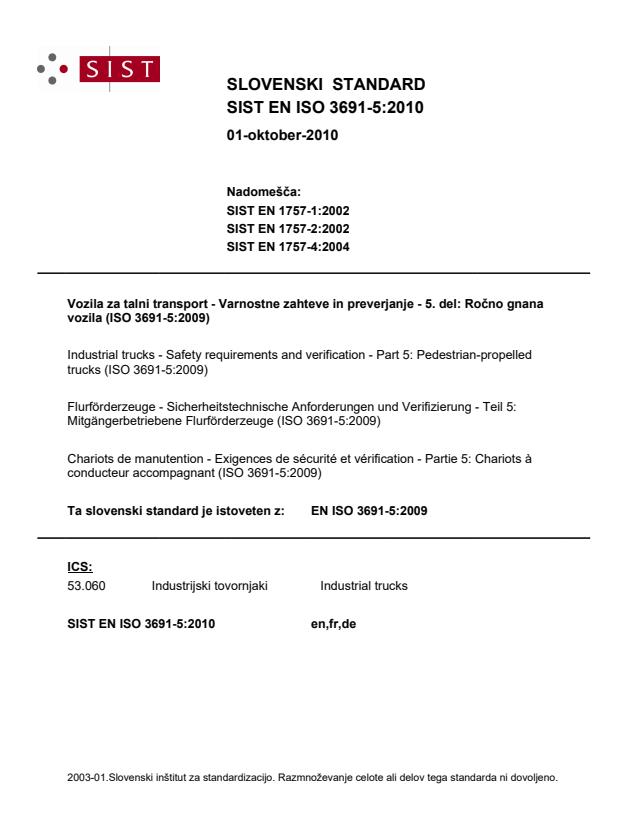
2003-01.Slovenski inštitut za standardizacijo. Razmnoževanje celote ali delov tega standarda ni dovoljeno.Flurförderzeuge - Sicherheitstechnische Anforderungen und Verifizierung - Teil 5: Mitgängerbetriebene Flurförderzeuge (ISO 3691-5:2009)Chariots de manutention - Exigences de sécurité et vérification - Partie 5: Chariots à conducteur accompagnant (ISO 3691-5:2009)Industrial trucks - Safety requirements and verification - Part 5: Pedestrian-propelled trucks (ISO 3691-5:2009)53.060Industrijski tovornjakiIndustrial trucksICS:Ta slovenski standard je istoveten z:EN ISO 3691-5:2009SIST EN ISO 3691-5:2010en,fr,de01-oktober-2010SIST EN ISO 3691-5:2010SLOVENSKI
STANDARDSIST EN 1757-4:2004SIST EN 1757-2:2002SIST EN 1757-1:20021DGRPHãþD
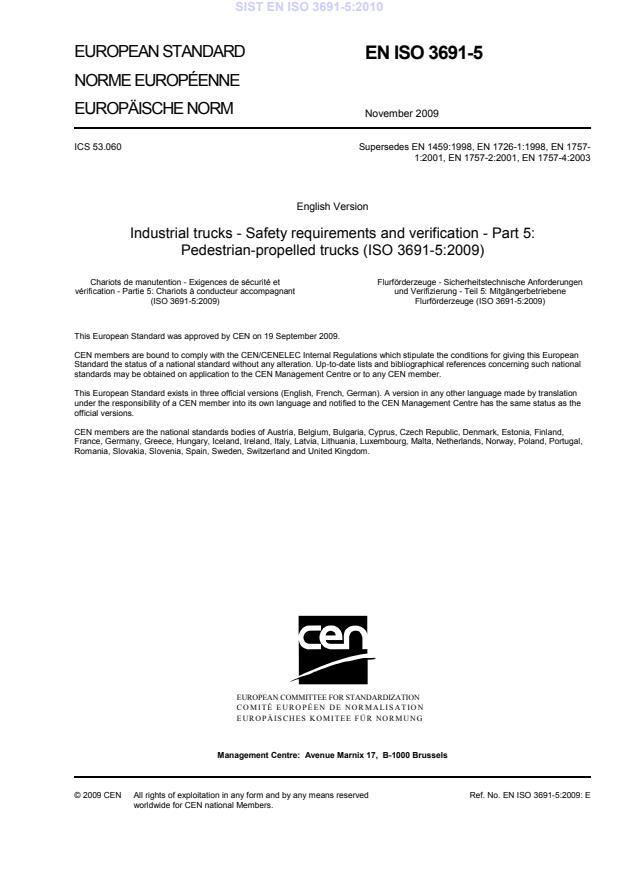
EUROPEAN STANDARD NORME EUROPÉENNE EUROPÄISCHE NORM
EN ISO 3691-5
November 2009 ICS 53.060 Supersedes EN 1459:1998, EN 1726-1:1998, EN 1757-1:2001, EN 1757-2:2001, EN 1757-4:2003English Version
Industrial trucks - Safety requirements and verification - Part 5: Pedestrian-propelled trucks (ISO 3691-5:2009)
Chariots de manutention - Exigences de sécurité et vérification - Partie 5: Chariots à conducteur accompagnant (ISO 3691-5:2009)
Flurförderzeuge - Sicherheitstechnische Anforderungen und Verifizierung - Teil 5: Mitgängerbetriebene Flurförderzeuge (ISO 3691-5:2009) This European Standard was approved by CEN on 19 September 2009.
CEN members are bound to comply with the CEN/CENELEC Internal Regulations which stipulate the conditions for giving this European Standard the status of a national standard without any alteration. Up-to-date lists and bibliographical references concerning such national standards may be obtained on application to the CEN Management Centre or to any CEN member.
This European Standard exists in three official versions (English, French, German). A version in any other language made by translation under the responsibility of a CEN member into its own language and notified to the CEN Management Centre has the same status as the official versions.
CEN members are the national standards bodies of Austria, Belgium, Bulgaria, Cyprus, Czech Republic, Denmark, Estonia, Finland, France, Germany, Greece, Hungary, Iceland, Ireland, Italy, Latvia, Lithuania, Luxembourg, Malta, Netherlands, Norway, Poland, Portugal, Romania, Slovakia, Slovenia, Spain, Sweden, Switzerland and United Kingdom.
EUROPEAN COMMITTEE FOR STANDARDIZATION
COMITÉ EUROPÉEN DE NORMALISATION EUROPÄISCHES KOMITEE FÜR NORMUNG
Management Centre:
Avenue Marnix 17,
B-1000 Brussels © 2009 CEN All rights of exploitation in any form and by any means reserved worldwide for CEN national Members. Ref. No. EN ISO 3691-5:2009: ESIST EN ISO 3691-5:2010
Relationship between this European Standard and the Essential Requirements of EU Directive 98/37/EC, amended by Directive 98/79/EC .4Annex ZB (informative)
Relationship between this European Standard and the Essential Requirements of EU Directive 2006/42/EC .5 SIST EN ISO 3691-5:2010
Relationship between this European Standard and the Essential Requirements of EU Directive 98/37/EC, amended by Directive 98/79/EC This European Standard has been prepared under a mandate given to CEN by the European Commission and the European Free Trade Association to provide a means of conforming to Essential Requirements of the New Approach Machinery Directive 98/37/EC, amended by 98/79 EC. Once this standard is cited in the Official Journal of the European Union under that Directive and has been implemented as a national standard in at least one Member State, compliance with the normative clauses of this standard confers, within the limits of the scope of this standard, a presumption of conformity with the corresponding Essential Requirements of that Directive and associated EFTA regulations.
WARNING — Other requirements and other EU Directives may be applicable to the product(s) falling within the scope of this standard.
Relationship between this European Standard and the Essential Requirements of EU Directive 2006/42/EC This European Standard has been prepared under a mandate given to CEN by the European Commission and the European Free Trade Association to provide a means of conforming to Essential Requirements of the New Approach Machinery Directive 2006/42/EC. Once this standard is cited in the Official Journal of the European Union under that Directive and has been implemented as a national standard in at least one Member State, compliance with the normative clauses of this standard confers, within the limits of the scope of this standard, a presumption of conformity with the corresponding Essential Requirements of that Directive and associated EFTA regulations. WARNING — Other requirements and other EU Directives may be applicable to the product(s) falling within the scope of this standard. SIST EN ISO 3691-5:2010
Reference numberISO 3691-5:2009(E)© ISO 2009
INTERNATIONAL STANDARD ISO3691-5First edition2009-11-15Industrial trucks — Safety requirements and verification — Part 5: Pedestrian-propelled trucks Chariots de manutention — Exigences de sécurité et vérification — Partie 5: Chariots à conducteur accompagnant
ISO 3691-5:2009(E) PDF disclaimer This PDF file may contain embedded typefaces. In accordance with Adobe's licensing policy, this file may be printed or viewed but shall not be edited unless the typefaces which are embedded are licensed to and installed on the computer performing the editing. In downloading this file, parties accept therein the responsibility of not infringing Adobe's licensing policy. The ISO Central Secretariat accepts no liability in this area. Adobe is a trademark of Adobe Systems Incorporated. Details of the software products used to create this PDF file can be found in the General Info relative to the file; the PDF-creation parameters were optimized for printing. Every care has been taken to ensure that the file is suitable for use by ISO member bodies. In the unlikely event that a problem relating to it is found, please inform the Central Secretariat at the address given below.
©
ISO 2009 All rights reserved. Unless otherwise specified, no part of this publication may be reproduced or utilized in any form or by any means, electronic or mechanical, including photocopying and microfilm, without permission in writing from either ISO at the address below or ISO's member body in the country of the requester. ISO copyright office Case postale 56 • CH-1211 Geneva 20 Tel.
+ 41 22 749 01 11 Fax
+ 41 22 749 09 47 E-mail
copyright@iso.org Web
www.iso.org Published in Switzerland
ii © ISO 2009 – All rights reserved
ISO 3691-5:2009(E) © ISO 2009 – All rights reserved iii Contents Page Foreword.iv Introduction.v 1 Scope.1 2 Normative references.2 3 Terms and definitions.2 4 List of significant hazards.4 5 Safety requirements and/or protective measures.8 5.1 General.8 5.2 Propelling, steering.8 5.3 Load-handling controls.12 5.4 Lifting systems.13 5.5 Parking brake.15 5.6 Stability.15 5.7 Lateral stabilizers.16 5.8 Protection against crushing, shearing and entanglement points.16 5.9 Edges and angles.16 5.10 Protective devices.16 5.11 Additional requirements for trucks with battery-powered lifting.17 5.12 Lifting points.17 6 Verification of safety requirements and/or protective measures.18 6.1 General.18 6.2 Functional verification.18 6.3 Design verification (type test).18 7 Information for use.18 7.1 General.18 7.2 Instruction handbooks.18 7.3 Marking.21 Annex A (normative)
Method for measurement of forces, F.23 Annex B (normative)
Rated capacity.28 Bibliography.31
ISO 3691-5:2009(E) iv © ISO 2009 – All rights reserved Foreword ISO (the International Organization for Standardization) is a worldwide federation of national standards bodies (ISO member bodies). The work of preparing International Standards is normally carried out through ISO technical committees. Each member body interested in a subject for which a technical committee has been established has the right to be represented on that committee. International organizations, governmental and non-governmental, in liaison with ISO, also take part in the work. ISO collaborates closely with the International Electrotechnical Commission (IEC) on all matters of electrotechnical standardization. International Standards are drafted in accordance with the rules given in the ISO/IEC Directives, Part 2. The main task of technical committees is to prepare International Standards. Draft International Standards adopted by the technical committees are circulated to the member bodies for voting. Publication as an International Standard requires approval by at least 75 % of the member bodies casting a vote. Attention is drawn to the possibility that some of the elements of this document may be the subject of patent rights. ISO shall not be held responsible for identifying any or all such patent rights. ISO 3691-5 was prepared by Technical Committee ISO/TC 110, Industrial trucks, Subcommittee SC 2, Safety of powered industrial trucks. This first edition of ISO 3691-5, together with ISO 3691-1, ISO 3691-2, ISO 3691-3, ISO 3691-4, ISO 3691-6, ISO/TS 3691-7 and ISO/TS 3691-8, cancels and replaces ISO 3691:1980, of which it constitutes a technical revision. ISO 3691 consists of the following parts, under the general title Industrial trucks — Safety requirements and verification: ⎯ Part 1: Self-propelled industrial trucks, other than driverless, variable-reach and burden-carrier trucks ⎯ Part 2: Self-propelled variable-reach trucks ⎯ Part 3: Additional requirements for trucks with elevating operator position and trucks specifically designed to travel with elevated loads ⎯ Part 4: Driverless industrial trucks and their systems ⎯ Part 5: Pedestrian-propelled trucks ⎯ Part 6: Burden and personnel carriers ⎯ Part 7: Regional requirements for countries within the European Community [Technical Specification] ⎯ Part 8: Regional requirements for countries outside the European Community [Technical Specification] SIST EN ISO 3691-5:2010
ISO 3691-5:2009(E) © ISO 2009 – All rights reserved v Introduction General This document is a type-C standard as stated in ISO 12100. The machinery concerned and the extent to which hazards, hazardous situations or hazardous events are covered are indicated in the Scope of this document. When requirements of this type-C standard are different from those which are stated in type-A or B standards, the requirements of this type-C standard take precedence over the requirements of the other standards for machines that have been designed and built according to the requirements of this type-C standard. The ISO 3691 series of standards covers safety requirements and their verification for industrial trucks as defined in ISO 5053. For the purposes of the ISO 3691 series of standards, industrial trucks are wheeled, self-propelled or manually driven vehicles, except for those running on rails. They are operator-controlled and are designed to carry, tow, push, lift, stack or tier in racks. Structure An important step forward in the work on the ISO 3691 series of standards was the agreement to issue a new structure of International Standards for industrial trucks having on one side basic standards for all kinds of trucks (see Foreword) and on the other side independent standards to cover the respective specific functions of industrial trucks, e.g. visibility, noise, vibration, electrical requirements, etc. Assessment of hazards The product needs to be designed in such a way that it is fit for its purpose or function and can be adjusted and maintained without putting persons at risk when used under the conditions foreseen by the manufacturer. In order to properly design a product and to cover all specific safety requirements, the manufacturer will have to identify the hazards that apply to his product and carry out a risk assessment. The manufacturer will then need to design and construct the product taking this assessment into account. The aim of this procedure is to eliminate the risk of accidents throughout the foreseeable lifetime of the machinery, including the phases of assembling and dismantling where risks of accidents could also arise from foreseeable abnormal situations. In selecting the most appropriate methods, the manufacturer will need to apply the following principles, in the order given here: a) eliminate or reduce risks as far as possible by design (inherently safe machinery design and construction); b) take the necessary protective measures in relation to risks that cannot be eliminated by design; c) inform users of any shortcoming of the protective measures adopted; d) indicate whether any particular training is required; e) specify any need to provide personal protection equipment; f) refer to the appropriate user's document for proper operating instructions. SIST EN ISO 3691-5:2010
ISO 3691-5:2009(E) vi © ISO 2009 – All rights reserved Industrial trucks need to be designed to prevent foreseeable misuse wherever possible, if such would engender risk. In other cases, the manufacturer's instructions will need to draw the user's attention to ways shown by experience in which the machinery ought not to be used. This part of ISO 3691 does not repeat all the technical rules which are state-of-the-art and which are applicable to the material used to construct the industrial truck. Reference will also need to be made to ISO 12100. Legislative situation/Vienna Agreement From the very beginning, the task of the working group was to revise ISO 3691:1980 and establish worldwide basic standards to comply with the major legislative regulations in, for example, the EU, Japan, Australia and North America. Every effort was made to develop a globally relevant International Standard. That goal was achieved with most of the issues. For several potential problem areas compromises were needed and will be needed in the future. Where divergent regional requirements remain, these are addressed by ISO/TS 3691-7 and ISO/TS 3691-8. In order to ensure that the revised International Standard will be actively used in the ISO member countries, worldwide, procedures are necessary to replace the existing national standards and technical regulations by the revised International Standard. In the European Community, ISO and the European Committee for Standardization (CEN) agreed on technical co-operation under the Vienna Agreement, with the aim of replacing European Standards (EN) by International Standards. Other countries are asked to make similar agreements to ensure that their national standards and technical regulations are replaced by this International Standard. Only by these actions will there be the guarantee that products in accordance with International Standards can be shipped worldwide freely without any technical barriers.
INTERNATIONAL STANDARD ISO 3691-5:2009(E) © ISO 2009 – All rights reserved 1 Industrial trucks — Safety requirements and verification — Part 5: Pedestrian-propelled trucks 1 Scope This part of ISO 3691 gives safety requirements and the means for their verification for the following types of pedestrian-propelled trucks (hereafter referred to as trucks), equipped with load-handling devices for normal industrial duties, e.g. fork arms and platforms, or integrated attachments for special applications: ⎯ pedestrian-propelled straddle stackers, ⎯ pallet stackers, ⎯ industrial trucks with capacities not exceeding 1 000 kg with manual or electrical battery-powered lifting, ⎯ low-lift pallet trucks with lift height up to 300 mm and rated capacity up to 2 300 kg, ⎯ scissor-lift pallet trucks with lift heights up to 1 000 mm or rated capacity up to 1 000 kg with manual or electrical battery-powered lifting. It is applicable to trucks provided with either manual or electrical battery-powered lifting, operating on smooth, level, hard surfaces. NOTE On-board battery chargers are considered to be part of the truck. Attachments mounted on the load-carrier or on the fork arms which are removable by the user are not considered to be part of the truck. This part of ISO 3691 deals with significant hazards, hazardous situations and events relevant to the applicable machines when used as intended and under conditions of misuse which are reasonably foreseeable by the manufacturer (see Clause 4). It does not establish the additional requirements for a) climatic conditions, b) operation in severe conditions (e.g. extreme environmental conditions such as freezer applications, high temperatures, corrosive environments, strong magnetic fields), c) electromagnetic compatibility (emission/immunity), d) handling of loads the nature of which could lead to dangerous situations (e.g. molten metal, acids/alkalis, radiating materials, especially brittle loads), e) handling suspended loads which may swing freely handling, f) use on public roads, g) direct contact with foodstuffs, h) operation on gradients or on surfaces other than smooth, level, hard surfaces, SIST EN ISO 3691-5:2010
ISO 3691-5:2009(E) 2 © ISO 2009 – All rights reserved i) lifting systems using belts, j) lifting of persons, k) trucks with overturning moment greater than 40 000 N.m, l) scissor-lift trucks whose lifting is powered by external means (electric, pneumatic), m) roll containers, n) trucks that are intended to be towed by powered vehicles, o) trucks designed for special applications (e.g. hospitals, restaurant trolleys), p) winch-operated trucks, q) mobile lifting tables. Hazards relevant to noise, vibration and visibility are not significant and are not dealt with in this part of ISO 3691. Regional requirements, additional to those given in this part of ISO 3691, are addressed in ISO/TS 3691-7. 2 Normative references The following referenced documents are indispensable for the application of this document. For dated references, only the edition cited applies. For undated references, the latest edition of the referenced document (including any amendments) applies. ISO 2328, Fork-lift trucks — Hook-on type fork arms and fork arm carriages — Mounting dimensions ISO 3287, Powered industrial trucks — Symbols for operator controls and other displays ISO 5053, Powered industrial trucks — Terminology ISO 12100-1, Safety of machinery — Basic concepts, general principles for design — Part 1: Basic terminology, methodology ISO 12100-2, Safety of machinery — Basic concepts, general principles for design — Part 2: Technical principles ISO 13857, Safety of machinery — Safety distances to prevent hazard zones being reached by upper and lower limbs ISO 15870, Powered industrial trucks — Safety signs and hazard pictorials — General principles ISO 20898, Industrial trucks — Electrical requirements 3 Terms and definitions For the purposes of this document, the terms and definitions given in ISO 5053 and ISO 12100-1, and the following apply. 3.1 stacker truck masted truck without tilt, with load-bearing outriggers, equipped with fork arms, a platform or other load-handling device, designed to be manually pushed, pulled and steered by one pedestrian operator NOTE The load can be raised by either manual means or battery power. SIST EN ISO 3691-5:2010
ISO 3691-5:2009(E) © ISO 2009 – All rights reserved 3 3.1.1 straddle stacker stacking truck with outriggers, equipped with fork arms that are located between the outriggers 3.1.2 pallet stacker stacking truck where the fork arms extend over the outriggers 3.2 pallet truck truck with wheels supporting lifting fork arms for handling pallets, designed to be manually pushed, pulled and steered, on a smooth, level, hard surface by a pedestrian operator using an articulated tiller and designed to raise a load by pumping the tiller to a height sufficient for transporting 3.3 pedestrian-propelled industrial scissor-lift pallet truck truck without a mast, with three or more wheels and with two fork arms or a platform, with a scissor lifting mechanism, a wheel base that varies with the lift height and lateral stabilizers, operating on a smooth, level, hard surface and designed to be manually pushed, pulled and steered by one pedestrian operator using an articulated tiller 3.4 actual capacity maximum load in kilograms, established by the manufacturer based on component strength and truck stability, which the truck can carry, lift and stack to a specified height, at a specified load centre distance and reach, if applicable, in normal operation NOTE The actual capacity depends on the configuration of the truck in terms of such variables as the type and lift height of the mast fitted, the actual load centre and any attachments that may be fitted. Additional actual capacity ratings with removable attachments can also be established where permitted by the appropriate stability tests or by calculation using empirical data. 3.5 rated capacity of removable attachments maximum load in kilograms and load centre distance, where applicable, established by the manufacturer of the attachment, which the attachment is capable of handling in normal operating conditions as specified by the manufacturer NOTE For determination, see Annex B. 3.6 rated capacity 〈of a stacker truck〉 maximum load in kilograms given by the manufacturer, based on component strength and truck stability, that the truck can carry, lift and stack to a standard lift height, at a standard load centre in normal position NOTE 1 Where a truck does not lift to the standard lift height, H, it is given a rated capacity at its maximum lift height. For determination, see Annex B. NOTE 2 The rated capacity is used to compare the capacity of different manufacturers' trucks and to provide the break points used in technical standards and statistics. It gives the load that the truck type is capable of transporting or lifting under the above conditions. The safe operating limits for the truck are defined by its actual capacity (see ISO 3691-1). 3.7 normal operating position position in which the operator shall be able to control all functions for load handling as defined by the manufacturer SIST EN ISO 3691-5:2010
ISO 3691-5:2009(E) 4 © ISO 2009 – All rights reserved 3.8 normal operation intended use for which the truck is designed, according to the manufacturer’s specification and defined in the instruction handbook 4 List of significant hazards This list contains all the significant hazards, hazardous situations and events, as far as they deal with this part of ISO 3691, identified by risk assessment of industrial trucks and which require action to eliminate or reduce the risk. No. Type or group/origin Potential consequences Corresponding requirement 1 Mechanical hazards
⎯ Acceleration, deceleration (kinetic energy) ⎯ Machinery mobility ⎯ Moving elements ⎯ Rotating elements ⎯ Being run over ⎯ Being thrown ⎯ Crushing ⎯ Drawing-in or trapping ⎯ Impact 5.2 5.3.1 5.3.2 5.3.3
5.4.3.1 5.4.3.6
5.4.6.1 5.5 5.11.2 6
7 Propelling, steering Load-handling controls — General Control with a device on the tiller Control with a device not located on the tiller Limitation of stroke Failure of energy supply of hydraulic circuit Disengagement of the attachment Parking brake Electrical systems and equipment Verification of safety requirements and/or measures Information for use
⎯ Angular parts ⎯ Approach of a moving element to a fixed part ⎯ Cutting parts ⎯ Sharp edges ⎯ Crushing ⎯ Cutting or severing ⎯ Drawing-in or trapping ⎯ Entanglement ⎯ Shearing ⎯ Stabbing or puncture 5.2 5.8
5.9 5.10 6
7 Propelling, steering Protection against crushing, shearing and entanglement points Edges and angles Protective devices Verification of safety requirements and/or measures Information for use
ISO 3691-5:2009(E) © ISO 2009 – All rights reserved 5 No. Type or group/origin Potential consequences Corresponding requirement
⎯ Falling objects ⎯ Crushing ⎯ Impact 5.4.1 5.4.2 5.4.3.1 5.4.3.2 5.4.3.4 5.4.3.5 5.4.4
5.4.5 5.4.6
5.6 5.7 5.10.4 5.12 6
7 Chain system Wire rope system Limitation of stroke Load supporting Hydraulic circuit Lowering speed limitation Fork arms and platforms — Stacker trucks only Fork carriers — Stacker trucks only Load handling attachments — Stacker trucks only Stability Lateral stabilizers Pallet handling Lifting points Verification of safety requirements and/or measures Information for use
⎯ High pressure ⎯ Injection 5.4.3.3 5.4.3.4 6
7 Pressure relief valves Hydraulic circuit Verification of safety requirements and/or measures Information for use
⎯ Stability ⎯ Being thrown ⎯ Crushing ⎯ Impact 5.6 5.7 5.12 6
7 Stability Lateral stabilizers Lifting points Verification of safety requirements and/or measures Information for use
ISO 3691-5:2009(E) 6 © ISO 2009 – All rights reserved No. Type or group/origin Potential consequences Corresponding requirement 2 Electrical hazards
⎯ Arc ⎯ Electromagnetic phenomena ⎯ Electrostatic phenomena ⎯ Live parts ⎯ Not enough distance from live parts under high voltage ⎯ Overload ⎯ Parts which have become live under fault conditions ⎯ Short-circuit ⎯ Thermal radiation ⎯ Burn ⎯ Chemical effects ⎯ Electrocution ⎯ Falling, being thrown ⎯ Fire ⎯ Projection of molten particles ⎯ Shock 5.11.2 6
7 Electrical systems and equipment Verification of safety requirements and/or measures Information for use 3 Thermal hazards
⎯ Explosion ⎯ Flame ⎯ Radiation from heat sources ⎯ Burn ⎯ Dehydration ⎯ Discomfort ⎯ Injuries by the radiation of heat sources ⎯ Scald 5.11.2 6
7 Electrical systems and equipment Verification of safety requirements and/or measures Information for use 4 Noise hazards
No origin of this kind of hazard in industrial trucks covered by these specifications
5 Vibration hazards
No origin of this kind of hazard in industrial trucks covered by these specifications
6 Radiation hazards
No origin of this kind of hazard in industrial trucks covered by these specifications
ISO 3691-5:2009(E) © ISO 2009 – All rights reserved 7 No. Type or group/origin Potential consequences Corresponding requirement 7 Material/substance hazards
⎯ Combustible ⎯ Explosive ⎯ Flammable ⎯ Fluid ⎯ Fume ⎯ Gas ⎯ Breathing difficulties, suffocation ⎯ Cancer ⎯ Corrosion ⎯ Effects on reproductive capability ⎯ Explosion ⎯ Fire ⎯ Infection ⎯ Mutation ⎯ Poisoning ⎯ Sensitization 5.4.3.4 5.10.2 5.11.2 6
7 Hydraulic circuit Glass guards or screens Electrical systems and equipment Verification of safety requirements and/or measures Information for use 8 Ergonomic hazards
⎯ Access ⎯ Design or location of indicators and visual display units ⎯ Design, location or identification of control devices ⎯ Effort ⎯ Local lighting ⎯ Mental overload/ underload ⎯ Posture ⎯ Repetitive activity ⎯ Visibility ⎯ Discomfort ⎯ Fatigue ⎯ Musculoskeletal disorder ⎯ Stress ⎯ Any other (e.g. mechanical, electrical) as a consequence of human error 5.2 5.3 5.11.1 5.11.2 6
7 Propelling, steering Load-handling controls Lifting Electrical systems and equipment Verification of safety requirements and/or measures Information for use
ISO 3691-5:2009(E) 8 © ISO 2009 – All rights reserved No. Type or group/origin Potential consequences Corresponding requirement 9 Hazards associated with environment in which the machine is used
⎯ Dust and fog ⎯ Electromagnetic disturbance ⎯ Lightning ⎯ Moisture ⎯ Temperature ⎯ Water ⎯ Lack of oxygen ⎯ Burn ⎯ Slight disease ⎯ Slipping, falling ⎯ Suffocation Any other as a consequence of the effect caused by the sources of the hazards on the machine or parts of the machine 7 Information for use 10 Combination of hazards
E.g. repetitive activity + effort + high environmental temperature E.g. dehydration, loss of awareness, heat stroke 7 Information for use
5 Safety requirements and/or protective measures 5.1 General Trucks shall comply with the safety requirements and/or protective measures of this clause. In addition, the truck shall be designed according to the principles of ISO 12100 for relevant but not significant hazards which are not dealt with by this document. 5.2 Propelling, steering 5.2.1 Push/pull handles Push/pull handle(s), either vertical or horizontal, and/or a tiller shall be provided to allow the operator to push, pull and steer the truck and, where applicable, lift the load. The force shall be measured and be within the limits defined in Annex A. 5.2.2 Tiller The tiller shall be provided with a handle of the closed loop type or otherwise designed to ensure lateral protection of the operator’s hands. The hand grips shall be of a cross-section enclosed within the space between two concentric circles of 25 mm inside diameter and 35 mm outside diameter and provide a minimum span of 120 mm for each hand. The height of the tiller handle (dimension a) shall conform to the dimensions shown in Figures 1 to 7. When pulling, the horizontal distance between the end of the tiller and the front of the wheel (dimension b in Figures 3, 5, and 7) shall be more than 500 mm, the handle axis being positioned within 700 mm to 1 000 mm height. The tiller shall automatically return to the upper rest position when released. SIST EN ISO 3691-5:2010
ISO 3691-5:2009(E) © ISO 2009 – All rights reserved 9
a 1 100 mm to 1 300 mm. Figure 1 — Height of the tiller handle
a 1 100 mm to 1 300 mm. Figure 2 — Tiller (pushing)
a 700 mm to 1 000 mm. b 500 mm minimum. Figure 3 — Tiller (pulling)
a 1 100 mm to 1 300 mm. Figure 4 — Tiller (pushing) SIST EN ISO 3691-5:2010
ISO 3691-5:2009(E) 10 © ISO 2009 – All rights reserved
a 700 mm to 1 000 mm. b 500 mm minimum. Figure 5 — Tiller (pulling)
a 1 100 mm to 1 300 mm. Figure 6 — Height of the tiller handle
a 700 mm to 1 000 mm. b 500 mm minimum. Figure 7 — Position of the tiller when pulling 5.2.3 Push/pull bars The height from the ground to the centre of push/pull bar shall be 1 100 mm to 1 300 mm, see Figures 8 to 11. Vertical bars shall have a vertical length of at least 300 mm, see Figure 9. SIST EN ISO 3691-5:2010
ISO 3691-5:2009(E) © ISO 2009 – All rights reserved 11 A minimum distance of 50 mm shall be provided between the lateral outside of the push/pull bars and the lateral plan view of the truck. The hand grips shall be of a cross-section that is enclosed within the space between two concentric circles of 25 mm inside diameter and 35 mm outside diameter.
a 1 100 mm to 1 300 mm. Figure 8 — Horizontal push/pull handle
a 300 mm minimum. b 1 100 mm to 1 300 mm. Figure 9 — Vertical push/pull handle
a 1 100 mm to 1 300 mm. Figure 10 — Horizontal push/pull handle SIST EN ISO 3691-5:2010
ISO 3691-5:2009(E) 12 © ISO 2009 – All rights reserved
a 1 100 mm to 1 300 mm. Figure 11 — Vertical push/pull handle 5.3 Load-handling controls 5.3.1 General Lift and lower controls may be located on the tiller, when fitted, or may be by a separate device. Controls shall be designed to minimize the risk of unintended operation and shall return to neutral and stop movement when released. 5.3.2 Control with a device located on the tiller If the lift and lower controls are on the tiller, they shall be located in such a way that the operator is able to activate the controls without releasing hold of the hand grip. The lift and neutral controls shall be maintained in the selected position. The lower control, when released, shall return to the neutral position and lowering movement of the forks or platform shall stop. The actuating force on selection devices shall not exceed 150 N. Where the movements of selection devices for lifting and lowering are located in a plane parallel to the tiller plane, the lift control shall be selected by pushing the selection devices towards the tiller articulation point, and the lower control by pulling the selection device in the opposite direction. See Figure 12.
Key 1 lower 2 neutral 3 raise a Tiller plane. Figure 12 — Example of selection control lever in the plane of the tiller SIST EN ISO 3691-5:2010
ISO 3691-5:2009(E) © ISO 2009 – All rights reserved 13 5.3.3 Control with a device not located on the tiller Lifting can be performed by a separate device, e.g. a hand pump lever, foot-operated lever or rotating handle. Lowering can be by a separate device, e.g. hand-operated lever, foot-operated lever or screw type valve, all of which return to neutral or closed position and stop movement when released. 5.4 Lifting systems 5.4.1 Chain system The truck or mast manufacturer shall have on record a certificate on chains from the chain manufacturer, showing the breaking load of chains. When the lifting mechanism includes a chain or chains, the truck manufacturer shall only use leaf or roller chains. The chain(s) shall provide a minimum safety factor, K1 W 5, when the maximum capacity load is in the transporting position, assuming no friction in the mast structure. K1 is given by Equation (1): 1c()()KLnRw=×+ (1) where K1 is the safety factor of the chain; Lc is the minimum breaking load for a new chain; n is the number of chains; R is the maximum load capacity of the truck; w is the dead weight of lifting mechanism supported by the chains. Pulley diameters shall be in accordance with the chain manufacturer’s instructions. 5.4.2 Wire rope system The truck manufacturer shall select wire ropes that will provide a minimum safety factor of K2 = 6 when the rated capacity is in the transporting position, assuming no friction in the mast structure. K2 is given by Equation (2): 2r()()KLnRw=×+ (2) where K2 is the safety factor of the rope; Lr is the minimum breaking load for new wire rope; n is the number of wire ropes; R is the maximum rated capacity of the truck; w is the dead weight of lifting mechanism. The diameter of wire rope guide pulleys, measured from the bottom of the groove, shall be at least 22 × the diameter of the wire rope. SIST EN ISO 3691-5:2010
ISO 3691-5:2009(E) 14 © ISO 2009 – All rights reserved Splicing of wire ropes, except at the terminal ends, is not allowed. Where more than one wire rope is used, means shall be provided to limit uneven loading in the wire ropes, e.g. by adjustment. 5.4.3 Hydraulic system 5.4.3.1 Limitation of stroke On stacker trucks, the lift assembly shall be fitted with a positive means of preventing over-travelling. In addition, positive means (e.g. mechanical stops) shall be provided to prevent the fork carrier and moving elements of the mast structure from unintentionally disengaging from the upper end of the mast. On pallet and scissor-lift trucks, means shall be provided to limit the stroke of the lifting ram at stroke end. 5.4.3.2 Load supporting The descent of a load equal to the rated capacity caused by an internal leakage in the hydraulic system shall not exceed 25 mm during the first 10 min, under intended operation and with hydraulic fluid at the ambient temperature. 5.4.3.3 Pressure relief valves Except for manually operated lifting trucks, all powered hydraulic systems shall include a device that prevents the pressure in the system from exceeding a preset level, which shall be less than 115 % of the maximum working pressure under the intended operation. The device shall be so designed that it cannot work loose by itself and that a tool or key is required to alter the pressure setting. Manually operated lifting trucks shall be designed in such a way that can be equipped with a pressure-limiting device. 5.4.3.4 Hydraulic circuit All hoses, pipes and connections subject to internal pressure shall be capable of withstanding, without bursting or permanent deformation, a pressure equal to at least three times the operating pressure of the respective hydraulic circuit. On trucks with powered lifting, the hydraulic system shall include a means for appropriate filtering (e.g. a filter or collecting magnet). 5.4.3.5 Lowering speed limitation On stacker trucks, a device shall be incorporated in the lift circuit, which, in the event of a failure of the hydraulic lift cylinder(s), shall restrict the rate of descent of the lifting mechanism with its rated load to 0,6 m/s maximum. On pallet and scissor-lift trucks, the lowering device shall be designed to allow the operator to control the lowering speed, or the lowering speed shall automatically be limited to 0,2 m/s. 5.4.3.6 Failure of energy supply of hydraulic circuit In the case of a fault or interruption of the supply of energy, the design of the hydraulic system shall be such that it does not allow any uncontrolled motion of equipment or attachment. Unintentional descent of the lifting system shall be avoided. 5.4.4 Fork arms and platforms — Stacker trucks only Disengagement of the fork arms from the fork carrier shall only be possible with intentional manual action. SIST EN ISO 3691-5:2010
ISO 3691-5:2009(E) © ISO 2009 – All rights reserved 15 5.4.5 Fork carriers — Stacker trucks only 5.4.5.1 Disengagement of the fork Fork carriers shall comply with ISO 2328. 5.4.5.2 Fork arm removal slot Fork carriers shall comply with ISO 2328. 5.4.5.3 Unintentional lateral displacement of fork arms Fork carriers shall comply with ISO 2328. 5.4.6 Load-handling attachments — Stacker trucks only 5.4.6.1 Disengagement of the attachments Disengagement of the attachments (e.g. clamps, tilted fork carrier, fork extensions, etc.) shall only be possible with intentional manual action. Movements of the attachment and its parts shall be mechanically limited at the extreme positions. 5.4.6.2 Clamping devices Clamping devices shall be so designed that the clamping pressure is automatically sustained for at least 10 min by means of non-return valves or any other effective system when the truck's control mechanisms are in the neutral position, or in the event of a malfunction in the power system of the attachment used for support of the load. Instructions in the event of a malfunction shall be given in accordance with 7.2.3 n). 5.4.6.3 Separate attachment hydraulic system If an attachment has its own separate hydraulic system, this shall comply with the provisions of 5.4.3.4. 5.4.6.4 Attachment hydraulic system connected to truck hydraulic system If an attachment has a hydraulic system that is connected to the truck hydraulic system, then the two systems shall be compatible and the combined system shall comply with the provisions of 5.4.3.4. 5.5 Parking brake Stacker and platform trucks shall be provided with a parking brake that should be sufficient to hold the truck laden to its rated capacity on a gradient of 5 % with a hard, smooth surface. Pallet and scissor-lift trucks shall be designed in such a way that they can be equipped with a parking brake. 5.6 Stability In order to minimize the hazards of longitudinal and lateral tip-over during intended operation, the trucks shall comply with the requirements for the respective tests defined, for example, in ISO 22915-16 without permanent deformation. SIST EN ISO 3691-5:2010
ISO 3691-5:2009(E) 16 © ISO 2009 – All rights reserved 5.7 Lateral stabilizers Scissor lifts shall be equipped with stabilizers that shall be automatically applied at between 350 mm and 450 mm lift height. They sha
...