


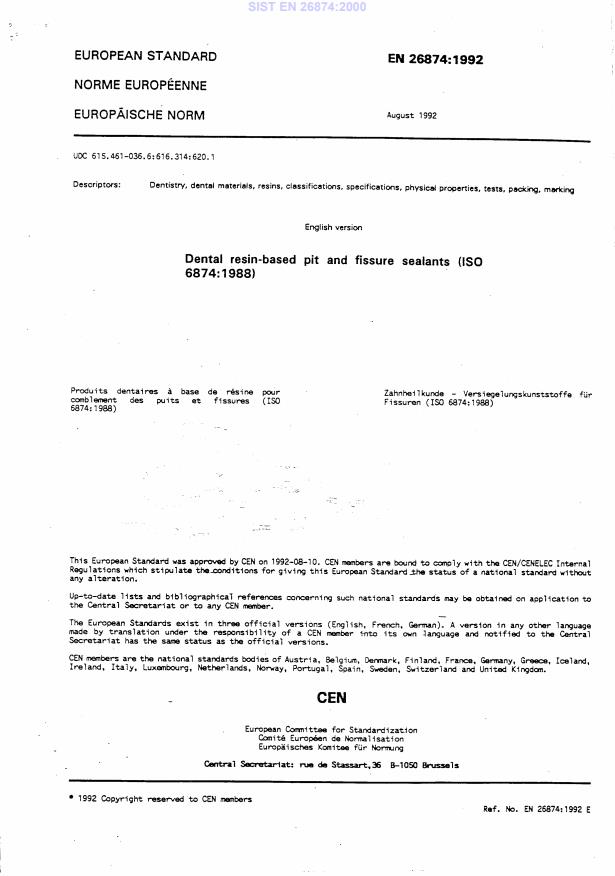
EN 26874:1992
(Main)Dental resin-based pit and fissure sealants (ISO 6874:1988)
Dental resin-based pit and fissure sealants (ISO 6874:1988)
Zahnheilkunde - Versiegelungskunststoffe für Fissuren (ISO 6874:1988)
Produits dentaires à base de résine pour comblement des puits et fissures (ISO 6874:1988)
Dental resin-based pit and fissure sealants (ISO 6874:1988)
General Information
- Status
- Withdrawn
- Publication Date
- 27-Aug-1992
- Withdrawal Date
- 14-Aug-2005
- Technical Committee
- CEN/TC 55 - Dentistry
- Drafting Committee
- CEN/TC 55 - Dentistry
- Current Stage
- 9960 - Withdrawal effective - Withdrawal
- Start Date
- 15-Aug-2005
- Completion Date
- 15-Aug-2005
Relations
- Effective Date
- 22-Dec-2008

Get Certified
Connect with accredited certification bodies for this standard

BSI Group
BSI (British Standards Institution) is the business standards company that helps organizations make excellence a habit.

TÜV Rheinland
TÜV Rheinland is a leading international provider of technical services.

TÜV SÜD
TÜV SÜD is a trusted partner of choice for safety, security and sustainability solutions.
Sponsored listings
Frequently Asked Questions
EN 26874:1992 is a standard published by the European Committee for Standardization (CEN). Its full title is "Dental resin-based pit and fissure sealants (ISO 6874:1988)". This standard covers: Dental resin-based pit and fissure sealants (ISO 6874:1988)
Dental resin-based pit and fissure sealants (ISO 6874:1988)
EN 26874:1992 is classified under the following ICS (International Classification for Standards) categories: 11.060.10 - Dental materials. The ICS classification helps identify the subject area and facilitates finding related standards.
EN 26874:1992 has the following relationships with other standards: It is inter standard links to EN ISO 6874:2005. Understanding these relationships helps ensure you are using the most current and applicable version of the standard.
EN 26874:1992 is available in PDF format for immediate download after purchase. The document can be added to your cart and obtained through the secure checkout process. Digital delivery ensures instant access to the complete standard document.
Standards Content (Sample)
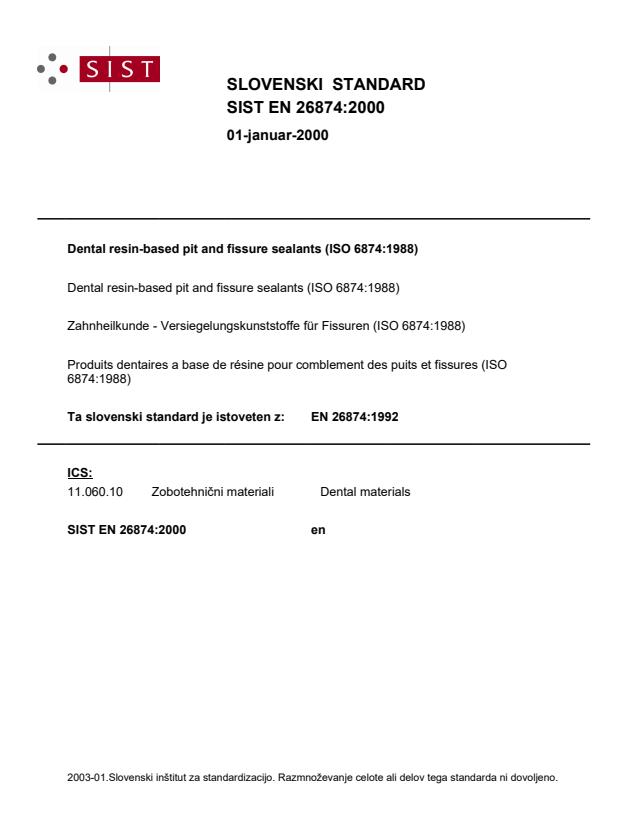
2003-01.Slovenski inštitut za standardizacijo. Razmnoževanje celote ali delov tega standarda ni dovoljeno.Dental resin-based pit and fissure sealants (ISO 6874:1988)Zahnheilkunde - Versiegelungskunststoffe für Fissuren (ISO 6874:1988)Produits dentaires a base de résine pour comblement des puits et fissures (ISO 6874:1988)Dental resin-based pit and fissure sealants (ISO 6874:1988)11.060.10Dental materialsICS:Ta slovenski standard je istoveten z:EN 26874:1992SIST EN 26874:2000en01-januar-2000SIST EN 26874:2000SLOVENSKI
STANDARD
INTERNATIONAL STANDARD ---~ -_~-- __-- INTERNATIONAL ORGANIZATION FOR STANDARDIZATION ORGANISATION INTERNATIONALE DE NORMALISATION MEXJJYHAPOAHAR OPTAHM3AL(Mfl l-l0 CTAH~APTM3A~MM Dental resin-based pit and fissure sealants Produits dentaires 21 base de rksine pour comblement des puits et fissures ISO 6874 First edition 1988-11-15 Reference number ISO 6874: 1988 (E) SIST EN 26874:2000
ISO 6874 : 1988 (El Foreword ISO (the International Organization for Standardization) is a worldwide federation of national Standards bodies (ISO member bodies). The work of preparing International Standards is normally carried out through ISO technical committees. Esch member body interested in a subject for which a technical committee has been established has the right to be represented on that committee. International organizations, govern- mental and non-governmental, in liaison with ISO, also take part in the work. ISO collaborates closely with the International Electrotechnical Commission (IEC) on all matters of electrotechnical stndardization. Draft International Standards adopted by the technical committees are circulated to the member bodies for approval before their acceptance as International Standards by the ISO Council. They are approved in accordance with ISO procedures requiring at least 75 % approval by the member bodies voting. International Standard ISO 6874 was prepared by Technical Committee ISO/TC 106, Den tis try. 0 International Organkation for Standardkation, 1988 Printed in Switzerland SIST EN 26874:2000
ISO 6874 : 1988 (El Introduction The efficacy of pit and fissure sealant materials for the prevention of dental caries is now widely accepted. The resin-based materials harden by free radical polymerization and protect teeth from the formation of caries in the pits and fissures. Specific qualitative and quantitative requirements for freedom from biological hazard are not included in this International Standard, but it is recommended that reference should be made to ISO/TR 7405 : 1984, Biological evaluation of dental materials when assessing possible biological or toxicological hazards. SIST EN 26874:2000
Chis page intentionally left blank SIST EN 26874:2000
INTERNATIONAL STANDARD ISO 6874 : 1988 (E) Dental resin-based pit and fissure sealants 1 Scope This International Standard specifies requirements and test methods for resin-based materials suitable for sealing pits and fissures in teeth. This International Standard covers both chemically cured and external-energy-cured materials. 2 Normative references The following Standards contain provisions which, through reference in this text, constitute provisions of this International Standard. At the time of publication, the editions indicated were valid. All Standards are subject to revision, and Parties to agreements based on this International Standard are encouraged to investigate the possibility of applying the most recent editions of the Standards listed below. Members of IEC and ISO maintain registers of currently valid International Standards. ISO 2014 : 1976, Writing of calendar dates in all-numeric form. ISO 7491 : 1985, Dental ma terials - Determination of colour s tability of dental polymeric ma terials. 3 Classification For the purposes of this International Standard, resin-based pit and fissure sealants are classified, according to the method of curing, as follows : Type 1: Chemically cured Type 2: External-energy-cured 4 Requirements 4.1 General Sealants shall consist of one or more liquids, or of a combina- tion of liquids and powders or pastes that, when mixed or ac- tivated in accordance with the manufacturer’s instructions, fulfil the requirements laid down in 4.2, 4.3 and 4.4. 4.2 Condition of components The components, when handled in accordance with the manufacturer’s instructions [sec 8.3~11, shall be of uniform consistency and colour, and shall be free from extraneous mat- ter when inspected (sec 7.1). 4.3 Set sealant 4.3.1 Appearance The appearance of the set sealant shall be as described by the manufacturer [see 8.3a)l when inspected (sec 7.1). 4.4 Physical properties 4.4.1 Working time, type 1 sealant The working time for type 1 sealants, determined in accord- ante with 7.2, shall not be less than that stated by the manufacturer [see 8.3d)l or 45 s, whichever is the greater. 4.4.2 Setting time, type 1 sealant The setting time for type 1 sealants, determined in accordance with 7.3, shall not differ by more than 30 s from that stated by the manufacturer [see 8.3 d)]; in no case shall it exceed 5 min. 4.4.3 Sensitivity to ambient light, type 2 sealant The time at which the onset of polymerization is detectable for type 2 sealants, determined in accordance with 7.4, shall be not less than 25 s. 4.4.4 Curing time, type 2 sealant The curing time (i.e. the exposure time required for application of the external Source to Cause complete setting) for type 2 sealants, determined in accordance with 7.5, shall not exceed that stated by the manufacturer or 60 s, whichever is the lesser. I 4.4.5 Depth of eure, type 2 sealant The depth of eure for type 2 sealants, determined in accord- ante with 7.6, shall be not less than 1,5 mm. SIST EN 26874:2000
ISO6874:1988 (EI 4.4.6 Uncured film thickness The thermocouple consists of wires (025 * 0,051 mm in diameter, made of a material (e.g. copper/constantan) capable of registering temperature changes in a specimen of setting material to an accuracy of 0,l OC. The thermocouple is connected to an instrument (e.g. Voltmeter or Chart recorder) capable of recording the temperature to that accuracy. The uncured film thickn ess, determined shal I be not more than 0,l mm. accordance with 7.7, 4.4.7 Biocompatibility See the Introduction for guidance on biocompatibility. 7.2.2 Procedure Prepare the sealant in accordance with the manufacturer’s in- structions (see 8.3) and Start timing from the moment mixing is begun. Maintain the mould at (23 I!I 1) OC; 30 s aker the Start of mixing, place the mixed sealant in the mould and record the temperature, TI, of the sealant. Maintain the apparatus at (23 + l)OCa n continuously record the temperature of the d sealant until the peak temperature is reached. 5 Sampling The test Sample shall consist of a retail package, or packages, from the same batch containing sufficient material (a minimum of 30 g) to carry out the specified tests and repeat tests, if necessary. NOTE - A typical recording trace is shown in figure 2. As soon as the sealant is inserted into the mouid, the temperature falls slightly until it becomes steady at T( and then Starts to increase. The Point at which the temperature begins to increase denotes the Start of the setting reaction and, therefore, the end of the working time. The results are extremely temperature-dependent and slight variations within the per- mitted temperature range will Cause variations of several seconds. 6 Preparation of test specimens 6.1 Ambient conditions All test specimens shall be prepared at (23 Z!I 1) OC and at a relative humidity of (50 ZL 51%. Record the time, temperature Starts t from toYncrease. the Start of mixing until the 6.2 Procedure Carry out five determinations and calculate the mean the nearest 10 s as the working time of the seal ant. time to Prepare the sealant in accordance with the manufacturer’s in- structions [see 8.3b)l. 7.3 Setting time, type 1 sealant 7 Test methods 7.3.1 Apparatus 7.1 Inspection Thermocouple apparatus, as specified in 7.2.1. Visually inspect the test specimens to determine compliance with requirements laid down in 4.2, 4.3 .l and clau se 8. 7.3.2 Procedure Repeat the procedure described in 7.2.2, but maintain the ap- paratus at (37 + 1) OC in air. 7.2 Working time, type 1 sealant Record the time elapsed between the sta peak temperature, Tz, as the setting time, at of mixing and the 7.2.1 Apparatus t,. Thermocouple apparatus, as shown in figure 1. 7.4 Sensitivity to ambient light, type 2 sealant The appa
...
Questions, Comments and Discussion
Ask us and Technical Secretary will try to provide an answer. You can facilitate discussion about the standard in here.
Loading comments...