

EN 1434-3:2015
(Main)Heat meters - Part 3: Data exchange and interfaces
- Abstract
This European Standard specifies the general requirements and applies to heat meters. Heat meters are instruments intended for measuring the energy which in a heat-exchange circuit is absorbed (cooling) or given up (heating) by a liquid called the heat-conveying liquid. The meter indicates heat in legal units.
Part 3 specifies the data exchange between a meter and a readout device (POINT / POINT communication). For these applications using the optical readout head, the EN 62056-21 protocol is recommended.
For direct or remote local readout of a single or a few meters via a battery driven readout device, the physical layer of EN 13757-6 (local bus) is recommended.
For bigger networks with up to 250 meters, a master unit with AC mains supply according to EN 13757-2 is necessary to control the M-Bus. For these applications the physical and link layer of EN 13757-2 and the application layer of EN 13757-3 is required.
For wireless meter communications, EN 13757-4 describes several alternatives of walk/drive-by readout via a mobile station or by using stationary receivers or a network. Both unidirectionally and bidirectionally transmitting meters are supported by this standard.
- Status
- Withdrawn
- Publication Date
- 01-Dec-2015
- Withdrawal Date
- 06-Oct-2026
- Technical Committee
- CEN/TC 294 - Communication systems for meters and remote reading of meters
- Drafting Committee
- CEN/TC 294/WG 4 - Data exchange for meters on bus-systems and interface
- Current Stage
- 9960 - Withdrawal effective - Withdrawal
- Start Date
- 02-Apr-2025
- Completion Date
- 07-Oct-2026

Relations
- Effective Date
- 08-Jun-2022
- Effective Date
- 18-Jan-2023
- Effective Date
- 09-Feb-2026
- Effective Date
- 28-Jan-2026
- Refers
EN 13757-2:2018+A1:2023 - Communication systems for meters - Part 2: Wired M-Bus communication - Effective Date
- 28-Jan-2026
- Effective Date
- 28-Jan-2026
- Effective Date
- 28-Jan-2026
- Effective Date
- 28-Jan-2026
Get Certified
Connect with accredited certification bodies for this standard

BSMI (Bureau of Standards, Metrology and Inspection)
Taiwan's standards and inspection authority.
Sponsored listings
Frequently Asked Questions
EN 1434-3:2015 is a standard published by the European Committee for Standardization (CEN). Its full title is "Heat meters - Part 3: Data exchange and interfaces". This standard covers: This European Standard specifies the general requirements and applies to heat meters. Heat meters are instruments intended for measuring the energy which in a heat-exchange circuit is absorbed (cooling) or given up (heating) by a liquid called the heat-conveying liquid. The meter indicates heat in legal units. Part 3 specifies the data exchange between a meter and a readout device (POINT / POINT communication). For these applications using the optical readout head, the EN 62056-21 protocol is recommended. For direct or remote local readout of a single or a few meters via a battery driven readout device, the physical layer of EN 13757-6 (local bus) is recommended. For bigger networks with up to 250 meters, a master unit with AC mains supply according to EN 13757-2 is necessary to control the M-Bus. For these applications the physical and link layer of EN 13757-2 and the application layer of EN 13757-3 is required. For wireless meter communications, EN 13757-4 describes several alternatives of walk/drive-by readout via a mobile station or by using stationary receivers or a network. Both unidirectionally and bidirectionally transmitting meters are supported by this standard.
This European Standard specifies the general requirements and applies to heat meters. Heat meters are instruments intended for measuring the energy which in a heat-exchange circuit is absorbed (cooling) or given up (heating) by a liquid called the heat-conveying liquid. The meter indicates heat in legal units. Part 3 specifies the data exchange between a meter and a readout device (POINT / POINT communication). For these applications using the optical readout head, the EN 62056-21 protocol is recommended. For direct or remote local readout of a single or a few meters via a battery driven readout device, the physical layer of EN 13757-6 (local bus) is recommended. For bigger networks with up to 250 meters, a master unit with AC mains supply according to EN 13757-2 is necessary to control the M-Bus. For these applications the physical and link layer of EN 13757-2 and the application layer of EN 13757-3 is required. For wireless meter communications, EN 13757-4 describes several alternatives of walk/drive-by readout via a mobile station or by using stationary receivers or a network. Both unidirectionally and bidirectionally transmitting meters are supported by this standard.
EN 1434-3:2015 is classified under the following ICS (International Classification for Standards) categories: 17.200.10 - Heat. Calorimetry. The ICS classification helps identify the subject area and facilitates finding related standards.
EN 1434-3:2015 has the following relationships with other standards: It is inter standard links to EN 1434-3:2008, EN 1434-3:2025, EN 62056-21:2002, EN 13757-3:2013, EN 13757-2:2018+A1:2023, EN 13757-4:2025, EN 13757-6:2015, EN 1434-2:2022. Understanding these relationships helps ensure you are using the most current and applicable version of the standard.
EN 1434-3:2015 is available in PDF format for immediate download after purchase. The document can be added to your cart and obtained through the secure checkout process. Digital delivery ensures instant access to the complete standard document.
Standards Content (Sample)
2003-01.Slovenski inštitut za standardizacijo. Razmnoževanje celote ali delov tega standarda ni dovoljeno.Toplotni števci - 3. del: Izmenjava podatkov in vmesnikiWärmezähler - Teil 3: Datenaustausch und SchnittstellenCompteurs d'énergie thermique - Partie 3 : Échange de données et interfacesHeat meters - Part 3: Data exchange and interfaces17.200.10Toplota. KalorimetrijaHeat. CalorimetryICS:Ta slovenski standard je istoveten z:EN 1434-3:2015SIST EN 1434-3:2016en,fr,de01-februar-2016SIST EN 1434-3:2016SLOVENSKI
STANDARDSIST EN 1434-3:20081DGRPHãþD
EUROPEAN STANDARD NORME EUROPÉENNE EUROPÄISCHE NORM
EN 1434-3
December
t r s w ICS
s yä t r rä s r Supersedes EN
s v u væ uã t r r zEnglish Version
Heat meters æ Part
uã Data exchange and interfaces Compteurs d 5énergie thermique æ Partie
u ã Échange de données et interfaces
Wärmezähler æ Teil
uã Datenaustausch und Schnittstellen This European Standard was approved by CEN on
t y September
t r s wä
egulations which stipulate the conditions for giving this European Standard the status of a national standard without any alterationä Upætoædate lists and bibliographical references concerning such national standards may be obtained on application to the CENæCENELEC Management Centre or to any CEN memberä
translation under the responsibility of a CEN member into its own language and notified to the CENæCENELEC Management Centre has the same status as the official versionsä
CEN members are the national standards bodies of Austriaá Belgiumá Bulgariaá Croatiaá Cyprusá Czech Republicá Denmarká Estoniaá Finlandá Former Yugoslav Republic of Macedoniaá Franceá Germanyá Greeceá Hungaryá Icelandá Irelandá Italyá Latviaá Lithuaniaá Luxembourgá Maltaá Netherlandsá Norwayá Polandá Portugalá Romaniaá Slovakiaá Sloveniaá Spainá Swedená Switzerlandá Turkey and United Kingdomä
EUROPEAN COMMITTEE FOR STANDARDIZATION COMITÉ EUROPÉEN DE NORMALISATION EUROPÄISCHES KOMITEE FÜR NORMUNG
CEN-CENELEC Management Centre:
Avenue Marnix 17,
B-1000 Brussels
t r s w CEN All rights of exploitation in any form and by any means reserved worldwide for CEN national Membersä Refä Noä EN
s v u væ uã t r s w ESIST EN 1434-3:2016
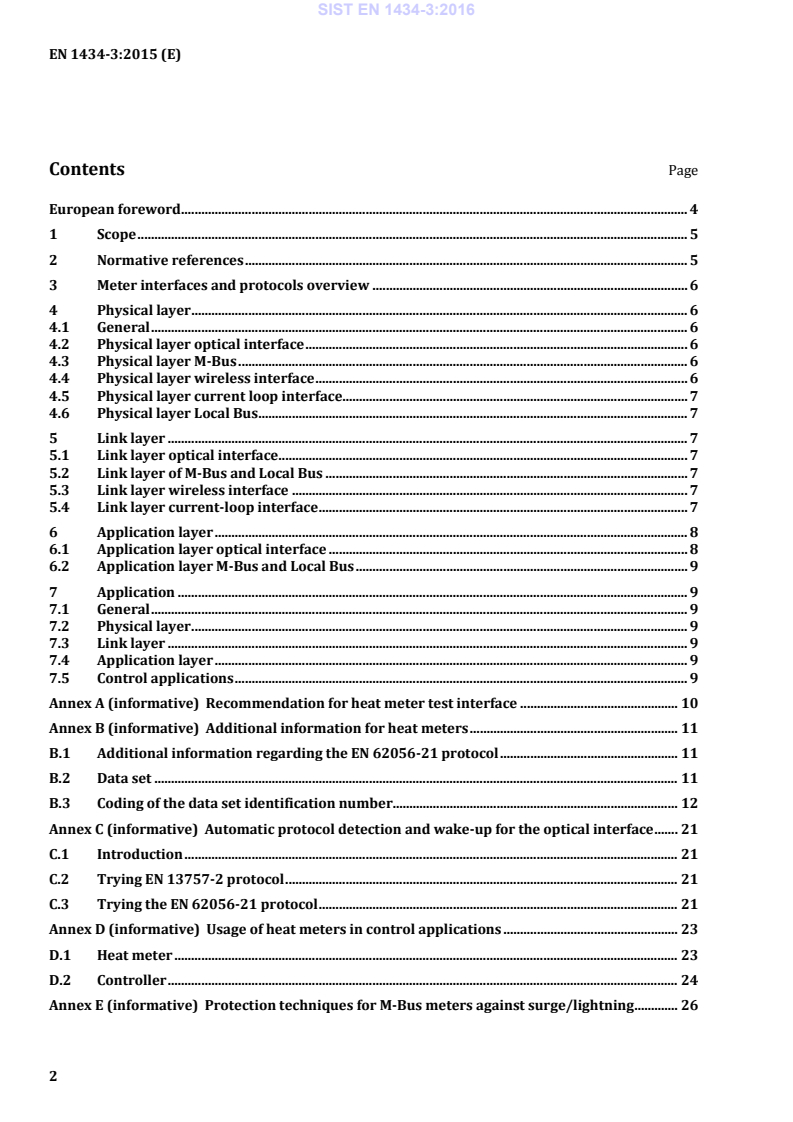
Recommendation for heat meter test interface . 10 Annex B (informative)
Additional information for heat meters . 11 B.1 Additional information regarding the EN 62056-21 protocol . 11 B.2 Data set . 11 B.3 Coding of the data set identification number . 12 Annex C (informative)
Automatic protocol detection and wake-up for the optical interface . 21 C.1 Introduction . 21 C.2 Trying EN 13757-2 protocol . 21 C.3 Trying the EN 62056-21 protocol . 21 Annex D (informative)
Usage of heat meters in control applications . 23 D.1 Heat meter . 23 D.2 Controller . 24 Annex E (informative)
Protection techniques for M-Bus meters against surge/lightning . 26 SIST EN 1434-3:2016
Additional information about the master-unit for the M-Bus . 30 F.1 Master side interface to the M-Bus . 30 F.2 Master side interface for local data read out . 30 F.3 Full size level converter . 31 Bibliography . 33
Recommendation for heat meter test interface Modern heat meters are mainly equipped with CMOS microprocessors with a very low power consumption, allowing battery operation. Testing and adjusting of this type of meters needs a completely different approach. Until now, almost every meter type needed its own test equipment to handle the manufacturer's specific requirements. This is a very complicated and expensive way for users of several types of meters and for initial verification institutes. The more different types of heat meters a user has installed, the more testing equipment he may need. An economical testing of several meters should be possible and an easy adaptation to the existing test bench is of great interest. Since this problem came up, experts have been researching an acceptable solution to it. Details of one example of an acceptable solution are given in AGFW FW 203, "Normierter Wärmezähler-Adapter" [3]. SIST EN 1434-3:2016
Additional information for heat meters B.1 Additional information regarding the EN 62056-21 protocol List of "T" group codes. Overview on values in use: — "0" = identification (only in connection with value type 0); — "1" = reserved for electrical energy active; — "2" = reserved for electrical energy reactive; — "3" = reserved for electrical energy reserve; — "4" = not used; — "5" = reserved for energy; — "6" = heat meters; — "7" = gas meters; — "8" = water meters; — "9" = reserved for specific identification number or status information; — "F" = error identification for meters. NOTE This list is taken from "VEÖ Pflichtenheft für Tarifgeräte" [4]. B.2 Data set
Figure B.1 — Signal direction As recommended in EN 62056-21:2002, 5.7 each data set (shown diagrammatically above) consists of: — an identification number with the schematic structure; SIST EN 1434-3:2016
Key 1 group code, 1 digit 6 separator, 1 character only to be used if the 2 separator, decimal point
following value is a stored value: 3 type of register, 1 or 2 digits
* separator: if reset is triggered automatically 4 separator, decimal point
(e.g. RCR, RTC) 5 number of the tariff, 1 digit
& separator: if reset is done manually (e.g. by
e.g. 1 = tariff 1; 2 = tariff 2
push button)
...9 = tariff 9 7 number of pre-stored values, 2 digits, to be used
only if the following value is a stored value Figure B.2 — Schematic structure B.3.2 Values for “T” group code Relevant values for heat meters are: "0" for the identification, "6" to identify a heat meter and "F" to identify an error message. The code "9" can be used for manufacturer specific status information. For additional information refer to B.3.7. B.3.3 Values for "UU", register codes The "UU" consists of a one or two digit number to identify the measured values. The numbers shown in Table B.1 shall be used for heat meters. The heat meter shall at least transmit the values for 0, 8 and 26. SIST EN 1434-3:2016
...