

EN 12501-1:2003
(Main)Protection of metallic materials against corrosion - Corrosion likelihood in soil - Part 1: General
- Abstract
This standard provides a basis for assessing the corrosion likelihood in soil of buried metallic structures. These structures include for example pipelines, metal sheathed cables, storage tanks, sheet pilings, tower support anchors, culverts and earth reinforcement. Metallic materials covered by the standard are steel, cast iron and stainless steel, as well as copper, lead, aluminium, zinc and their alloys. These metallic materials may be uncoated or coated with other metallic materials.
- Status
- Published
- Publication Date
- 22-Apr-2003
- Withdrawal Date
- 30-Oct-2003
- Technical Committee
- CEN/TC 262 - Metallic and other inorganic coatings
- Drafting Committee
- CEN/TC 262/WG 10 - Corrosion likelihood
- Current Stage
- 9093 - Decision to confirm - Review Enquiry
- Start Date
- 15-Jan-2024
- Completion Date
- 07-Oct-2026

Overview
EN 12501-1:2003 - Protection of metallic materials against corrosion - Corrosion likelihood in soil - Part 1: General (CEN) provides a structured basis for assessing the likelihood of soil corrosion affecting buried metallic structures. It applies to a wide range of buried assets (pipelines, metal-sheathed cables, storage tanks, sheet piling, anchors, culverts, earth reinforcement) and to common metals and alloys including steel, cast iron, stainless steel, copper, lead, aluminium, zinc and their alloys (coated or uncoated). EN 12501-1 defines general concepts, assessment steps and the main factors that influence corrosion in soil, and it is intended to be used together with Part 2 and other product- or protection-specific standards.
Key Topics
- Corrosion load in soil: Defines the concept and introduces a practical assessment framework that combines soil parameters, structure characteristics and environmental factors.
- Three-class classification: Corrosion load in soil is classified as LOW / MEDIUM / HIGH for a given metal; this reflects the probability of corrosion rates or specific corrosion types (e.g., pitting, crevice corrosion).
- Assessment procedure: A stepwise method (Annex A) covering:
- Preliminary enquiry (design documents, geological/hydrological maps)
- Site survey (physico-chemical soil characteristics, pollution indicators, voltage gradients)
- Soil sampling and laboratory analysis
- Factors influencing soil corrosion (summarized in Annex B): soil texture and resistivity, pH, water content, salts (chlorides, sulfates), bacterial activity (sulfate-reducing bacteria), backfill, structure geometry, coatings, electrical continuity and stray/current influences.
- Limitations and scope: Part 1 gives general guidance; detailed quantitative assessment and metallic-specific criteria are in EN 12501-2 (low-alloy and non-alloy ferrous materials). Cathodic protection design and measurement are outside the detailed scope (see related standards).
Applications and Users
- Practical for engineers and corrosion specialists performing soil corrosion assessments for new design, maintenance planning or risk analysis of buried metallic infrastructure.
- Used by pipeline operators, utility companies, civil/structural engineers, asset managers and consultants to:
- Identify risk of appearance of corrosion damage
- Decide monitoring needs and the necessity for additional protective measures (coatings, cathodic protection)
- Inform design choices and service-life expectations
- Useful input for environmental site investigations, soil sampling campaigns and pre-construction reviews.
Related Standards
- EN 12501-2 - Corrosion likelihood in soil: Low-alloyed and non-alloyed ferrous materials
- EN 12954, EN 13509 - Cathodic protection and measurement techniques
- prEN 50162 - Protection against corrosion from stray DC currents
Keywords: EN 12501-1, corrosion likelihood in soil, buried metallic structures, soil corrosion assessment, corrosion load, soil sampling, cathodic protection.
Relations
- Refers
EN ISO 8044:1999 - Corrosion of metals and alloys - Basic terms and definitions (ISO 8044:1999) - Effective Date
- 28-Jan-2026
- Effective Date
- 28-Jan-2026
- Effective Date
- 28-Jan-2026
Get Certified
Connect with accredited certification bodies for this standard

Element Materials Technology
Materials testing and product certification.

Inštitut za kovinske materiale in tehnologije
Institute of Metals and Technology. Materials testing, metallurgical analysis, NDT.
Sponsored listings
Frequently Asked Questions
EN 12501-1:2003 is a standard published by the European Committee for Standardization (CEN). Its full title is "Protection of metallic materials against corrosion - Corrosion likelihood in soil - Part 1: General". This standard covers: This standard provides a basis for assessing the corrosion likelihood in soil of buried metallic structures. These structures include for example pipelines, metal sheathed cables, storage tanks, sheet pilings, tower support anchors, culverts and earth reinforcement. Metallic materials covered by the standard are steel, cast iron and stainless steel, as well as copper, lead, aluminium, zinc and their alloys. These metallic materials may be uncoated or coated with other metallic materials.
This standard provides a basis for assessing the corrosion likelihood in soil of buried metallic structures. These structures include for example pipelines, metal sheathed cables, storage tanks, sheet pilings, tower support anchors, culverts and earth reinforcement. Metallic materials covered by the standard are steel, cast iron and stainless steel, as well as copper, lead, aluminium, zinc and their alloys. These metallic materials may be uncoated or coated with other metallic materials.
EN 12501-1:2003 is classified under the following ICS (International Classification for Standards) categories: 77.060 - Corrosion of metals. The ICS classification helps identify the subject area and facilitates finding related standards.
EN 12501-1:2003 has the following relationships with other standards: It is inter standard links to EN ISO 8044:1999, EN 12501-2:2003, EN ISO 13631:2002. Understanding these relationships helps ensure you are using the most current and applicable version of the standard.
EN 12501-1:2003 is available in PDF format for immediate download after purchase. The document can be added to your cart and obtained through the secure checkout process. Digital delivery ensures instant access to the complete standard document.
Standards Content (Sample)
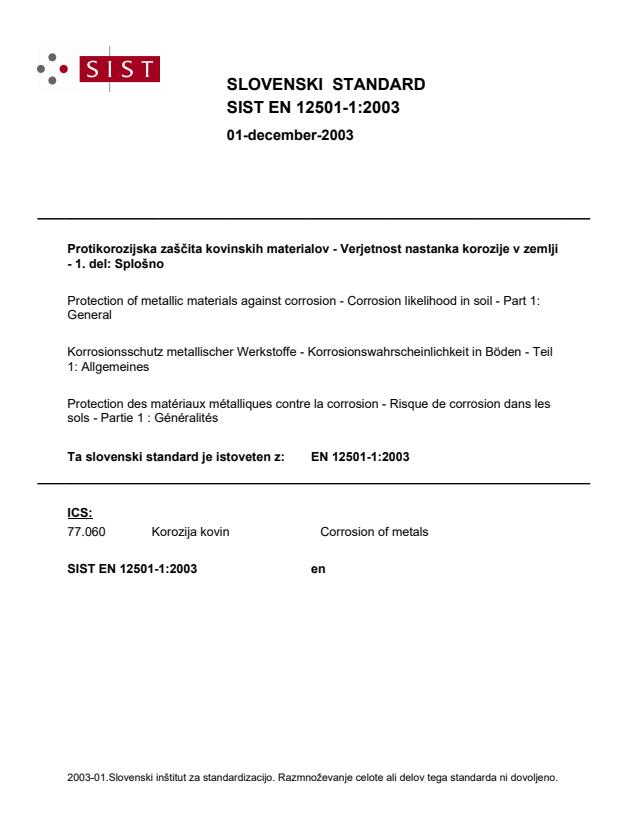
2003-01.Slovenski inštitut za standardizacijo. Razmnoževanje celote ali delov tega standarda ni dovoljeno.Korrosionsschutz metallischer Werkstoffe - Korrosionswahrscheinlichkeit in Böden - Teil 1: AllgemeinesProtection des matériaux métalliques contre la corrosion - Risque de corrosion dans les sols - Partie 1 : GénéralitésProtection of metallic materials against corrosion - Corrosion likelihood in soil - Part 1: General77.060Korozija kovinCorrosion of metalsICS:Ta slovenski standard je istoveten z:EN 12501-1:2003SIST EN 12501-1:2003en01-december-2003SIST EN 12501-1:2003SLOVENSKI
STANDARD
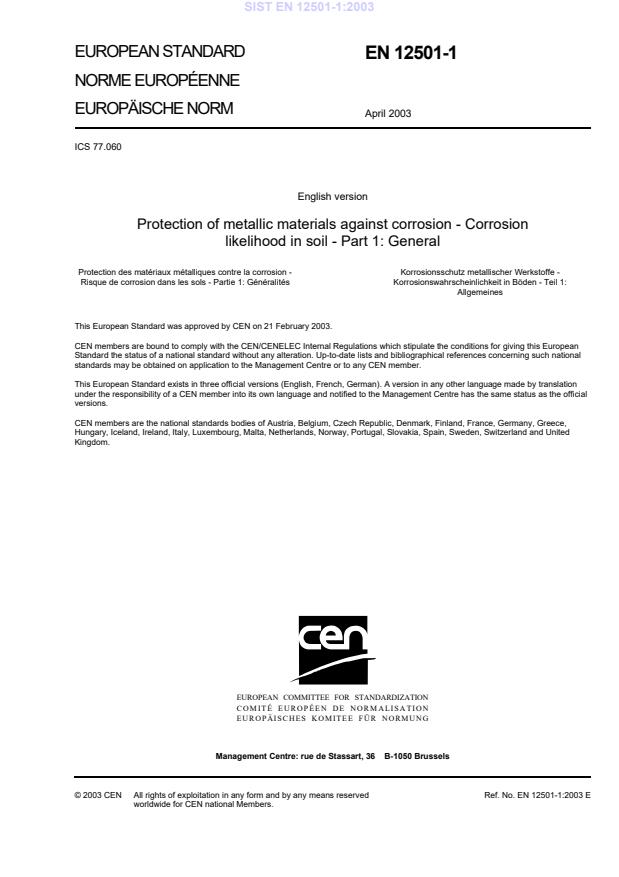
EUROPEAN STANDARDNORME EUROPÉENNEEUROPÄISCHE NORMEN 12501-1April 2003ICS 77.060English versionProtection of metallic materials against corrosion - Corrosionlikelihood in soil - Part 1: GeneralProtection des matériaux métalliques contre la corrosion -Risque de corrosion dans les sols - Partie 1: GénéralitésKorrosionsschutz metallischer Werkstoffe -Korrosionswahrscheinlichkeit in Böden - Teil 1:AllgemeinesThis European Standard was approved by CEN on 21 February 2003.CEN members are bound to comply with the CEN/CENELEC Internal Regulations which stipulate the conditions for giving this EuropeanStandard the status of a national standard without any alteration. Up-to-date lists and bibliographical references concerning such nationalstandards may be obtained on application to the Management Centre or to any CEN member.This European Standard exists in three official versions (English, French, German). A version in any other language made by translationunder the responsibility of a CEN member into its own language and notified to the Management Centre has the same status as the officialversions.CEN members are the national standards bodies of Austria, Belgium, Czech Republic, Denmark, Finland, France, Germany, Greece,Hungary, Iceland, Ireland, Italy, Luxembourg, Malta, Netherlands, Norway, Portugal, Slovakia, Spain, Sweden, Switzerland and UnitedKingdom.EUROPEAN COMMITTEE FOR STANDARDIZATIONCOMITÉ EUROPÉEN DE NORMALISATIONEUROPÄISCHES KOMITEE FÜR NORMUNGManagement Centre: rue de Stassart, 36
B-1050 Brussels© 2003 CENAll rights of exploitation in any form and by any means reservedworldwide for CEN national Members.Ref. No. EN 12501-1:2003 ESIST EN 12501-1:2003
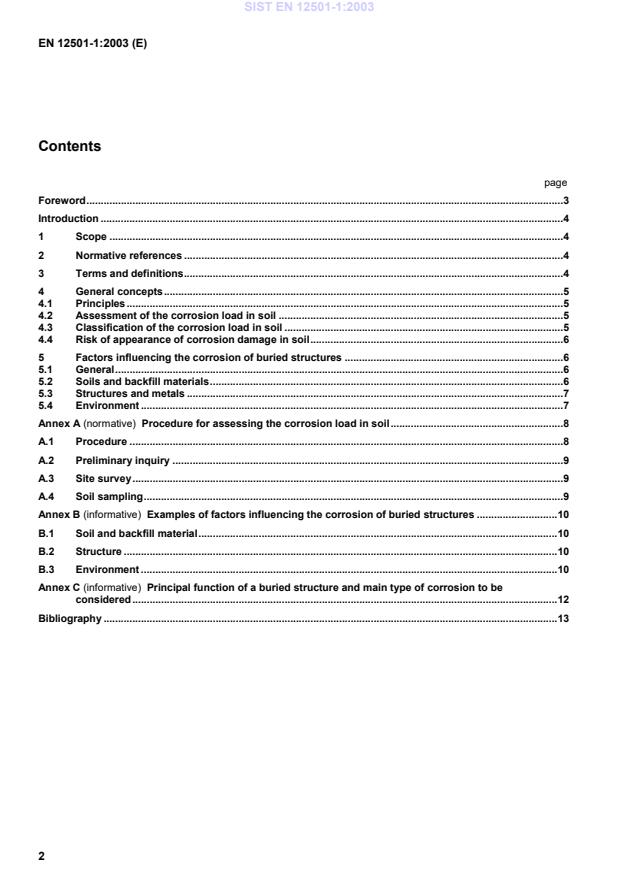
Procedure for assessing the corrosion load in soil.8A.1Procedure.8A.2Preliminary inquiry.9A.3Site survey.9A.4Soil sampling.9Annex B (informative)
Examples of factors influencing the corrosion of buried structures.10B.1Soil and backfill material.10B.2Structure.10B.3Environment.10Annex C (informative)
Principal function of a buried structure and main type of corrosion to beconsidered.12Bibliography.13SIST EN 12501-1:2003
...