


EN 15490:2007
(Main)Ethanol as a blending component for petrol - Determination of pHe
Ethanol as a blending component for petrol - Determination of pHe
This European Standard describes a procedure for the determination of acid strength, as a pHe value, of ethanol to be used as a blend component for gasoline.
NOTE For the purposes of this European Standard, the term “% (V/V)” is used to represent the volume fraction.
Ethanol zur Verwendung als Blendkomponente in Ottokraftstoff - Bestimmung des pHe-Wertes
Ethanol comme base de mélange à l'essence - Détermination du pHe
La présente Norme européenne prescrit une procédure pour la détermination de l’acidité, sous forme de pHe, de l’éthanol utilisé comme base de mélange à l'essence pour automobiles.
Pour des informations supplémentaires concernant l'applicabilité de ce document, le lecteur peut se référer à l'Annexe A.
NOTE Pour les besoins de la présente Norme européenne, le terme « % (V/V) » est utilisé pour représenter la fraction volumique.
Etanol kot komponenta za dodajanje motornemu bencinu – Določevanje pH vrednosti
General Information
- Status
- Published
- Publication Date
- 21-Aug-2007
- Withdrawal Date
- 21-Feb-2008
- Technical Committee
- CEN/TC 19 - Petroleum products, lubricants and related products
- Drafting Committee
- CEN/TC 19 - Petroleum products, lubricants and related products
- Current Stage
- 9093 - Decision to confirm - Review Enquiry
- Start Date
- 23-Mar-2012
- Completion Date
- 23-Mar-2012
Overview
EN 15490:2007 is a European Standard developed by CEN focused on the determination of pHe - the acid strength in ethanol intended for use as a blending component in petrol (gasoline). This standard outlines a specific procedure for measuring the pHe value, which is critical to maintaining fuel quality and ensuring compliance with European fuel regulations. The standard is applicable for ethanol blending in petrol, emphasizing analytical accuracy and sample handling to assess ethanol’s acid-base properties in a non-aqueous environment.
The method utilizes a pH meter system with a lithium chloride (LiCl) electrode in an ethanol medium to obtain the pHe value. Although primarily designed for ethanol in fuel applications, this method highlights limitations in precision and reproducibility at regulatory boundaries, with further improvements and replacement testing methods anticipated.
Key Topics
Scope and Purpose
- Defines a procedure to measure acid strength (pHe) in ethanol for petrol blending.
- Essential for verifying ethanol quality and preventing the presence of strong acids or alkalis.
Measurement Principle
- Measurement involves a combined pH electrode filled with lithium chloride in 99% ethanol.
- Temperature control at 22 °C ± 2 °C during testing to stabilize readings.
- Non-aqueous measurement means pHe values are not directly comparable to aqueous pH.
Reagents and Equipment
- Use of high-purity reagents: 99% ethanol, buffer solutions at pH 4, 7, and 10.
- Instruments include a precise pH meter (0.01 pH resolution), combined electrodes suited for ethanol media, magnetic stirrers, and covered beakers to minimize CO2 contamination.
Sampling and Handling
- Sampling procedures follow EN ISO 3170 to avoid atmospheric moisture uptake.
- Use of sealed glass bottles and syringe sampling to maintain sample integrity.
Calibration and Verification
- Calibration with standard buffer solutions in ethanol to ensure accuracy.
- Daily equipment verification using pH 7 buffer ensures measurement reliability.
Test Methodology
- Method involves stirring the ethanol sample, waiting for pHe stabilization (may exceed 4 minutes).
- Minimizing exposure to atmospheric CO2 is important to reduce measurement drift.
- Result is expressed to the nearest 0.01 pHe unit.
Precision and Reproducibility
- Repeatability and reproducibility figures are provided, highlighting variability sources.
- The method has limited robustness near ethanol specification limits due to water content influences and electrode response variability.
Applications
Fuel Quality Control
- Monitoring acid strength in ethanol used as a gasoline blending component.
- Ensuring ethanol meets fuel standards to prevent damage to engines and fuel systems.
Regulatory Compliance
- Assists laboratories and manufacturers in adhering to European ethanol fuel specifications.
- Measurement of pHe helps detect presence/absence of harmful strong acids or alkalines in ethanol fuel.
Research and Development
- Provides baseline methods for ethanol acidity analysis in biofuel development.
- Supports further innovation to improve ethanol fuel blend quality through enhanced analytical techniques.
Related Standards
- EN ISO 3170: Petroleum liquids - Manual sampling procedures applicable during ethanol sampling.
- EN ISO 3696: Water for analytical laboratory use - Ensures use of high purity water in testing processes.
- EN ISO 4259: Petroleum products - Guidelines on precision and reproducibility analysis relevant to the evaluation of pHe results.
Practical Notes
- Users must handle samples carefully to minimize contamination and moisture uptake.
- Electrode conditioning and proper calibration are critical for precise results.
- Stability of the pHe reading varies, and prolonged stirring may be necessary to attain accuracy.
- The method is recognized as insufficient for detecting some specification limits; emerging tests will address its limitations.
Keywords
EN 15490:2007, ethanol blending component, petrol blending, pHe determination, acid strength ethanol, ethanol fuel quality, fuel ethanol specifications, pHe measurement procedure, CEN standards ethanol, ethanol sampling and analysis, fuel blend acidity testing, European ethanol fuel standard.


Frequently Asked Questions
EN 15490:2007 is a standard published by the European Committee for Standardization (CEN). Its full title is "Ethanol as a blending component for petrol - Determination of pHe". This standard covers: This European Standard describes a procedure for the determination of acid strength, as a pHe value, of ethanol to be used as a blend component for gasoline. NOTE For the purposes of this European Standard, the term “% (V/V)” is used to represent the volume fraction.
This European Standard describes a procedure for the determination of acid strength, as a pHe value, of ethanol to be used as a blend component for gasoline. NOTE For the purposes of this European Standard, the term “% (V/V)” is used to represent the volume fraction.
EN 15490:2007 is classified under the following ICS (International Classification for Standards) categories: 71.080.60 - Alcohols. Ethers; 75.160.20 - Liquid fuels. The ICS classification helps identify the subject area and facilitates finding related standards.
EN 15490:2007 is associated with the following European legislation: EU Directives/Regulations: 98/70/EC; Standardization Mandates: M/344. When a standard is cited in the Official Journal of the European Union, products manufactured in conformity with it benefit from a presumption of conformity with the essential requirements of the corresponding EU directive or regulation.
You can purchase EN 15490:2007 directly from iTeh Standards. The document is available in PDF format and is delivered instantly after payment. Add the standard to your cart and complete the secure checkout process. iTeh Standards is an authorized distributor of CEN standards.
Standards Content (Sample)
2003-01.Slovenski inštitut za standardizacijo. Razmnoževanje celote ali delov tega standarda ni dovoljeno.Ethanol as a blending component for petrol - Determination of pHeYUHGQRVWLEthanol comme base de mélange a l'essence - Détermination du pHeEthanol zur Verwendung als Blendkomponente in Ottokraftstoff - Bestimmung des pHe-WertesTa slovenski standard je istoveten z:EN 15490:2007SIST EN 15490:2007en75.160.20Liquid fuels71.080.60Alkoholi. EtriAlcohols. EthersICS:SLOVENSKI
STANDARDSIST EN 15490:200701-december-2007
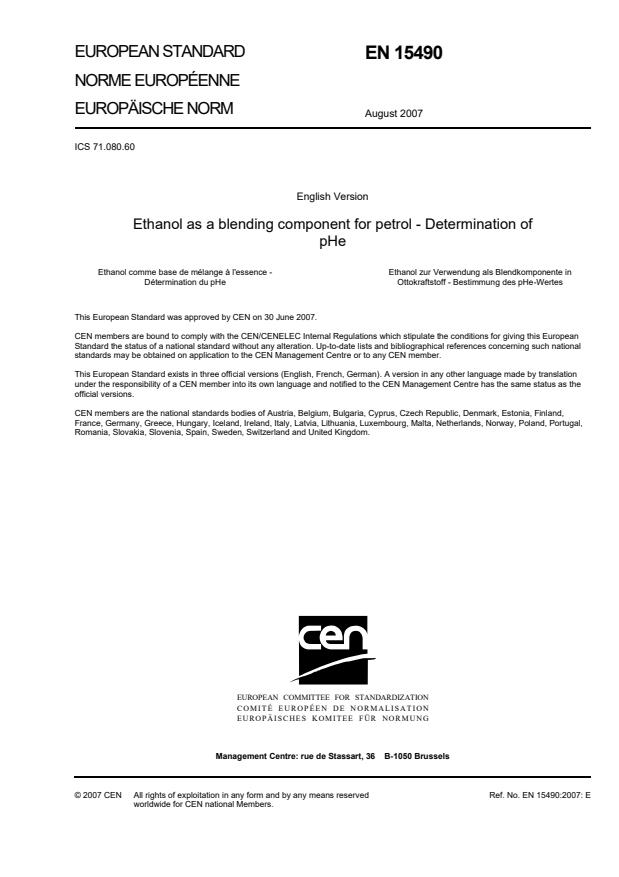
EUROPEAN STANDARDNORME EUROPÉENNEEUROPÄISCHE NORMEN 15490August 2007ICS 71.080.60 English VersionEthanol as a blending component for petrol - Determination ofpHeEthanol comme base de mélange à l'essence -Détermination du pHeEthanol zur Verwendung als Blendkomponente inOttokraftstoff - Bestimmung des pHe-WertesThis European Standard was approved by CEN on 30 June 2007.CEN members are bound to comply with the CEN/CENELEC Internal Regulations which stipulate the conditions for giving this EuropeanStandard the status of a national standard without any alteration. Up-to-date lists and bibliographical references concerning such nationalstandards may be obtained on application to the CEN Management Centre or to any CEN member.This European Standard exists in three official versions (English, French, German). A version in any other language made by translationunder the responsibility of a CEN member into its own language and notified to the CEN Management Centre has the same status as theofficial versions.CEN members are the national standards bodies of Austria, Belgium, Bulgaria, Cyprus, Czech Republic, Denmark, Estonia, Finland,France, Germany, Greece, Hungary, Iceland, Ireland, Italy, Latvia, Lithuania, Luxembourg, Malta, Netherlands, Norway, Poland, Portugal,Romania, Slovakia, Slovenia, Spain, Sweden, Switzerland and United Kingdom.EUROPEAN COMMITTEE FOR STANDARDIZATIONCOMITÉ EUROPÉEN DE NORMALISATIONEUROPÄISCHES KOMITEE FÜR NORMUNGManagement Centre: rue de Stassart, 36
B-1050 Brussels© 2007 CENAll rights of exploitation in any form and by any means reservedworldwide for CEN national Members.Ref. No. EN 15490:2007: E
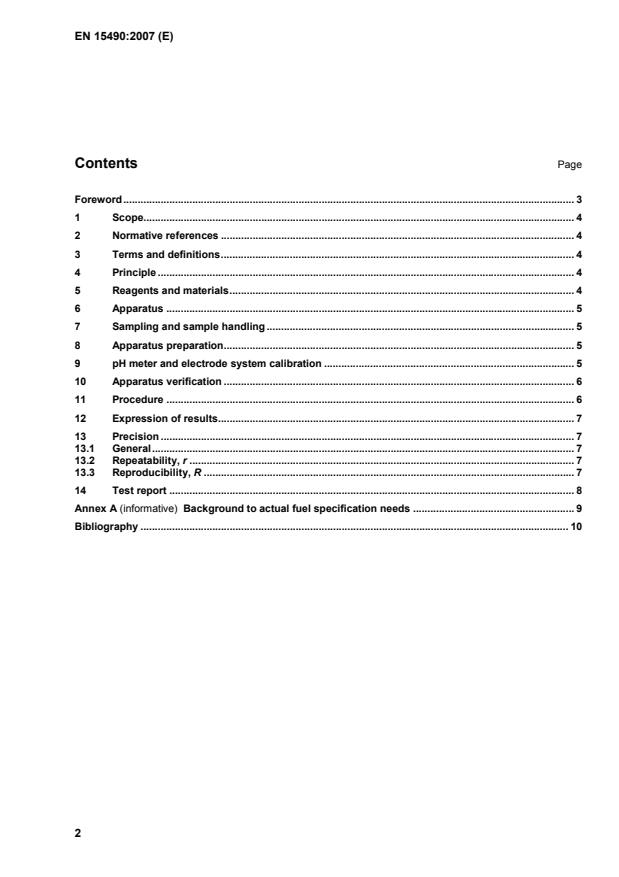
2 Contents Page Foreword.3 1 Scope.4 2 Normative references.4 3 Terms and definitions.4 4 Principle.4 5 Reagents and materials.4 6 Apparatus.5 7 Sampling and sample handling.5 8 Apparatus preparation.5 9 pH meter and electrode system calibration.5 10 Apparatus verification.6 11 Procedure.6 12 Expression of results.7 13 Precision.7 13.1 General.7 13.2 Repeatability, r.7 13.3 Reproducibility, R.7 14 Test report.8 Annex A (informative)
Background to actual fuel specification needs.9 Bibliography.10
...
Questions, Comments and Discussion
Ask us and Technical Secretary will try to provide an answer. You can facilitate discussion about the standard in here.
Loading comments...