

FprEN 3293
(Main)Aerospace series - Bolts, T-head, close tolerance, medium thread length, in heat resisting nickel base alloy NI-P100HT (Inconel 718), uncoated - Classification: 1 275 MPa/650 °C
- Abstract
This document specifies the dimensions of uncoated T-head bolts, close tolerance, with MJ-thread, medium thread length, in heat-resisting nickel base alloy NI-P100HT for aerospace applications.
Maximum test temperature of the parts is 650 °C.
These bolts are used in aerospace fastening systems mainly stressed in shearing force.
- Status
- Not Published
- Publication Date
- 29-Nov-2026
- Technical Committee
- ASD-STAN - Aerospace
- Drafting Committee
- ASD-STAN/D 3/WG 2 - Fasteners
- Current Stage
- 6055 - CEN Ratification completed (DOR) - Publishing
- Start Date
- 28-Sep-2026
- Due Date
- 28-Sep-2026
- Completion Date
- 28-Sep-2026

FprEN 3293 is a CEN draft European Standard for uncoated, close-tolerance T-head bolts for aerospace use. It specifies the dimensions, designation, marking, material reference and technical specification for MJ-thread bolts made from heat-resisting nickel base alloy NI-P100HT (Inconel 718), classified as 1 275 MPa/650 °C. The bolts are intended mainly for aerospace fastening systems that are stressed in shear.
What does FprEN 3293 specify?
FprEN 3293 specifies the dimensions of uncoated T-head bolts with close tolerance, MJ-thread and medium thread length for aerospace applications. It also sets the associated designation, marking and technical specification, so users can identify the correct bolt and check that it matches the intended aerospace fastener definition.
The document is organized into these clauses:
- Scope
- Normative references
- Terms and definitions
- Required characteristics
- Designation
- Marking
- Technical specification
For practical use, that means the standard is not just a drawing standard. It combines the bolt geometry with the material basis and the identification rules needed for ordering, inspection and product marking.
What are the key requirements of FprEN 3293?
FprEN 3293 focuses on a defined bolt family rather than a general fastener range. The main requirement is that the bolt form, size limits and material basis stay within the document so the parts fit aerospace joints reliably.
Geometry, dimensions and tolerances
Clause 4.1 ties the bolt configuration to Figure 1 and the dimensions, tolerances and masses to Tables 1 and 2. The document also states that unspecified details of form are left to the manufacturer's option. In practice, this means the buyer or inspector checks the stated dimensions and does not assume extra shape features beyond what is shown.
The figure and tables cover the nominal diameter codes and lengths used for this bolt family. The notes in Figure 1 also control thread runout, lead thread and the way certain measurements are taken when the shank is shorter than the nominal shank diameter. That matters because close-tolerance bolts are sensitive to fit, alignment and how dimensional checks are made.
Edge condition and thread form
Clause 4.1 requires sharp edges to be broken within a small radius range, and it links thread runout and lead thread to ISO 3353-1. It also states that the thread major diameter tolerance is modified according to Figure 1. In practice, this gives the manufacturer and inspector a clear rule for the thread area, which is critical for assembly and load transfer.
Material and surface condition
Clause 4.2 requires the nickel alloy to comply with TR 3775, for example SAE AMS5662. Clause 4.3 states that the surface treatment is none. That means the bolt is supplied uncoated, so users should not plan on a protective coating or plating unless a separate specification says otherwise.
Identification and marking
Clause 5 gives the designation structure: the document number, then the nominal diameter code, then the length code. Clause 6 requires marking in accordance with EN 2424, Style A. This is important for procurement and traceability because the bolt can be identified without measuring it again.
Technical specification
Clause 7 requires compliance with EN 2583. In practice, FprEN 3293 gives the dimensional definition, while EN 2583 supplies the technical requirements that the bolt also has to meet.
What terms does FprEN 3293 define?
FprEN 3293 does not provide a separate list of formal definitions, but it uses these key terms consistently:
- T-head bolt - A bolt with a T-shaped head, used where the head profile must suit a matching slot or joint detail.
- Close tolerance - A tighter dimensional control class that helps the bolt fit and locate accurately in aerospace assemblies.
- MJ-thread - The aerospace metric thread form used for these bolts and governed here by ISO 5855-1 and ISO 5855-2.
- Medium thread length - A thread length category used to define the usable threaded portion of the bolt.
- NI-P100HT - The heat-resisting nickel base alloy named in the title and scope for these bolts.
- Inconel 718 - The common alloy name given alongside NI-P100HT.
- EN 2424 - The marking standard used for identifying the finished aerospace product.
- TR 3775 - The material reference used to identify the nickel alloy basis for the bolt.
Who uses FprEN 3293?
FprEN 3293 is used by aerospace designers, fastener manufacturers, quality managers, inspectors and procurement teams. Designers use it to select a bolt with the right head form, thread and length for a shear-loaded joint. Manufacturers use it to make the bolt to the correct dimensions and material condition. Quality and receiving teams use it to verify marking, size codes and conformance to the listed technical specification.
What changed in FprEN 3293 from the previous edition?
FprEN 3293 supersedes EN 3293:2008. The foreword states two significant technical changes:
- SAE AMS5662 was added as a material standard.
- Clause 3.4, “Thread surface”, was removed.
Which standards are used with FprEN 3293?
- EN 2424 - gives the marking style for aerospace products.
- EN 2583 - provides the technical specification that these bolts have to meet.
- ISO 3353-1 - covers lead and runout threads for rolled external threads.
- ISO 5855-1 - gives the general requirements for MJ threads.
- ISO 5855-2 - gives the limit dimensions for MJ bolts and nuts.
- TR 3775 - provides material guidance for bolts and pins.
- SAE AMS5662 - is named as an example material standard for the nickel alloy.
What does the FprEN 3293 document contain?
FprEN 3293 contains a figure showing the bolt configuration and two main tables for the dimensional system. Table 1 gives the coded diameter sizes and their limits, while Table 2 gives the matching length and mass data. The document also includes the designation format, the marking rule and the clause that links the bolt to EN 2583. For users, that means it supports design selection, production control, inspection and identification of a specific aerospace bolt type.
Relations
- Effective Date
- 12-Feb-2025
Get Certified
Connect with accredited certification bodies for this standard

BUREAU VERITAS Certification Germany
Bureau Veritas certification in Germany.

Element Materials Technology
Materials testing and product certification.

AQMS Ltd.
AQMS provides ISO certification to SMEs across the UK.
Sponsored listings
Frequently Asked Questions
FprEN 3293 is a draft published by the European Committee for Standardization (CEN). Its full title is "Aerospace series - Bolts, T-head, close tolerance, medium thread length, in heat resisting nickel base alloy NI-P100HT (Inconel 718), uncoated - Classification: 1 275 MPa/650 °C". This standard covers: This document specifies the dimensions of uncoated T-head bolts, close tolerance, with MJ-thread, medium thread length, in heat-resisting nickel base alloy NI-P100HT for aerospace applications. Maximum test temperature of the parts is 650 °C. These bolts are used in aerospace fastening systems mainly stressed in shearing force.
This document specifies the dimensions of uncoated T-head bolts, close tolerance, with MJ-thread, medium thread length, in heat-resisting nickel base alloy NI-P100HT for aerospace applications. Maximum test temperature of the parts is 650 °C. These bolts are used in aerospace fastening systems mainly stressed in shearing force.
FprEN 3293 is classified under the following ICS (International Classification for Standards) categories: 49.030.20 - Bolts, screws, studs. The ICS classification helps identify the subject area and facilitates finding related standards.
FprEN 3293 has the following relationships with other standards: It is inter standard links to EN 3293:2008. Understanding these relationships helps ensure you are using the most current and applicable version of the standard.
FprEN 3293 is available in PDF format for immediate download after purchase. The document can be added to your cart and obtained through the secure checkout process. Digital delivery ensures instant access to the complete standard document.
Standards Content (Sample)
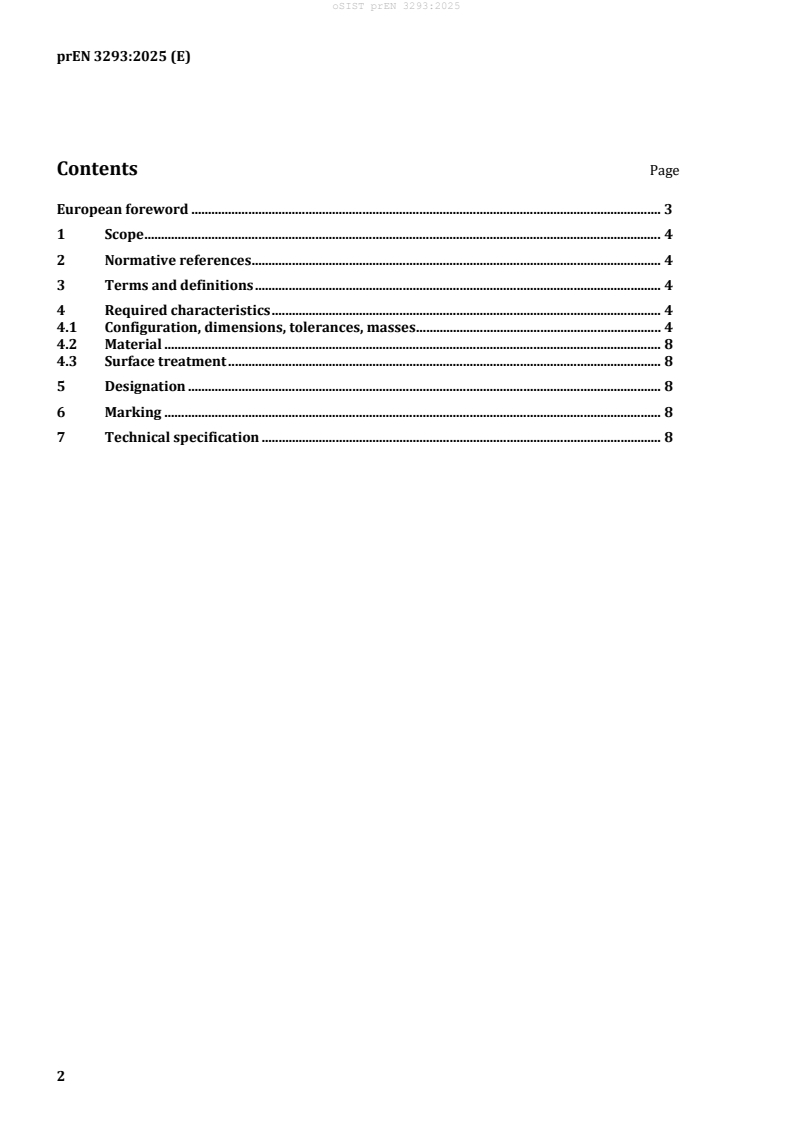
Contents
- 1 Scope
- 2 Normative references
- 3 Terms and definitions
- 4 Required characteristics
- 4.1 Configuration, dimensions, tolerances, masses
- 4.2 Material
- 4.3 Surface treatment
- 5 Designation
- 6 Marking
- 7 Technical specification
1 Scope
This document specifies the dimensions of uncoated T-head bolts, close tolerance, with MJ-thread, medium thread length, in heat-resisting nickel base alloy NI-P100HT for aerospace applications. Maximum test temperature of the parts is 650 °C.
These bolts are used in aerospace fastening systems mainly stressed in shearing force.
2 Normative references
The following documents are referred to in the text in such a way that some or all of their content constitutes requirements of this document. For dated references, only the edition cited applies. For undated references, the latest edition of the referenced document (including any amendments) applies. EN 2424, Aerospace series — Marking of aerospace products EN 2583, Aerospace series — Bolts, MJ threads, in heat resisting nickel base alloy NI-PH2601 (Inconel 718) — Classification: 1 275 MPa (at ambient temperature)/650°C — Technical specification ISO 3353-1, Aerospace — Lead and runout threads — Part 1: Rolled external threads ISO 5855-1, Aerospace — MJ threads — Part 1: General requirements ISO 5855-2, Aerospace — MJ threads — Part 2: Limit dimensions for bolts and nuts TR 3775, Bolts and pins — Materials
SAE AMS5662, Nickel Alloy, Corrosion- and Heat-Resistant, Bars, Forgings, Rings, and Stock for Forgings and Rings 52.5Ni — 19Cr — 3.0Mo — 5.1Cb (Nb) — 0.90Ti — 0.50Al — 18Fe Consumable Electrode or Vacuum Induction Melted 1 775 °F (968 °C) Solution Heat Treated, Precipitation-Hardenable
3 Terms and definitions
No terms and definitions are listed in this document.
ISO and IEC maintain terminology databases for use in standardization at the following addresses:
- ISO Online browsing platform: available at https://www.iso.org/obp/
- IEC Electropedia: available at https://www.electropedia.org/
4 Required characteristics
4.1 Configuration, dimensions, tolerances, masses
Configuration shall be in accordance with Figure 1. Dimensions, tolerances and masses shall be in accordance with Tables 1 and 2. Details of form, not stated are at the manufacturer's option.
Published by Society of Automotive Engineers (SAE), available at: https://www.sae.org/.
oSIST prEN 3293:2025 prEN 3293:2025 (E) Dimensions in millimetres
Break sharp edges 0,1 mm to 0,4 mm.
Key a when the length of the shank is less than the nominal value of the shank diameter, D, the run-out is measured at a distance equal to half the actual shank length.
b total straightness with reference to nominal length N c For bolts having a shank length less than the nominal value of the shank diameter, D, the pitch diameter axis shall be used as datum.
...