

EN 1947:2002+A1:2007
(Main + Amendment)Fire-fighting hoses - Semi-rigid delivery hoses and hose assemblies for pumps and vehicles
- Abstract
This European Standard specifies the requirements and test methods for semi-rigid reel hoses for use on fire-fighting vehicles and trailer pumps. The hoses are intended for use at a maximum working pressure of 1,5 MPa for normal pressure hoses (category I) and 4,0 MPa for high pressure hoses (category II). The hoses are further subdivided into types and classes (see clause 4).
The standard applies to delivery hoses for fire-fighting purposes intended for use at a minimum temperature of -20 °C.
NOTE 1 Hoses for use at temperatures lower than -20 °C may be supplied by agreement between the manufacturer and purchaser.
Hoses conforming to this standard should be used with fire hose couplings conforming to the relevant national standards couplings.
Requirements are also given for hose assemblies (see clause 8) where these are fitted by the hose manufacturer.
NOTE 2 All pressures are expressed in megapascals. 1 MPa = 10 bar.
- Status
- Withdrawn
- Publication Date
- 10-Apr-2007
- Withdrawal Date
- 06-Oct-2026
- Technical Committee
- CEN/TC 192 - Fire service equipment
- Drafting Committee
- CEN/TC 192/WG 1 - Hoses for firefighting
- Current Stage
- 9960 - Withdrawal effective - Withdrawal
- Start Date
- 09-Jul-2014
- Completion Date
- 07-Oct-2026

Relations
- Effective Date
- 18-Jan-2023
- Effective Date
- 16-Jul-2014
- Refers
ISO 4671:1984 - Rubber and plastics hose and hose assemblies — Methods of measurement of dimensions - Effective Date
- 09-Feb-2026
- Refers
ISO 188:1998 - Rubber, vulcanized or thermoplastic — Accelerated ageing and heat resistance tests - Effective Date
- 09-Feb-2026
- Effective Date
- 09-Feb-2026
- Effective Date
- 28-Jan-2026
- Effective Date
- 28-Jan-2026
- Effective Date
- 28-Jan-2026
- Effective Date
- 28-Jan-2026
- Effective Date
- 28-Jan-2026
- Effective Date
- 28-Jan-2026
Get Certified
Connect with accredited certification bodies for this standard

CIS Institut d.o.o.
Personal Protective Equipment (PPE) certification body. Notified Body NB-2890 for EU Regulation 2016/425 PPE.
Institut za varilstvo d.o.o. (Welding Institute)
Slovenia's leading welding institute since 1952. ISO 3834, EN 1090, pressure equipment certification, NDT personnel, welder qualification. Only IIW Au

Kiwa BDA Testing
Building and construction product certification.
Sponsored listings
Frequently Asked Questions
EN 1947:2002+A1:2007 is a standard published by the European Committee for Standardization (CEN). Its full title is "Fire-fighting hoses - Semi-rigid delivery hoses and hose assemblies for pumps and vehicles". This standard covers: This European Standard specifies the requirements and test methods for semi-rigid reel hoses for use on fire-fighting vehicles and trailer pumps. The hoses are intended for use at a maximum working pressure of 1,5 MPa for normal pressure hoses (category I) and 4,0 MPa for high pressure hoses (category II). The hoses are further subdivided into types and classes (see clause 4). The standard applies to delivery hoses for fire-fighting purposes intended for use at a minimum temperature of -20 °C. NOTE 1 Hoses for use at temperatures lower than -20 °C may be supplied by agreement between the manufacturer and purchaser. Hoses conforming to this standard should be used with fire hose couplings conforming to the relevant national standards couplings. Requirements are also given for hose assemblies (see clause 8) where these are fitted by the hose manufacturer. NOTE 2 All pressures are expressed in megapascals. 1 MPa = 10 bar.
This European Standard specifies the requirements and test methods for semi-rigid reel hoses for use on fire-fighting vehicles and trailer pumps. The hoses are intended for use at a maximum working pressure of 1,5 MPa for normal pressure hoses (category I) and 4,0 MPa for high pressure hoses (category II). The hoses are further subdivided into types and classes (see clause 4). The standard applies to delivery hoses for fire-fighting purposes intended for use at a minimum temperature of -20 °C. NOTE 1 Hoses for use at temperatures lower than -20 °C may be supplied by agreement between the manufacturer and purchaser. Hoses conforming to this standard should be used with fire hose couplings conforming to the relevant national standards couplings. Requirements are also given for hose assemblies (see clause 8) where these are fitted by the hose manufacturer. NOTE 2 All pressures are expressed in megapascals. 1 MPa = 10 bar.
EN 1947:2002+A1:2007 is classified under the following ICS (International Classification for Standards) categories: 13.220.10 - Fire-fighting; 23.040.70 - Hoses and hose assemblies. The ICS classification helps identify the subject area and facilitates finding related standards.
EN 1947:2002+A1:2007 has the following relationships with other standards: It is inter standard links to EN 1947:2002, EN 1947:2014, ISO 4671:1984, ISO 188:1998, ISO 8330:1998, EN ISO 1307:2008, EN ISO 8033:2017, EN ISO 1402:2021, EN ISO 176:1999, EN 27326:1993, EN ISO 4672:1999. Understanding these relationships helps ensure you are using the most current and applicable version of the standard.
EN 1947:2002+A1:2007 is available in PDF format for immediate download after purchase. The document can be added to your cart and obtained through the secure checkout process. Digital delivery ensures instant access to the complete standard document.
Standards Content (Sample)
2003-01.Slovenski inštitut za standardizacijo. Razmnoževanje celote ali delov tega standarda ni dovoljeno.Fire-fighting hoses - Semi-rigid delivery hoses and hose assemblies for pumps and vehiclesLODTuyaux de lutte contre l'incendie - Tuyaux de refoulement semi-rigides et flexibles pour pompes et véhiculesFeuerlöschschläuche - Formstabile Druckschläuche und Einbände für Pumpen und FeuerwehrfahrzeugeTa slovenski standard je istoveten z:EN 1947:2002+A1:2007SIST EN 1947:2003+A1:2007en;fr;de23.040.70Gumene cevi in armatureHoses and hose assemblies13.220.10Gašenje požaraFire-fightingICS:SLOVENSKI
STANDARDSIST EN 1947:2003+A1:200701-julij-2007
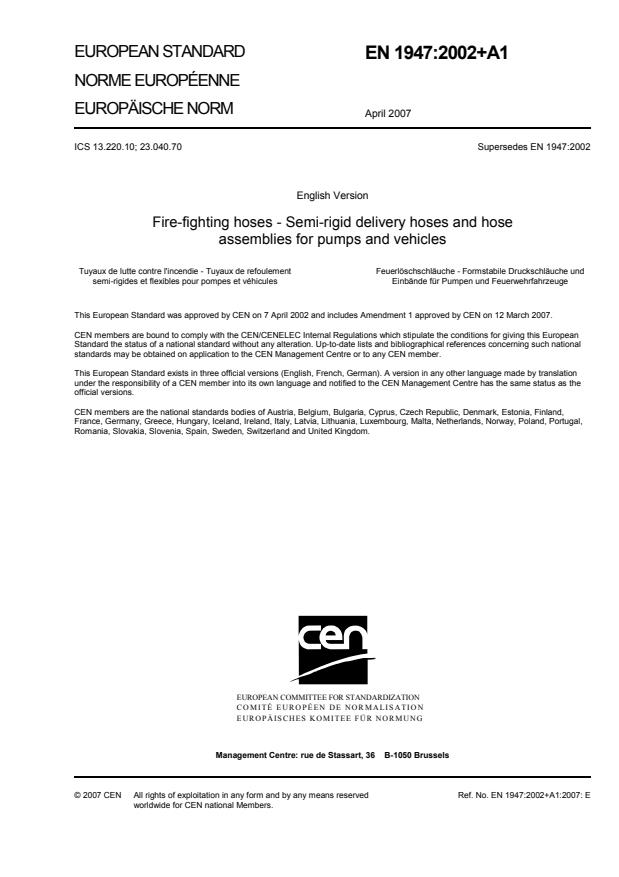
EUROPEAN STANDARD NORME EUROPÉENNE EUROPÄISCHE NORM
EN 1947:2002+A1
April 2007 ICS 13.220.10; 23.040.70 Supersedes EN 1947:2002English Version
Fire-fighting hoses - Semi-rigid delivery hoses and hose assemblies for pumps and vehicles
Tuyaux de lutte contre l'incendie - Tuyaux de refoulement semi-rigides et flexibles pour pompes et véhicules
Feuerlöschschläuche - Formstabile Druckschläuche und Einbände für Pumpen und Feuerwehrfahrzeuge This European Standard was approved by CEN on 7 April 2002 and includes Amendment 1 approved by CEN on 12 March 2007.
CEN members are bound to comply with the CEN/CENELEC Internal Regulations which stipulate the conditions for giving this European Standard the status of a national standard without any alteration. Up-to-date lists and bibliographical references concerning such national standards may be obtained on application to the CEN Management Centre or to any CEN member.
This European Standard exists in three official versions (English, French, German). A version in any other language made by translation under the responsibility of a CEN member into its own language and notified to the CEN Management Centre has the same status as the official versions.
CEN members are the national standards bodies of Austria, Belgium, Bulgaria, Cyprus, Czech Republic, Denmark, Estonia, Finland, France, Germany, Greece, Hungary, Iceland, Ireland, Italy, Latvia, Lithuania, Luxembourg, Malta, Netherlands, Norway, Poland, Portugal, Romania, Slovakia, Slovenia, Spain, Sweden, Switzerland and United Kingdom.
EUROPEAN COMMITTEE FOR STANDARDIZATION
COMITÉ EUROPÉEN DE NORMALISATION EUROPÄISCHES KOMITEE FÜR NORMUNG
Management Centre: rue de Stassart, 36
B-1050 Brussels © 2007 CEN All rights of exploitation in any form and by any means reserved worldwide for CEN national Members. Ref. No. EN 1947:2002+A1:2007: E
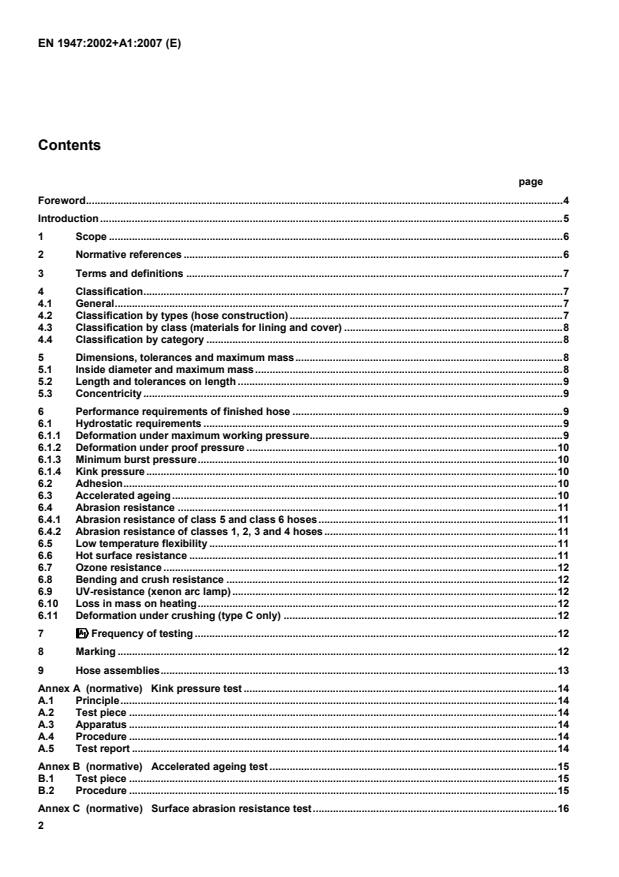
(normative)
Kink pressure test.14 A.1 Principle.14 A.2 Test piece.14 A.3 Apparatus.14 A.4 Procedure.14 A.5 Test report.14 Annex B
(normative)
Accelerated ageing test.15 B.1 Test piece.15 B.2 Procedure.15 Annex C
(normative)
Surface abrasion resistance test.16
(normative)
Point abrasion resistance test.19 D.1 Test piece.19 D.2 Apparatus.19 D.3 Procedure.21 D.4 Test report.21 Annex E
(normative)
Hot surface resistance test.22 E.1 Test piece.22 E.2 Apparatus.22 E.3 Procedure.25 E.4 Test report.25 Annex F
(normative)
Bending and crush resistance test.26 F.1 Test piece.26 F.2 Procedure.26 F.3 Test report.28 Annex G
(normative)
Deformation under crushing test.29 G.1 Test piece.29 G.2 Apparatus.29 G.3 Procedure.29 G.4 Test report.31 Annex H
(normative)
Test for hose assemblies.32 H.1 Test piece.32 H.2 Procedure.32 Annex I
(normative)
!!!!Frequencies of testing (type test and production test).33 Annex J (informative)
!!!!Frequencies of testing (batch test).34 Bibliography.35
Requirements for semi-rigid hoses for use with fixed systems are given in EN 694; those for non-percolating layflat hoses are given in prEN 1924 (pumps and vehicles) and prEN 14540 (fixed systems). !deleted text" Users of this European Standard are advised to consider the desirability of independent certification of product conformity with this European Standard based on testing and continuing surveillance, which may be coupled with assessment of a supplier’s quality system against EN ISO 9001. According to the CEN/CENELEC Internal Regulations, the national standards organizations of the following countries are bound to implement this European Standard: Austria, Belgium, Bulgaria, Cyprus, Czech Republic, Denmark, Estonia, Finland, France, Germany, Greece, Hungary, Iceland, Ireland, Italy, Latvia, Lithuania, Luxembourg, Malta, Netherlands, Norway, Poland, Portugal, Romania, Slovakia, Slovenia, Spain, Sweden, Switzerland and United Kingdom.
1 Scope This European Standard specifies the requirements and test methods for semi-rigid reel hoses for use on fire-fighting vehicles and trailer pumps.
The hoses are intended for use at a maximum working pressure of 1,5 MPa for normal pressure hoses (category I) and 4,0 MPa for high pressure hoses (category II). The hoses are further subdivided into types and classes (see clause 4). The standard applies to delivery hoses for fire-fighting purposes intended for use at a minimum ambient temperature of -20 °C. NOTE 1 Hoses for use at temperatures lower than -20 °C may be supplied by agreement between the manufacturer and purchaser. Hoses conforming to this standard should be used with fire hose couplings conforming to the relevant national standards couplings. Requirements are also given for hose assemblies (see clause 9) where these are fitted by the hose manufacturer. NOTE 2 All pressures are expressed in megapascals. 1 MPa = 10 bar. 2 Normative references This European Standard incorporates by dated or undated reference, provisions from other publications. These normative references are cited at the appropriate places in the text, and the publications are listed hereafter. For dated references, subsequent amendments to or revisions of any of these publications apply to this European Standard only when incorporated in it by amendment or revision. For undated references, the latest edition of the publication referred to applies (including amendments). EN
27326:1993, Rubber and plastics hoses — Assessment of ozone resistance under static conditions (ISO 7326:1991). EN 28033, Rubber and plastics hose — Determination of adhesion between components (ISO 8033:1991). EN ISO 176:1999, Plastics — Determination of loss of plasticizers — Activated carbon method (ISO 176:1976). EN ISO 1307, Rubber and plastics hoses for general-purpose industrial applications — Bore diameters and tolerances, and tolerances on length (ISO 1307:1992). EN ISO 1402, Rubber and plastics hoses and hose assemblies — Hydrostatic testing (ISO 1402:1994). EN ISO 4672:1999, Rubber and plastics hoses — Sub-ambient temperature flexibility tests (ISO 4672:1997). ISO 188, Rubber, vulcanized or thermoplastic— Accelerated ageing and heat-resistance tests. ISO 4671:1984, Rubber and plastics hoses and hose assemblies — Methods of measurement of dimensions. ISO 8330, Rubber and plastics hoses and hose assemblies — Vocabulary.
3 Terms and definitions For the purposes of this European Standard the following term and definition apply, together with those for working pressure, proof pressure and burst pressure given in ISO 8330. 3.1 semi-rigid hose hose which maintains its round cross-section even when unpressurized 4 Classification 4.1 General All types and classes of hose shall be so flexible that they can be rolled and kept on a drum of minimum diameter 200 mm for 12 mm inside diameter, 19 mm inside diameter and 25 mm inside diameter hose and of minimum diameter 280 mm for 33 mm inside diameter hose. Hoses shall be one of two categories distinguished by the maximum working pressure.
Each hose shall be further divided into one of three types distinguished by its construction, and then into six classes distinguished by the materials used for lining and cover. NOTE The hose may be coloured by agreement between the purchaser and the manufacturer. 4.2 Classification by types (hose construction) Type A hoses shall consist of: a) a seamless rubber or plastics lining; b) a textile spiral or braided reinforcement; c) a rubber or plastics cover. Type B hoses shall consist of: a) a seamless rubber or plastics lining; b) a circular woven textile reinforcement with a rigid spiral helix; c) an uncovered or rubber or plastics cover. Type C hoses shall consist of: a) a seamless rubber or plastics lining; b) any suitable reinforcement; c) a rubber or plastics cover. NOTE Whilst the construction of types A and C hoses may be similar or even identical, the performance requirements differ for the following: burst and proof pressure, adhesion, hot surface resistance, crush resistance.
4.4 Classification by category All hoses shall be divided into two categories dependent on the maximum working pressure in accordance with Table 2. Table 2 — Maximum working pressure, proof pressure and minimum burst pressure Pressure Category ICategory II Mpa Types A and BTypes A and BType C
Classes 1 to 6 Classes 1 to 6 Classes 1 to 6 Maximum working pressure 1,5
4,0
4,0 Proof pressure 3,0
6,0
8,0 Minimum burst pressure 4,5 10,0 12,0
EXAMPLE: A type C hose, constructed using a rubber lining and rubber cover and which has a maximum working pressure of 4,0 MPa, a proof pressure of 8,0 MPa and a minimum burst pressure of 12,0 MPa is classified as II/C/1. 5 Dimensions, tolerances and maximum mass 5.1 Inside diameter and maximum mass The inside diameter of the hose and tolerances, when measured in accordance with ISO 4671 using any suitable method stated in clause 4 of that standard, shall conform to the requirements given in Table 3. The mass per metre length of the hose shall be in accordance with Table 3.
Table 3 — Inside diameter, tolerances on inside diameter and maximum mass per unit lengthInside diameter Tolerances for inside diameterMass per unit length mm mm kg/m
Types A and CType BTypes A and C
Type B
max. max. 12 0 to + 0,6 — 0,30 — 19 0 to + 0,9 0 to + 1,5 0,75 0,25 25 0 to + 1,2 0 to + 1,5 0,90 0,35 33 0 to + 1,6 0 to + 2,0 1,00 0,50
5.2 Length and tolerances on length The total length of hose supplied shall be in accordance with the purchaser’s requirements and shall be stated in metres. Tolerance on length shall be in accordance with EN ISO 1307. 5.3 Concentricity When tested in accordance with 8.2 Method 2 of ISO 4671:1984, the variation from concentricity measured between inside and outside diameters shall not exceed the following values: Types A and C 1,5 mm Type B 0,4 mm
6 Performance requirements of finished hose 6.1 Hydrostatic requirements 6.1.1 Deformation under maximum working pressure The dimensional stability of the hose, when tested in accordance with EN ISO 1402, shall conform to the requirements given in Table 4. The length of the test piece shall be 1 m. For category I hoses the initial test pressure shall be 0,07 MPa and the final test pressure shall be 1,5 MPa. For category II hoses the initial test pressure shall be 0,07 MPa and the final test pressure shall be 4,0 MPa. The twist shall be not greater than 30°/m for types A and C. For type B the twist may be greater than 30°/m but in this case it shall only be in a direction which closes the coupling and shall be stated in the test report.
Table 4 — Change in length and external diameter
Tolerances for types A, B and C
% Change in length 0 to +7,5 Change in external diameter 0 to +7,5
NOTE Hose with a lower maximum change in length may be agreed between the purchaser and manufacturer. 6.1.2 Deformation under proof pressure A proof pressure hold test shall be carried out on three hose lengths each of 1 m in accordance with EN ISO 1402. The proof pressure shall be as given in table 2 and on examination during the test, the test pieces shall not show any evidence of leakage, cracking, abrupt distortion or other signs of failure. 6.1.3 Minimum burst pressure !A burst pressure test shall be carried out in accordance with EN ISO 1402 on the three test pieces used for the deformation under proof pressure test. NOTE It is not necessary to increase the pressure above the minimum burst value to b
...