

prEN 17808
(Main)Precast concrete products - Essential characteristics
- Abstract
This document identifies the essential characteristics of precast concrete products made of reinforced or prestressed normal weight or light weight concrete, used for the frame, foundation, floors, walls, stairs and roofs of building and civil engineering works, and for garages, boundary fences, masts and poles.
This document also covers blocks made of other materials than concrete and intended to be used in concrete beam-and-blocks floor systems.
This document specifies procedures for assessment and verification of constancy (AVCP) of performance of characteristics of those elements.
This document does not cover the following concrete products:
- Masonry and ancillary products,
- Lighting columns and spigots,
- Roof covering products for discontinuous laying,
- Chimney components,
- Products for wastewater treatment,
- Prefabricated reinforced components of autoclaved aerated concrete or light-weight aggregate concrete with open structure,
- Paving units and kerbs,
- Road equipment,
- Elements made with concrete containing more than 1% of homogeneously distributed organic material, by mass or by volume (whichever is the most onerous).
This document does not cover the design, production, handling, installation of the elements and the water tightness of joints between elements.
- Status
- Not Published
- Publication Date
- 10-Oct-2023
- Technical Committee
- CEN/TC 229 - Precast concrete products
- Drafting Committee
- CEN/TC 229 - Precast concrete products
- Current Stage
- 4098 - Decision to abandon - Enquiry
- Start Date
- 07-Jun-2023
- Completion Date
- 07-Oct-2026

Overview
The prEN 17808 standard, developed by CEN (European Committee for Standardization), defines the essential characteristics of precast concrete products. This standard covers precast elements made of reinforced or prestressed concrete, whether normal weight or lightweight, intended for use in building and civil engineering structures. Common applications include frames, foundations, floors, walls, stairs, roofs, garages, boundary fences, masts, and poles. Additionally, it addresses blocks composed of materials other than concrete for use in beam-and-block floor systems.
Importantly, prEN 17808 sets out the assessment and verification of constancy of performance (AVCP) procedures for these elements' characteristics. However, it excludes specific concrete products such as masonry ancillary products, lighting columns, roof covering products for discontinuous laying, chimney components, waste treatment products, prefabricated reinforced components of autoclaved aerated concrete, paving units, road equipment, and concrete with homogeneously distributed organic materials above 1%.
Key Topics
This standard details critical characteristics and their respective testing methods to ensure reliability and compliance of precast concrete products. The key characteristics include:
- Compressive strength of concrete – Fundamental to structural integrity.
- Ultimate tensile and tensile yield strength of steel – For reinforcing and prestressing steel.
- Dimensioning – Ensures accurate sizing and compatibility.
- Permeability – Covers both water vapor and water permeability to assess durability.
- Rigidity of joints – Important for structural stability between precast elements.
- Drying shrinkage – Affects dimensional stability over time.
- Density – Influences weight and handling.
- Loadbearing capacity – Specific to blocks, masts, poles, and boundary fences.
- Mechanical strength – Tested through various methods to ensure product robustness.
- Reaction and resistance to fire – Evaluates fire safety performance.
- Acoustic properties – Includes airborne sound insulation and impact noise transmission.
- Thermal resistance – Important for energy efficiency and insulation.
- Durability – Assesses resistance to freeze/thaw cycles and steel corrosion.
Testing and assessment methods are precisely outlined for each characteristic, ensuring consistent and reliable performance verification.
Applications
prEN 17808 serves as a vital reference for manufacturers, designers, and quality control personnel involved with precast concrete elements in diverse construction projects including:
- Residential and commercial buildings (frames, stairs, floors, walls, roofs)
- Civil engineering structures (foundations, boundary fences, poles)
- Beam-and-block floor systems, particularly with non-concrete blocks
- Garages and storage buildings
This standard supports achieving compliance with regulatory requirements, enhancing product safety, durability, and performance consistency across Europe. Its application assists project stakeholders in specifying precast concrete products that meet stringent quality and safety criteria.
Related Standards
For comprehensive compliance and integration, prEN 17808 complements several related standards and regulations, including but not limited to:
- EN 206 - Concrete specification, performance, production, and conformity
- EN 13369 - Common rules for precast concrete products
- EN 13670 - Execution of concrete structures
- EN 1992 (Eurocode 2) - Design of concrete structures
- Fire safety standards related to reaction and resistance to fire testing
- Acoustic standards for building elements sound insulation
Utilizing prEN 17808 in conjunction with these standards ensures a harmonized approach to precast concrete product quality, safety, and performance verification.
Keywords: prEN 17808, precast concrete products, essential characteristics, reinforced concrete, prestressed concrete, beam-and-block floor systems, AVCP, durability, fire resistance, mechanical strength, CEN standards, concrete product testing, civil engineering, building materials standards, European precast concrete.
Relations
- Effective Date
- 28-Jan-2026
Get Certified
Connect with accredited certification bodies for this standard

DIBt (Deutsches Institut für Bautechnik)
German Institute for Building Technology.
DIN CERTCO
DIN Group product certification.

Aboma Certification B.V.
Specialized in construction, metal, and transport sectors.
Sponsored listings
Frequently Asked Questions
prEN 17808 is a draft published by the European Committee for Standardization (CEN). Its full title is "Precast concrete products - Essential characteristics". This standard covers: This document identifies the essential characteristics of precast concrete products made of reinforced or prestressed normal weight or light weight concrete, used for the frame, foundation, floors, walls, stairs and roofs of building and civil engineering works, and for garages, boundary fences, masts and poles. This document also covers blocks made of other materials than concrete and intended to be used in concrete beam-and-blocks floor systems. This document specifies procedures for assessment and verification of constancy (AVCP) of performance of characteristics of those elements. This document does not cover the following concrete products: - Masonry and ancillary products, - Lighting columns and spigots, - Roof covering products for discontinuous laying, - Chimney components, - Products for wastewater treatment, - Prefabricated reinforced components of autoclaved aerated concrete or light-weight aggregate concrete with open structure, - Paving units and kerbs, - Road equipment, - Elements made with concrete containing more than 1% of homogeneously distributed organic material, by mass or by volume (whichever is the most onerous). This document does not cover the design, production, handling, installation of the elements and the water tightness of joints between elements.
This document identifies the essential characteristics of precast concrete products made of reinforced or prestressed normal weight or light weight concrete, used for the frame, foundation, floors, walls, stairs and roofs of building and civil engineering works, and for garages, boundary fences, masts and poles. This document also covers blocks made of other materials than concrete and intended to be used in concrete beam-and-blocks floor systems. This document specifies procedures for assessment and verification of constancy (AVCP) of performance of characteristics of those elements. This document does not cover the following concrete products: - Masonry and ancillary products, - Lighting columns and spigots, - Roof covering products for discontinuous laying, - Chimney components, - Products for wastewater treatment, - Prefabricated reinforced components of autoclaved aerated concrete or light-weight aggregate concrete with open structure, - Paving units and kerbs, - Road equipment, - Elements made with concrete containing more than 1% of homogeneously distributed organic material, by mass or by volume (whichever is the most onerous). This document does not cover the design, production, handling, installation of the elements and the water tightness of joints between elements.
prEN 17808 is classified under the following ICS (International Classification for Standards) categories: 91.100.30 - Concrete and concrete products. The ICS classification helps identify the subject area and facilitates finding related standards.
prEN 17808 has the following relationships with other standards: It is inter standard links to EN ISO 6368:2021. Understanding these relationships helps ensure you are using the most current and applicable version of the standard.
prEN 17808 is associated with the following European legislation: EU Directives/Regulations: 305/2011; Standardization Mandates: M/100. When a standard is cited in the Official Journal of the European Union, products manufactured in conformity with it benefit from a presumption of conformity with the essential requirements of the corresponding EU directive or regulation.
prEN 17808 is available in PDF format for immediate download after purchase. The document can be added to your cart and obtained through the secure checkout process. Digital delivery ensures instant access to the complete standard document.
Standards Content (Sample)
SLOVENSKI STANDARD
01-julij-2022
Montažni betonski izdelki - Bistvene značilnosti
Precast concrete products - Essential characteristics
Betonfertigteile - Wesentliche Merkmale
Produits préfabriqués en béton - Caractéristiques essentielles
Ta slovenski standard je istoveten z: prEN 17808
ICS:
91.100.30 Beton in betonski izdelki Concrete and concrete
products
2003-01.Slovenski inštitut za standardizacijo. Razmnoževanje celote ali delov tega standarda ni dovoljeno.
DRAFT
EUROPEAN STANDARD
NORME EUROPÉENNE
EUROPÄISCHE NORM
April 2022
ICS 91.100.30
English Version
Precast concrete products - Essential characteristics
Produits préfabriqués en béton - Caractéristiques Betonfertigteile - Wesentliche Merkmale
essentielles
This draft European Standard is submitted to CEN members for enquiry. It has been drawn up by the Technical Committee
CEN/TC 229.
If this draft becomes a European Standard, CEN members are bound to comply with the CEN/CENELEC Internal Regulations
which stipulate the conditions for giving this European Standard the status of a national standard without any alteration.
This draft European Standard was established by CEN in three official versions (English, French, German). A version in any other
language made by translation under the responsibility of a CEN member into its own language and notified to the CEN-CENELEC
Management Centre has the same status as the official versions.
CEN members are the national standards bodies of Austria, Belgium, Bulgaria, Croatia, Cyprus, Czech Republic, Denmark, Estonia,
Finland, France, Germany, Greece, Hungary, Iceland, Ireland, Italy, Latvia, Lithuania, Luxembourg, Malta, Netherlands, Norway,
Poland, Portugal, Republic of North Macedonia, Romania, Serbia, Slovakia, Slovenia, Spain, Sweden, Switzerland, Turkey and
United Kingdom.
Recipients of this draft are invited to submit, with their comments, notification of any relevant patent rights of which they are
aware and to provide supporting documentation.
Warning : This document is not a European Standard. It is distributed for review and comments. It is subject to change without
notice and shall not be referred to as a European Standard.
EUROPEAN COMMITTEE FOR STANDARDIZATION
COMITÉ EUROPÉEN DE NORMALISATION
EUROPÄISCHES KOMITEE FÜR NORMUNG
CEN-CENELEC Management Centre: Rue de la Science 23, B-1040 Brussels
© 2022 CEN All rights of exploitation in any form and by any means reserved Ref. No. prEN 17808:2022 E
worldwide for CEN national Members.
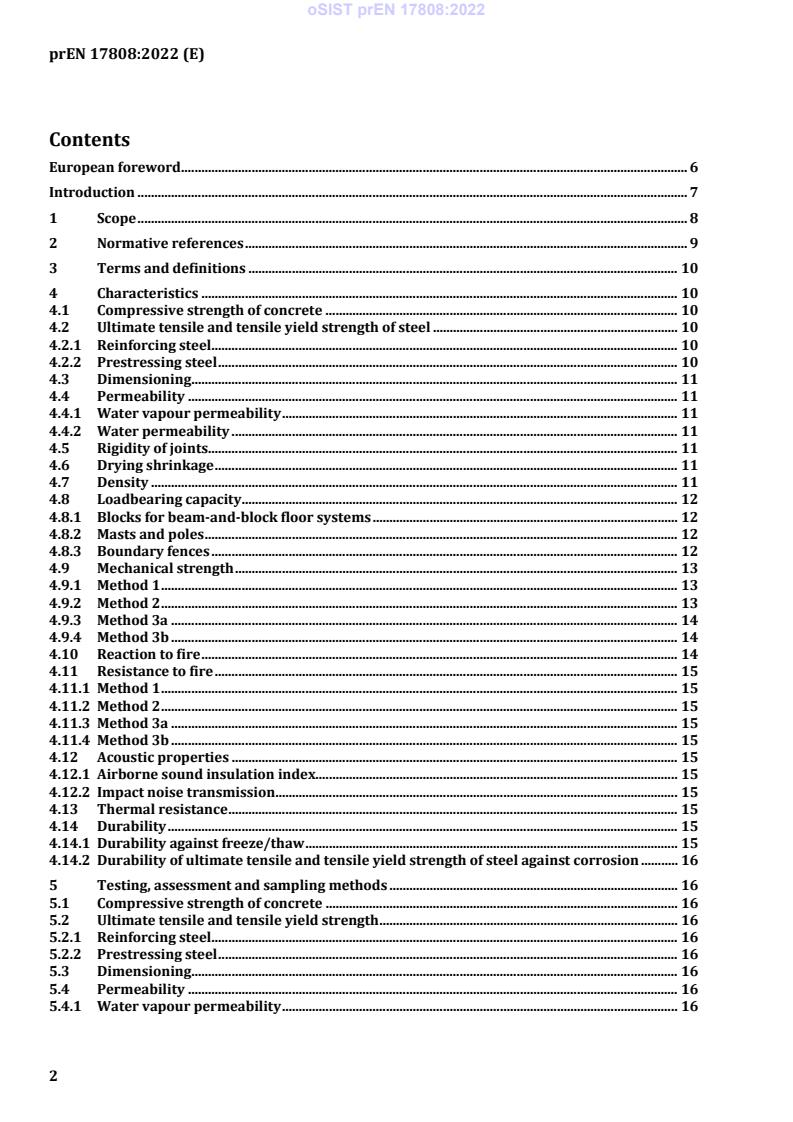
Contents
European foreword . 6
Introduction . 7
1 Scope . 8
2 Normative references . 9
3 Terms and definitions . 10
4 Characteristics . 10
4.1 Compressive strength of concrete . 10
4.2 Ultimate tensile and tensile yield strength of steel . 10
4.2.1 Reinforcing steel . 10
4.2.2 Prestressing steel . 10
4.3 Dimensioning . 11
4.4 Permeability . 11
4.4.1 Water vapour permeability . 11
4.4.2 Water permeability . 11
4.5 Rigidity of joints . 11
4.6 Drying shrinkage . 11
4.7 Density . 11
4.8 Loadbearing capacity . 12
4.8.1 Blocks for beam-and-block floor systems . 12
4.8.2 Masts and poles . 12
4.8.3 Boundary fences . 12
4.9 Mechanical strength . 13
4.9.1 Method 1 . 13
4.9.2 Method 2 . 13
4.9.3 Method 3a . 14
4.9.4 Method 3b . 14
4.10 Reaction to fire . 14
4.11 Resistance to fire . 15
4.11.1 Method 1 . 15
4.11.2 Method 2 . 15
4.11.3 Method 3a . 15
4.11.4 Method 3b . 15
4.12 Acoustic properties . 15
4.12.1 Airborne sound insulation index. 15
4.12.2 Impact noise transmission. 15
4.13 Thermal resistance . 15
4.14 Durability . 15
4.14.1 Durability against freeze/thaw . 15
4.14.2 Durability of ultimate tensile and tensile yield strength of steel against corrosion . 16
5 Testing, assessment and sampling methods . 16
5.1 Compressive strength of concrete . 16
5.2 Ultimate tensile and tensile yield strength . 16
5.2.1 Reinforcing steel . 16
5.2.2 Prestressing steel . 16
5.3 Dimensioning . 16
5.4 Permeability . 16
5.4.1 Water vapour permeability . 16
5.4.2 Water permeability . 16
5.5 Rigidity of joints . 17
5.6 Drying shrinkage . 17
5.7 Dry density . 17
5.8 Loadbearing capacity . 17
5.8.1 Blocks for beam-and-block floor systems. 17
5.8.2 Masts and poles . 17
5.8.3 Boundary fences . 17
5.9 Mechanical strength . 18
5.9.1 Method 1 . 18
5.9.2 Method 2 . 18
5.9.3 Method 3a . 18
5.9.4 Method 3b . 18
5.10 Reaction to fire . 18
5.11 Resistance to fire . 19
5.11.1 Method 1 . 19
5.11.2 Method 2 . 19
5.11.3 Method 3a . 19
5.11.4 Method 3b . 19
5.12 Acoustic properties . 20
5.12.1 Airborne sound insulation index . 20
5.12.2 Impact noise transmission . 20
5.13 Thermal resistance . 20
5.14 Durability. 20
5.14.1 Durability against freeze/thaw . 20
5.14.2 Durability against corrosion. 20
6 Assessment and verification of constancy of performance – AVCP . 20
6.1 General . 20
6.2 Assessment of performance . 21
6.2.1 General . 21
6.2.2 Test samples, testing and compliance criteria . 22
6.2.3 Test reports . 26
6.3 Verification of constancy of performance . 26
6.3.1 Factory production control (FPC) . 26
6.3.2 Initial inspection of factory and of FPC . 30
6.3.3 Continuous surveillance of FPC . 30
Annex A (normative) Test method for the verification of robustness and rigidity of pile
joints . 31
A.1 Impact load test with subsequent bending test . 31
A.1.1 Principle . 31
A.1.2 Apparatus . 31
A.1.3 Test specimens . 31
A.1.4 Impact load test . 31
A.1.5 Bending test . 32
A.1.6 Evaluation of the test results . 33
A.1.7 Test report . 34
Annex B (normative) Loadbearing capacity testing of blocks for beam-and-blocks floor
systems . 35
B.1 Punching-bending strength . 35
B.1.1 General . 35
B.1.2 Equipment . 35
B.1.3 Procedure. 35
B.1.4 Interpretation of test results . 36
B.1.5 Test report . 37
B.2 Bending strength . 37
B.2.1 Equipment . 37
B.2.2 Procedure. 37
B.2.3 Evaluation . 38
B.2.4 Test report . 38
B.3 Longitudinal compression test for resisting and semi-resisting concrete blocks . 38
B.3.1 Equipment . 38
B.3.2 Procedure. 38
B.3.3 Interpretation of test results . 40
B.3.4 Test report . 40
B.4 Transverse testing of resisting and semi-resisting concrete blocks . 41
B.4.1 General . 41
B.4.2 Equipment . 41
B.4.3 Procedure. 41
B.4.4 Test result . 41
Annex C (normative) Loadbearing capacity testing of masts and poles . 42
C.1 General . 42
C.2 Bending test . 42
C.2.1 Testing device . 42
C.2.2 Elastic test . 42
C.3 Loadbearing capacity test . 43
C.4 Torsion test . 44
C.4.1 Requirements for testing device. 44
C.4.2 Test method . 44
Annex D (normative) Loadbearing capacity testing of boundary fences . 45
D.1 Test method for loadbearing capacity . 45
D.1.1 Apparatus . 45
D.1.2 Test piece . 45
D.1.3 Testing of posts . 45
D.1.3.1 Principle . 45
D.1.3.2 Procedure . 45
D.1.3.3 Expression of results . 47
D.1.4 Testing of panels . 47
D.1.5 Testing of rails . 47
D.2 Test method for complementary loadbearing capacity . 49
D.2.1 Apparatus . 49
D.2.2 Test piece . 49
D.2.3 Testing of posts . 49
D.2.3.1 Principle . 49
D.2.3.2 Procedure . 50
D.2.3.3 Expression of results . 50
D.2.4 Testing of panels . 51
D.2.5 Testing of rails . 51
Annex E (normative) Reaction to fire test for thin blocks - Fire testing test for thin blocks . 52
E.1 General . 52
E.2 Terminology . 52
E.3 Mounting and fixing . 52
E.3.1 General . 52
E.3.2 Dimensions of test rig . 52
E.3.3 Test specimen . 53
E.3.4 Mounting and fixing of the test assembly . 53
E.4 End Use Application Rules . 54
E.4.1 General . 54
E.4.2 Air gap . 54
E.4.3 Substrate . 54
E.4.4 Influence of the thickness . 55
E.4.5 Influence of the density of the material . 55
E.4.6 Influence of the formulation . 55
E.4.7 Influence of colour . 55
E.4.8 Influence of other variables . 55
E.5 Additional conditions for polypropylene blocks . 55
Annex F (informative) Thermal maps . 57
Annex ZA (informative) Relationship of this European Standard with Regulation (EU)
No.305/2011 . 61
ZA.1 Scope and relevant characteristics . 61
ZA.2 System of Assessment and Verification of Constancy of Performance (AVCP) . 71
ZA.3 Assignment of AVCP tasks . 71
European foreword
This document (prEN 17808:2022) has been prepared by Technical Committee CEN/TC 229 “Precast
concrete products”, the secretariat of which is held by AFNOR.
This document is currently submitted to the CEN Enquiry.
This document identifies the essential characteristics of precast concrete products and specifies the
procedures for assessment and verification of constancy (AVCP) of performance.
This document has been prepared under a Standardization Request given to CEN by the European
Commission and the European Free Trade Association, and supports essential requirements of EU
Directive(s) / Regulation(s).
For relationship with EU Directive(s) / Regulation(s), see informative Annex ZA, which is an integral part
of this document.
Introduction
This document was written in answer to standardization request M/100 given to CEN by the European
Commission and the European Free Trade Association. It merges and supersedes the corresponding
clauses and annexes of the following standards, and is the harmonized technical specification for the
declaration of performance of the products covered by their scope:
EN 1168:2005+A3:2011, Precast concrete products – Hollow core slabs
EN 12737:2004+A1:2007, Precast concrete products – Floor slats for livestock
EN 12794:2005+A1:2007, Precast concrete products – Foundation piles
EN 12839:2012, Precast concrete products – Elements for fences
EN 12843:2004, Precast concrete products – Masts and poles
EN 13224:2011, Precast concrete products – Ribbed floor elements
EN 13225:2013, Precast concrete products – Linear structural elements
EN 13693:2004+A1:2009, Precast concrete products – Special roof elements
EN 13747:2005+A2:2010, Precast concrete products – Floor plates for floor systems
EN 13978-1:2005, Precast concrete products – Precast concrete garages
EN 14843:2007, Precast concrete products – Stairs
EN 14844:2006+A2:2011, Precast concrete products – Box culverts
EN 14991:2007, Precast concrete products – Foundation elements
EN 14992:2007+A1:2012, Precast concrete products – Wall elements
EN 15037-1:2008, Precast concrete products – Beam-and-block floor systems – Part 1: Beams
EN 15037-2:2009+A1:2011, Precast concrete products – Beam-and-block floor systems – Part 2: Concrete
blocks
EN 15037-3:2009+A1:2011, Precast concrete products – Beam-and-block floor systems – Part 3: Clay
blocks
EN 15037-4:2010+A1:2013, Precast concrete products – Beam-and-block floor systems – Part 4: Expanded
polystyrene blocks
EN 15037-5:2013, Precast concrete products – Beam-and-block floor systems – Part 5: Lightweight blocks
for simple formwork
EN 15050:2007+A1:2012, Precast concrete products – Bridge elements
EN 15258:2008, Precast concrete products – Retaining wall elements
EN 15435:2008, Precast concrete products — Normal weight and lightweight concrete shuttering blocks
— Product properties and performance
EN 15498:2008, Precast concrete products — Wood-chip concrete shuttering blocks — Product properties
and performance
1 Scope
This document identifies the essential characteristics of precast concrete products made of reinforced or
prestressed normal weight or light weight concrete, used for the frame, foundation, floors, walls, stairs
and roofs of building and civil engineering works, and for garages, boundary fences, masts and poles.
This document also covers blocks made of other materials than concrete and intended to be used in
concrete beam-and-blocks floor systems.
This document specifies procedures for assessment and verification of constancy (AVCP) of performance
of characteristics of those elements.
This document does not cover the following concrete products:
— Masonry and ancillary products,
— Lighting columns and spigots,
— Roof covering products for discontinuous laying,
— Chimney components,
— Products for wastewater treatment,
— Prefabricated reinforced components of autoclaved aerated concrete or light-weight aggregate
concrete with open structure,
— Paving units and kerbs,
— Road equipment,
— Elements made with concrete containing more than 1 % of homogeneously distributed organic
material, by mass or by volume (whichever is the most onerous).
This document does not cover the design, production, handling, installation of the elements and the water
tightness of joints between elements.
2 Normative references
The following documents are referred to in the text in such a way that some or all of their content
constitutes requirements of this document. For dated references, only the edition cited applies. For
undated references, the latest edition of the referenced document (including any amendments) applies.
EN 206:2013+A2:2021, Concrete - Specification, performance, production and conformity
EN 1992-1-1:2004, Eurocode 2: Design of concrete structures — Part 1-1: General rules and rules for
buildings
EN 1992-1-2:2004, Eurocode 2: Design of concrete structures — Part 1-2: General rules — Structural fire
design
EN 12390-4:2019, Testing hardened concrete - Part 4: Compressive strength - Specification for testing
machines
EN 12390-7:2019, Testing hardened concrete — Part 7: Density of hardened concrete
prEN 13369:2022, Common rules for precast concrete products
EN 13501-1:2018, Fire classification of construction products and building elements — Part 1:
Classification using data from reaction to fire tests
EN 13501-2:2016, Fire classification of construction products and building elements — Part 2:
Classification using data from fire resistance tests, excluding ventilation services
EN 13823:2020, Reaction to fire tests for building products - Building products excluding floorings exposed
to the thermal attack by a single burning item
EN ISO 11925-2:2020, Reaction to fire tests - Ignitability of products subjected to direct impingement of
flame - Part 2: Single-flame source test (ISO 11925-2:2020)
EN ISO 12572:2016, Hygrothermal performance of building materials and products - Determination of
water vapour transmission properties - Cup method (ISO 12572:2016)
As impacted by EN 1992-1-1:2004/AC:2010 and EN 1992-1-1:2004/A1:2014.
As impacted by EN 1992-1-2:2004/AC:2008 and EN 1992-1-2:2004/A1:2019.
3 Terms and definitions
For the purposes of this document, the terms and definitions given in EN 1992-1-1:2004 and
prEN 13369:2022 and the following apply.
3.1
expression method (for mechanical strength and resistance to fire)
method chosen to express the product performance for mechanical strength and resistance to fire
through a description and a reference to a product documentation, using one of the following
possibilities:
a) Method 1: declaration of geometrical data and material properties, with reference to a product
documentation,
b) Method 2: declaration of geometry, material properties and product properties determined following
this standard and EN Eurocodes,
c) Method 3a: declaration of product compliance with reference to a given design specification provided
by the client,
d) Method 3b: declaration of product compliance with reference to a given design specification
provided by the manufacturer according to the client's order
Note 1 to entry: These methods do not apply to other essential characteristics.
3.2
design specification
set of documents related to the design of the product containing relevant information (e.g., calculation
sheets, drawings .) taking into account the applicable expression method with the objective of declaring
the corresponding performance
4 Characteristics
4.1 Compressive strength of concrete
When assessed, the characteristic value of the compressive strength of normal weight concrete or
lightweight concrete shall be determined according to 5.1.
The performance, in the form of the characteristic value, shall be expressed as indication of the value in
MPa, rounded to the unit.
4.2 Ultimate tensile and tensile yield strength of steel
4.2.1 Reinforcing steel
When assessed, the ultimate tensile strength and tensile yield strength of reinforcing steel shall be
determined according to 5.2.1 and expressed as follows:
— ultimate tensile strength: characteristic value in MPa,
— tensile yield strength: characteristic value in MPa.
4.2.2 Prestressing steel
When assessed, the ultimate tensile strength and tensile 0,1 % proof-stress of prestressing steel shall be
determined according to 5.2.2 and expressed as follows:
— ultimate tensile strength: characteristic value in MPa,
— tensile 0,1 % proof-stress: characteristic value in MPa.
4.3 Dimensioning
When assessed, the dimensioning of stairs shall be expressed as geometrical data and shall be determined
according to 5.3.
4.4 Permeability
4.4.1 Water vapour permeability
When assessed, the water vapour permeability of external walls and cladding elements shall be expressed
as permeance in kg/(m ·s·Pa) and determined according to 5.4.1.
4.4.2 Water permeability
When assessed, the water permeability of external walls and cladding elements shall be expressed as a
water absorption ratio in % and determined according to 5.4.2.
4.5 Rigidity of joints
When assessed, the rigidity of joints of foundation piles shall be expressed as class and relevant capacity
values according to Table 1 and determined according to 5.5.
Table 1 — Classification of pile joints
Class Capacity Performance Verification Methods
Static calculations to be Impact load test with 1 000
Compression/tension Robustness and
a
A verified by impact testing and impact blows having stress level
and bending rigidity
subsequent bending test. 28 N/mm
Static calculations to be Impact load test with 1 000
Compression/tension Robustness and
a
B verified by impact testing and impact blows having stress level
and bending rigidity
subsequent bending test. 22 N/mm
Static calculations to be Impact load test with 1 000
Compression/tension Robustness and
a
C verified by impact testing and impact blows having stress level
and bending rigidity
subsequent bending test. 17 N/mm
Static calculations to be Impact load test with 500 impact
Robustness and
a
D Compression verified by impact testing. blows having stress level
rigidity
17 N/mm
a
Stress level means compressive stresses around the pile joint caused by impact blows.
4.6 Drying shrinkage
For lightweight concrete, when assessed, the drying shrinkage shall be determined according to 5.4 and
expressed in mm/m, rounded to 10 mm/m.
4.7 Density
For lightweight concrete, when assessed, the dry density shall be determined according to 5.5 and
3 3
expressed in kg/m , rounded to 10 kg/m .
4.8 Loadbearing capacity
4.8.1 Blocks for beam-and-block floor systems
When assessed, the loadbearing capacity of blocks for beam-and-block floor systems shall be determined
and expressed according to one of the following classes:
Class A
The compliance criterion for class A shall be verified through the following characteristics:
a) Punching-bending strength
The blocks shall be classified in type defined by the characteristic failure load obtained in the punching-
bending test described in B.1. Table 2 gives the characteristic failure load (5 % fractile) for each type of
block.
Table 2 — Concrete block types
Characteristic failure load by punching-
bending
Type of block
(5 % fractile) in kN
Non-resisting (NR) 1,5
Semi-resisting (SR) 2,0
Resisting (RR) 2,5
For resisting blocks used in conjunction with self-bearing beams, without topping, the punching-bending
test may be replaced by the transverse testing described in B.4.
b) Longitudinal compressive strength of resisting and semi-resisting blocks
When the manufacturer declares a longitudinal compressive strength of at least 20 MPa with a view to
take it into account in the design of the finished floor system, the longitudinal compressive strength of
the resisting and semi-resisting blocks shall be tested according to B.3.
Class B
The compliance criterion for class B shall be verified through the following characteristics:
a) Bending strength
When tested in accordance with B.2, concrete blocks of all types shall withstand a strip load of not less
than P = 12 L (kN) acting at the centre or at the least favourable point, with L given in m. The strip load
shall be not less than 2,0 kN.
b) Longitudinal compressive strength of resisting and semi-resisting blocks
When testing as specified in B.3 the characteristic value of the longitudinal compressive strength of the
resisting blocks shall be not less than 16 MPa.
4.8.2 Masts and poles
When assessed, the loadbearing capacity of masts and poles shall be expressed as the ultimate force F in
u
kN and the ultimate torsional moment in kNm and determined according to 5.8.2.
4.8.3 Boundary fences
When assessed, the loadbearing capacity of boundary fences shall be expressed as service load and failure
load in N and determined according to 5.8.3.
4.9 Mechanical strength
4.9.1 Method 1
When assessed according to Method 1, the mechanical strength of the product is established through the
following set of characteristics, as determined according to 5.9.1:
— compressive strength of concrete: see 4.1,
— ultimate tensile and tensile yield strength of steel: see 4.2,
— reference to the product documentation including geometrical data.
4.9.2 Method 2
When assessed according to Method 2, the relevant mechanical characteristics of the product are
established by the manufacturer through the following, as determined according to 5.9.2:
— compressive strength of concrete: see 4.1,
— ultimate tensile and tensile yield strength of steel: see 4.2,
— reference to the design specification.
For reinforced garages, monolithic or consisting of single sections with room dimensions, the compliance
criterion for the impact of vehicles with
...