

EN 16232:2013
(Main)Child use and care articles - Infant swings
- Abstract
This European Standard specifies safety requirements and the corresponding test methods for infant swings intended for children up to a weight of 9 kg or unable to sit up unaided.
If an infant swing has several functions or can be converted into another function, the relevant European Standards apply to it.
Swings falling under the scope of EN 71-8 are excluded from the scope of this European Standard.
See rationale in A.1.
- Status
- Withdrawn
- Publication Date
- 13-Aug-2013
- Withdrawal Date
- 06-Oct-2026
- Technical Committee
- CEN/TC 252 - Child use and care articles
- Drafting Committee
- CEN/TC 252/WG 1 - Seating and body care
- Current Stage
- 9960 - Withdrawal effective - Withdrawal
- Start Date
- 05-Mar-2019
- Completion Date
- 07-Oct-2026

Relations
- Effective Date
- 13-Jun-2018
- Effective Date
- 09-Feb-2026
- Effective Date
- 09-Feb-2026
- Effective Date
- 09-Feb-2026
- Effective Date
- 09-Feb-2026
- Effective Date
- 09-Feb-2026
- Effective Date
- 28-Jan-2026
- Effective Date
- 28-Jan-2026
- Effective Date
- 28-Jan-2026
- Effective Date
- 19-Oct-2016
Frequently Asked Questions
EN 16232:2013 is a standard published by the European Committee for Standardization (CEN). Its full title is "Child use and care articles - Infant swings". This standard covers: This European Standard specifies safety requirements and the corresponding test methods for infant swings intended for children up to a weight of 9 kg or unable to sit up unaided. If an infant swing has several functions or can be converted into another function, the relevant European Standards apply to it. Swings falling under the scope of EN 71-8 are excluded from the scope of this European Standard. See rationale in A.1.
This European Standard specifies safety requirements and the corresponding test methods for infant swings intended for children up to a weight of 9 kg or unable to sit up unaided. If an infant swing has several functions or can be converted into another function, the relevant European Standards apply to it. Swings falling under the scope of EN 71-8 are excluded from the scope of this European Standard. See rationale in A.1.
EN 16232:2013 is classified under the following ICS (International Classification for Standards) categories: 97.190 - Equipment for children. The ICS classification helps identify the subject area and facilitates finding related standards.
EN 16232:2013 has the following relationships with other standards: It is inter standard links to EN 16232:2013+A1:2018, EN 61672-2:2013, EN 62115:2005, EN 61672-1:2013, EN IEC 61558-2-16:2025, EN IEC 61558-2-7:2025, EN 71-3:1994, EN ISO 3746:2010, EN 1103:2005, EN 16232:2013/FprA1:2018. Understanding these relationships helps ensure you are using the most current and applicable version of the standard.
EN 16232:2013 is available in PDF format for immediate download after purchase. The document can be added to your cart and obtained through the secure checkout process. Digital delivery ensures instant access to the complete standard document.
Standards Content (Sample)
2003-01.Slovenski inštitut za standardizacijo. Razmnoževanje celote ali delov tega standarda ni dovoljeno.Artikel für Säuglinge und Kleinkinder - BabyschaukelnArticles de puériculture - Transats balancelleChild use and care articles - Infant swings97.190Otroška opremaEquipment for childrenICS:Ta slovenski standard je istoveten z:EN 16232:2013SIST EN 16232:2013en,fr,de01-september-2013SIST EN 16232:2013SLOVENSKI
STANDARD
EUROPEAN STANDARD NORME EUROPÉENNE EUROPÄISCHE NORM
EN 16232
August 2013 ICS 97.190 English Version
Child use and care articles - Infant swings
Articles de puériculture - Balancelles suspendues pour enfant
Artikel für Säuglinge und Kleinkinder - Babyschaukeln This European Standard was approved by CEN on 5 July 2013.
CEN members are bound to comply with the CEN/CENELEC Internal Regulations which stipulate the conditions for giving this European Standard the status of a national standard without any alteration. Up-to-date lists and bibliographical references concerning such national standards may be obtained on application to the CEN-CENELEC Management Centre or to any CEN member.
This European Standard exists in three official versions (English, French, German). A version in any other language made by translation under the responsibility of a CEN member into its own language and notified to the CEN-CENELEC Management Centre has the same status as the official versions.
CEN members are the national standards bodies of Austria, Belgium, Bulgaria, Croatia, Cyprus, Czech Republic, Denmark, Estonia, Finland, Former Yugoslav Republic of Macedonia, France, Germany, Greece, Hungary, Iceland, Ireland, Italy, Latvia, Lithuania, Luxembourg, Malta, Netherlands, Norway, Poland, Portugal, Romania, Slovakia, Slovenia, Spain, Sweden, Switzerland, Turkey and United Kingdom.
EUROPEAN COMMITTEE FOR STANDARDIZATION
COMITÉ EUROPÉEN DE NORMALISATION EUROPÄISCHES KOMITEE FÜR NORMUNG
Management Centre:
Avenue Marnix 17,
B-1000 Brussels © 2013 CEN All rights of exploitation in any form and by any means reserved worldwide for CEN national Members. Ref. No. EN 16232:2013: ESIST EN 16232:2013
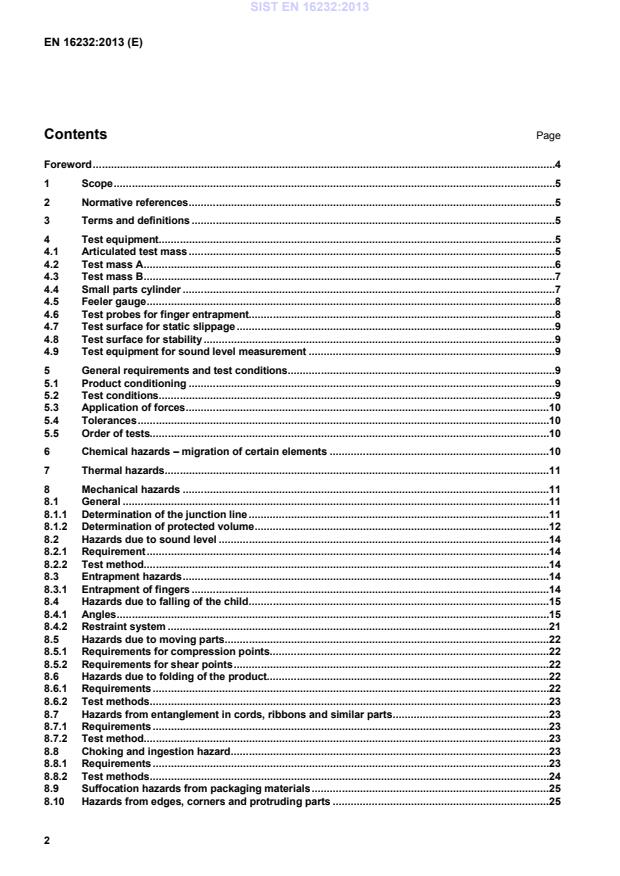
Rationales . 33 A.1 General (see Clause 1) . 33 A.2 Protective volume and protective barriers (see 8.1.2 and 8.1.2.2) . 33 A.3 Hazards due to sound level (see 8.2). 33 A.4 Hazards due to detachment of toy bars . 33 A.5 Hazards from possible movement of the infant swing on the floor (see 8.13) . 33 Annex B (informative)
A-deviation . 34 Bibliography . 35
Key 1 part to be placed onto the seat surface 2 part to be placed onto the backrest surface 3 hinge pin made of steel E mass: (4 495 ± 50) g F mass: (4 501 ± 50) g G mass of hinge axle: (17 ± 0,5) g, length: 79,5 mm Mass tolerance: (9 ± 0,1) kg Dimensions tolerance: ± 2 mm All edges shall be chamfered. Figure 1 — Articulated test mass 4.2 Test mass A Test mass A is a rigid cylinder (160 ± 5) mm in diameter and (300 ± 5) mm in height, having a mass of ()0100 9,+ kg and with its centre of gravity in the centre of the cylinder. All edges shall have a radius of (5 ± 1) mm. SIST EN 16232:2013
Key 1 radius: (5 ± 1) mm 2 two anchorage points Figure 2 — Test mass A 4.3 Test mass B Test mass B is a (150 ± 30) mm by (200 ± 30) mm rectangular shaped sand bag with a mass of (3 ± 0,1) kg. 4.4 Small parts cylinder Small parts cylinder for the assessment of small components, having dimensions in accordance with Figure 3. SIST EN 16232:2013
Figure 3 — Small parts cylinder 4.5 Feeler gauge Gauge with a thickness of (0,4 ± 0,02) mm and an insertion edge radius of (3 ± 0,5) mm (see Figure 4). Dimensions in millimetres
Figure 4 — Feeler gauge 4.6 Test probes for finger entrapment Probes made from plastics or other hard, smooth material of diameters ()01,0-7 mm and ()1,0012+ mm with a full hemispherical end that can be mounted on a force-measuring device, see Figure 5. Mesh probe made from plastics or other hard, smooth material as shown in Figure 6. SIST EN 16232:2013
Key (dimensions in millimetres) Probe type 7mm probe 12mm probe Diameter A 01,0-7 1,0012+ Radius RB 3,5 ± 0,2 6 ± 0,2 1 line scribed around circumference showing depth of penetration Figure 5 — Test probes with hemispherical end
Figure 6 — Test probe for mesh 4.7 Test surface for static slippage Rigid plane covered with uncoated tempered float glass with a smooth surface and thickness of (6 ± 0,5) mm, inclined at angle of (12 + 0,5/0)° to the horizontal. 4.8 Test surface for stability Test surface, inclined at (15° + 0,5/0)° to the horizontal, covered with aluminium oxide paper of grade 80. 4.9 Test equipment for sound level measurement The instrumentation system, including the microphone and cable, shall meet the requirements of a type 1 or type 2 instrument specified in EN 61672-1 and EN 61672-2. When measuring high peak emission sound pressure levels, the microphone and the entire instrumentation system shall have the capability of handling linear peak levels at least up to 125 dB. 5 General requirements and test conditions 5.1 Product conditioning Before testing, any fabrics used shall be cleaned or washed and dried twice in accordance with the manufacturer's instructions. 5.2 Test conditions The tests shall be carried out in ambient conditions of (20 ± 5) °C. SIST EN 16232:2013
± 5 % of the nominal force; — Masses:
± 0,5 % of the nominal mass; — Dimensions:
± 0,5 mm of the nominal dimension; — Angles:
± 0,5° of the nominal angle; The tests are described in terms of the application of forces. Masses can however be used. The relationship 10 N = 1 kg may be used for this purpose. Unless otherwise specified, the test forces may be applied by any suitable device which does not adversely affect the results. 5.5 Order of tests Unless otherwise stated in the test methods, the tests shall be carried out on the same infant swing in the order listed in this standard. 6 Chemical hazards – migration of certain elements The migration of synthetic or natural elements from coatings of paint, varnish, lacquer, polymer and similar coatings on exterior surfaces shall not exceed the following amounts: Antimony: 60 mg/kg Arsenic:
25 mg/kg Barium:
1 000 mg/kg Cadmium: 75 mg/kg Chromium: 60 mg/kg SIST EN 16232:2013
90 mg/kg Mercury:
60 mg/kg Selenium: 500 mg/kg These limits shall be verified in accordance with the test method given in EN 71-3:1994. Where a surface is coated with a multi-layer of paint or similar coating, the test sample shall not include the base material. A separate sample may be used for these tests. 7 Thermal hazards Fabrics shall not produce a surface flash when applying a flame as described in EN 1103. A separate sample may be used for these tests. 8 Mechanical hazards 8.1 General 8.1.1 Determination of the junction line The junction line is determined as in Figure 7.
Key LL junction line 1 backrest 2 seat Figure 7 — Junction line When the seat unit is in the form of a hammock, then a theoretical junction line, “LL”, is determined as shown in Figure 8. NOTE The junction line might vary when the backrest is adjusted in different positions. 1 SIST EN 16232:2013
Key LL junction line CL vertical projection of C on the hammock Figure 8 — Junction line for infant swings in form of a hammock 8.1.2 Determination of protected volume 8.1.2.1 General The protected volume is determined as follows. Place articulated test mass (see 4.1) on the seat unit with part 1 against the seat and with part 2 against the backrest with the hinge aligned with the junction line and the longitudinal axis of the test mass aligned with the longitudinal axis of the seat unit as shown in Figure 9. The protected volume is the space around the test mass defined by a part of a cylinder with its main axis along the projection of the junction line on the top surface of the test mass, a radius of 330 mm and a width of 350 mm on each side from the longitudinal axis of the test mass as shown in Figure 9. The area located behind the backrest and the area located underneath the seat is outside of the protected volume. The width of the protected volume may be reduced by the presence of protective barriers complying with 8.1.2.2. If another barrier (e.g. mesh or fabric decoration …) does not comply with 8.1.2.2, the full protected volume as described above shall be considered. See A.2. SIST EN 16232:2013
Side view Top view Key 1 origin from which the protected volume shall be measured: middle point of the junction line on the top surface of the test mass 2 seat 3 backrest Figure 9 — Protected volume 8.1.2.2 Protective barriers 8.1.2.2.1 Requirements If present, protective barriers shall enclose a circular section with a radius of 350 mm and with its centre on the junction line (see Figure 10). NOTE The measurement of dimensions of protective barriers is taken without removing the articulated test mass from the product. Dimensions in millimetres
Figure 10 — Examples of protective barriers If present, protective barriers shall not allow the test probe to come into contact to an entrapment, compression or shearing point when tested in accordance with 8.1.2.2.2. SIST EN 16232:2013
Key . angle between part 1 and part 2 of the test mass
angle between part 2 of the test mass and the horizontal surface / angle between part 1 of the test mass and the horizontal surface
angle drawn by the swinging frame from its rest position during lateral swinging movement Figure 11 — Angles 8.4.1.2 Test methods for angles 8.4.1.2.1 Test method for . angle Place the infant swing on a horizontal plane. Place articulated test mass (see 4.1) on the seat unit with part 1 against the seat and with part 2 against the backrest with the hinge aligned with the junction line and the longitudinal axis of the test mass aligned with the longitudinal axis of the seat unit as shown in Figure 9. If applicable, adjust the backrest in the most upright position. Let the test mass and the seat unit reach the equilibrium. Measure the . angle. 8.4.1.2.2 Test method for
and / angles Place the infant swing on a horizontal plane with some space under the plane to allow hanging of weights (see Figure 12). SIST EN 16232:2013
Key
angle between part 2 of the test mass and the horizontal surface / angle between part 1 of the test mass and the horizontal surface M 9 kg test mass Figure 12 — Measurement of angles
and / If applicable, adjust the backrest in the most upright position. Place articulated test mass (see 4.1) on the seat unit with part 1 against the seat and with part 2 against the backrest with the hinge aligned with the junction line and the longitudinal axis of the test mass aligned with the longitudinal axis of the seat unit as shown in Figure 9. Restrain the articulated test mass with the restraint system and adjust the restraint system as close as possible to the size of the test mass. Any movement of the test mass shall be avoided using wedges of negligible mass. Hang a mass of 9 kg within 20 mm from the most external edge of the seat along the longitudinal axis of the seat (see Figure 13 a). If the most external edge of the seat does not lie on the longitudinal axis, suitable means of negligible mass shall be used to hang the mass within 20 mm from the projection of the most external edge of the seat on the lo
...