

EN ISO 844:2026
(Main)Rigid cellular plastics - Determination of compressive properties (ISO 844:2026)
- Abstract
This document specifies methods for determining the compressive strength, the corresponding compressive strain, the compressive stress at 10 % nominal compressive strain, and the compressive modulus of rigid cellular plastics.
Two procedures are specified. Procedure A and Procedure B.
Procedure A utilizes the compression plate displacement for the nominal property determination. It is used to determine:
compressive strength and the corresponding nominal compressive strain;
compressive stress at 10 % nominal compressive strain;
nominal compressive modulus.
Procedure B uses an extensometer and determines the conventional properties. It is used to determine:
compressive strength and the corresponding compressive strain;
compressive modulus.
- Status
- Published
- Publication Date
- 07-Jul-2026
- Technical Committee
- CEN/TC 249 - Plastics
- Drafting Committee
- CEN/TC 249 - Plastics
- Current Stage
- 6060 - Definitive text made available (DAV) - Publishing
- Start Date
- 08-Jul-2026
- Due Date
- 08-Jul-2026
- Completion Date
- 08-Jul-2026
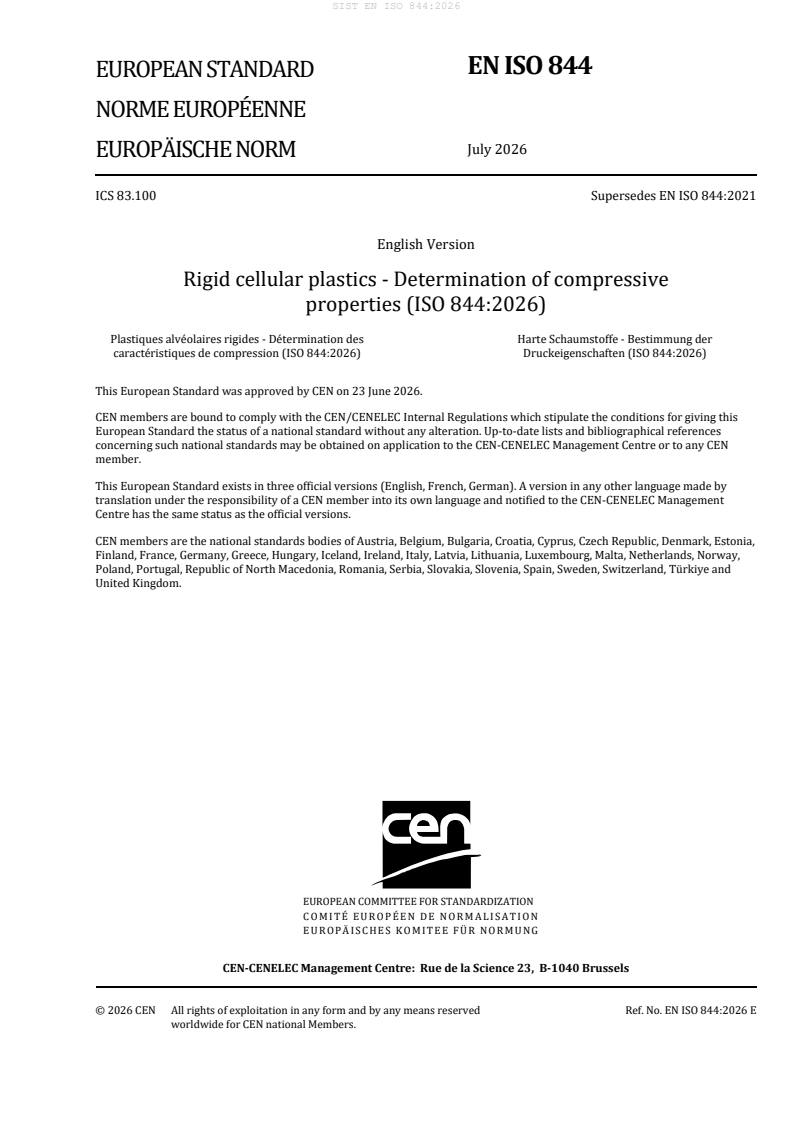


EN ISO 844:2026 is the European adoption of ISO 844:2026 for rigid cellular plastics. It specifies how to determine compressive strength, compressive strain, compressive stress at 10 % nominal compressive strain, and compressive modulus. The document is written for testing laboratories, manufacturers, and specifiers that need comparable compression data for rigid cellular plastics.
What does EN ISO 844:2026 specify?
EN ISO 844:2026 covers methods for measuring the compressive properties of rigid cellular plastics under constant displacement loading between rigid plates. It defines two procedures: Procedure A gives nominal properties from compression plate displacement, and Procedure B gives conventional properties from an extensometer on the specimen.
The document is organized into clauses on scope, normative references, terms and definitions, symbols, principle, apparatus, test specimens, procedure, result expression, precision, and test report. Annex A is informative and shows extensometer arrangements for Procedure B.
| Annex | What it covers |
|---|---|
| Annex A | Extensometer for Procedure B, including mechanical and optical arrangements |
What are the key requirements of EN ISO 844:2026?
Apparatus and calibration
EN ISO 844:2026 requires a compression-testing machine with two rigid, ground, plane-parallel plates that can cover the force and displacement range of the test. The plates must be stiff enough not to influence the result, aligned axially within 1:1 000, and flat and perpendicular to the loading axis within the stated limits. In practice, this reduces machine-induced error, which matters because the standard compares small differences in slope and force.
For Procedure A, the machine must measure plate displacement continuously with the stated accuracy. For Procedure B, the machine must use an extensometer that measures specimen displacement directly and meets class 1 of ISO 9513. The force-measuring system must meet class 1 of ISO 7500-1, and the equipment must be calibrated periodically to ISO 7500-1 and ISO 9513.
Test specimens and conditioning
Clause 7 sets the preferred specimen geometry as a right prism of 100 mm by 100 mm with a 50 mm thickness. Square or circular specimens are also allowed within the stated area range, and the minimum thickness depends on the product and the procedure. This matters because specimen size and thickness can change the measured compression response.
The specimens must be cut with the base normal to the compression direction in use, and the cutting method must not change the cellular structure. Moulded skins are removed unless they remain integral in use. The standard also requires conditioning in one of the stated atmospheres for at least 6 hours, and the test must be carried out in the same environment. In practice, that keeps moisture and temperature effects consistent.
Procedure A and Procedure B
Clause 8 requires the specimen to be placed centrally between the plates, the extensometer to be attached for Procedure B, and the machine to run at a speed close to 10 % of the original thickness per minute. The specimen is compressed until the required force values are obtained, and a force-displacement curve is recorded. The speed target is important because compression results depend on rate.
Procedure A uses relative plate displacement to determine nominal compressive properties. Procedure B uses direct specimen displacement to determine conventional properties. The introduction explains why this difference matters: plate displacement includes machine effects, while direct specimen measurement better reflects specimen deformation.
Result calculation and curve interpretation
Clause 9 defines compressive strength as maximum force divided by initial cross-sectional area, with the result taken at the relevant point on the curve. For Procedure A, the standard also determines nominal compressive strain and compressive stress at 10 % nominal compressive strain. For Procedure B, it determines compressive strain and compressive modulus.
The standard gives rules for different force-displacement curve shapes, including cases with force-drop and cases without it. If a toe region appears at the start of the curve, it must be compensated before strain is calculated. For modulus, the standard uses the steepest linear range below the proportional limit, found by dividing the relevant part of the curve into at least six segments and comparing adjacent slopes. This makes the reported modulus more consistent across foams with non-linear early behavior.
Precision and reporting
Clause 10 gives precision information from interlaboratory tests for both procedures. For Procedure A, the precision data cover compressive strength, stress at 10 % nominal compressive strain, and nominal compressive modulus. For Procedure B, the precision data cover compressive strength and compressive modulus. This helps users judge how much spread to expect between laboratories.
Clause 11 lists what the test report must include: the reference to EN ISO 844:2026, identification of the product, specimen dimensions, force direction relative to anisotropy or geometry, the procedure used, number of specimens, average results, individual values when variation is high, testing date, and any deviations. For buyers and quality teams, that report structure is what makes the result traceable and comparable.
What terms does EN ISO 844:2026 define?
- Nominal compressive strain - the decrease in thickness per unit original thickness of the specimen; Procedure A uses this measure.
- Compressive strain - the decrease in length per unit original gage length of the specimen; Procedure B uses this measure.
- Compressive strength - the maximum compressive force divided by the initial cross-sectional area of the specimen.
- Compressive stress at 10 % nominal compressive strain - the force at 10 % nominal compressive strain divided by the initial area.
- Nominal compressive modulus - the slope-like value based on compressive stress and nominal compressive strain below the nominal proportional limit.
- Compressive modulus - the equivalent modulus based on compressive stress and compressive strain below the proportional limit.
- Nominal proportional limit - the upper displacement limit of the linear part of the force-nominal displacement curve.
- Proportional limit - the upper displacement limit of the linear part of the force-displacement curve.
Who uses EN ISO 844:2026?
EN ISO 844:2026 is used by testing laboratories, material producers, and quality control teams that need repeatable compression data for rigid cellular plastics. It is also relevant to buyers, specifiers, and technical assessors who compare supplier data or confirm that a product has been tested in a defined way. Procedure A is useful when the user needs nominal properties based on plate displacement, while Procedure B is used when direct specimen deformation is needed.
What changed in EN ISO 844:2026 from the previous edition?
EN ISO 844:2026 supersedes EN ISO 844:2021. The ISO foreword says this eighth edition replaces ISO 844:2021 and was technically revised.
The stated changes are:
- the term “compression” was changed to “compressive” throughout the document, including the title;
- the scope was expanded to describe Procedure A and Procedure B in more detail;
- “relative deformation” was changed to “compressive strain”;
- “nominal relative deformation” was changed to “nominal compressive strain”;
- “necking” was replaced with the more descriptive “force-drop”.
Which standards are used with EN ISO 844:2026?
- ISO 291 - gives the standard atmospheres used for conditioning and testing.
- ISO 1923 - provides the method for measuring linear dimensions of the test specimens.
- ISO 7500-1 - covers calibration and verification of the force-measuring system of the testing machine.
- ISO 9513 - covers calibration of extensometer systems used in uniaxial testing.
- ISO 5725-2 - is used in clause 10 to analyse repeatability and reproducibility data from the interlaboratory tests.
What does the EN ISO 844:2026 document contain?
EN ISO 844:2026 contains the full test method for compression testing of rigid cellular plastics, including symbols, principle, apparatus requirements, specimen preparation, conditioning, test procedure, calculation rules, precision data, and reporting requirements. It includes figures showing example force-displacement curves for both procedures, a table linking specimen thickness to extensometer gage length, and tables with interlaboratory precision results. Annex A gives practical extensometer arrangements for Procedure B, including mechanical and optical approaches.
Relations
- Replaces
EN ISO 844:2021 - Rigid cellular plastics - Determination of compression properties (ISO 844:2021) - Effective Date
- 19-Jan-2023
- Refers
ISO 9513:2012 - Metallic materials — Calibration of extensometer systems used in uniaxial testing - Effective Date
- 22-Jul-2026
- Effective Date
- 22-Jul-2026
- Effective Date
- 22-Jul-2026
- Effective Date
- 22-Jul-2026
- Effective Date
- 15-Jul-2026
- Effective Date
- 15-Jul-2026
- Effective Date
- 15-Jul-2026
- Effective Date
- 28-Jan-2026
- Effective Date
- 12-Feb-2026
Get Certified
Connect with accredited certification bodies for this standard

DIN CERTCO
DIN Group product certification.

Smithers Quality Assessments
US management systems and product certification.
Sponsored listings
Frequently Asked Questions
EN ISO 844:2026 is a standard published by the European Committee for Standardization (CEN). Its full title is "Rigid cellular plastics - Determination of compressive properties (ISO 844:2026)". This standard covers: This document specifies methods for determining the compressive strength, the corresponding compressive strain, the compressive stress at 10 % nominal compressive strain, and the compressive modulus of rigid cellular plastics. Two procedures are specified. Procedure A and Procedure B. Procedure A utilizes the compression plate displacement for the nominal property determination. It is used to determine: compressive strength and the corresponding nominal compressive strain; compressive stress at 10 % nominal compressive strain; nominal compressive modulus. Procedure B uses an extensometer and determines the conventional properties. It is used to determine: compressive strength and the corresponding compressive strain; compressive modulus.
This document specifies methods for determining the compressive strength, the corresponding compressive strain, the compressive stress at 10 % nominal compressive strain, and the compressive modulus of rigid cellular plastics. Two procedures are specified. Procedure A and Procedure B. Procedure A utilizes the compression plate displacement for the nominal property determination. It is used to determine: compressive strength and the corresponding nominal compressive strain; compressive stress at 10 % nominal compressive strain; nominal compressive modulus. Procedure B uses an extensometer and determines the conventional properties. It is used to determine: compressive strength and the corresponding compressive strain; compressive modulus.
EN ISO 844:2026 is classified under the following ICS (International Classification for Standards) categories: 83.100 - Cellular materials. The ICS classification helps identify the subject area and facilitates finding related standards.
EN ISO 844:2026 has the following relationships with other standards: It is inter standard links to EN ISO 844:2021, ISO 9513:2012, ISO 291:2008, ISO 7500-1:2018, ISO 1923:1981, EN 17415-1:2020, EN 253:2019, EN 17333-4:2020, EN ISO 5139:2023, ISO 844:2026. Understanding these relationships helps ensure you are using the most current and applicable version of the standard.
EN ISO 844:2026 is available in PDF format for immediate download after purchase. The document can be added to your cart and obtained through the secure checkout process. Digital delivery ensures instant access to the complete standard document.
Standards Content (Sample)
Contents
- Introduction
- 1 Scope
- 2 Normative references
- 3 Terms and definitions
- 3.1 nominal compressive strain
- 3.2 compressive strain
- 3.3 compressive strength
- 3.4 compressive stress at 10 % nominal compressive strain
- 3.5 nominal compressive modulus
- 3.6 compressive modulus
- 3.7 nominal proportional limit
- 3.8 proportional limit
- 4 Symbols
- 5 Principle
- 6 Apparatus
- 6.1 Testing machine
- 6.2 Devices for measuring displacement and force
- 6.3 Devices for measuring the dimensions of the test specimens
- 7 Test specimens
- 7.1 Dimensions
- 7.2 Preparation
- 7.3 Number
- 7.4 Conditioning
- 8 Procedure
- 9 Expression of results
- 9.1 General
- 9.2 Compressive strength and compressive strains
- 9.3 Compressive stress at 10 % nominal compressive strain (procedure A)
- 9.4 Modulus
- 10 Precision
- 10.1 Procedure A
- 10.2 Procedure B
- 11 Test report
- Annex A
- Bibliography
Introduction
For the determination of compressive properties, it is common practice to apply a uniform compressive deformation to a standard test specimen, especially for quality assurance. However, the test specimen has a complex and inhomogeneous deformation state, under compression, which is not subjected to further analysis in such an evaluation. Measurement results are, therefore, not easily transferable to other test specimens or products. This document describes Procedure A, which determines the nominal compressive properties. Procedure B determines conventional compressive properties. Procedure A employs relative plate displacement for the determination of compressive properties. Procedure B employs displacement measuring devices directly positioned on the specimen (contact or optical extensometer) or similar devices that measure the specimen displacement.
SIST EN ISO 844:2026
SIST EN ISO 844:2026 International Standard ISO 844:2026(en) Rigid cellular plastics — Determination of compressive properties
1 Scope
This document specifies methods for determining the compressive strength, the corresponding compressive strain, the compressive stress at 10 % nominal compressive strain, and the compressive modulus of rigid cellular plastics.
Two procedures are specified. Procedure A and Procedure B.
Procedure A utilizes the compression plate displacement for the nominal property determination. It is used to determine:
- compressive strength and the corresponding nominal compressive strain;
- compressive stress at 10 % nominal compressive strain;
- nominal compressive modulus.
Procedure B uses an extensometer and determines the conventional properties. It is used to determine:
- compressive strength and the corresponding compressive strain;
- compressive modulus.
2 Normative references
The following documents are referred to in the text in such a way that some or all of their content constitutes requirements of this document. For dated references, only the edition cited applies. For undated references, the latest edition of the referenced document (including any amendments) applies. ISO 291, Plastics — Standard atmospheres for conditioning and testing ISO 1923, Cellular plastics and rubbers — Determination of linear dimensions ISO 7500-1, Metallic materials — Calibration and verification of static uniaxial testing machines — Part 1:
Tension/compression testing machines — Calibration and verification of the force-measuring system ISO 9513, Metallic materials — Calibration of extensometer systems used in uniaxial testing
3 Terms and definitions
For the purposes of this document, the following terms and definitions apply. ISO and IEC maintain terminology databases for use in standardization at the following addresses:
- ISO Online browsing platform: available at https:// www .iso .org/ obp
- IEC Electropedia: available at https:// www .electropedia .org/
SIST EN ISO 844:2026 ISO 844:2026(en)
3.1 nominal compressive strain
ε C decrease in thickness per unit original thickness h of the test specimen
Note 1 to entry: It is expressed as a percentage.
Note 2 to entry: ε is the nominal compressive strain at σ (see 3.3). Cm m Note 3 to entry: Procedure A applies.
3.2 compressive strain
ε decrease in length per unit original gage length l o Note 1 to entry: It is expressed as a percentage.
Note 2 to entry: ε is the compressive strain at σ (see 3.3).
m m Note 3 to entry: Procedure B applies.
3.3 compressive strength
σ m maximum compressive force F divided by the initial cross-sectional area A of the test specimen when the m 0 ε and the ε , respectively, < 10 % m Cm Note 1 to entry: It is expressed in megapascals (MPa).
3.4 compressive stress at 10 % nominal compressive strain
σ
ratio of the compressive force F at 10 % nominal compressive strain ε to the initial cross-sectional area 10 C10 A of the test specimen
Note 1 to entry: It is expressed in megapascals (MPa).
Note 2 to entry: Procedure A applies
3.5 nominal compressive modulus
E C difference in compressive stress divided by the difference in corresponding nominal compressive strain below the nominal proportional limit Note 1 to entry: It is expressed in megapascals (MPa).
Note 2 to entry: Procedure A applies.
3.6 compressive modulus
E difference in compressive stress divided by the difference in corresponding compressive strain below the proportional limit Note 1 to entry: It is expressed in megapascals (MPa).
Note 2 to entry: Procedure B applies.
SIST EN ISO 844:2026 ISO 844:2026(en)
3.7 nominal proportional limit
X Ce upper displacement limit of the linear part of the force -nominal displacement curve Note 1 to entry: It is expressed in millimetres (mm).
Note 2 to entry: Procedure A applies.
3.8 proportional limit
X e upper displacement limit of the linear part of the force–displacement curve Note 1 to entry: It is expressed in millimetres (mm).
Note 2 to entry: Procedure B applies.
4 Symbols
Symbol Definition Unit A initial cross-sectional area square millimetres
E compressive modulus megapascals E nominal compressive modulus megapascals C F force at proportional limit newtons e F force at nominal proportional limit newtons Ce F maximum force newtons m F force at 10 % nominal compressive strain newtons
h initial thickness of test specimen millimetres
l initial gage length of the extensometer millimetres o Ra compression plate surface roughness micrometres t compression plate thickness millimetres X proportional limit millimetres e X nominal proportional limit millimetres Ce X displacement at maximum force millimetres m X nominal displacement at maximum force millimetres Cm X displacement at 10 % nominal compressive strain millimetres C10 ε compressive strain at compressive strength percent m ε nominal compressive strain at compressive strength percent Cm ε 10 % nominal compressive strain percent C10 σ compressive stress at proportional limit megapascals e σ compressive strength megapascals m σ compressive stress at 10 % nominal compressive strain megapascals
5 Principle
A compressive force is applied perpendicular to the faces of the test specimen positioned between two rigid plates using a constant displacement loading. Nominal compressive properties are determined from the stress-strain data produced using the relative plate displacement as the displacement indicator. In contrast, compressive properties are determined with an extensometer that provides a direct measurement of the test specimen deformation.
SIST EN ISO 844:2026 ISO 844:2026(en)
6 Apparatus
6.1 Testing machine
A testing machine suited to cover the range of compressive force and displacement involved and having two square or circular plane parallel rigid ground compression plates to the following requirements shall be used.
...