

EN 13041:2011
(Main)Soil improvers and growing media - Determination of physical properties - Dry bulk density, air volume, water volume, shrinkage value and total pore space
- Abstract
This European Standard describes an instrumental method for the routine determination of the physical properties, dry bulk density, water volume, air volume, shrinkage value and total pore space of soil improvers or growing media.
This European Standard is not suitable for those materials which are very coarse, which do not make proper capillary contact or those which are pre-formed and non-particulate and have closed porosity. It is applicable to materials with particles 25 mm and/or flexible fibres 80 mm.
This method is not applicable to liming materials and preformed materials such as mineral wool slabs and foam slabs.
NOTE The requirements of the standard may differ from the national legal requirements for the declaration of the products concerned.
- Status
- Published
- Publication Date
- 01-Nov-2011
- Withdrawal Date
- 30-May-2012
- Technical Committee
- CEN/TC 223 - Soil improvers and growing media
- Drafting Committee
- CEN/TC 223/WG 4 - Analytical methods
- Current Stage
- 9093 - Decision to confirm - Review Enquiry
- Start Date
- 04-Sep-2023
- Completion Date
- 14-Oct-2026

Overview
EN 13041:2011 (CEN) specifies a routine instrumental method for determining key physical properties of soil improvers and growing media: dry bulk density, water volume, air volume, shrinkage value and total pore space. The method is intended for particulate and fibrous substrates (particles ≤ 25 mm, flexible fibres ≤ 80 mm) and is not applicable to very coarse materials, pre‑formed non‑particulate products with closed porosity (e.g. mineral wool slabs, foam slabs) or liming materials. The test relies on water saturation, controlled suction equilibration and wet/dry mass and dimensional measurements to calculate the physical parameters.
Key Topics and Requirements
- Scope & limitations
- Applicable to soil improvers and growing media with specified particle/fibre size limits.
- Not suitable for coarse or closed‑porosity preformed materials.
- Principle
- Samples are saturated, equilibrated on a sand suction table and equilibrated at defined pressure heads (typical suctions: –10 cm = –1 kPa, –50 cm = –5 kPa, –100 cm = –10 kPa). Wet and oven‑dry masses and sample dimensions are used to compute volumes and densities.
- Apparatus & test conditions
- Double rings (lower ring: internal Ø 100 ±1 mm, height 50 ±1 mm; upper ring: height 53 ±1 mm).
- Removable gauze (mesh ≈ 0.1 mm), plastic tubes (~2 L), water bath, sand suction table, ventilated drying oven (103 ±2 °C), analytical balance (0.1 g resolution).
- Procedure highlights
- Saturation and equilibration at –50 cm (–5 kPa), transfer to double rings, re‑wet and equilibrate at –10 cm (–1 kPa); optional further suctions at –50 cm and –100 cm.
- Separate rings, level the sample, record sequential masses and dimensions (masses m1…m5, heights and diameters) and calculate results.
- Results & reporting
- Calculates dry bulk density, shrinkage value, particle density, total pore space, water and air volumes at specified suctions.
- Includes guidance on number of replicates, precision and required test report contents.
Applications and Users
- Quality control and product specification for substrate manufacturers, peat alternatives, compost suppliers and soil improver producers.
- Routine testing in laboratories and third‑party testing bodies validating physical porosity and water retention properties.
- R&D teams optimizing substrate mixes for horticulture, nursery production, green roofs and container media.
- Useful for agronomists, horticultural consultants and buyers assessing suitability of growing media for irrigation and aeration requirements.
Related Standards
- EN 12579 - Sampling for soil improvers and growing media
- EN 13039 - Determination of organic matter content and ash
- EN 13040:2007 - Sample preparation, dry matter and moisture determination
Note: EN 13041:2011 provides standardized measurement procedures; declared product requirements may still differ from national legal obligations.
Relations
- Effective Date
- 05-Nov-2011
- Effective Date
- 05-Nov-2011
- Refers
EN 13039:2011 - Soil improvers and growing media - Determination of organic matter content and ash - Effective Date
- 28-Jan-2026
- Effective Date
- 28-Jan-2026
- Effective Date
- 28-Jan-2026
- Referred By
CR 13456:1999 - Soil improvers and growing media - Labelling, specifications and product schedules - Effective Date
- 28-Jan-2026
Get Certified
Connect with accredited certification bodies for this standard

Control Union Certifications
Global certification for agriculture and sustainability.

ECOCERT
Organic and sustainability certification.

FSC International
Forest Stewardship Council certification.
Sponsored listings
Frequently Asked Questions
EN 13041:2011 is a standard published by the European Committee for Standardization (CEN). Its full title is "Soil improvers and growing media - Determination of physical properties - Dry bulk density, air volume, water volume, shrinkage value and total pore space". This standard covers: This European Standard describes an instrumental method for the routine determination of the physical properties, dry bulk density, water volume, air volume, shrinkage value and total pore space of soil improvers or growing media. This European Standard is not suitable for those materials which are very coarse, which do not make proper capillary contact or those which are pre-formed and non-particulate and have closed porosity. It is applicable to materials with particles 25 mm and/or flexible fibres 80 mm. This method is not applicable to liming materials and preformed materials such as mineral wool slabs and foam slabs. NOTE The requirements of the standard may differ from the national legal requirements for the declaration of the products concerned.
This European Standard describes an instrumental method for the routine determination of the physical properties, dry bulk density, water volume, air volume, shrinkage value and total pore space of soil improvers or growing media. This European Standard is not suitable for those materials which are very coarse, which do not make proper capillary contact or those which are pre-formed and non-particulate and have closed porosity. It is applicable to materials with particles 25 mm and/or flexible fibres 80 mm. This method is not applicable to liming materials and preformed materials such as mineral wool slabs and foam slabs. NOTE The requirements of the standard may differ from the national legal requirements for the declaration of the products concerned.
EN 13041:2011 is classified under the following ICS (International Classification for Standards) categories: 65.080 - Fertilizers. The ICS classification helps identify the subject area and facilitates finding related standards.
EN 13041:2011 has the following relationships with other standards: It is inter standard links to EN 13041:1999, EN 13041:1999/A1:2006, EN 13039:2011, EN 12579:1999, EN 13040:2007, CR 13456:1999. Understanding these relationships helps ensure you are using the most current and applicable version of the standard.
EN 13041:2011 is available in PDF format for immediate download after purchase. The document can be added to your cart and obtained through the secure checkout process. Digital delivery ensures instant access to the complete standard document.
Standards Content (Sample)
2003-01.Slovenski inštitut za standardizacijo. Razmnoževanje celote ali delov tega standarda ni dovoljeno.Bodenverbesserungsmittel und Kultursubstrate - Bestimmung der physikalischen Eigenschaften - Rohdichte (trocken), Luftkapazität, Wasserkapazität, Schrumpfungswert und GesamtporenvolumenAmendements du sol et supports de culture - Détermination des propriétés physiques - Masse volumique apparente sèche, volume d'air, volume d'eau, valeur de rétraction et porosité totaleSoil improvers and growing media - Determination of physical properties - Dry bulk density, air volume, water volume, shrinkage value and total pore space65.080GnojilaFertilizersICS:Ta slovenski standard je istoveten z:EN 13041:2011SIST EN 13041:2012en,fr,de01-marec-2012SIST EN 13041:2012SLOVENSKI
STANDARDSIST EN 13041:2001/A1:2006SIST EN 13041:20011DGRPHãþD
EUROPEAN STANDARD NORME EUROPÉENNE EUROPÄISCHE NORM
EN 13041
November 2011 ICS 65.080 Supersedes EN 13041:1999English Version
Soil improvers and growing media - Determination of physical properties - Dry bulk density, air volume, water volume, shrinkage value and total pore space
Amendements du sol et supports de culture - Détermination des propriétés physiques - Masse volumique apparente sèche, volume d'air, volume d'eau, valeur de rétraction et porosité totale
Bodenverbesserungsmittel und Kultursubstrate - Bestimmung der physikalischen Eigenschaften -Rohdichte (trocken), Luftkapazität, Wasserkapazität, Schrumpfungswert und Gesamtporenvolumen This European Standard was approved by CEN on 17 September 2011.
CEN members are bound to comply with the CEN/CENELEC Internal Regulations which stipulate the conditions for giving this European Standard the status of a national standard without any alteration. Up-to-date lists and bibliographical references concerning such national standards may be obtained on application to the CEN-CENELEC Management Centre or to any CEN member.
This European Standard exists in three official versions (English, French, German). A version in any other language made by translation under the responsibility of a CEN member into its own language and notified to the CEN-CENELEC Management Centre has the same status as the official versions.
CEN members are the national standards bodies of Austria, Belgium, Bulgaria, Croatia, Cyprus, Czech Republic, Denmark, Estonia, Finland, France, Germany, Greece, Hungary, Iceland, Ireland, Italy, Latvia, Lithuania, Luxembourg, Malta, Netherlands, Norway, Poland, Portugal, Romania, Slovakia, Slovenia, Spain, Sweden, Switzerland and United Kingdom.
EUROPEAN COMMITTEE FOR STANDARDIZATION
COMITÉ EUROPÉEN DE NORMALISATION EUROPÄISCHES KOMITEE FÜR NORMUNG
Management Centre:
Avenue Marnix 17,
B-1000 Brussels © 2011 CEN All rights of exploitation in any form and by any means reserved worldwide for CEN national Members. Ref. No. EN 13041:2011: ESIST EN 13041:2012
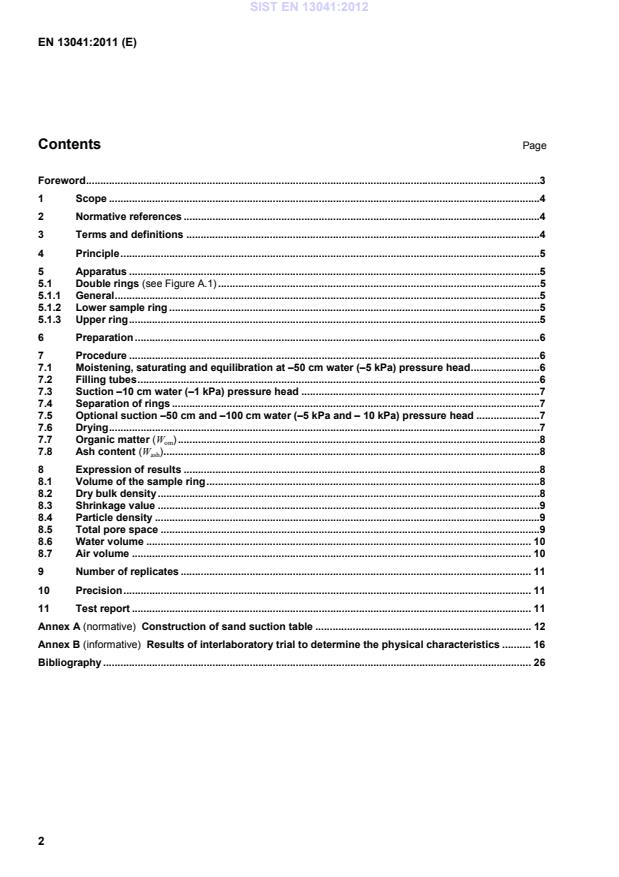
Construction of sand suction table . 12Annex B (informative)
Results of interlaboratory trial to determine the physical characteristics . 16Bibliography . 26 SIST EN 13041:2012
As each ring is individually made it is necessary to determine the volume (V1), record the mass (m1) and identify each lower sample ring. The volume shall be determined by measuring the mean height (at least quadruplicate measurements) (h1) and mean diameter (d1) of the sample rings with a calliper gauge (At least triplicate measurements; top, middle and bottom). 5.1.2.2 Removable gauze-retaining ring or collar 20 mm high and 7,5 mm to 8,5 mm larger than the outer diameter of the sample ring. 5.1.2.3 Non-biodegradable synthetic gauze with a mesh size of about 0,1 mm. 5.1.3 Upper ring 5.1.3.1 Upper ring having the same internal diameter as the ring prepared in (see 5.1.2.1) and height
(53 ± 1) mm. 5.1.3.2 Collar - fixed on the ring permitting the upper cylinder to be secured to the lower cylinder for the duration of the test.
5.2 Plastic tube, of approximately 14 cm diameter and 14 cm high to give a volume of about 2 l. Tightly stretch and secure the gauze (see 5.1.2.3) to one end of the tube by means of an elastic band. 5.3 Water bath, capable of holding at least 4 plastic tubes (see 5.2) standing on a coarse mesh and capable of being filled with water to the top of the plastic tubes. 5.4 Sand suction table (see Figure A.3) Prepare the sand suction table for example in accordance with Annex A, using the fine sand to obtain the required suction. The pressure head in the plastic tubes (–50 cm water = –5 kPa) is measured from the SIST EN 13041:2012
–100 cm water, equivalent to –1 kPa, –5 kPa and –10 kPa, respectively) is measured from the middle of the lower ring (see Figure A.3). The setting of the pressure head can be checked with a tensiometer or pressure transducer. 5.5 Ventilated drying oven set at (103 ± 2) °C. 5.6 Analytical balance with a scale interval of 0,1 g. 5.7 Shallow vessel, spoon or scoop approximately 50 ml capacity. 6 Preparation Prepare the laboratory sample in accordance with 8.4 of EN 13040:2007. 7 Procedure 7.1 Moistening, saturating and equilibration at –50 cm water (–5 kPa) pressure head 7.1.1 Fill at least 2 tubes (see 5.2) with the test portion taking care to prevent artificial air voids. Cover each tube with synthetic gauze (see 5.1.2.3) secured with an elastic band. Place the tube on the grid in a dry water bath (see 5.3).
7.1.2 Slowly, with constant flow, fill the bath with water until the level reaches to within 1 cm below the top of the tube. Filling should take approximately 30 min. 7.1.3 If a tube shows signs of floating, place a weighted disc on the top of the tube allowing air to evacuate and at the same time ensuring that compaction of the sample does not take place, (see Figure A.4). 7.1.4 Allow to stand maintaining a constant water level until the sample is thoroughly wetted (up to 36 h). 7.1.5 Remove the tubes and without delay, transfer the tubes to the sand suction table. The bottom of the tube should be fully in contact with the sand. Apply a –50 cm water (–5 kPa) pressure head, measured from the bottom of the tube, for 48 h. 7.2 Filling tubes 7.2.1 Secure the gauze (see 5.1.2.3) with the collar (see 5.1.2.2) to the base of the lower sample ring (see 5.1.2). Attach and secure the upper sample ring (see 5.1.3) to the lower sample ring. 7.2.2 Empty the tubes containing the equilibrated (–50 cm water, –5 kPa) wet sample from 7.1.5 onto a clean surface and gently mix taking care not to cause any physical damage to the sample. 7.2.3 Transfer using the shallow vessel (see 5.7) approximately 50 ml portions of the mixed sample to the prepared sample rings taking care to avoid compaction or artificial air voids and filling the cylinder and removable ring completely. 7.2.4 Fill at least 4 units with the sample. Place the unit on the grid in a dry water bath. Slowly, with constant flow, fill the bath (see 5.3) with water until the level reaches to within 1 cm below the top of the tube. Filling should take approximately 30 min. 7.2.5 Maintain a constant water level for 24 h (see Figure A.5). NOTE Two different baths may be used, one for -10 cm water (–1 kPa) and one for –50 cm water (–5 kPa). SIST EN 13041:2012
Apply the suction until equilibrium is reached. A minimum of 48 h and up to 72 h is required. 7.4 Separation of rings 7.4.1 Remove the double ring sample cylinders from the sand box and place on a flat solid surface. Carefully remove the upper ring in a vertical movement. Use a knife or straight edge to strike off the material level with the top of the sample ring without causing compaction. The levelling of fibrous materials can best be done by cutting off excess matter with a pair of scissors exercising considerable care to avoid other disturbances. 7.4.2 Remove any materials adhering to the outside of the sample ring and record the mass (m2) taking care not to turn the ring. 7.5 Optional suction –50 cm and –100 cm water (–5 kPa and – 10 kPa) pressure head
NOTE After –10 cm water (–1 kPa) pressure head it is possible also to determine the air and water volume at –50 cm and –100 cm water (–5 kPa and –10 kPa) pressure head. The following procedure (see 7.5) can be skipped only if values for water and air volume at –10 cm water (–1 kPa) are necessary. 7.5.1 Carefully place the ring to the sand bath (see 5.4) making sure there is contact between the sand and the lower part of the ring. Cover the sand box and apply a –50 cm water (–5 kPa) pressure head, measured from the middle of the ring. 7.5.2 It is important to regularly check that no air bubbles are present in the suction level regulator tubes. 7.5.3 Apply the suction until equilibrium is reached. A minimum of 48 h and up to 72 h is required. 7.5.4 Record the mass (m3). 7.5.5 Carefully place the ring to the sand bath (see 5.4) making sure there is contact between the sand and the lower part of the ring. Cover the sand box and apply a –100 cm water (–10 kPa) pressure head, measured from the middle of the ring. 7.5.6 It is important to regularly check that no air bubbles are present in the suction level regulator tubes. 7.5.7 Apply the suction until equilibrium is reached. A minimum of 48 h and up to 72 h is required. 7.5.8 Record the mass (m4). 7.6 Drying 7.6.1 Place in the drying oven (see 5.5) without altering the structure and dry at (103 ± 2) °C to constant mass (m5). SIST EN 13041:2012
...