


prEN 18122
(Main)High chairs and learning towers - Learning towers - Requirements and test methods
High chairs and learning towers - Learning towers - Requirements and test methods
This document specifies safety requirements and test methods for learning towers for domestic use that are intended to raise children to allow them to carry out tasks on kitchen worktops, bathroom sinks, etc. in a standing position.
If the learning tower has additional functions or can be converted into other products, the relevant European Standards may apply.
Kinderhochstühle und Lerntürme - Lerntürme - Anforderungen und Prüfverfahren
Dieses Dokument legt sicherheitstechnische Anforderungen an und Prüfverfahren für Lerntürme für den Hausgebrauch fest, die dafür vorgesehen sind, Kinder anzuheben, damit es ihnen möglich ist, Aufgaben auf Küchenarbeitsplatten, an Waschbecken usw. in stehender Position auszuführen.
Lerntürme werden üblicherweise von Kindern ab dem Alter, in dem sie ohne Hilfe stehen können, bis etwa 6 Jahre verwendet.
ANMERKUNG Wenn das Produkt andere Funktionen bietet, können andere Normen angewendet werden.
Chaises hautes et tours d'apprentissage - Tours d'apprentissage - Exigences et méthodes d'essai
Le présent document spécifie les exigences de sécurité et les méthodes d’essai applicables aux tours d’apprentissage à usage domestique, conçues pour permettre aux enfants d’exécuter debout des tâches sur un plan de travail de cuisine, un lavabo de salle de bain, etc.
Les tours d’apprentissage sont généralement utilisées par les enfants jusqu’à six ans.
Note Si le produit présente des fonctions supplémentaires, d’autres normes peuvent s’appliquer.
Otroški visoki stoli - Učni stolpi - Zahteve in preskusne metode
General Information
- Status
- Not Published
- Publication Date
- 15-Jul-2026
- Technical Committee
- CEN/TC 364 - Project Committee - High Chairs
- Drafting Committee
- CEN/TC 364 - Project Committee - High Chairs
- Current Stage
- 4599 - Dispatch of FV draft to CMC - Finalization for Vote
- Start Date
- 21-Jan-2026
- Due Date
- 01-Jan-2026
- Completion Date
- 21-Jan-2026
- Directive
- 2001/95/EC - General product safety
Overview
The prEN 18122:2024 standard, developed by the European Committee for Standardization (CEN), defines the safety requirements and test methods for learning towers designed for domestic use. These products are intended to safely raise children, generally up to 6 years old, to a standing height suitable for carrying out activities on kitchen worktops, bathroom sinks, and similar surfaces. Learning towers enhance child participation during daily tasks while ensuring their safety and stability.
This standard is critical for manufacturers, designers, and safety inspectors of children’s furniture, especially focusing on high chairs and learning towers used in domestic environments. It addresses the safety, structural integrity, and chemical and mechanical hazards associated with these products.
Key Topics
Product Scope and Definitions
Defines the learning tower as a freestanding product including a raised platform and guardrails designed to prevent falls. Essential components such as platforms, guardrails, locking mechanisms, and operating devices are clearly described for standardization.Safety Requirements
Covers critical safety aspects such as:- Protecting children from falls via guardrails
- Preventing entrapment of fingers, head, or neck
- Avoiding hazards caused by moving or folding parts
- Ensuring stability under various conditions, including step/rung integrity
- Removing choking hazards from small parts and ingestion risks
- Addressing thermal hazards and chemical migration according to toxicological safety standards
Test Methods
Specifies a detailed sequence of tests and the necessary equipment such as finger probes, head probes, test masses, and loading pads. Tests simulate realistic forces and conditions to evaluate structural strength, stability, and resistance to mechanical failures under normal use.Marking and Product Information
Requires clear, durable marking and comprehensive user instructions explaining proper assembly, use, and maintenance to support compliance and safe usage.
Applications
prEN 18122:2024 directly applies to the manufacture, testing, and certification of learning towers and children’s high chairs for domestic environments. Relevant stakeholders include:
- Furniture manufacturers designing safe, ergonomic child learning towers
- Safety testing labs verifying compliance with European safety standards
- Retailers and resellers assessing product safety and labeling accuracy
- Child safety advocacy organizations evaluating hazards in home furniture
- Regulatory bodies monitoring the market to enforce consumer safety laws
These towers enable young children to safely participate at elevated worktops, fostering developmental independence while minimizing risks.
Related Standards
EN 71-2:2020 (Safety of Toys - Flammability)
Addresses the fire safety aspects of materials used in children’s products including learning towers.EN 71-3:2019+A1:2021 (Safety of Toys - Migration of Certain Elements)
Governs chemical safety concerning toxic element migration ensuring materials do not present health risks.ISO 48-4:2018 (Rubber Hardness Measurement)
Provides methods for assessing the hardness of rubber components used in parts like grips or protective surfaces on learning towers.
Products with multifunctionality or convertible features may additionally require compliance with other European standards relevant to those specific functions.
By adhering to prEN 18122:2024, manufacturers ensure that children’s learning towers meet rigorous safety benchmarks, supporting both consumer confidence and regulatory compliance across Europe. This standard plays a crucial role in safeguarding children in domestic settings where elevated support furniture is used.

Frequently Asked Questions
prEN 18122 is a draft published by the European Committee for Standardization (CEN). Its full title is "High chairs and learning towers - Learning towers - Requirements and test methods". This standard covers: This document specifies safety requirements and test methods for learning towers for domestic use that are intended to raise children to allow them to carry out tasks on kitchen worktops, bathroom sinks, etc. in a standing position. If the learning tower has additional functions or can be converted into other products, the relevant European Standards may apply.
This document specifies safety requirements and test methods for learning towers for domestic use that are intended to raise children to allow them to carry out tasks on kitchen worktops, bathroom sinks, etc. in a standing position. If the learning tower has additional functions or can be converted into other products, the relevant European Standards may apply.
prEN 18122 is classified under the following ICS (International Classification for Standards) categories: 97.140 - Furniture; 97.190 - Equipment for children. The ICS classification helps identify the subject area and facilitates finding related standards.
prEN 18122 is associated with the following European legislation: EU Directives/Regulations: 2001/95/EC, 2023/988/EU. When a standard is cited in the Official Journal of the European Union, products manufactured in conformity with it benefit from a presumption of conformity with the essential requirements of the corresponding EU directive or regulation.
prEN 18122 is available in PDF format for immediate download after purchase. The document can be added to your cart and obtained through the secure checkout process. Digital delivery ensures instant access to the complete standard document.
Standards Content (Sample)
SLOVENSKI STANDARD
01-oktober-2024
Otroški visoki stoli - Učni stolpi
Children's high chairs - Learning towers
Kinderhochstühle - Lerntürme
Chaises hautes pour enfants - Tours d’apprentissage
Ta slovenski standard je istoveten z: prEN 18122
ICS:
97.140 Pohištvo Furniture
97.190 Otroška oprema Equipment for children
2003-01.Slovenski inštitut za standardizacijo. Razmnoževanje celote ali delov tega standarda ni dovoljeno.
DRAFT
EUROPEAN STANDARD
NORME EUROPÉENNE
EUROPÄISCHE NORM
August 2024
ICS 97.140; 97.190
English Version
Children's high chairs - Learning towers
Kinderhochst?le - Lernt?me
This draft European Standard is submitted to CEN members for enquiry. It has been drawn up by the Technical Committee
CEN/TC 364.
If this draft becomes a European Standard, CEN members are bound to comply with the CEN/CENELEC Internal Regulations
which stipulate the conditions for giving this European Standard the status of a national standard without any alteration.
This draft European Standard was established by CEN in three official versions (English, French, German). A version in any other
language made by translation under the responsibility of a CEN member into its own language and notified to the CEN-CENELEC
Management Centre has the same status as the official versions.
CEN members are the national standards bodies of Austria, Belgium, Bulgaria, Croatia, Cyprus, Czech Republic, Denmark, Estonia,
Finland, France, Germany, Greece, Hungary, Iceland, Ireland, Italy, Latvia, Lithuania, Luxembourg, Malta, Netherlands, Norway,
Poland, Portugal, Republic of North Macedonia, Romania, Serbia, Slovakia, Slovenia, Spain, Sweden, Switzerland, Türkiye and
United Kingdom.
Recipients of this draft are invited to submit, with their comments, notification of any relevant patent rights of which they are
aware and to provide supporting documentation.
Warning : This document is not a European Standard. It is distributed for review and comments. It is subject to change without
notice and shall not be referred to as a European Standard.
EUROPEAN COMMITTEE FOR STANDARDIZATION
COMITÉ EUROPÉEN DE NORMALISATION
EUROPÄISCHES KOMITEE FÜR NORMUNG
CEN-CENELEC Management Centre: Rue de la Science 23, B-1040 Brussels
© 2024 CEN All rights of exploitation in any form and by any means reserved Ref. No. prEN 18122:2024 E
worldwide for CEN national Members.
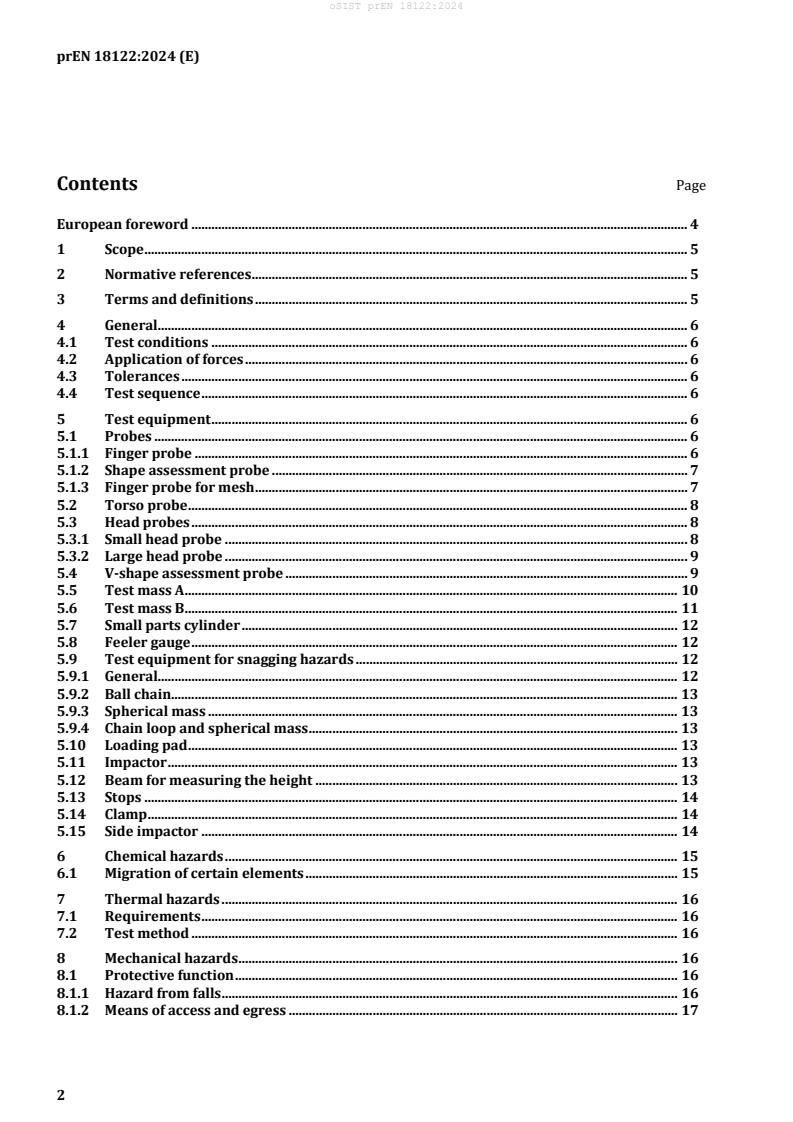
Contents Page
European foreword . 4
1 Scope . 5
2 Normative references . 5
3 Terms and definitions . 5
4 General. 6
4.1 Test conditions . 6
4.2 Application of forces . 6
4.3 Tolerances . 6
4.4 Test sequence . 6
5 Test equipment . 6
5.1 Probes . 6
5.1.1 Finger probe . 6
5.1.2 Shape assessment probe . 7
5.1.3 Finger probe for mesh . 7
5.2 Torso probe . 8
5.3 Head probes . 8
5.3.1 Small head probe . 8
5.3.2 Large head probe . 9
5.4 V-shape assessment probe . 9
5.5 Test mass A . 10
5.6 Test mass B . 11
5.7 Small parts cylinder . 12
5.8 Feeler gauge . 12
5.9 Test equipment for snagging hazards . 12
5.9.1 General. 12
5.9.2 Ball chain. 13
5.9.3 Spherical mass . 13
5.9.4 Chain loop and spherical mass . 13
5.10 Loading pad . 13
5.11 Impactor . 13
5.12 Beam for measuring the height . 13
5.13 Stops . 14
5.14 Clamp . 14
5.15 Side impactor . 14
6 Chemical hazards . 15
6.1 Migration of certain elements . 15
7 Thermal hazards . 16
7.1 Requirements . 16
7.2 Test method . 16
8 Mechanical hazards . 16
8.1 Protective function . 16
8.1.1 Hazard from falls . 16
8.1.2 Means of access and egress . 17
8.1.3 Dimensional requirements . 18
8.1.4 Castors and wheels . 19
8.2 Entrapment hazards . 19
8.2.1 Entrapment of fingers (see A.1). 19
8.2.2 Head and neck entrapment . 19
8.3 Hazards from moving parts . 22
8.3.1 Hazards caused by folding of the product . 22
8.3.2 Compression points . 23
8.3.3 Shearing points . 23
8.4 Entanglement hazards . 23
8.4.1 Requirements . 23
8.4.2 Test method . 24
8.5 Choking and ingestion hazards. 24
8.5.1 Requirements . 24
8.5.2 Test methods for small parts . 24
8.6 Suffocation hazards from plastic packaging . 25
8.7 Hazardous edges, points and corners . 26
8.8 Hazards from protrusions . 26
8.8.1 Requirements . 26
8.8.2 Test method . 26
8.9 Structural integrity . 26
8.9.1 General . 26
8.9.2 Strength of the platform . 26
8.9.3 Strength of the guardrails . 27
8.10 Stability . 28
8.10.1 Requirement . 28
8.10.2 Test method . 28
8.10.3 Step / rung stability . 28
9 Product information . 29
9.1 General . 29
9.2 Marking . 29
9.2.1 Requirements . 29
9.2.2 Durability of marking . 30
9.3 Purchase information . 30
9.4 Instructions for use . 30
Annex A (informative) Rationales . 32
Bibliography . 34
European foreword
This document (prEN 18122:2024) has been prepared by Technical Committee CEN/TC 364 “High chairs
and learning towers”, the secretariat of which is held by UNI.
This document is currently submitted to the CEN Enquiry.
1 Scope
This document specifies safety requirements and test methods for learning towers for domestic use that
are intended to raise children to allow them to carry out tasks on kitchen worktops, bathroom sinks, etc.
in a standing position.
Learning towers are normally used by children up to 6 years old.
Note If the product offers other functions other standards can be applied.
2 Normative references
The following documents are referred to in the text in such a way that some or all of their content
constitutes requirements of this document. For dated references, only the edition cited applies. For
undated references, the latest edition of the referenced document (including any amendments) applies.
EN 71-2:2020, Safety of toys - Part 2: Flammability
EN 71-3:2019+A1:2021, Safety of toys - Part 3: Migration of certain elements
ISO 48-4:2018, Rubber, vulcanized or thermoplastic — Determination of hardness — Part 4: Indentation
hardness by durometer method (Shore hardness)
3 Terms and definitions
For the purposes of this document, the following terms and definitions apply.
ISO and IEC maintain terminology databases for use in standardization at the following addresses:
• IEC Electropedia: available at https://www.electropedia.org/
• ISO Online browsing platform: available at https://www.iso.org/obp/
3.1
learning tower
freestanding product comprised of at least a raised platform and protective components (e.g. guardrails)
3.2
platform
part of the product on which the child stands during use
3.3
guardrail
component at the top of the product intended to prevent a child from falling
3.4
locking mechanism
assembly consisting of one or more locking device(s) and one or more operating device(s)
3.5
locking device
component that maintains part(s) of the product in the position of use
EXAMPLE Latch, a hook, an over centre lock
3.6
operating device
part of the locking mechanism(s) designed to be activated by the carer by one or several action(s)
4 General
4.1 Test conditions
The product shall be tested as delivered; it shall be assembled according to the manufacturer's
instructions. If the instructions allow for different adjustments or configurations of components, the most
onerous combination shall be used for each test, unless otherwise specified in the test method.
Fittings shall be tightened before testing in accordance with instructions; further re-tightening shall not
take place.
Unless otherwise specified by the manufacturer, the sample for test shall be stored in indoor ambient
conditions for at least 24 h immediately prior to testing.
The tests shall be carried out at a temperature between 17°C and 27°C.
Before beginning the testing, visually inspect the unit thoroughly and record any defects so that they are
not assumed to have been caused by the tests.
NOTE See Annex A for rationale on tests and requirements.
4.2 Application of forces
The forces in the static load tests shall be applied sufficiently slowly to ensure that negligible dynamic
force is applied.
The tests are described in terms of the application of forces; however, masses can be used. The
relationship 10 N = 1 kg shall be used for this purpose.
4.3 Tolerances
Unless otherwise stated, the following tolerances apply to the test equipment:
— forces: ± 5 % of the nominal force;
— masses: ± 0,5 % of the nominal mass;
— dimensions: ± 1,0 mm of the nominal dimension;
— angles: ± 2° of the nominal angle.
4.4 Test sequence
The tests in Clause 8 shall be carried out on the same learning tower and in the order of the clauses of
this document.
5 Test equipment
5.1 Probes
5.1.1 Finger probe
Probe with hemispherical ends made of plastics or other hard, smooth material, mounted on a force
measuring device, see Figure 1.
Dimensions in millimetres
Key
1 hemispherical end
2 line around circumference
3 Ø 7 (+0 / - 0,1)
Figure 1 — Finger probe with hemispherical end
5.1.2 Shape assessment probe
Probe made of plastics or other hard, smooth material with the dimensions shown in Figure 2
Dimensions in millimetres
Key
A side view
B top view
C face view
D isometric view
Figure 2 — Shape assessment probe
5.1.3 Finger probe for mesh
A probe with a diameter of 7 (+0 / −0,1) mm, mounted on a force-measuring device, with the end as
specified in Figure 3, made of plastics or other hard, smooth material. The end radius shall be (2,8 ± 0,2)
mm.
Dimensions in millimetres
Figure 3 — Finger probe for mesh
5.2 Torso probe
Probe made of plastics or other hard, smooth material with the dimensions shown in Figure 4
Dimensions in millimetres
Key
1 handle
Figure 4 — Torso probe
5.3 Head probes
5.3.1 Small head probe
Probe made of plastics or other hard, smooth material with the dimensions shown in Figure 5
Dimensions in millimetres
Key
1 handle
Figure 5 — Small head probe
5.3.2 Large head probe
Probe made of plastics or other hard, smooth material with the dimensions shown in Figure 6
Dimensions in millimetres
Key
1 handle
Figure 6 — Large head probe
5.4 V-shape assessment probe
Probe made of any material and with dimensions as given in Figure 7.
Dimensions in millimetres
Key
A “A” portion of probe
B “B” portion of probe
B1 Shoulder section – either 25 mm or 45 mm dimension is acceptable
Figure 7 — V-shape assessment probe
5.5 Test mass A
Rigid cylinder 200 mm in diameter and 300 mm in height, having a mass of 15 kg with its centre of gravity
150 mm above its base. The edges shall have a radius of 5 mm. Two anchorage points shall be provided.
These shall be positioned 150 mm from the base and at an angle of 180° to each other around the
circumference (see Figure 8).
Dimensions in millimetres
Key
1 edge radius: (5 ± 1) mm
2 anchorage points
Figure 8 — Test mass A
5.6 Test mass B
A test mass of (50 ± 0,5) kg with the dimensions given in Figure 9.
Dimensions in millimetres
Figure 9 — Test mass B
5.7 Small parts cylinder
A cylinder for assessment of small components, having dimensions in accordance with Figure 10.
Dimensions in millimetres
Figure 10 — Small parts cylinder
5.8 Feeler gauge
A gauge with a thickness of (0,4 ± 0,02) mm and an insertion end radius of (3 ± 0,5) mm (see Figure 11).
Dimensions in millimetres
Figure 11 — Feeler gauge
5.9 Test equipment for snagging hazards
5.9.1 General
The test equipment comprises a ball chain (specified in 5.9.2) attached to a spherical mass (specified
in 5.9.3) the combination of which is given in 5.9.4.
5.9.2 Ball chain
The ball chain comprises balls distributed along the length of the chain, the diameter of each ball is
(3,2 ± 0,2) mm, the distance between the centre of each ball is (4 ± 0,5) mm see Figure 12.
Dimensions in millimetres
Figure 12 — Ball chain
5.9.3 Spherical mass
A smooth spherical mass of (2,5 ± 0,05) kg and (115 ± 1) mm diameter.
5.9.4 Chain loop and spherical mass
The ball chain loop is formed by the ball chain entering the spherical mass at a common fixing point with
a ball from each side of the chain in contact with each other. See Figure 13.
Dimensions in millimetres
Key
1 ball chain 5.9.2 with length of (200 ± 2) mm
2 spherical mass 5.9.3
3 fixing point
Figure 13 — Loop and mass
5.10 Loading pad
A rigid cylindrical object 100 mm in diameter having a smooth hard surface and edges rounded with
radius of 12 mm.
5.11 Impactor
A cylindrical bag with a diameter of 150 mm filled with steel shot with a diameter of (4 ± 2) mm. The total
mass shall be 23 kg.
5.12 Beam for measuring the height
A beam, 86 mm wide and with a mass of (0,5 ± 0,01) kg.
5.13 Stops
Stops no higher than 12 mm to prevent sliding.
5.14 Clamp
A (100 ± 5) mm rigid clamp (see Figure 14).
The width shall be adjustable to the thickness of the of the guardrail to which forces are applied.
Dimensions in millimetres
Key
1 clamp
2 centre line indicating direction and position for the application of the force
3 foam, to prevent undue damage
4 top of the guardrail
Figure 14 — Clamp
5.15 Side impactor
A pendulum with a cylindrical head made of steel (Figure 15). The head of the pendulum shall be
surrounded by a 10 mm thick layer of rubber of hardness (75 ± 5) Shore A in accordance with
ISO 48-4:2018. The total mass shall be 2 kg.
Dimensions in millimetres
Key
1 pivot point
2 centre of gravity
3 rubber (75 ± 5) Shore A
Figure 15 — Side impactor
6 Chemical hazards
6.1 Migration of certain elements
This requirement does not apply to parts of learning towers which, due to their accessibility, function,
volume, or mass, clearly exclude any hazard due to sucking, licking or prolonged skin contact when the
learning tower is used as intended or in a foreseeable way, bearing in mind the behaviour of children.
A separate sample may be used for this test.
The migration of elements from surface materials of the learning tower shall comply with
EN 71-3:2019+A1:2021.
7 Thermal hazards
7.1 Requirements
A separate sample may be used for this test.
This clause applies only to textiles, coated textiles, and plastic coverings.
Hook and loop fasteners, cords and alike are excluded.
When tested in accordance with 7.2, there shall be no surface flash.
7.2 Test method
Apply the test flame defined in EN 71-2:2020, 5.5 for (3 ± 0,5) s to the product in different places likely
to cause surface flash.
8 Mechanical hazards
8.1 Protective function
8.1.1 Hazard from falls
8.1.1.1 Requirements
The learning tower shall be equipped with guardrail(s) at the top on all sides.
The lowest point of the top of the guardrail shall be at least 450 mm above the highest platform position,
measured vertically in accordance with 8.1.1.2.
The vertical distance between the platform and the guardrail on the side intended to be the means of
access and egress shall not be greater than 700 mm.
8.1.1.2 Test method for the measurement of the distance between the guardrail and the platform
Position the test beam (5.12) across the rim of the guardrail with the 86 mm side in a horizontal position
(see Figure 16).
Measure the minimum vertical distance between the under surface of the beam and the platform (see
Figure 16).
Key
1 Test beam
h height
Figure 16 — Measurement of the distance between the guardrail and the platform
8.1.2 Means of access and egress
To facilitate a safe access to and egress from the platform, the following requirements shall be met:
a) There shall be no obstructions (e.g. door, sliding or swinging panel or bar) between the top of the
platform and the bottom of the guardrail on the side intended to be the means of access and egress.
b) The product shall not be fitted with any means to restrain the child (e.g. harness system or belts),
with the exception of guardrails.
c) The width of any step or rungs, if present, shall be 240 mm or more.
d) The distance between the upper surfaces of the steps or rungs, if present, shall not exceed 310 mm
when measured vertically; this requirement also applies to the distance between the uppermost step
and the platform and to the distance between the floor and the first step or the floor and the platform
in case no steps are present.
e) The depth of steps on closed step ladders shall be 120 mm or more.
f) The horizontal gap between the rear of one step and the front of the next step or the platform shall
not exceed 25 mm (see Figure 17).
Key
A distance to be checked (less than 25 mm)
Figure 17 — Examples of steps protruding from the step below
8.1.3 Dimensional requirements
When measured from the ground, there shall be no part of the learning tower above a height of 1000 mm,
on the side intended to be used against the kitchen worktops, bathroom sinks, etc.
The learning tower shall have the following maximum internal dimensions of the guardrail, measured
horizontally:
— width 500 mm;
— depth 400 mm.
The vertical projection of the guardrail shall not extend more than 50mm outside the edges of the
platform (see Figure 18).
Picture 1: PASS vertical projection of the guardrail
within the area of the platform
Picture 2: PASS vertical projection of the guardrail
within 50mm outside the area of the platform
Picture 3: FAIL vertical projection of the guardrail not within 50mm outside the area of the
platform
Key
Grey square platform area
Black br
...
Questions, Comments and Discussion
Ask us and Technical Secretary will try to provide an answer. You can facilitate discussion about the standard in here.
Loading comments...