

EN 14974:2006
(Main)Facilities for users of roller sports equipment - Safety requirements and test methods
- Abstract
This standard applies to facilities for users of inline-skates, roller skates, skateboards or similar roller sports
equipment, as well as BMX cycles (hereinafter referred to as facility/facilities).
It specifies general and specific requirements and test methods for facilities used in unsupervised areas.
The purpose of this European Standard is to specify the safety requirements, which to a large extent protect users and third parties (e.g. spectators) from hazards when using a facility as intended or as can be reasonably ex-pected.
- Status
- Withdrawn
- Publication Date
- 27-Jun-2006
- Withdrawal Date
- 13-Jul-2010
- Technical Committee
- CEN/TC 136 - Sports, playground and other recreational equipment
- Drafting Committee
- CEN/TC 136/WG 12 - Facilities for users of roller sport equipment
- Current Stage
- 9960 - Withdrawal effective - Withdrawal
- Start Date
- 14-Jul-2010
- Completion Date
- 14-Jul-2010

Relations
- Effective Date
- 19-Jan-2023
- Effective Date
- 28-Jan-2026
- Effective Date
- 07-Nov-2009
Frequently Asked Questions
EN 14974:2006 is a standard published by the European Committee for Standardization (CEN). Its full title is "Facilities for users of roller sports equipment - Safety requirements and test methods". This standard covers: This standard applies to facilities for users of inline-skates, roller skates, skateboards or similar roller sports equipment, as well as BMX cycles (hereinafter referred to as facility/facilities). It specifies general and specific requirements and test methods for facilities used in unsupervised areas. The purpose of this European Standard is to specify the safety requirements, which to a large extent protect users and third parties (e.g. spectators) from hazards when using a facility as intended or as can be reasonably ex-pected.
This standard applies to facilities for users of inline-skates, roller skates, skateboards or similar roller sports equipment, as well as BMX cycles (hereinafter referred to as facility/facilities). It specifies general and specific requirements and test methods for facilities used in unsupervised areas. The purpose of this European Standard is to specify the safety requirements, which to a large extent protect users and third parties (e.g. spectators) from hazards when using a facility as intended or as can be reasonably ex-pected.
EN 14974:2006 is classified under the following ICS (International Classification for Standards) categories: 97.220.10 - Sports facilities. The ICS classification helps identify the subject area and facilitates finding related standards.
EN 14974:2006 has the following relationships with other standards: It is inter standard links to EN 14974:2006+A1:2010, EN 13892-5:2003, EN 14974:2006/FprA1. Understanding these relationships helps ensure you are using the most current and applicable version of the standard.
EN 14974:2006 is available in PDF format for immediate download after purchase. The document can be added to your cart and obtained through the secure checkout process. Digital delivery ensures instant access to the complete standard document.
Standards Content (Sample)
SLOVENSKI STANDARD
01-november-2006
Naprave za poligon za rolanje – Varnostne zahteve in preskusne metode
Facilities for users of roller sports equipment - Safety requirements and test methods
Anlagen für Benutzer von Rollsportgeräten - Sicherheitstechnische Anforderungen und
Prüfverfahren
Installations pour sports a roulettes et BMX - Exigences de sécurité et méthodes d'essai
Ta slovenski standard je istoveten z: EN 14974:2006
ICS:
97.220.10 Športni objekti Sports facilities
2003-01.Slovenski inštitut za standardizacijo. Razmnoževanje celote ali delov tega standarda ni dovoljeno.
EUROPEAN STANDARD
EN 14974
NORME EUROPÉENNE
EUROPÄISCHE NORM
June 2006
ICS 97.220.10
English Version
Facilities for users of roller sports equipment - Safety
requirements and test methods
Installations pour sports à roulettes et vélos bicross - Anlagen für Benutzer von Rollsportgeräten -
Exigences de sécurité et méthodes d'essai Sicherheitstechnische Anforderungen und Prüfverfahren
This European Standard was approved by CEN on 24 May 2006.
CEN members are bound to comply with the CEN/CENELEC Internal Regulations which stipulate the conditions for giving this European
Standard the status of a national standard without any alteration. Up-to-date lists and bibliographical references concerning such national
standards may be obtained on application to the Central Secretariat or to any CEN member.
This European Standard exists in three official versions (English, French, German). A version in any other language made by translation
under the responsibility of a CEN member into its own language and notified to the Central Secretariat has the same status as the official
versions.
CEN members are the national standards bodies of Austria, Belgium, Cyprus, Czech Republic, Denmark, Estonia, Finland, France,
Germany, Greece, Hungary, Iceland, Ireland, Italy, Latvia, Lithuania, Luxembourg, Malta, Netherlands, Norway, Poland, Portugal, Romania,
Slovakia, Slovenia, Spain, Sweden, Switzerland and United Kingdom.
EUROPEAN COMMITTEE FOR STANDARDIZATION
COMITÉ EUROPÉEN DE NORMALISATION
EUROPÄISCHES KOMITEE FÜR NORMUNG
Management Centre: rue de Stassart, 36 B-1050 Brussels
© 2006 CEN All rights of exploitation in any form and by any means reserved Ref. No. EN 14974:2006: E
worldwide for CEN national Members.
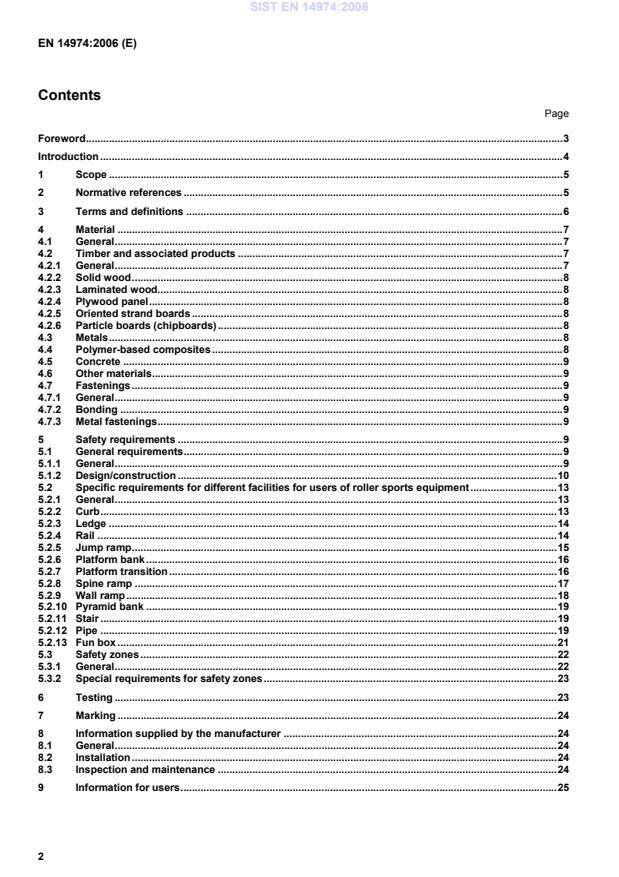
Contents
Page
Foreword.3
Introduction .4
1 Scope .5
2 Normative references .5
3 Terms and definitions .6
4 Material .7
4.1 General.7
4.2 Timber and associated products .7
4.2.1 General.7
4.2.2 Solid wood.8
4.2.3 Laminated wood.8
4.2.4 Plywood panel.8
4.2.5 Oriented strand boards .8
4.2.6 Particle boards (chipboards).8
4.3 Metals.8
4.4 Polymer-based composites .8
4.5 Concrete .9
4.6 Other materials.9
4.7 Fastenings .9
4.7.1 General.9
4.7.2 Bonding .9
4.7.3 Metal fastenings.9
5 Safety requirements .9
5.1 General requirements.9
5.1.1 General.9
5.1.2 Design/construction .10
5.2 Specific requirements for different facilities for users of roller sports equipment.13
5.2.1 General.13
5.2.2 Curb.13
5.2.3 Ledge .14
5.2.4 Rail .14
5.2.5 Jump ramp.15
5.2.6 Platform bank.16
5.2.7 Platform transition.16
5.2.8 Spine ramp .17
5.2.9 Wall ramp.18
5.2.10 Pyramid bank .19
5.2.11 Stair .19
5.2.12 Pipe .19
5.2.13 Fun box .21
5.3 Safety zones .22
5.3.1 General.22
5.3.2 Special requirements for safety zones.23
6 Testing .23
7 Marking .24
8 Information supplied by the manufacturer .24
8.1 General.24
8.2 Installation .24
8.3 Inspection and maintenance .24
9 Information for users.25
Foreword
This document (EN 14974:2006) has been prepared by Technical Committee CEN/TC 136 “Sports, playground
and other recreational equipment”, the secretariat of which is held by DIN.
This European Standard shall be given the status of a national standard, either by publication of an identical text or
by endorsement, at the latest by December 2006, and conflicting national standards shall be withdrawn at the latest
by December 2006.
According to the CEN/CENELEC Internal Regulations, the national standards organizations of the following coun-
tries are bound to implement this European Standard: Austria, Belgium, Cyprus, Czech Republic, Denmark, Esto-
nia, Finland, France, Germany, Greece, Hungary, Iceland, Ireland, Italy, Latvia, Lithuania, Luxembourg, Malta,
Netherlands, Norway, Poland, Portugal, Romania, Slovakia, Slovenia, Spain, Sweden, Switzerland and United
Kingdom.
Introduction
The use of facilities for users of roller sports equipment is connected with sporting risks. Sporting skills and the use
of appropriate protective equipment essentially reduces the risk of accident.
It is not the intention of this standard to specify every possible shape and construction of facilities for users of roller
sports equipment.
For supervised practices, facilities for users of roller sports equipment (competitions, demonstrations, training and
initiation) having different dimensions and thus also increased risks, are also acceptable within the frame of legal
provisions (e.g. regional building regulations).
The development of facilities for users of roller sports equipment is in constant evolution, therefore, some specific
structures are not considered in this European Standard. For all such structures the general requirements apply.
This European Standard does not specify specific requirements for combinations.
1 Scope
This standard applies to facilities for users of inline-skates, roller skates, skateboards or similar roller sports
equipment, as well as BMX cycles (hereinafter referred to as facility/facilities).
It specifies general and specific requirements and test methods for facilities used in unsupervised areas.
The purpose of this European Standard is to specify the safety requirements, which to a large extent protect users
and third parties (e.g. spectators) from hazards when using a facility as intended or as can be reasonably ex-
pected.
2 Normative references
The following referenced documents are indispensable for the application of this document. For dated references,
only the edition cited applies. For undated references, the latest edition of the referenced document (including any
amendments) applies.
EN 59, Glass reinforced plastics - Measurement of hardness by means of a Barcol impressor.
EN 206-1, Concrete - Part 1: Specification, performance, production and conformity
EN 300:1997, Oriented Strand Boards (OSB) - Definitions, classification and specifications
EN 301, Adhesives, phenolic and aminoplastic, for load-bearing timber structures - Classification and performance
requirements
EN 312, Particleboards - Specifications
EN 335-1:1992, Durability of wood and wood-based products - Definition of hazard classes of biological attack -
Part 1: General
EN 338:2003, Structural timber - Strength classes
EN 351-1, Durability of wood and wood-based products - Preservative-treated solid wood - Part 1: Classification of
preservative penetration and retention
EN 599-1, Durability of wood and wood-based products - Performance of preventive wood preservatives as deter-
mined by biological tests - Part 1: Specification according to hazard class
EN 636, Plywood - Specifications
EN 789, Timber structures - Test methods - Determination of mechanical properties of wood based panels
EN ISO 5470-1, Rubber- or plastics-coated fabrics - Determination of abrasion resistance - Part 1: Taber abrader
(ISO 5470-1:1999)
EN ISO 12944-5, Paints and varnishes - Corrosion protection of steel structures by protective paint systems -
Part 5: Protective paint systems (ISO 12944-5:1998)
ENV 1099, Plywood - Biological durability - Guidance for the assessment of plywood for use in different hazard
classes
3 Terms and definitions
For the purposes of this European Standard, the following terms and definitions apply.
3.1
facility for users of roller sports equipment
structure and necessary area designated for users of roller sports equipment including inline-skates, roller skates,
skateboards or similar roller sports equipment, as well as BMX cycles
3.2
structure
sports equipment having a solid surface on which the user of skateboards, roller skates, inline skates or similar
roller sports equipment as well as BMX cycles can manoeuvre freely
3.3
ramp
structure incorporating one or more transitions and/or banks
3.4
transition
curved part of the riding surface
3.5
riding surface
part of the structure intended for grinding, sliding and rolling
3.6
rolling surface
part of the structure intended for rolling
3.7
grinding surface
part of the structure intended for grinding and sliding
3.8
extension
raised, horizontal portion of the platform which permits continuation of the rolling surface passed the lower portion
of the platform
3.9
vert
vertical part of the rolling surface at the top of transition
3.10
coping
circular tube or section of a circular tube, which is firmly attached to the top of the riding surface
3.11
safety zone
space around a structure necessary for the safety of the user as well as third parties
3.12
run-up zone
space which is required to access a structure on roller sports equipment
3.13
free-fall height
vertical distance between the supporting surfaces and an adjoining horizontal surface located at a lower level
NOTE Supporting surfaces are horizontal riding surfaces and surfaces intended for standing. Exceptions are described in
relevant sub-clauses of Clause 5.
3.14
platform
horizontal surface on a structure provided with a barrier
3.15
run-out zone
space required to exit a structure on roller sports equipment
3.16
foot
part of the rolling surface located at a junction with the ground
3.17
barrier
construction which prevents the user and/or roller sports equipment from falling from a height
3.18
table
horizontal surface on a structure without a barrier
3.19
bank
straight inclined part of the riding surface
3.20
table edge
part of the rolling surface located at a junction with the table
3.21
board
optional vertical wall located along the lateral edges of the rolling surface on a pipe
3.22
fastening
mechanical load bearing component joining materials, parts and structures to withstand extreme vibrations and
extreme temperatures
4 Material
4.1 General
The materials shall be selected in such a manner that the construction of a structure of any element manufactured
from these materials meets the requirements of this standard.
Indoor structures shall comply with current Fire safety regulations.
The requirements in 4.2 and 4.3 relating to resistance to weather conditions may be neglected if the facility is in-
stalled in indoor or covered areas.
No substance that can adversely affect health shall be present in the facility.
NOTE The restrictions on the marketing and use of certain dangerous substances and preparations are ruled by the Euro-
th
pean Council Directive 76/769/EEC of the 27 July 1976 and its Amendments.
4.2 Timber and associated products
4.2.1 General
Building elements made of wood which touch the ground, shall be protected against rotting.
NOTE When selecting metal fastenings, consideration should be given to the species of timber and chemical treatments
used, as some will accelerate corrosion of certain metals if there is contact.
Timber components shall be designed so that rain shall drain or drop freely from the structure.
4.2.2 Solid wood
If it is in contact with the ground, solid wood shall meet the biological attack requirements of hazard class 4 accord-
ing to EN 335-1:1992, or of hazard class 3, if it is at least over 200 mm from the ground. This natural or conferred
durability of solid wood shall meet the levels required by EN 351-1 and EN 599-1.
For structural use solid wood shall be of at least class C 24 according to EN 338:2003.
4.2.3 Laminated wood
Laminated wood shall comply with the requirements of hazard class 2 for indoor use and of hazard class 3 for out-
door use in accordance with EN 335-1:1992. Laminate wood shall be of structural quality with bondings taking into
account the intended indoor or outdoor use.
4.2.4 Plywood panel
Plywood panels shall meet the biological attack requirements of hazard class 2 for indoor use and of hazard
class 3 for outdoor use according to EN 335-1:1992 and ENV 1099.
For structural use and climatic resistance, the requirements for structural panels according to EN 636 shall be met.
The longitudinal modulus of elasticity and shear stress (mean value in each direction) and bending compressive
and shear strength (characteristic value in each direction), shall be specified according to EN 789.
4.2.5 Oriented strand boards
Oriented strand boards shall meet the biological attack requirements of hazard class 2 for indoor use according to
EN 335-1:1992.
For structural use the requirements of class OSB 4 are to be met according to EN 300:1997. In addition its me-
chanical properties, measured in accordance with EN 789, shall be defined.
4.2.6 Particle boards (chipboards)
Particle boards shall only be used for indoor facilities. They shall meet the biological attack requirements of hazard
class 2 according to EN 335-1:1992.
For structural use particle boards shall comply with EN 312.
4.3 Metals
Metal components shall be resistant to weathering under atmospheric conditions. See also EN ISO 12944-5.
4.4 Polymer-based composites
When conducting the tests in accordance with EN ISO 5470-1, the layer situated beneath the gelcoat shall not be
visible. The thickness of the gelcoat shall be at least 0,3 mm.
When conducting tests in accordance with EN 59, all types of polymer surfaces shall meet a Barcol hardness level
equal to at least 40.
If, during the course of maintenance it is difficult to determine when the material becomes brittle, the manufacturers
shall indicate a period of time after which the part or equipment should be replaced.
4.5 Concrete
4.5.1 Concrete mix and reinforcement shall comply with EN 206-1.
4.5.2 Concrete used for riding surfaces and foundations shall be at least in accordance with Table 1.
Table 1 — Types of concrete to be used
Concrete used for Application area Type of concrete
Riding surfaces Outdoor C 35/45
Riding surfaces Indoor C 25/30
Foundations Outdoor and indoor C 16/20
4.6 Other materials
The use of other materials is acceptable provided their suitability has been sufficiently proven by the supplier
and/or manufacturer.
4.7 Fastenings
4.7.1 General
The complete fastening system shall be protected against corrosion.
NOTE This protection can be achieved for example, by galvanising or equivalent procedures.
4.7.2 Bonding
Glues used
...