


EN 12697-12:2008
(Main)Bituminous mixtures - Test methods for hot mix asphalt - Part 12: Determination of the water sensitivity of bituminous specimens
Bituminous mixtures - Test methods for hot mix asphalt - Part 12: Determination of the water sensitivity of bituminous specimens
This European Standard describes three test methods for determining the effect of saturation and accelerated water conditioning.
These methods can be used to evaluate the effect of moisture with or without anti-stripping additives including liquids, such as amines, and fillers, such as hydrated lime or cement:
method A uses the indirect tensile strength of cylindrical specimens of bituminous mixtures;
method B uses the compression strength of cylindrical specimens of bituminous mixtures;
method C defines the bonding value of soft asphalt mixtures 1 h after mixing, where the bonding of bitumen and aggregate can be equated to a bonding value.
Method A and method B give the same result in average. However, if the slenderness of the specimens is less than 0,5, method B is not suitable.
Method C is suitable for soft asphalt mixtures with bitumen of viscosity at 60 ºC of 4000 mm2/s or less, for which methods A and B are not suitable.
NOTE Methods A and B are suitable for soft asphalt mixtures with bitumen of viscosity at 60 ºC greater than 4000 mm2/s.
Asphalt - Prüfverfahren für Heißasphalt - Teil 12: Bestimmung der Wasserempfindlichkeit von Asphalt-Probekörpern
Diese Europäische Norm beschreibt drei Prüfverfahren zur Bestimmung des Einflusses der Wassersättigung und der beschleunigten Klimatisierung durch Wasserlagerung.
Diese Verfahren können zur Beurteilung der Auswirkung von Feuchte mit oder ohne Haftvermittler, einschlie߬lich Flüssigkeiten, wie z. B. Aminen, und Zusätze, wie z. B. hydratisierter Kalk oder Zement, herangezogen werden:
Verfahren A: Es wird die indirekte Zugfestigkeit von zylindrischen Asphalt-Probekörpern geprüft;
Verfahren B: Es wird die Druckfestigkeit von zylindrischen Asphalt-Probekörpern geprüft;
Verfahren C: Es wird das Haftvermögen von Softasphaltmischungen 1 h nach dem Mischen defi¬niert. Das Haften von Asphalt auf der Gesteinskörnung wird als „Haftwert“ bezeichnet.
Verfahren A und B ergeben den gleichen Durchschnittswert. Verfahren B ist jedoch nicht geeignet, wenn die Schlankheit der Probekörper geringer als 0,5 beträgt.
Das Verfahren C eignet sich für Softasphaltmischungen mit Asphalt mit einer Viskosität von maximal 4 000 mm2/s bei 60 °C. Im diesen Fall sind die Verfahren A und B ungeeignet.
ANMERKUNG Die Verfahren A und B eignen sich für Softasphaltmischungen mit Asphalt mit einer Viskosität höher als 4 000 mm2/s bei 60 °C.
Mélanges bitumineux - Méthodes d'essai pour mélange hydrocarboné à chaud - Partie 12 : Détermination de la sensibilité à l'eau des éprouvettes bitumineuses
La présente Norme européenne décrit trois modes opératoires pour la détermination de l'effet d'une saturation et d'une immersion accélérée dans l'eau.
Ces modes opératoires peuvent servir à l'évaluation de l'effet de l'humidité avec ou sans dopes d'adhésivité aussi bien sous forme de liquides comme les amines que de fillers comme la chaux hydratée ou le ciment.
- La méthode A utilise la résistance à la traction indirecte des éprouvettes cylindriques de mélanges bitumineux ;
- la méthode B utilise la résistance à la compression des éprouvettes cylindriques de mélanges bitumineux ;
- la méthode C définit l'adhésivité des mélanges hydrocarbonés mous 1 h après mélange, lorsque l'adhésivité du bitume et du granulat peut être assimilée à une adhésivité.
La méthode A et la méthode B donnent, en moyenne, le même résultat. En revanche, si l'élancement des éprouvettes est inférieur à 0,5, la méthode B n'est pas applicable.
La méthode C est applicable aux mélanges hydrocarbonés mous avec un bitume ayant une viscosité à 60 °C inférieure ou égale à 4 000 mm2/s, pour lesquels les méthodes A et B sont inappropriées.
NOTE Les méthodes A et B sont adaptées aux mélanges hydrocarbonés mous avec un bitume ayant une viscosité à 60 ºC supérieure à 4 000 mm2/s.
Bitumenske zmesi - Preskusne metode za vroče asfaltne zmesi - 12. del: Ugotavljanje občutljivosti bitumenskih preskušancev na vodo
General Information
- Status
- Withdrawn
- Publication Date
- 17-Jun-2008
- Withdrawal Date
- 10-Feb-2026
- Technical Committee
- CEN/TC 227 - Road materials
- Drafting Committee
- CEN/TC 227 - Road materials
- Current Stage
- 9960 - Withdrawal effective - Withdrawal
- Start Date
- 20-Jun-2018
- Completion Date
- 11-Feb-2026
Relations
- Effective Date
- 22-Dec-2008
- Effective Date
- 08-Jun-2022
- Effective Date
- 28-Jan-2026
- Effective Date
- 28-Jan-2026
- Effective Date
- 28-Jan-2026
- Effective Date
- 28-Jan-2026
- Effective Date
- 28-Jan-2026
- Effective Date
- 28-Jan-2026
- Effective Date
- 28-Jan-2026
- Effective Date
- 28-Jan-2026
- Effective Date
- 28-Jan-2026
- Effective Date
- 28-Jan-2026
- Effective Date
- 28-Jan-2026

Get Certified
Connect with accredited certification bodies for this standard

Zavod za gradbeništvo Slovenije (ZAG) - Inšpekcija
ZAG inspection body for construction products, structures, and materials.
Sponsored listings
Frequently Asked Questions
EN 12697-12:2008 is a standard published by the European Committee for Standardization (CEN). Its full title is "Bituminous mixtures - Test methods for hot mix asphalt - Part 12: Determination of the water sensitivity of bituminous specimens". This standard covers: This European Standard describes three test methods for determining the effect of saturation and accelerated water conditioning. These methods can be used to evaluate the effect of moisture with or without anti-stripping additives including liquids, such as amines, and fillers, such as hydrated lime or cement: method A uses the indirect tensile strength of cylindrical specimens of bituminous mixtures; method B uses the compression strength of cylindrical specimens of bituminous mixtures; method C defines the bonding value of soft asphalt mixtures 1 h after mixing, where the bonding of bitumen and aggregate can be equated to a bonding value. Method A and method B give the same result in average. However, if the slenderness of the specimens is less than 0,5, method B is not suitable. Method C is suitable for soft asphalt mixtures with bitumen of viscosity at 60 ºC of 4000 mm2/s or less, for which methods A and B are not suitable. NOTE Methods A and B are suitable for soft asphalt mixtures with bitumen of viscosity at 60 ºC greater than 4000 mm2/s.
This European Standard describes three test methods for determining the effect of saturation and accelerated water conditioning. These methods can be used to evaluate the effect of moisture with or without anti-stripping additives including liquids, such as amines, and fillers, such as hydrated lime or cement: method A uses the indirect tensile strength of cylindrical specimens of bituminous mixtures; method B uses the compression strength of cylindrical specimens of bituminous mixtures; method C defines the bonding value of soft asphalt mixtures 1 h after mixing, where the bonding of bitumen and aggregate can be equated to a bonding value. Method A and method B give the same result in average. However, if the slenderness of the specimens is less than 0,5, method B is not suitable. Method C is suitable for soft asphalt mixtures with bitumen of viscosity at 60 ºC of 4000 mm2/s or less, for which methods A and B are not suitable. NOTE Methods A and B are suitable for soft asphalt mixtures with bitumen of viscosity at 60 ºC greater than 4000 mm2/s.
EN 12697-12:2008 is classified under the following ICS (International Classification for Standards) categories: 93.080.20 - Road construction materials. The ICS classification helps identify the subject area and facilitates finding related standards.
EN 12697-12:2008 has the following relationships with other standards: It is inter standard links to EN 12697-12:2003, EN 12697-12:2018, EN 1426:2024, EN 13108-1:2016, EN 12697-33:2019+A1:2022, EN 12697-6:2020, EN 12697-30:2018, EN 12697-32:2019, EN 12697-29:2020, EN 12697-23:2017, EN 12697-31:2019, EN 12697-8:2018, EN 12697-27:2017. Understanding these relationships helps ensure you are using the most current and applicable version of the standard.
EN 12697-12:2008 is available in PDF format for immediate download after purchase. The document can be added to your cart and obtained through the secure checkout process. Digital delivery ensures instant access to the complete standard document.
Standards Content (Sample)
2003-01.Slovenski inštitut za standardizacijo. Razmnoževanje celote ali delov tega standarda ni dovoljeno.Asphalt - Prüfverfahren für Heißasphalt - Teil 12: Bestimmung der Wasserempfindlichkeit von Asphalt-ProbekörpernMélanges bitumineux - Méthodes d'essai pour mélange hydrocarboné à chaud - Partie 12 : Détermination de la sensibilité à l'eau des éprouvettes bitumineusesBituminous mixtures - Test methods for hot mix asphalt - Part 12: Determination of the water sensitivity of bituminous specimens93.080.20Materiali za gradnjo cestRoad construction materialsICS:Ta slovenski standard je istoveten z:EN 12697-12:2008SIST EN 12697-12:2009en,fr,de01-januar-2009SIST EN 12697-12:2009SLOVENSKI
STANDARDSIST EN 12697-12:20041DGRPHãþD
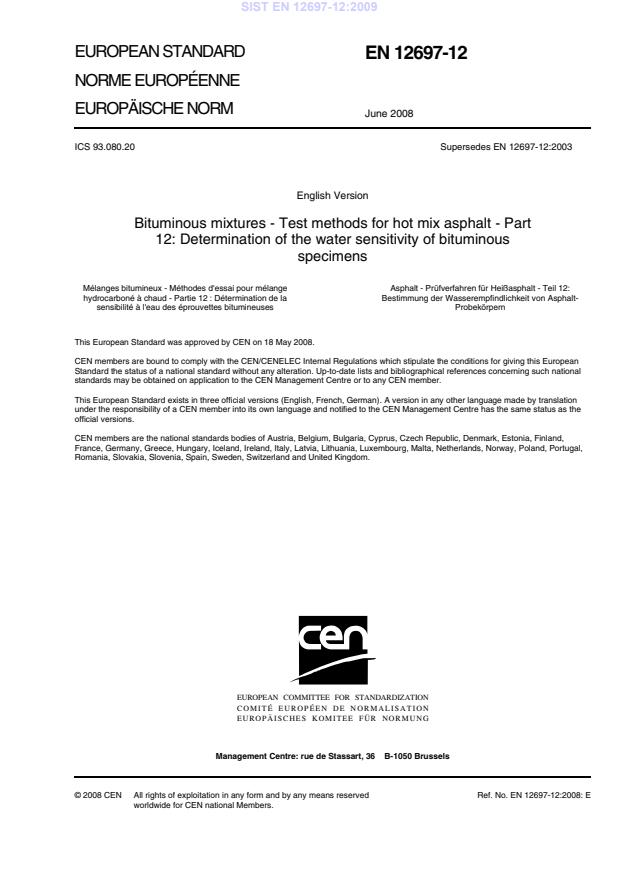
EUROPEAN STANDARDNORME EUROPÉENNEEUROPÄISCHE NORMEN 12697-12June 2008ICS 93.080.20Supersedes EN 12697-12:2003
English VersionBituminous mixtures - Test methods for hot mix asphalt - Part12: Determination of the water sensitivity of bituminousspecimensMélanges bitumineux - Méthodes d'essai pour mélangehydrocarboné à chaud - Partie 12 : Détermination de lasensibilité à l'eau des éprouvettes bitumineusesAsphalt - Prüfverfahren für Heißasphalt - Teil 12:Bestimmung der Wasserempfindlichkeit von Asphalt-ProbekörpernThis European Standard was approved by CEN on 18 May 2008.CEN members are bound to comply with the CEN/CENELEC Internal Regulations which stipulate the conditions for giving this EuropeanStandard the status of a national standard without any alteration. Up-to-date lists and bibliographical references concerning such nationalstandards may be obtained on application to the CEN Management Centre or to any CEN member.This European Standard exists in three official versions (English, French, German). A version in any other language made by translationunder the responsibility of a CEN member into its own language and notified to the CEN Management Centre has the same status as theofficial versions.CEN members are the national standards bodies of Austria, Belgium, Bulgaria, Cyprus, Czech Republic, Denmark, Estonia, Finland,France, Germany, Greece, Hungary, Iceland, Ireland, Italy, Latvia, Lithuania, Luxembourg, Malta, Netherlands, Norway, Poland, Portugal,Romania, Slovakia, Slovenia, Spain, Sweden, Switzerland and United Kingdom.EUROPEAN COMMITTEE FOR STANDARDIZATIONCOMITÉ EUROPÉEN DE NORMALISATIONEUROPÄISCHES KOMITEE FÜR NORMUNGManagement Centre: rue de Stassart, 36
B-1050 Brussels© 2008 CENAll rights of exploitation in any form and by any means reservedworldwide for CEN national Members.Ref. No. EN 12697-12:2008: ESIST EN 12697-12:2009
These methods can be used to evaluate the effect of moisture with or without anti-stripping additives including liquids, such as amines, and fillers, such as hydrated lime or cement: method A uses the indirect tensile strength of cylindrical specimens of bituminous mixtures; method B uses the compression strength of cylindrical specimens of bituminous mixtures; method C defines the bonding value of soft asphalt mixtures 1 h after mixing, where the bonding of bitumen and aggregate can be equated to a bonding value. Method A and method B give the same result on average. However, if the slenderness of the specimens is less than 0,5, method B is not suitable.
Method C is suitable for soft asphalt mixtures with bitumen of viscosity at 60 ºC of 4000 mm2/s or less, for which methods A and B are not suitable. NOTE
Methods A and B are suitable for soft asphalt mixtures with bitumen of viscosity at 60 ºC greater than 4000 mm2/s. 2 Normative references The following referenced documents are indispensable for the application of this document. For dated references, only the edition cited applies. For undated references, the latest edition of the referenced document (including any amendments) applies. EN 1426, Bitumen and bituminous binders – Determination of needle penetration EN 12697-6, Bituminous mixtures – Test methods for hot mix asphalt – Part 6: Determination of bulk density of bituminous specimens EN 12697-8, Bituminous mixtures – Test methods for hot mix asphalt – Part 8: Determination of void characteristics of bituminous specimens EN 12697-23, Bituminous mixtures – Test methods for hot mix asphalt – Part 23: Determination of the indirect tensile strength of bituminous specimens EN 12697-27, Bituminous mixtures – Test methods for hot mix asphalt – Part 27: Sampling EN 12697-29, Bituminous mixtures – Test method for hot mix asphalt – Part 29: Determination of the dimensions of a bituminous specimen EN 12697-30, Bituminous mixtures – Test methods for hot mix asphalt – Part 30: Specimen preparation by impact compactor EN 12697-31, Bituminous mixtures – Test methods for hot mix asphalt – Part 31: Specimen preparation by gyratory compactor EN 12697-32, Bituminous mixtures – Test methods for hot mix asphalt – Part 32: Laboratory compaction of bituminous mixtures by vibratory compactor EN 12697-33, Bituminous mixtures – Test methods for hot mix asphalt – Part 33: Specimen prepared by roller compactor SIST EN 12697-12:2009
3.3 water sensitivity (in accordance with method B) the i/C value obtained on compacted specimens of wet (water conditioned) specimens to that of dry specimens of a bituminous mixture 3.4 indirect tensile strength ratio (ITSR) ratio of the indirect tensile strength of wet (water conditioned) specimens to that of dry specimens, expressed in percent 3.5 indirect tensile strength (IST)
maximum tensile stress applied to a cylindrical specimen loaded at the specified test temperature and speed of displacement of the compression testing machine, determined in accordance with EN 12697-23 3.6 compressive strength ratio (i/C)
ratio of the strength of a specimen loaded in compression at the specified test temperature and speed of displacement of the press, of wet (water conditioned) specimens to that of dry specimens expressed in percent 3.7 bonding value
amount of aggregate fines and bitumen which comes loose from 1000 g sample of soft asphalt mixture when mixed with 1500 ml of water in a graduated glass beaker 3.8 precision closeness of agreement between independent test results obtained under stipulated conditions. NOTE 1: Precision depends only on the distribution of random errors and does not relate to the true value or the specified value. NOTE 2: The measure of precision is usually expressed in terms of imprecision and computed as a standard deviation of the test results.
Less precision is reflected by a larger standard deviation. NOTE 3: "Independent test results" means results obtained in a manner not influenced by any previous result on the same or similar test object.
Quantitative measures of precision depend critically on the stipulated conditions.
Repeatability and reproducibility conditions are particular sets of extreme conditions. SIST EN 12697-12:2009
...
Questions, Comments and Discussion
Ask us and Technical Secretary will try to provide an answer. You can facilitate discussion about the standard in here.
Loading comments...