

EN 14971:2006
(Main)Textiles - Knitted fabrics - Determination of number of stitches per unit length and unit area
- Abstract
This test method determines the number of wales and courses per centimetre in most knitted fabrics.
- Status
- Published
- Publication Date
- 17-Jan-2006
- Withdrawal Date
- 30-Jul-2006
- Technical Committee
- CEN/TC 248 - Textiles and textile products
- Drafting Committee
- CEN/TC 248/WG 12 - Physical testing of knitted fabrics and garments
- Current Stage
- 9020 - Submission to 2 Year Review Enquiry - Review Enquiry
- Start Date
- 15-Jul-2026
- Completion Date
- 15-Jul-2026

Overview
EN 14971:2006 is a European Standard developed by CEN that specifies a standardized test method for determining the number of stitches in knitted fabrics. This standard focuses on measuring the number of wales (vertical columns of stitches) and courses (horizontal rows of stitches) per centimetre, as well as stitches per unit area for most types of knitted textiles. The standard ensures consistency in textile quality control, product development, and standardization across the industry.
This test method is essential for textile manufacturers, quality inspectors, and researchers aiming to accurately characterize knitted fabric structures. It supports both weft-knitted fabrics and warp-knitted fabrics by providing clear terminology, precise procedures, and detailed calculation methods for stitch count.
Key Topics
Scope and Applicability
EN 14971:2006 applies to most knitted fabrics and provides a quantitative measure of fabric density by determining stitches per unit length and unit area. It explicitly excludes fabric edges to ensure representative sampling.Terms and Definitions
The standard defines critical terms such as:- Wale: Column of stitches running lengthwise.
- Course: Row of stitches running widthwise.
- Weft-knitted fabrics: Fabric with stitches formed across the width.
- Warp-knitted fabrics: Fabric with stitches formed along the length.
Testing Atmosphere and Specimen Preparation
Conditioning fabrics in a controlled atmosphere per EN ISO 139 ensures consistent testing conditions by standardizing temperature and humidity.Measurement Methods
Two measurement approaches are described:- Method A (Counting Glass): Preferred for fabrics with 10 or more wales per cm. Uses a counting glass aperture and magnification tools to count stitches accurately.
- Method B (Ruler Method): Designed for fabrics with fewer than 10 wales per cm, employing a ruled measuring device for counting over a specific fabric length.
Calculation and Reporting
Counts are averaged over multiple locations (minimum five) to improve accuracy. The final stitch density per square centimetre is computed by multiplying mean wales and courses values. The test report must include:- Sample identification
- Method used (A or B)
- Measurement face details
- Individual and mean counts of wales and courses
- Any deviations from the standard procedure
Applications
Textile Industry Quality Control
EN 14971:2006 is vital for routine inspection and quality assurance of knitted fabrics, ensuring fabric consistency and uniformity in production batches.Product Development and Design
Designers and technicians use stitch count data to influence fabric elasticity, thickness, appearance, and performance traits.Research and Standardization
The standard facilitates standardized communication on knitted fabric structure among manufacturers, testing laboratories, and regulatory bodies.Textile Education and Training
This standard provides a foundational methodology for teaching knitted fabric analysis in academic and professional training environments.Complex Fabric Structures
For knitted fabrics with complex, multi-structure designs, stitch counts per unit area provide a practical metric for evaluation when simple linear counts are insufficient.
Related Standards
EN ISO 139: Specifies standard atmospheres for conditioning and testing textiles, crucial for preparing specimens under controlled temperature and humidity.
EN ISO 4921: Covers knitting vocabulary and basic concepts, aiding in consistent terminology for knitted fabric tests.
EN ISO 8388: Defines types of knitted fabrics and related vocabulary, supporting classification and communication within textile testing.
By adhering to EN 14971:2006, textile professionals can achieve reliable, internationally recognized measurements of knitted fabric structures, contributing to improved product quality and industrial harmonization across Europe and beyond. Keywords related to this standard include knitted fabric testing, stitch density measurement, wale and course count, textile conditioning, and knitted textile standards.
Relations
- Effective Date
- 28-Jan-2026
- Effective Date
- 28-Jan-2026
- Effective Date
- 28-Jan-2026
Get Certified
Connect with accredited certification bodies for this standard

Control Union Certifications
Global certification for agriculture and sustainability.

Hohenstein Institut
Textile testing and certification.

Bureau Veritas Bangladesh
Bureau Veritas certification services in Bangladesh.
Sponsored listings
Frequently Asked Questions
EN 14971:2006 is a standard published by the European Committee for Standardization (CEN). Its full title is "Textiles - Knitted fabrics - Determination of number of stitches per unit length and unit area". This standard covers: This test method determines the number of wales and courses per centimetre in most knitted fabrics.
This test method determines the number of wales and courses per centimetre in most knitted fabrics.
EN 14971:2006 is classified under the following ICS (International Classification for Standards) categories: 59.080.30 - Textile fabrics. The ICS classification helps identify the subject area and facilitates finding related standards.
EN 14971:2006 has the following relationships with other standards: It is inter standard links to EN ISO 4921:2001, EN ISO 8388:2003, EN ISO 139:2005. Understanding these relationships helps ensure you are using the most current and applicable version of the standard.
EN 14971:2006 is available in PDF format for immediate download after purchase. The document can be added to your cart and obtained through the secure checkout process. Digital delivery ensures instant access to the complete standard document.
Standards Content (Sample)
SLOVENSKI STANDARD
01-maj-2006
Tekstilije - Pletiva - Ugotavljanje števila petelj na dolžinsko in površinsko enoto
Textiles - Knitted fabrics - Determination of number of stitches per unit length and unit
area
Textilien - Maschenwaren - Bestimmung der Maschenzahl je Längeneinheit und
Flächeneinheit
Textiles - Etoffes tricotées - Détermination du nombre de mailles par unité de longueur et
unité de surface
Ta slovenski standard je istoveten z: EN 14971:2006
ICS:
59.080.30 Tkanine Textile fabrics
2003-01.Slovenski inštitut za standardizacijo. Razmnoževanje celote ali delov tega standarda ni dovoljeno.
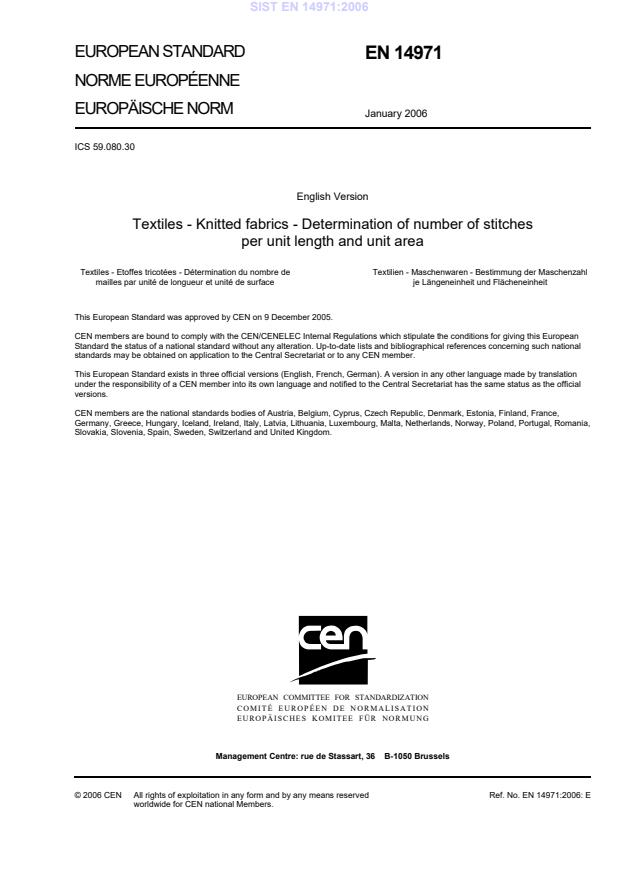
EUROPEAN STANDARD
EN 14971
NORME EUROPÉENNE
EUROPÄISCHE NORM
January 2006
ICS 59.080.30
English Version
Textiles - Knitted fabrics - Determination of number of stitches
per unit length and unit area
Textiles - Etoffes tricotées - Détermination du nombre de Textilien - Maschenwaren - Bestimmung der Maschenzahl
mailles par unité de longueur et unité de surface je Längeneinheit und Flächeneinheit
This European Standard was approved by CEN on 9 December 2005.
CEN members are bound to comply with the CEN/CENELEC Internal Regulations which stipulate the conditions for giving this European
Standard the status of a national standard without any alteration. Up-to-date lists and bibliographical references concerning such national
standards may be obtained on application to the Central Secretariat or to any CEN member.
This European Standard exists in three official versions (English, French, German). A version in any other language made by translation
under the responsibility of a CEN member into its own language and notified to the Central Secretariat has the same status as the official
versions.
CEN members are the national standards bodies of Austria, Belgium, Cyprus, Czech Republic, Denmark, Estonia, Finland, France,
Germany, Greece, Hungary, Iceland, Ireland, Italy, Latvia, Lithuania, Luxembourg, Malta, Netherlands, Norway, Poland, Portugal, Romania,
Slovakia, Slovenia, Spain, Sweden, Switzerland and United Kingdom.
EUROPEAN COMMITTEE FOR STANDARDIZATION
COMITÉ EUROPÉEN DE NORMALISATION
EUROPÄISCHES KOMITEE FÜR NORMUNG
Management Centre: rue de Stassart, 36 B-1050 Brussels
© 2006 CEN All rights of exploitation in any form and by any means reserved Ref. No. EN 14971:2006: E
worldwide for CEN national Members.
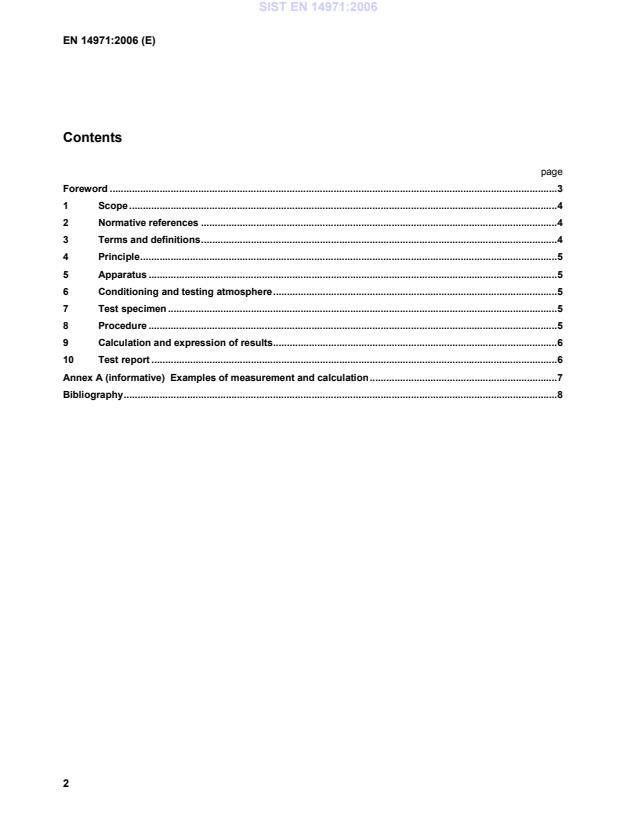
Contents
page
Foreword .3
1 Scope .4
2 Normative references .4
3 Terms and definitions.4
4 Principle.5
5 Apparatus .5
6 Conditioning and testing atmosphere.5
7 Test specimen .5
8 Procedure .5
9 Calculation and expression of results.6
10 Test report .6
Annex A (informative) Examples of measurement and calculation.7
Bibliography.8
Foreword
This European Standard (EN 14971:2006) has been prepared by Technical Committee CEN/TC 248 “Textiles and
textile products”, the secretariat of which is held by BSI.
This European Standard shall be given the status of a national standard, either by publication of an identical text or
by endorsement, at the latest by July 2006, and conflicting national standards shall be withdrawn at the latest by
July 2006.
According to the CEN/CENELEC Internal Regulations, the national standards organizations of the following
countries are bound to implement this European Standard: Austria, Belgium, Cyprus, Czech Republic, Denmark,
Estonia, Finland, France, Germany, Greece, Hungary, Iceland, Ireland, Italy, Latvia, Lithuania, Luxembourg, Malta,
Netherlands, Norway, Poland, Portugal, Romania, Slovakia, Slovenia, Spain, Sweden, Switzerland and United
Kingdom.
1 Scope
This test method determines the number of wales and courses per centimetre in most knitted fabrics.
2 Normative references
The following referenced documents are indispensable for the application of this European Standard. For dated
references, only the edition cited applies. For undated references, the latest edition of the referenced document
(including any amendments) applies.
EN ISO 139, Textiles — Standard atmospheres for conditioning and testing (ISO 139:2005)
3 Terms and definitions
For the purposes of this European Standard, the following terms and definitions apply.
3.1
weft-knitted fabrics
generic name applied to knitted fabrics in which the stitches made by each weft thread are formed substantially
across the width of the fabric
NOTE Weft-k
...