

EN 16224:2012
(Main)Healthcare provision by chiropractors
- Abstract
This European Standard specifies requirements and recommendations for healthcare services provided by chiropractors.
- Status
- Withdrawn
- Publication Date
- 26-Jun-2012
- Withdrawal Date
- 28-Jan-2014
- Technical Committee
- CEN/TC 394 - Project Committee - Services of chiropractors
- Drafting Committee
- CEN/TC 394 - Project Committee - Services of chiropractors
- Current Stage
- 9960 - Withdrawal effective - Withdrawal
- Start Date
- 29-Jan-2014
- Completion Date
- 29-Jan-2014


Relations
- Effective Date
- 19-Jan-2023
Get Certified
Connect with accredited certification bodies for this standard

BSI Group
BSI (British Standards Institution) is the business standards company that helps organizations make excellence a habit.

TÜV Rheinland
TÜV Rheinland is a leading international provider of technical services.

TÜV SÜD
TÜV SÜD is a trusted partner of choice for safety, security and sustainability solutions.
Sponsored listings
Frequently Asked Questions
EN 16224:2012 is a standard published by the European Committee for Standardization (CEN). Its full title is "Healthcare provision by chiropractors". This standard covers: This European Standard specifies requirements and recommendations for healthcare services provided by chiropractors.
This European Standard specifies requirements and recommendations for healthcare services provided by chiropractors.
EN 16224:2012 is classified under the following ICS (International Classification for Standards) categories: 03.120.10 - Quality management and quality assurance; 11.020 - Medical sciences and health care facilities in general; 11.020.01 - Quality and environmental management in health care; 11.020.10 - Health care services in general. The ICS classification helps identify the subject area and facilitates finding related standards.
EN 16224:2012 has the following relationships with other standards: It is inter standard links to EN 16224:2012+A1:2014. Understanding these relationships helps ensure you are using the most current and applicable version of the standard.
EN 16224:2012 is available in PDF format for immediate download after purchase. The document can be added to your cart and obtained through the secure checkout process. Digital delivery ensures instant access to the complete standard document.
Standards Content (Sample)
2003-01.Slovenski inštitut za standardizacijo. Razmnoževanje celote ali delov tega standarda ni dovoljeno.Zdravstveno varstvo, ki ga zagotavljajo kiropraktikiBereitstellung von Gesundheitsleistungen durch ChiropraktorenPrestation de soins de santé par les chiropraticiensHealth care provision by chiropractors11.020.10Zdravstvene storitve na splošnoHealth care services in generalICS:Ta slovenski standard je istoveten z:EN 16224:2012SIST EN 16224:2012en,fr,de01-september-2012SIST EN 16224:2012SLOVENSKI
STANDARD
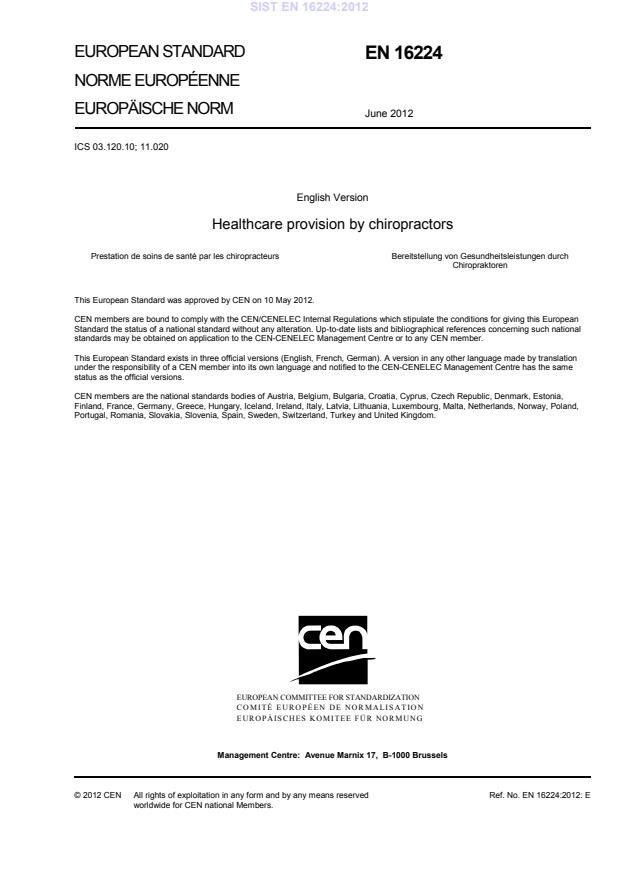
EUROPEAN STANDARD NORME EUROPÉENNE EUROPÄISCHE NORM
EN 16224
June 2012 ICS 03.120.10; 11.020 English Version
Healthcare provision by chiropractors
Prestation de soins de santé par les chiropracteurs
Bereitstellung von Gesundheitsleistungen durch Chiropraktoren This European Standard was approved by CEN on 10 May 2012.
CEN members are bound to comply with the CEN/CENELEC Internal Regulations which stipulate the conditions for giving this European Standard the status of a national standard without any alteration. Up-to-date lists and bibliographical references concerning such national standards may be obtained on application to the CEN-CENELEC Management Centre or to any CEN member.
This European Standard exists in three official versions (English, French, German). A version in any other language made by translation under the responsibility of a CEN member into its own language and notified to the CEN-CENELEC Management Centre has the same status as the official versions.
CEN members are the national standards bodies of Austria, Belgium, Bulgaria, Croatia, Cyprus, Czech Republic, Denmark, Estonia, Finland, France, Germany, Greece, Hungary, Iceland, Ireland, Italy, Latvia, Lithuania, Luxembourg, Malta, Netherlands, Norway, Poland, Portugal, Romania, Slovakia, Slovenia, Spain, Sweden, Switzerland, Turkey and United Kingdom.
EUROPEAN COMMITTEE FOR STANDARDIZATION
COMITÉ EUROPÉEN DE NORMALISATION EUROPÄISCHES KOMITEE FÜR NORMUNG
Management Centre:
Avenue Marnix 17,
B-1000 Brussels © 2012 CEN All rights of exploitation in any form and by any means reserved worldwide for CEN national Members. Ref. No. EN 16224:2012: ESIST EN 16224:2012
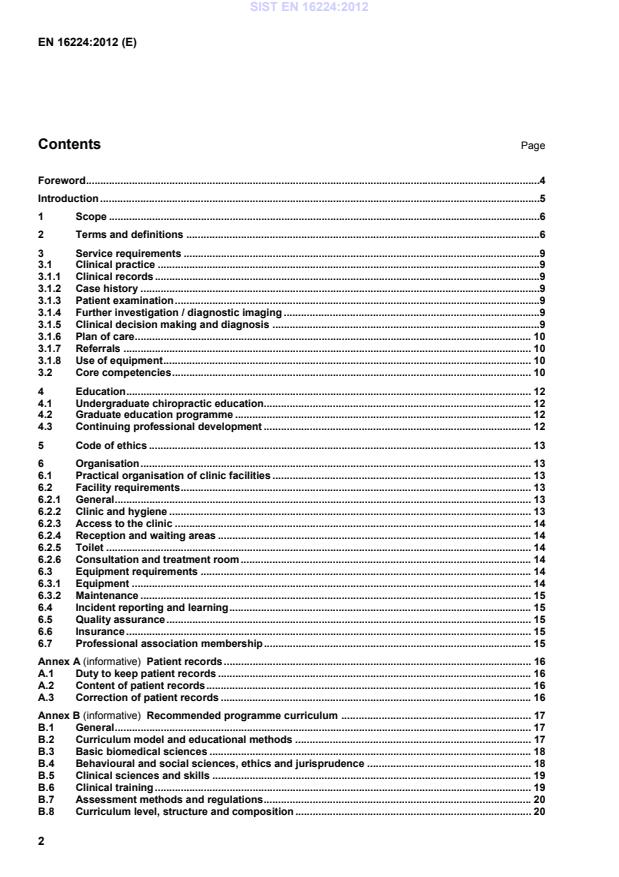
Patient records . 16A.1Duty to keep patient records . 16A.2Content of patient records . 16A.3Correction of patient records . 16Annex B (informative)
Recommended programme curriculum
.................................................................. 17B.1General ................................................................................................................................................. 17B.2Curriculum model and educational methods .................................................................................. 17B.3Basic biomedical sciences ................................................................................................................ 18B.4Behavioural and social sciences, ethics and jurisprudence ......................................................... 18B.5Clinical sciences and skills ............................................................................................................... 19B.6Clinical training ................................................................................................................................... 19B.7Assessment methods and regulations ............................................................................................. 20B.8Curriculum level, structure and composition .................................................................................. 20SIST EN 16224:2012
Code of ethics . 21C.1Working with patients . 21C.1.1Good clinical care . 21C.1.2Health promotion and self care . 21C.1.3Raising concerns about patient safety . 21C.1.4Equality and diversity . 22C.1.5Keeping up to date . 22C.1.6Teaching, training, appraising and assessing . 22C.1.7The chiropractor-patient partnership . 22C.1.8Communicating with patients . 22C.1.9Communicating with other health professionals . 23C.1.10Preparing reports for third parties . 23C.1.11Children and young people . 24C.1.12Vulnerable adults . 24C.1.13Dealing with relatives, carers and partners . 24C.2Openness and honesty . 24C.2.1General . 24C.2.2Maintaining trust in the profession . 25C.2.3Consent . 25C.2.4Providing access to patient health records . 26C.2.5Confidentiality . 26C.2.6Discharging patients . 26C.3Working with colleagues . 27C.3.1General . 27C.3.2Colleagues’ conduct and performance . 27C.3.3Respect for colleagues . 27C.3.4Sharing information with colleagues . 27C.3.5Delegation and referral . 27C.3.6Honesty and trustworthiness . 28C.3.7Providing and publishing information about chiropractic services . 28C.3.8Writing reports and giving evidence . 28C.3.9Research. 28C.3.10Financial dealings . 29C.3.11Conflicts of interest . 29C.4Health and safety . 29C.4.1General . 29C.4.2Evidence-based care . 29Bibliography . 30 SIST EN 16224:2012
The chiropractic profession has evolved in Europe and occupies an important position in both primary and secondary healthcare provision. It is therefore imperative that chiropractic services are delivered at the highest attainable level.
The principal objective of any standard for healthcare services ought to be that users of any given service can
be confident of a level of care that assures reproducible quality throughout the profession. Clinical governance, the determination of monitoring healthcare provision and ensuring maintenance of standards therefore form one of the cornerstones of care.
This standard is concerned with the provision of chiropractic services. It aspires to set a standard that provides optimum levels of patient management, patient safety, clinical and cost effectiveness and ethical practice. It also defines a level of education consistent with producing chiropractors who are competent to comply with the standard. It is not intended to be a guideline, although information contained might inform the development of guidelines for individual nations and national organisations.
Finally, this standard encourages that services provided by chiropractors be subjected to regular review through an evidence-based approach and a commitment to supporting and acting upon clinical research. This European Standard does not supersede national legislation. SIST EN 16224:2012
2.4 capacity ability of a patient to understand, remember and consider information provided to them 2.5 care interventions that are designed to improve health 2.6 case history detailed account of a person’s history which results from the acquisition of information through interview, questionnaires and assessment of appropriate medical records 2.7 chaperone person who is present during a professional encounter between an health professional and a patient EXAMPLE Family members or another member of the healthcare team. 2.8 chiropractic health profession concerned with the diagnosis, treatment and prevention of mechanical disorders of the musculoskeletal system, and the effects of these disorders on the function of the nervous system and general health Note 1 to entry: There is an emphasis on manual treatments including spinal adjustment and other joint and soft-tissue manipulation. Note 2 to entry: Taken from WFC Dictionary definition [11]. 2.9 chiropractic institution educational establishment dedicated to the provision of chiropractic education and training SIST EN 16224:2012
2.12 consent acceptance by a patient of a proposed clinical intervention after having been informed of all relevant factors relating to that intervention 2.13 continuing professional development
CPD means by which members of a profession maintain, improve and broaden their knowledge and skills and develop the personal qualities required in their professional lives 2.14 delegation asking someone who is not a regulated health professional to provide care on a chiropractor’s behalf 2.15 diagnosis identification of a disease or illness resulting from clinical assessment 2.16 diagnostic procedure structured procedure that exists to enable a chiropractor to arrive at a diagnosis which may include physical examination, diagnostic imaging and laboratory tests 2.17 discharge release of a patient from a course or programme of care 2.18 evidence-based care clinical practice that incorporates the best available evidence from research, the expertise of the practitioner, and the preference of the patient 2.19 formal education educational activity at established recognised formal systems of elementary, secondary or higher education Note 1 to entry: Compare with the ISO 29990:2010, definition 2.15 "non-formal education" [4]. 2.20 further investigation additional clinical study which contributes to the assessment of a patient and which may include diagnostic imaging and laboratory tests 2.21 graduate education programme
GEP dedicated framework for the continuing education of new graduates of chiropractic institutions during their initial period in practice SIST EN 16224:2012
Note 1 to entry: This definition is in accordance with Council Directive 93/42/EEC [7] and with EN ISO 13485:2003 [1]. 2.25 neuromusculoskeletal interaction between the nervous system, musculature and skeletal framework of the body 2.26 patient confidentiality right of an individual to have information about them kept private 2.27 patient examination assessment of a patient with the intention of reaching or reviewing a diagnosis or plan of care 2.28 plan of care
plan designed to deliver therapeutic benefit to patients following diagnosis 2.29 primary contact practitioner healthcare professional qualified to undertake a process of assessment, diagnosis and care in the absence of a formal referral from another registered healthcare provider 2.30 professional development continuum of education, embracing undergraduate and postgraduate studies and regular refresher training 2.31 referral transferring of responsibility for care to a third party for a particular purpose, such as additional investigation, care or treatment that is outside the chiropractor’s competence 2.32 undergraduate chiropractic education acquisition of knowledge and skills by students at chiropractic institutions leading to an accredited qualification in chiropractic SIST EN 16224:2012
3.1.1 Clinical records Clinical records shall be maintained in accordance with good professional conduct and shall contain relevant and necessary information about the patient and the patient's healthcare (see also Annex A). 3.1.2 Case history The chiropractor shall acquire and document current and past information on a patient related to their health (i.e. physical, psychological and social wellbeing) by asking specific questions, either of the patient, responsible adult or legal guardian with the aim of obtaining suitable clinical information useful in formulating a diagnosis and leading to a plan of care for the patient. 3.1.3 Patient examination a) Following the taking of the case history, the patient shall be investigated for signs of disease, abnormality or dysfunction. b) The chiropractor shall use examination methods that include, but are not limited to, physical examination procedures; orthopaedic, neurological, and chiropractic tests, as clinically indicated.
3.1.4 Further investigation / diagnostic imaging The chiropractor shall: a)
identify when further investigations are needed and act on this need in the patient’s best interests;
b) use further investigations when the information gained from such investigations will benefit the management of the patient;
c) undertake and/or interpret the results or, if this is not possible, refer the patient for appropriate further investigations;
d) record the outcomes of the investigations in the patient record. 3.1.5 Clinical decision making and diagnosis The chiropractor shall: a) evaluate the patient’s health status and health needs from the information gained during the case history, physical examination and further investigations; b) formulate and document a working diagnosis and/or differential diagnosis and a rationale for care, based on the evaluation of this information. The diagnosis, or rationale for care, shall be kept under review while caring for the patient; c) interpret all of the information available about a patient and then make and record decisions about the patient’s health and health needs and how these change over time; d) consider the natural history and prognosis of any presenting complaint, or emergency situation that might need immediate action, and the likelihood of preventing recurrences or managing any long-term healthcare needs. SIST EN 16224:2012
3.1.7 Referrals The chiropractor shall consider onward referral to another appropriately qualified healthcare professional when it becomes clear that a patient a) is not appropriate for chiropractic care, or b) requires concurrent or additional investigation or
care, or c) is failing to respond to chiropractic care, is deteriorating or has developed additional symptoms outside the field of expertise of the chiropractor.
Referrals should be in writing or done verbally and should detail the reason for the referral, the care provided by the chiropractor and any relevant aspects of the patient’s health. Referral details shall be noted in the patient record. 3.1.8 Use of equipment All medical devices used by chiropractors shall be CE-marked [7].
In case of X-ray equipment, management shall fulfil Council Directive 96/29/Euratom [8]. A maintenance record shall be kept for each piece of equipment or device. 3.2 Core competencies a) The chiropractor shall have knowledge and understanding of: 1) normal structure and function of the human body; 2) aetiology, pathology, symptoms and signs, natural history and prognosis of neuromusculoskeletal complaints, pain syndromes and associated conditions presenting to chiropractors, including the psychological and social aspects of these conditions; 3) evaluation of the health and health needs of a patient, including common diagnostic procedures, their uses and limitations, and appropriate referral procedures; 4) management of neuromusculoskeletal conditions using manual therapies, physical rehabilitation, general nutritional advice, and the principles of health promotion and disease prevention; 5) scientific methods to provide and understand the evidence-base for current chiropractic practice, and to acquire and incorporate the advances in knowledge that will occur throughout professional life; SIST EN 16224:2012
8) nature of professional accountability and duty to protect and promote the interests of their patients, including not abusing their position, avoiding psychological dependence and maintaining patients’ trust. b) The chiropractor shall have developed the following abilities: 1) ability to obtain appropriate consent before assessing individuals and for providing chiropractic care; 2) ability to take a comprehensive and problem-focused case history and perform an accurate physical examination; 3) ability to integrate case history, physical examination and diagnostic imaging to arrive at an appropriate diagnosis and/or differential diagnosis; 4) ability to interpret diagnostic procedures and make an appropriate response; 5) ability to select appropriate clinical skills and to formulate a management plan in concert with the patient; 6) ability to apply appropriate clinical skills in the treatment of a patient, and to provide information and advice for recovery and continued health; 7) ability to communicate clearly with patients, their families, other healthcare professionals, and the general public, and to ensure patients are fully informed of their treatment choices and care; 8) ability to interpret scientific evidence in a critical manner, and to find and use information relating to healthcare. c) The chiropractor shall demonstrate the following
essential abilities for safe and competent chiropractic practice: 1) recognition that the chiropractor’s primary professional responsibilities are the health and care of the patient; 2) respect for the values and attitudes of the patient, and a commitment to patient-centred care; 3) commitment to safe and ethical practice, and to maintain standards of chiropractic practice at the highest possible level throughout professional life; 4) appreciation of the need to recognise and work within the limits of their own knowledge, skills and experience and, when a condition exceeds their capacity to deal with it safely and effectively, to refer patients to other healthcare practitioners; 5) appreciation of the need to continually update knowledge and skills throughout professional life, apply continuous quality improvement in their practice, and to contribute towards the generation of knowledge and the education of colleagues; 6) willingness to work in the wider healthcare context, and in a team with other healthcare professionals. SIST EN 16224:2012
While it does not seek to define scope of practice, it may have this effect by virtue of the limitations it places on types of behaviour and practice. Chiropractors shall act in line with the principle that the wellbeing of the patient is paramount. It necessarily follows that the nature and delivery of chiropractic care shall be consistent with this value. The Code recognises that chiropractic is practised in a range of jurisdictions, each having different legislative frameworks and regulatory processes. Where a country is regulated by statute, this Code cannot supersede the Codes of Practice and Standard of Proficiency for that nation. In jurisdictions without statutory regulation, it is recommended that this Code be adopted for use to ensure a minimum consistent standard throughout European states. NOTE See Annex C for further details. 6 Organisation 6.1 Practical organisation of clinic facilities Facilities where chiropractic care is provided: a) shall be organised in such a way that health personnel are able to comply with their statutory duties; b) shall be organised in such a way that systems are in place to detect deficiencies in order to improve quality; c) should be organised in such a way that access for the disabled is provided. 6.2 Facility requirements 6.2.1 General The clinic in which chiropractors practice may vary considerably in size, position and environ in accordance with national requirements and legislation.
6.2.2 Clinic and hygiene
The clinic provider should ensure that: SIST EN 16224:2012
comfort of the patient;
d) all rooms have adequate sound proofing, low ambient noise level and good lighting. The facilities of the clinic should meet professional standards. 6.2.3 Access to the clinic
The chiropractor should be contactable by accepted means of communication. The clinic shall be clearly signed for anyone wishing to access the facilities. It should provide access for people with disabilities. 6.2.4 Reception and waiting areas
The reception and waiting area should have a reception desk and sufficient seats for the number of people expected in the clinic, including those accompanying the patient. The reception area should be designed so that patients are comfortable when giving private information, whenever possible. The prices for treatment shall be clearly displayed. A written complaints procedure shall be available for the patient on request. The clinic shall give access to drinking water.
6.2.5 Toilet There should be facilities for disabled available, whenever possible. 6.2.6 Consultation and treatment room The size of the consultation and treatment rooms shall be sufficient to allow the free movement of the chiropractor and patient. There should be a desk, and seating for at least the patient and a companion or chaperone. The consultation and treatment rooms shall be sufficiently sound-proofed to ensure privacy of conversations. Rooms for exercise or group activities shall be large enough to accommodate the designated activities. Any facility for dressing/undressing shall be large enough for the comfort of the patient, with direct access to the treatment room and the privacy of the patient ensured. A wash hand basin shall be readily accessible. 6.3 Equipment requirements 6.3.1 Equipment The following pieces of equipment are the minimum required for the proper provision of chiropractic services: a) Treatment table: A relevant table with paper or textile cover, which is changed or cleaned for each patient, shall be available. b) Equipment for examination: SIST EN 16224:2012
The chiropractor shall ensure that all equipment (see 3.1.8) is maintained in accordance with manufacturers' recommendations. Maintenance records shall be kept. 6.4 Incident reporting and learning Where they are available, the chiropractor should engage in chiropractic and/or multidisciplinary patient incident reporting and learning systems. 6.5 Quality assurance a) The chiropractor should review the effectiveness of services they provide. This may be achieved by participation in relevant quality assurance programmes. NOTE References to quality management system standards can be found in the Bibliography [2], [3] and [4]. b) The chiropractor shall have a written complaints procedure in place in their practice which is easily accessible to patients. Any complaint or claim made by a patient shall be dealt with promptly and fairly. Patients shall be told about their right to refer any unresolved complaint to the relevant authority. 6.6 Insurance The chiropractor shall hold: a) professional indemnity insurance to cover any liability to patients that may arise in connection with the performance of their profession; b) employers and public liability insurance to cover their practice, employees and the public in the event of a claim. 6.7 Professional association membership The chiropractor is strongly encouraged to join a national chiropractic association. SIST EN 16224:2012
Patient records A.1 Duty to keep patient records a) The chiropractor should record information in a patient record for each patient.
b) Patient records should be written in an official language of the country. c) Patient records should be stored by either paper or electronic means and the security maintained such that they are only accessible to authorised personnel. d) The chiropractor should ensure that provision is made for the safe-keeping and secure storage of patient records upon ceasing work at their practice address or in the event of their death. A.2 Content of patient records Patient records should contain the following information:
1) patient’s name, address, date of birth, contact details, marital status, gender, occupation; 2) if the patient is not competent to give consent, the name and status of the person giving consent; 3) notification if treatment or advice is given in contradiction with clinical guidelines;
4) advice given to the patient;
5) reason a patient has required access to records or required corrections of records;
6) information given to or received from other healthcare providers, institutions, laboratories, insurance companies, police, child welfare, etc.;
7) patient’s general medical practitioner;
8) notes on sick leave, reports.
Patient records should be an accurate reflection of each clinical encounter and should include any factors relevant to the patient’s ongoing care, including their general health.
All records should be understandable to another chiropractor who may be called upon to assume the care of the patient. Records should be stored securely in accordance with local legislation. A.3 Correction of patient records Any errors within a patient record should be corrected by the addition of the correct information without deletion of any previously entered information and noting the source of the correction. SIST EN 16224:2012
Recommended programme curriculum 1)
B.1 General A programme curriculum should include: 1) curriculum model and educational methods; 2) basic biomedical sciences; 3) behavioural and social sciences, ethics and jurisprudence; 4) clinical sciences and skills; 5) clinical training; 6) assessment methods and regulations; 7) curriculum level, structure and composition. B.2 Curriculum model and educational methods The chiropractic institution should define a curriculum model and educational (teaching and learning) methods consistent with the objectives of the curriculum. The curriculum and educational methods should ensure the students have responsibility for their learning, and prepare them for lifelong, self-directed learning throughout professional life. Curriculum models should include discipline, system, integrated, problem or case-based learning models, using organising principles such as themes and domains. Instructional methods should encompass teaching and learning methods that, while not neglecting the transmission of factual knowledge and skills, also stimulate enquiry, critical analysis and problem-solving abilities. The curriculum should encourage active participation through the principles of self-directed learning, and foster the concept that the curriculum is not only ‘taught’ based solely on didactic models. Teaching and learning methods should be diverse and include a variety of methods, e.g. prosection (or dissection), computer assisted methods, and large and small group classes. The curriculum and educational methods should foster life-long learning skills and an appreciation of the need to undertake CPD. The chiropractic institution should describe the content of courses that guide both staf
...