


prEN 18208
(Main)Liquid-to-liquid single-phase heat exchangers - Test procedure for determining performance
Liquid-to-liquid single-phase heat exchangers - Test procedure for determining performance
This document defines the general terms and the calculations used to determine the thermohydraulic performance of heat exchangers. It includes the general test procedure and related theories.
This document is intended to be used for acceptance-testing heat exchangers in test facilities such as laboratories, manufacturer test facilities and final installation site.
This document specifies three acceptance levels:
— level 1 for minimum tolerances;
— level 2 for nominal tolerances;
— level 3 for maximum tolerances;
This document constitutes an application-specific standard in line with EN 305 and EN 306.
Einphasen-flüssig/flüssig Wärmetauscher - Prüfverfahren zur Bestimmung der Leistungskriterien
Dieses Dokument definiert die allgemeinen Begriffe und Berechnungen für die Bestimmung der thermohydraulischen Leistung von Wärmeaustauschern. Es enthält das allgemeine Prüfverfahren und die damit verbundenen Theorien.
Dieses Dokument ist dafür vorgesehen, für die Abnahmeprüfung von Wärmeaustauschern in Prüfeinrichtungen wie Laboren, Hersteller-Prüfeinrichtungen und dem endgültigen Installationsort verwendet zu werden.
Dieses Dokument legt drei Abnahmestufen fest:
Stufe 1 für minimale Toleranzen;
Stufe 2 für Nenn-Toleranzen;
Stufe 3 für maximale Toleranzen.
Dieses Dokument stellt eine anwendungsspezifische Norm entsprechend EN 305 und EN 306 dar.
Echangeurs monophasiques liquide/liquide - Procédure d'essai pour la détermination de la performance
Le présent document définit les termes généraux et les calculs utilisés pour la détermination de la performance thermo-hydraulique des échangeurs thermiques. Il comprend le mode opératoire général d'essai ainsi que les théories correspondantes.
Le présent document est destiné à être utilisé pour l'essai de réception des échangeurs thermiques dans des installations d'essai, comme les laboratoires, les installations d'essai du fabricant et le site d'installation final.
Le présent document spécifie trois niveaux de réception :
– le niveau 1 pour des tolérances minimales ;
– le niveau 2 pour des tolérances nominales ;
– le niveau 3 pour des tolérances maximales.
Le présent document constitue une norme particulière à une application conformément aux normes EN 305 et EN 306.
Enofazni prenosniki toplote tekočina-tekočina - Preskusni postopek za določanje zmogljivosti
General Information
- Status
- Not Published
- Publication Date
- 30-Sep-2026
- Technical Committee
- CEN/TC 110 - Heat exchangers
- Drafting Committee
- CEN/TC 110/WG 2 - Heat exchangers - Water to water
- Current Stage
- 4599 - Dispatch of FV draft to CMC - Finalization for Vote
- Start Date
- 20-Apr-2026
- Due Date
- 17-Feb-2026
- Completion Date
- 20-Apr-2026
Overview
The prEN 18208:2025 standard, developed by the European Committee for Standardization (CEN), establishes a comprehensive test procedure for determining the performance of liquid-to-liquid single-phase heat exchangers. Targeted at manufacturers, testing laboratories, and end-users, this standard defines key terms, acceptance levels, and thermohydraulic performance calculations essential for heat exchanger evaluation.
Designed to complement and align with existing standards EN 305 and EN 306, prEN 18208 enables precise, reliable assessment of heat exchanger functionality under controlled conditions. It supports acceptance testing in various environments including manufacturer test facilities, laboratories, and final installation sites.
Key Topics
Thermohydraulic Performance Measurement
- Temperature, flow rate, and pressure measurements for both primary (hot) and secondary (cold) liquids.
- Critical performance metrics such as heat transfer rate, heat transfer coefficients, temperature differences, and pressure drops.
- Consideration of fouling and plugging factors affecting heat transfer efficiency.
- Definitions for terms like steady-state, pinch temperature, and irreversible pressure drop crucial for consistent testing methodologies.
Acceptance Levels
- Defines three acceptance tolerance levels:
- Level 1: Minimum tolerances (tightest criteria)
- Level 2: Nominal tolerances (standard criteria)
- Level 3: Maximum tolerances (loosest criteria)
- Allows tailoring of thermal performance acceptance thresholds based on client specifications, making it flexible for various applications.
Test Procedures and Instrumentation
- Guidelines for designing test benches and establishing test acceptance criteria.
- Detailed protocols for measurement instrumentation ensuring reliability with attention to sensor calibration and liquid quality.
- Processes for handling test uncertainties and standardizing liquid physical properties.
- Includes protocols to transpose test results to reference conditions, aiding comparison across different operational setups.
Calculation Methods and Theories
- Thermal performance quantified through metrics such as Log Mean Temperature Difference (LMTD) and Number of Thermal Transfer Units (NTU).
- Relationships between heat exchanger design parameters and performance indicators.
- Analytical approaches covered for calculating overall heat transfer coefficients and heat transfer surface effectiveness.
Applications
- Quality assurance during manufacturing to verify heat exchanger compliance with design specifications.
- Performance validation in laboratories prior to shipment or after installation.
- Periodic maintenance testing to determine heat exchanger condition and fouling impact.
- Benchmarking and comparison of heat exchangers for selection in industrial processes, HVAC systems, power plants, chemical processing, and water heating applications.
- Supporting customer-specific acceptance tests ensuring contractual performance criteria are met.
Related Standards
- EN 305 - Definitions of heat exchanger performance and general test procedures.
- EN 306 - Measurement methods for key parameters in performance assessment.
- EN 247 - Terminology for heat exchangers ensuring consistent language use.
- EN ISO 5167 - Flow measurement using pressure differential devices, crucial for fluid flow rate determination.
- ISO/TR 12767 - Guidance on deviations in flow measurement technique impacting accuracy.
Keywords: liquid-to-liquid heat exchangers, single-phase heat exchanger, heat exchanger performance test, thermohydraulic performance, acceptance test procedure, heat transfer coefficient, pressure drop, fouling, LMTD, heat exchanger calibration, CEN standards.

Get Certified
Connect with accredited certification bodies for this standard

DNV
DNV is an independent assurance and risk management provider.

Lloyd's Register
Lloyd's Register is a global professional services organisation specialising in engineering and technology.
DNV Energy Systems
Energy and renewable energy certification.
Sponsored listings
Frequently Asked Questions
prEN 18208 is a draft published by the European Committee for Standardization (CEN). Its full title is "Liquid-to-liquid single-phase heat exchangers - Test procedure for determining performance". This standard covers: This document defines the general terms and the calculations used to determine the thermohydraulic performance of heat exchangers. It includes the general test procedure and related theories. This document is intended to be used for acceptance-testing heat exchangers in test facilities such as laboratories, manufacturer test facilities and final installation site. This document specifies three acceptance levels: — level 1 for minimum tolerances; — level 2 for nominal tolerances; — level 3 for maximum tolerances; This document constitutes an application-specific standard in line with EN 305 and EN 306.
This document defines the general terms and the calculations used to determine the thermohydraulic performance of heat exchangers. It includes the general test procedure and related theories. This document is intended to be used for acceptance-testing heat exchangers in test facilities such as laboratories, manufacturer test facilities and final installation site. This document specifies three acceptance levels: — level 1 for minimum tolerances; — level 2 for nominal tolerances; — level 3 for maximum tolerances; This document constitutes an application-specific standard in line with EN 305 and EN 306.
prEN 18208 is classified under the following ICS (International Classification for Standards) categories: 27.060.30 - Boilers and heat exchangers. The ICS classification helps identify the subject area and facilitates finding related standards.
prEN 18208 is available in PDF format for immediate download after purchase. The document can be added to your cart and obtained through the secure checkout process. Digital delivery ensures instant access to the complete standard document.
Standards Content (Sample)
SLOVENSKI STANDARD
01-september-2025
Enofazni toplotni izmenjevalniki tekočina-tekočina - Preskusni postopek za
določanje zmogljivosti
Liquid-to-liquid single-phase heat exchangers - Test procedure for determining
performance
Einphasen-flüssig/flüssig Wärmetauscher - Prüfverfahren zur Bestimmung der
Leistungskriterien
Echangeurs monophasiques liquide/liquide - Procédure d'essai pour la détermination de
la performance
Ta slovenski standard je istoveten z: prEN 18208
ICS:
27.060.30 Grelniki vode in prenosniki Boilers and heat exchangers
toplote
2003-01.Slovenski inštitut za standardizacijo. Razmnoževanje celote ali delov tega standarda ni dovoljeno.
DRAFT
EUROPEAN STANDARD
NORME EUROPÉENNE
EUROPÄISCHE NORM
July 2025
ICS 27.060.30
English Version
Liquid-to-liquid single-phase heat exchangers - Test
procedure for determining performance
Echangeurs monophasiques liquide/liquide - Einphasen-flüssig/flüssig Wärmetauscher -
Procédure d'essai pour la détermination de la Prüfverfahren zur Bestimmung der Leistungskriterien
performance
This draft European Standard is submitted to CEN members for enquiry. It has been drawn up by the Technical Committee
CEN/TC 110.
If this draft becomes a European Standard, CEN members are bound to comply with the CEN/CENELEC Internal Regulations
which stipulate the conditions for giving this European Standard the status of a national standard without any alteration.
This draft European Standard was established by CEN in three official versions (English, French, German). A version in any other
language made by translation under the responsibility of a CEN member into its own language and notified to the CEN-CENELEC
Management Centre has the same status as the official versions.
CEN members are the national standards bodies of Austria, Belgium, Bulgaria, Croatia, Cyprus, Czech Republic, Denmark, Estonia,
Finland, France, Germany, Greece, Hungary, Iceland, Ireland, Italy, Latvia, Lithuania, Luxembourg, Malta, Netherlands, Norway,
Poland, Portugal, Republic of North Macedonia, Romania, Serbia, Slovakia, Slovenia, Spain, Sweden, Switzerland, Türkiye and
United Kingdom.
Recipients of this draft are invited to submit, with their comments, notification of any relevant patent rights of which they are
aware and to provide supporting documentation.
Warning : This document is not a European Standard. It is distributed for review and comments. It is subject to change without
notice and shall not be referred to as a European Standard.
EUROPEAN COMMITTEE FOR STANDARDIZATION
COMITÉ EUROPÉEN DE NORMALISATION
EUROPÄISCHES KOMITEE FÜR NORMUNG
CEN-CENELEC Management Centre: Rue de la Science 23, B-1040 Brussels
© 2025 CEN All rights of exploitation in any form and by any means reserved Ref. No. prEN 18208:2025 E
worldwide for CEN national Members.
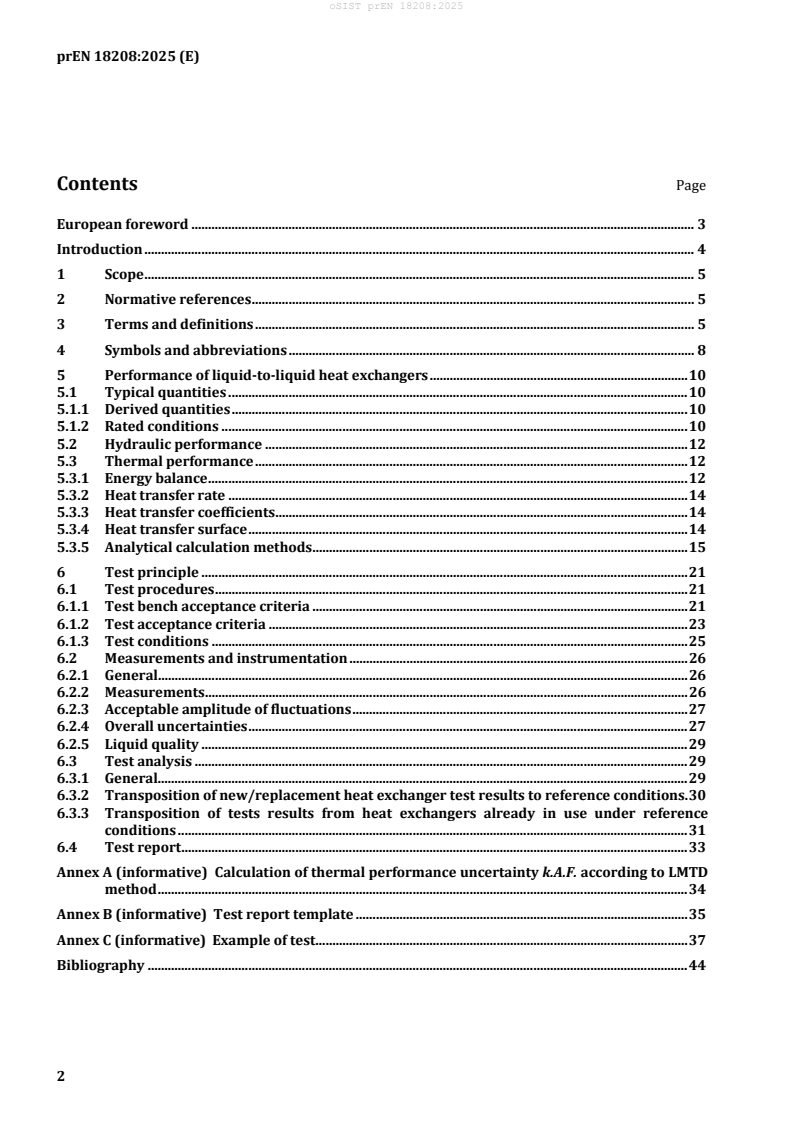
Contents Page
European foreword . 3
Introduction . 4
1 Scope . 5
2 Normative references . 5
3 Terms and definitions . 5
4 Symbols and abbreviations . 8
5 Performance of liquid-to-liquid heat exchangers . 10
5.1 Typical quantities . 10
5.1.1 Derived quantities . 10
5.1.2 Rated conditions . 10
5.2 Hydraulic performance . 12
5.3 Thermal performance . 12
5.3.1 Energy balance . 12
5.3.2 Heat transfer rate . 14
5.3.3 Heat transfer coefficients . 14
5.3.4 Heat transfer surface . 14
5.3.5 Analytical calculation methods . 15
6 Test principle . 21
6.1 Test procedures . 21
6.1.1 Test bench acceptance criteria . 21
6.1.2 Test acceptance criteria . 23
6.1.3 Test conditions . 25
6.2 Measurements and instrumentation . 26
6.2.1 General. 26
6.2.2 Measurements . 26
6.2.3 Acceptable amplitude of fluctuations . 27
6.2.4 Overall uncertainties . 27
6.2.5 Liquid quality . 29
6.3 Test analysis . 29
6.3.1 General. 29
6.3.2 Transposition of new/replacement heat exchanger test results to reference conditions . 30
6.3.3 Transposition of tests results from heat exchangers already in use under reference
conditions . 31
6.4 Test report . 33
Annex A (informative) Calculation of thermal performance uncertainty k.A.F. according to LMTD
method . 34
Annex B (informative) Test report template . 35
Annex C (informative) Example of test . 37
Bibliography . 44
European foreword
This document (prEN 18208:2025) has been prepared by Technical Committee CEN/TC 110 “Heat
exchangers”, the secretariat of which is held by DIN.
This document is currently submitted to the CEN Enquiry.
Introduction
This document is designed to support a series of European standards dedicated to heat exchangers.
This document provides manufacturers and users with the information needed to present the
thermohydraulic performance characteristics of a heat exchanger. These characteristics form the basis
for evaluating the state of a heat exchanger, whether it is new/a replacement, or already in operation.
This document also provides a performance-based acceptance test procedure for a liquid-to-liquid single-
phase heat exchanger (sensor calibration, acknowledgement of uncertainties, standardization of physical
properties of liquids) and the possible transpositions under various rated conditions.
The customer's technical specification, referred to in this document, defines or adapts the level of
tolerance. It also defines thermal performance acceptance criteria. Examples are provided in Annex C.
Underlying assumption of this document is that the liquid is a Newtonian fluid in turbulent conditions.
This document may be adapted for other liquids or conditions, as agreed by parties involved in the
performance test.
1 Scope
This document defines the general terms and the calculations used to determine the thermohydraulic
performance of heat exchangers. It includes the general test procedure and related theories.
This document is intended to be used for acceptance-testing heat exchangers in test facilities such as
laboratories, manufacturer test facilities and final installation site.
This document specifies three acceptance levels:
— level 1 for minimum tolerances;
— level 2 for nominal tolerances;
— level 3 for maximum tolerances;
This document constitutes an application-specific standard in line with EN 305 and EN 306.
2 Normative references
The following documents are referred to in the text in such a way that some or all of their content
constitutes requirements of this document. For dated references, only the edition cited applies. For
undated references, the latest edition of the referenced document (including any amendments) applies.
EN 247, Heat exchangers — Terminology
EN 305, Heat exchangers — Definitions of performance of heat exchangers and the general test procedure
for establishing performance of all heat exchangers
EN 306, Heat exchangers — Methods of measuring the parameters necessary for establishing the
performance
EN ISO 5167 (all parts), Measurement of fluid flow by means of pressure differential devices inserted in
circular cross-section conduits running full
ISO/TR 12767, Measurement of fluid flow by means of pressure differential devices — Guidelines on the
effect of departure from the specifications and operating conditions given in ISO 5167
3 Terms and definitions
For the purposes of this document, the terms and definitions given in EN 247 and the following apply.
ISO and IEC maintain terminology databases for use in standardization at the following addresses:
— ISO Online browsing platform: available at https://www.iso.org/obp/
— IEC Electropedia: available at https://www.electropedia.org/
3.1
liquid
any type of liquid, such as water, used to transfer thermal energy (heat)
Note 1 to entry: There can be a combination of two or more types of liquids, all in the same phase state (single-
phase liquid).
3.2
primary liquid
hottest liquid, which serves as a heat source
3.3
secondary liquid
coolest liquid, which serves as a heat sink
3.4
mixture
liquid with two or more elements, all in the same phase state
3.5
heat exchanger
device designed to transfer heat between two physically separated liquids
3.7
thermohydraulic performance of a heat exchanger
heat exchanger thermohydraulic performance that can be established by measuring, or can be calculated
using measured parameters, and is expressed according to one or more of the following elements:
— temperature of primary/secondary liquid;
— flow rate of primary/secondary liquid;
— pressure of primary/secondary liquid;
— temperature difference;
— heat transfer coefficient;
— heat transfer rate transferred by primary liquid / captured by secondary liquid;
— pressure drops;
— fouling factors.
Note 1 to entry: These elements are identified per EN 305 and may be established by measuring per EN 306.
3.8
heat exchanger categories
classification of heat exchanger types based on design criteria, physical criteria, or a mix of the two
3.9
heating
temperature increase of a secondary liquid that does not change its phase state
3.10
cooling
temperature decrease of a primary liquid that does not change its phase state
3.11
fouling
deposit of a layer of unwanted materials entailing/causing resistance to the heat transfer
3.12
plugging
obstruction of one or more openings/channels in a heat exchanger where no primary or secondary liquid
can circulate, resulting in a decrease in the transfer surface and an increase in pressure drops
3.13
irreversible pressure drop
decrease of static pressure between inlet and outlet not including change of level
3.14
typical inlet
inlet considered the most representative of each heat exchanger, chosen by the manufacturer or in
accordance with the installation conditions
3.15
typical outlet
outlet considered the most representative of each heat exchanger, chosen by the manufacturer or in
accordance with the conditions of use
3.16
pinch temperature
minimum difference between the primary liquid and secondary liquid temperatures
3.17
customer
user
entity that purchases a good or service from a supplier
Note 1 to entry: For test of used heat exchangers, the user is responsible of the fouling of the heat exchanger. (i.e for
cleaning it or defining the fouling resistance)
3.18
maker
manufacturer
supplier
entity that supplies goods to a user and guarantees the performance of the heat exchanger (sourcing,
manufacture, production inspection, packaging, storage, transport)
Note 1 to entry: For new heat exchangers, in the case of performance tests, they are also responsible for checking
heat exchanger cleanliness (initial cleanliness report), preparing the heat exchanger and its immediate environment
(e.g. anchoring, adapters, cradles, access scaffolding) and establishing the thermohydraulic criteria checking report
(by transposition if the conditions differ from the reference conditions, per 6.3).
3.19
verifier
laboratory
entity that verifies the equipment performance through one or more tests and ensures the exchanger test
measurements (calibration, test bench assembly, bench cleanliness check, sensor installation, liquid
analysis report, acquisition chain, test bench/heat exchanger adapters connection, performance test,
uncertainty calculations), including measurement uncertainties
3.20
design state
reference conditions
heat exchanger operating parameters that will determine the minimum k.A.F. coefficient required to
satisfy the customer's criteria
Note 1 to entry: This state is determined by the manufacturer based on the operating situations required by the
customer (mass flow rates and liquid temperatures, heat transfer rate to be transferred, etc.)
3.21
steady-state
condition where the average value of all main variables of the heat exchanger (temperature, pressure,
flow rate) remains constant over time, and fluctuations are in the same order of magnitude of the
measuring sensor, given that external conditions and inputs are unchanging
Note 1 to entry: Steady-state criteria are expressed in 6.1.3.
3.22
required
thermohydraulic rated conditions according to customer requirements
4 Symbols and abbreviations
For the purposes of this document, the symbols, abbreviations and subscripts apply:
A Reference heat transfer surface area m
C Hydraulic test factor —
DP
C Thermal test factor —
e
C Cleanliness factor —
foul
C Constant pressure specific heat capacity J/(kg °C)
p
F LMTD correction factor —
g Acceleration of gravity m/s
h Specific enthalpy J/kg
k Overall heat transfer coefficient W/(m °C)
k·A·F Heat exchanger thermal performance W/°C
k Heat transfer coefficient linked to fouling (inverse of R ) W/(m °C)
foul foul
LMTD Log mean temperature difference °C
NTU Number of thermal transfer units —
p Total absolute pressure Pa
abs
p Total relative pressure Pa
rel
q Mass flow kg/s
m
q c Heat capacity flow rate W/°C
m p
R Resistance (thermal) (m °C)/W
S Liquid flow section m
SM Excess surface heat transfer coefficient %
T Celsius temperature °C
U Absolute uncertainty —
v Velocity m/s
x Overall heat transfer coefficient margin %
y Heat flow ratio —
z Height m
α Convective heat transfer coefficient W/(m °C)
ε Thermal efficiency —
ζ Pressure drop coefficient —
λ Thermal conductivity W/(m °C)
µ Dynamic viscosity at liquid average temperature kg/(m.s)
µ Dynamic viscosity at temperature of wall in contact with liquid kg/(m.s)
w
Φ Heat transfer rate W
ρ Density kg/m
σ Experimental standard deviation —
Δ Difference —
Fouled/fouling
foul
Mass
m
max Maximum
Material in contact with liquid
mat
Minimum
min
Numerical
num
Operational
op
Clean
clean
Design reference
required
Transposed/transposition
transpo
Primary side
Secondary side
Inlet conditions, primary side
Outlet conditions, primary side
Inlet conditions, secondary side
Outlet conditions, secondary side
NOTE The LMTD correction factor F depends on the type of heat exchanger and the flow configuration. This
factor is equal to or less than 1 (5.3.5.2).
5 Performance of liquid-to-liquid heat exchangers
5.1 Typical quantities
5.1.1 Derived quantities
When this document serves as the basis for establishing performance characteristics, the parts contained
in EN 305 shall be used (see Table 1).
Table 1 — Quantity used to establish performance characteristics
Quantity Designation Subclause
Fouling thermal resistance R 5.1.2.5
foul
Excess surface heat transfer coefficient SM 5.1.2.5
Cleanliness factor C 5.1.2.5
foul
Pressure drops (hydraulic performance) Δp 5.2
Heat transfer rate Φ 5.3.2
Overall heat transfer coefficient k 5.3.3
Heat transfer area A 5.3.4
Logarithmic mean temperature difference LMTD 5.3.5.2
Thermal performance k.A.F 5.3.5.2.3
Number of thermal transfer units NTU 5.3.5.2.4
Thermal efficiency ε 5.3.5.3.2
5.1.2 Rated conditions
5.1.2.1 General
The thermohydraulic performance of a heat exchanger shall be defined for rated conditions by:
— type of liquid;
— flow rate (primary and second liquid mass flow rate);
— temperature (at primary and secondary liquid inlet and/or outlet);
— total pressure (at primary and secondary liquid inlet and/or outlet);
— pressure drops (of primary and secondary liquids);
— physical properties of liquid (density, enthalpy and/or specific heat capacity, thermal conductivity,
dynamic viscosity) and chemical composition of liquids involved (calculated at primary and
secondary mean temperature);
— physical properties of material used at the average temperature of the material;
— fouling state of heat transfer surfaces;
— auxiliary equipment requirements (e.g. purges, level controls, pumps);
— environmental constraints (e.g. ambient temperature, humidity, contamination);
— operating frequency (for regenerative heat exchangers).
NOTE The physical and thermodynamic properties of the liquids use international standards such as IAPWS
IF95/97 for standard water and IAPWS 08 for seawater. In the absence of an international standard, an appropriate
thermodynamic model to estimate the physical properties of the liquids can be proposed.
Fouling kinetics, whether asymptotic (soft, fragile deposits such as particulate fouling) or not (hard,
adhesive deposits such as scale), shall be taken in account at the design phase.
For the single-phase liquid system of a heat exchanger, multiplying the specific heat capacity by the
temperature difference on the primary and/or secondary side may be equivalent to the specific enthalpy
difference of the liquid in J/kg. It shall be checked according to the fluid properties and the difference
between both methods shall be less than aimed uncertainties to use heat capacity method.
EXAMPLE For liquid water, if the temperature is above 250°C, it is better to use the enthalpy balance.
5.1.2.2 Flow
Flow should be viewed as the mass flow rate q relative to the normal entry or outlet.
m
5.1.2.3 Temperature
The average inlet temperature shall refer to the heat exchanger inlet. The average outlet temperature
shall refer to the heat exchanger outlet.
5.1.2.4 Pressure
The total inlet pressure shall be expressed as the average absolute total pressure relative to the inlet.
The total outlet pressure shall be expressed as the average absolute total pressure relative to the outlet.
5.1.2.5 Fouling
The fouling thermal resistance (R and R ) of each side of the heat transfer wall is expressed as the
foul1 foul2
composite value R . Fouling can also be expressed in terms of the percentage difference on the overall
foul
heat transfer coefficient (k).
Fouling shall be calculated using the mean values obtained through the operating test data in accordance
with the following formulae:
— For fouling resistance, see Formula (1):
11 1
R =− = (1)
foul
kk k
op clean foul
— For variations in heat transfer surface (deviation of value k), see Formula (2):
kk−
clean op
SM= 100 (2)
k
op
— For cleanliness factor (C ), see Formula (3):
foul
k
op
C = (3)
foul
k
clean
where
R is the total fouling resistance, in m °C/W;
foul
k is the overall heat transfer coefficient in operation, in W/m °C;
op
k is the overall heat transfer coefficient under cleanliness conditions, in W/m °C;
clean
k is the inverse of R , in W/m °C;
foul foul
SM is the excess surface heat transfer coefficient;
C is the cleanliness factor.
foul
NOTE 1 The cleanliness factor is not constant and depends on test conditions. It is preferable to use the concept
of fouling resistance, which is intrinsic to the heat exchanger and does not depend on test conditions.
NOTE 2 In the case of new/replacement heat exchangers, the cleanliness factor is equal to 1.
5.2 Hydraulic performance
According to Bernoulli's theorem, the formula is written in the general form between two points A and B
of a single flow in a facility; see Formula (4):
2 2
∆p = ρρv − v + g z − z + p − p =−∆p (4)
( ) ( )
( )
B A BA B A
where
ρ is the density of the liquid, in kg/m ;
v is the velocity of the liquid between points (A) and (B), in m/s;
g is the acceleration of gravity, in m/s (generally equal to 9,81);
z is the height of points (A) and (B), in m;
p is the static pressure of points (A) and (B), in Pa;
is all the mechanical energy losses or pressure drops (regular and singular) between
Δp
points (A) and (B), in Pa.
q
m
Velocity v of the liquid is calculated using mass flow rate q , density ρ and flow section S, with v= .
m
ρS
5.3 Thermal performance
5.3.1 Energy balance
The energy balance allows the total energy at the heat exchanger inlet to be compared with the total
energy at its outlet, as shown in Figure 1.
This balance should be included in the test reports conducted on the heat exchangers in order to check
the measured results.
Figure 1 — Energy balance
In steady-state, the enthalpy variation on the primary liquid side shall be equal to the enthalpy variation
on the secondary liquid side assuming no heat losses to the environment nor heat sources inside the
component. In general, the power (mechanical or electrical) supplied within the limits of the
measurements, and the heat transfer (heat gains or losses) between the heat exchanger and its
environment, should be considered.
Based on Figure 1, this relationship can be written in the theoretical form given in Formula (5):
qh− h+ΦΦ− qh− h−+Φ Φ (5)
( ) ( )
m1 11 12 p1 loss1 m2 22 21 p2 loss2
where
q is the mass flow rate of the primary liquid, in kg/s;
m1
q is the mass flow rate of the secondary liquid, in kg/s;
m2
h is the specific enthalpy of the primary liquid, at the inlet, in J/kg;
h is the specific enthalpy of the primary liquid, at the outlet, in J/kg;
h is the specific enthalpy of the secondary liquid, at the inlet, in J/kg;
h is the specific enthalpy of the secondary liquid, at the outlet, in J/kg;
Φ is the heat dissipation due to the head losses, primary side, in W;
p1
Φ is the heat dissipation due to the head losses, secondary side, in W;
p2
Φ are the heat losses (gains), primary side, in W;
loss1
Φ are the heat losses (gains), secondary side, in W.
loss2
Generally, the previous formula is simplified as follows because heat losses to surroundings and head
losses thermal impact are negligible, see Formula (6):
qh−=h qh− h (6)
( ) ( )
m1 11 12 m2 22 21
=
5.3.2 Heat transfer rate
The heat transfer rate of a single-phase heat exchanger (i.e. when the two liquids remain in liquid state)
is characterized by the following formulae: see Formula (7) for primary side and Formula (8) for
secondary side.
φφq××c TT− + (7)
( )
1 m1 p1 11 12 perte1
φφq××c TT− +
(8)
( )
2 m2 p2 22 21 perte2
where
ϕ is the heat transfer rate, in W and is positive;
q is the mass flow rate, in kg/s;
m
c is the specific heat capacity at constant pressure, in J/kg °C;
p
T is the temperature, in °C;
n is the subscript relative to the heat exchanger primary circuit or secondary circuit;
ϕ is the heat loss or gain due to the surrounding environment, in W.
loss
In this relationship, the heat exchanger heat balance describes the fact that the heat transferred by the
primary liquid is equal to the heat captured by the secondary liquid, adjusted for heat losses or gains
to/from the surrounding environment.
5.3.3 Heat transfer coefficients
The heat transfer can be characterized by various types of heat transfer coefficients that express the heat
transfer rate per heat transfer surface area unit and per temperature difference unit.
The heat transfer coefficients shall be given separately for primary and secondary flows and aggregated
in an overall heat transfer coefficient. The overall heat transfer coefficient combines the effects of
convection and conduction between the two flows and the heat transfer surface of the heat exchanger.
The conditions for establishing the heat transfer coefficient — for example the conditions for establishing
the heat transfer surface area and the temperature difference — shall be described.
In this document, the overall heat transfer coefficient should be used. This coefficient is calculated based
on the log mean temperature difference (5.3.5.2) and the total heat transfer surface area in contact with
either liquid, by adding fins or any other type of additional surface.
Under normal operating conditions, the calculated values of the overall heat transfer coefficient might
need to be adjusted using the fouling coefficients from each side of the heat transfer wall, as shown in
5.1.2.5. The value of these coefficients shall be specified at the time of purchase.
5.3.4 Heat transfer surface
The part of the surface of the heat exchanger channel walls that is involved in the heat transfer process is
called the heat transfer surface.
The heat transfer surface can have a specific shape with special accessories, e.g. fins, designed to increase
the heat transfer coefficient or the transfer surface area.
The method for determining the transfer surface shall be described if there are several possible ways to
calculate it. The correlation used to calculate the performance shall be defined accordingly to the chosen
heat transfer surface.
=
=
5.3.5 Analytical calculation methods
5.3.5.1 General
Two types of thermal calculations can be used to size a heat exchanger according to its use:
— Determination of transfer surface, A, knowing the heat transfer rate transferred and the inlet and
outlet temperatures of the two liquids (LMTD method);
— Determination of the liquid outlet temperatures knowing their inlet temperatures and the transfer
surface (NTU method).
NOTE ASME PTC 12.5 is based on the LMTD method and ANSI/AHRI Standard 401 is based on the NTU method.
5.3.5.2 LMTD method
5.3.5.2.1 General
The log mean temperature difference (LMTD) shall be calculated as the ratio of the deviation between
the temperature differences at the inlet and outlet, and the logarithm of the quotient of these two
temperature differences, determined by the temperature difference between the primary and secondary
sides along the length of the heat exchanger; see Formulae (9) and (10):
∆∆TT−
i o
if ∆T ≠ ∆T (9)
DTML=
i o
∆T
i
ln
∆T
o
LMTD = ∆T = ∆T if ∆T = ∆T (10)
i o i o
where
LMTD is the log mean temperature difference, in °C;
ΔT is the temperature difference between the primary side inlet and the secondary side
i
entry or outlet, depending on the flow direction, in accordance with Figures 2 and 3;
ΔT is the temperature difference between the primary side outlet and the secondary side
o
entry or outlet, depending on the flow direction, in accordance with Figures 2 and 3.
Figure 2 — Counter-current flow
NOTE In this figure, the primary liquid is the limiting liquid (qmcp)min.
Figure 3 — Co-current flow
For other types of flows (e.g. cross or mixed flows), a correction factor, called F, strictly less than 1, shall
be applied to LMTD calculated using a counter-current flow approach and shall be applied to calculate
the heat transfer rate.
The pinch temperature shall be established by determining the difference between the primary circuit
outlet temperature and the secondary circuit inlet or outlet temperature, depending on the type of flow
(counter or co-current flow). For physical reasons, the final temperature difference, ΔT , is positive.
o
The LMTD method is generally used for heat exchanger design, in order to establish the heat exchanger
geometry.
5.3.5.2.2 Relations between ϕ, k and LMTD
As a basic heat exchanger principle, heat transfer rate transfer is characterized by the transfer of a certain
quantity of heat per time unit, defined by the following formulae:
— For heat transfer rate, see Formula (11):
Φ= k.AF.LMTD (11)
where
Φ is the heat transfer rate, in W;
k is the overall heat transfer coefficient, in W/m °C;
A is the reference heat transfer surface area, in m ;
F is the LMTD correction factor;
LMTD is the log mean temperature difference, in K.
The mean power on the primary side and secondary side shall be considered; see Formula (12):
φφ+
φ = (12)
mean
— For the overall heat transfer coefficient, see Formula (13):
φ
mean
k= (13)
AF.LMTD
5.3.5.2.3 Thermal performance
The definition of the thermal performance of a heat exchanger is as follows; see Formula (14):
φ
mean
k.AF= (14)
LMTD
5.3.5.2.4 Required thermal performance
The required k.A.F, k.A.F (see 6.1.2) is calculated based on reference conditions and the
required
Formula (14). This is the minimum k.A.F that the heat exchanger shall achieve. This k.A.Frequired may be
increased with margins such as:
— uncertainties provision for calculations;
— uncertainties provision for manufacture;
— uncertainties provision for performance acceptance tests;
— tube plugging margin.
There may be several k.A.F if there are several reference conditions (e.g. several operating points,
required
clean or fouled case).
5.3.5.3 NTU method
5.3.5.3.1 General
NTU (number of thermal transfer units) is a number with no dimension, often referred to as a “thermal
length” concept.
The NTU of a heat exchanger is calculated using Formula (15):
kA.kA kA.
NTU max NTU , NTU max , (15)
( )
max 1 2
qc qc
q c
mp11 mp22
( )
mp
min
===
The NTU method is generally used for simulations once the heat exchanger geometry is established.
5.3.5.3.2 Thermal efficiency
Heat exchanger efficiency is the ratio of heat transfer rate actually transferred relative to the maximum
heat transfer rate it is theoretically possible to transfer using ideal equipment (infinite exchange surface,
with no fouling), using the same liquids at the same mass flow rates and same inlet temperatures; see
Formulae (16), (17), (18) and (19).
The power transferred is at its maximum if one of the liquids undergoes a temperature variation equal to
the difference of the inlet temperatures of the two liquids. This maximum variation can only be
undergone by the liquid with the lowest q c value (Figures 4 and 5).
m p
max ∆∆TT,
( )
Φ
1 2
εε max, (16)
( )
1 2
Φ∆T
max max
Φ∆q c min× T q c min×−T T (17)
( )
( ) ( )
max m p max m p 11 21
TT− ∆T
11 12 1
ε (18)
∆T ∆T
max max
TT− ∆T
22 21 2
ε (19)
∆∆TT
max max
where
ε is the thermal efficiency;
Φ is the heat transfer rate transferred between the primary and secondary liquids, in W;
Φ is the maximum heat transfer rate transferred, in W;
max
q is the mass flow rate, in kg/s;
m
c is the specific heat capacity at constant pressure, in J/kg °C;
p
T is the inlet temperature, primary side, in °C;
T is the outlet temperature, primary side, in °C;
T is the inlet temperature, secondary side, in °C;
T is the outlet temperature, secondary side, in °C;
In practice, the efficiency of a heat exchanger is defined for main process liquid, i.e. the heated or cooled
liquid, for which q c is not necessarily the minimum. However, only the efficiency defined by the liquid
m p
for which q c is a minimum has physical meaning.
m p
==
==
= =
= ==
Figure 4 — Counter-current flow
Figure 5 — Co-current flow
5.3.5.3.3 Liquid heat flow ratio
The heat flow ratio of liquids, called y, is defined by the following formulae; see Formula (20).
q c min
( )
mp
y min yy, (20)
( )
1 2
q c max
( )
mp
— For the primary liquid, see Formula (21).
qc
TT− ∆T
mp11
22 21 2
(21)
y
qc T − T ∆T
mp2 2 11 12 1
— For the secondary liquid, see Formula (22).
qc
TT− ∆T
mp22
11 12 1
y (22)
qc T − T ∆T
mp1 1 22 21 2
===
===
==
5.3.5.3.4 Relationship between ε, NTU and y
In general, ε can be written as given in Formula (23).
ε = f (NTU, y, flow configuration) (23)
This formula is valid for both liquids.
In the case of simple flows that are exclusively either counter or co-current flows, the formula is as
follows:
— exclusively counter-current flow, see Formulae (24) and (25).
−−NUT 1 y
( )
1− e
ε= for y≠1 (24)
−−NUT 1 y
( )
1− ye×
NUT
ε= for y = 1 (25)
NUT+ 1
— exclusively co-current flow, see Formula (26).
−+NTU 1 y
( )
1− e
ε= (26)
1+ y
where
ε is the thermal efficiency, in accordance with 5.3.5.3.2;
NTU is the number of thermal transfer units, in accordance with 5.3.5.2.4;
y is the heat flow ratio, in accordance with 5.3.5.3.3.
Efficiency ε can be included in a diagram according to the NTU for various values of y, as illustrated in
Figures 6 and 7.
Figure 6 — Counter-current flow
Figure 7 — Co-current flow
These diagrams are limited to values of y between 0 and 1.
For other types of flows, the formulae can be found in the literature referenced in the bibliography, and
the manufacturer should include them in their documentation.
6 Test principle
6.1 Test procedures
6.1.1 Test bench acceptance criteria
6.1.1.1 General
This section gives several directives to manufacturers, test laboratories and users for preparing and
presenting the test procedures relative to the methods for measuring heat exchanger performance.
A heat exchanger intended to be installed in a given heat transfer system should be tested under similar
conditions with the auxiliary equipment required for its operation. Before commissioning, the heat
exchanger shall be identified and its conformity with design characteristics shall be checked.
The heat exchanger shall be connected to the test device, filled with the appropriate test liquids. Sealing
shall be checked, and its installation shall be guaranteed. Any air trapped in the system shall be purged
and sensors shall be installed per current standards.
To improve the heat balance, heat losses/gains to/from the environment should also be avoided.
Insulation can be used to avoid these heat exchanger heat losses/gains. It can also be used between the
heat exchanger to be tested and the temperature measurement stations.
Lastly, test bench start-up shall not disturb heat exchanger operation or its measurements. For example,
a pump installed very close to the heat exchanger can cause recirculating and inadequate distribution in
the heat exchanger.
The test bench shall never impact heat exchanger cleanliness, regardless of the test bench chosen (piping
material, equipment such as pump, heat exchanger, etc.).
6.1.1.2 Test method
The heat exchanger test method depends on the purpose of the test and shall therefore be chosen
according to whether the heat exchangers are new or already in use (operating).
1. A new heat exchanger is defined as a heat exchanger whose thermal and hydraulic characteristics
have not been altered by corrosion or deposits (i.e. clean).
A new heat exchanger intended to be installed in a given heat transfer system should be tested under
similar conditions with the auxiliary equipment required for its operation. Before start-up, the heat
exchanger shall be identified and its conformity with design characteristics shall be checked.
Sufficient performance data from near the theoretical point should be measured in order to predict the
performance characteristics under the reference conditions. The number of measurement points shall be
in accordance with EN 305 and EN 306.
2. Inversely, a heat exchanger that is already in use (operating) is a heat exchanger whose thermal
and/or hydraulic characteristics might have been altered due to corrosion and/or deposits, and
whose performance test is generally performed in situ.
Fouling is produced by several mechanisms including the formation of oxide scale, the calcination of
organic matter and the generalized deposit of organic and inorganic matter. It is important to have a
reference test of a new heat exchanger beforehand because it is difficult to characterize fouling. Regularly
testing heat exchangers that are already operating enable monitoring of their performance and indicate
when to perform cleaning or other necessary actions (plugging in the event of perforation), including
replacing the heat exchanger with a new device.
6.1.1.3 Test conditions
Test conditions shall be as close as possible as the reference condition. When it is not possible to match
references conditions, the following requirements shall be followed:
— Tests conditions shall include ± 20 % of Reynolds number conditions compared to the reference
conditions.
— To increase transposition accuracy, other tests points with varying Reynolds number (primary and
secondary sides) shall be included in the test programme.
Maximum transposition accuracy can be achieved by making Prandtl number vary for each Reynolds
number tested. (Variation of the test loop power)
Fluids used for the tests shall be as close as possible as fluids used in the plant. If not possible,
manufacturers and customers shall reach an agreement on the test fluids and their representativeness.
6.1.1.4 Test programme
The test program cannot be executed until the client has approved the programme and the procedure,
unless otherwise agreed between the parties.
Given that performance tests are conducted with a clean heat exchanger, as part of the test programme,
the manufacturer shall establish and provide the customer with a method for transposing the test results
in order to obtain the performance in fouled state in design state.
The test programme shall include:
— a risk and opportunity analysis dedicated to the tests (identification, level of exposure with potential
consequences and probability of occurrence, as well as treatment, circuit leaks);
— the general description of the test loop (technicians, location, date, description of primary circuit and
secondary circuit (equipment), instrumentation positions and settings, etc.);
— the thermohydraulic performance test procedure (test steps, interpretation of results (formulae
used, uncertainties, acceptability criteria and approach), performance test report, heat exchanger
state before, during and after testing).
The thermohydraulic performance test procedure shall include the following items:
— schedule;
— general order of operations (before testing such as assembly and cleaning of test loop, during testing,
after testing such as cleanliness tests and circuit disassembly);
— hydraulic network and instrumentation diagram;
— description of liquids used and/or produced.
Test data other than those required to establish heat exchanger thermohydraulic performance may be
supplied for information only.
In all cases, the customer, the manufacturer, and the verifier (if different from the customer or the
manufacturer) shall reach an agreement on the method for performing the tests with the appropriate
measurements.
6.1.2 Test acceptance criteria
6.1.2.1
...
Questions, Comments and Discussion
Ask us and Technical Secretary will try to provide an answer. You can facilitate discussion about the standard in here.
Loading comments...