

CEN/TS 17716:2022
(Main)Plant biostimulants - Determination of Escherichia coli
- Abstract
This document gives general guidelines for the detection and identification of the specified microorganism Escherichia coli in technical and formulated biostimulant products, both in liquid and solid state, and also the horizontal method for the enumeration of ß-glucuronidase-positive Escherichia coli in plant biostimulants products (both in liquid and solid state).
The qualitative method described in this document is based on the detection of Escherichia coli in a non-selective liquid medium (enrichment broth), followed by isolation on a selective agar medium. Other methods can be appropriate, depending on the level of detection required.
NOTE For the detection of Escherichia coli, subcultures can be performed on non-selective culture media followed by suitable identification steps (e.g. using identification kits).
The quantitative method described in this document uses a colony-count technique at 44 °C on a solid medium containing a chromogenic ingredient for detection of the enzyme ß-glucuronidase.
WARNING — Strains of Escherichia coli which do not grow at 44 °C and, in particular, those that are ß glucuronidase negative, such as Escherichia coli O157, will not be detected.
- Status
- Withdrawn
- Publication Date
- 22-Mar-2022
- Withdrawal Date
- 06-Oct-2026
- Technical Committee
- CEN/TC 455 - Plant Biostimulants and Agricultural Micro-Organisms
- Drafting Committee
- CEN/TC 455/WG 3 - Pathogenic and non-pathogenic microorganisms
- Current Stage
- 9960 - Withdrawal effective - Withdrawal
- Start Date
- 27-Nov-2024
- Completion Date
- 07-Oct-2026

Relations
- Effective Date
- 15-Feb-2023
Get Certified
Connect with accredited certification bodies for this standard

Control Union Certifications
Global certification for agriculture and sustainability.

ECOCERT
Organic and sustainability certification.

FSC International
Forest Stewardship Council certification.
Sponsored listings
Frequently Asked Questions
CEN/TS 17716:2022 is a technical specification published by the European Committee for Standardization (CEN). Its full title is "Plant biostimulants - Determination of Escherichia coli". This standard covers: This document gives general guidelines for the detection and identification of the specified microorganism Escherichia coli in technical and formulated biostimulant products, both in liquid and solid state, and also the horizontal method for the enumeration of ß-glucuronidase-positive Escherichia coli in plant biostimulants products (both in liquid and solid state). The qualitative method described in this document is based on the detection of Escherichia coli in a non-selective liquid medium (enrichment broth), followed by isolation on a selective agar medium. Other methods can be appropriate, depending on the level of detection required. NOTE For the detection of Escherichia coli, subcultures can be performed on non-selective culture media followed by suitable identification steps (e.g. using identification kits). The quantitative method described in this document uses a colony-count technique at 44 °C on a solid medium containing a chromogenic ingredient for detection of the enzyme ß-glucuronidase. WARNING — Strains of Escherichia coli which do not grow at 44 °C and, in particular, those that are ß glucuronidase negative, such as Escherichia coli O157, will not be detected.
This document gives general guidelines for the detection and identification of the specified microorganism Escherichia coli in technical and formulated biostimulant products, both in liquid and solid state, and also the horizontal method for the enumeration of ß-glucuronidase-positive Escherichia coli in plant biostimulants products (both in liquid and solid state). The qualitative method described in this document is based on the detection of Escherichia coli in a non-selective liquid medium (enrichment broth), followed by isolation on a selective agar medium. Other methods can be appropriate, depending on the level of detection required. NOTE For the detection of Escherichia coli, subcultures can be performed on non-selective culture media followed by suitable identification steps (e.g. using identification kits). The quantitative method described in this document uses a colony-count technique at 44 °C on a solid medium containing a chromogenic ingredient for detection of the enzyme ß-glucuronidase. WARNING — Strains of Escherichia coli which do not grow at 44 °C and, in particular, those that are ß glucuronidase negative, such as Escherichia coli O157, will not be detected.
CEN/TS 17716:2022 is classified under the following ICS (International Classification for Standards) categories: 65.080 - Fertilizers. The ICS classification helps identify the subject area and facilitates finding related standards.
CEN/TS 17716:2022 has the following relationships with other standards: It is inter standard links to EN 17716:2024. Understanding these relationships helps ensure you are using the most current and applicable version of the standard.
CEN/TS 17716:2022 is associated with the following European legislation: EU Directives/Regulations: 2019/1009; Standardization Mandates: M/564. When a standard is cited in the Official Journal of the European Union, products manufactured in conformity with it benefit from a presumption of conformity with the essential requirements of the corresponding EU directive or regulation.
CEN/TS 17716:2022 is available in PDF format for immediate download after purchase. The document can be added to your cart and obtained through the secure checkout process. Digital delivery ensures instant access to the complete standard document.
Standards Content (Sample)
SLOVENSKI STANDARD
01-februar-2023
Rastlinski biostimulanti - Določanje Escherichia coli
Plant biostimulants - Determination of Escherichia coli
Pflanzen-Biostimulanzien - Bestimmung von Escherichia coli
Biostimulants des végétaux - Détermination des Escherichia coli
Ta slovenski standard je istoveten z: CEN/TS 17716:2022
ICS:
65.080 Gnojila Fertilizers
2003-01.Slovenski inštitut za standardizacijo. Razmnoževanje celote ali delov tega standarda ni dovoljeno.
CEN/TS 17716
TECHNICAL SPECIFICATION
SPÉCIFICATION TECHNIQUE
March 2022
TECHNISCHE SPEZIFIKATION
ICS 65.080
English Version
Plant biostimulants - Determination of Escherichia coli
Biostimulants des végétaux - Détermination des Pflanzen-Biostimulanzien - Bestimmung von
Escherichia coli Escherichia coli
This Technical Specification (CEN/TS) was approved by CEN on 3 January 2022 for provisional application.
The period of validity of this CEN/TS is limited initially to three years. After two years the members of CEN will be requested to
submit their comments, particularly on the question whether the CEN/TS can be converted into a European Standard.
CEN members are required to announce the existence of this CEN/TS in the same way as for an EN and to make the CEN/TS
available promptly at national level in an appropriate form. It is permissible to keep conflicting national standards in force (in
parallel to the CEN/TS) until the final decision about the possible conversion of the CEN/TS into an EN is reached.
CEN members are the national standards bodies of Austria, Belgium, Bulgaria, Croatia, Cyprus, Czech Republic, Denmark, Estonia,
Finland, France, Germany, Greece, Hungary, Iceland, Ireland, Italy, Latvia, Lithuania, Luxembourg, Malta, Netherlands, Norway,
Poland, Portugal, Republic of North Macedonia, Romania, Serbia, Slovakia, Slovenia, Spain, Sweden, Switzerland, Turkey and
United Kingdom.
EUROPEAN COMMITTEE FOR STANDARDIZATION
COMITÉ EUROPÉEN DE NORMALISATIO N
EUROPÄISCHES KOMITEE FÜR NORMUN G
CEN-CENELEC Management Centre: Rue de la Science 23, B-1040 Brussels
© 2022 CEN All rights of exploitation in any form and by any means reserved Ref. No. CEN/TS 17716:2022 E
worldwide for CEN national Members.
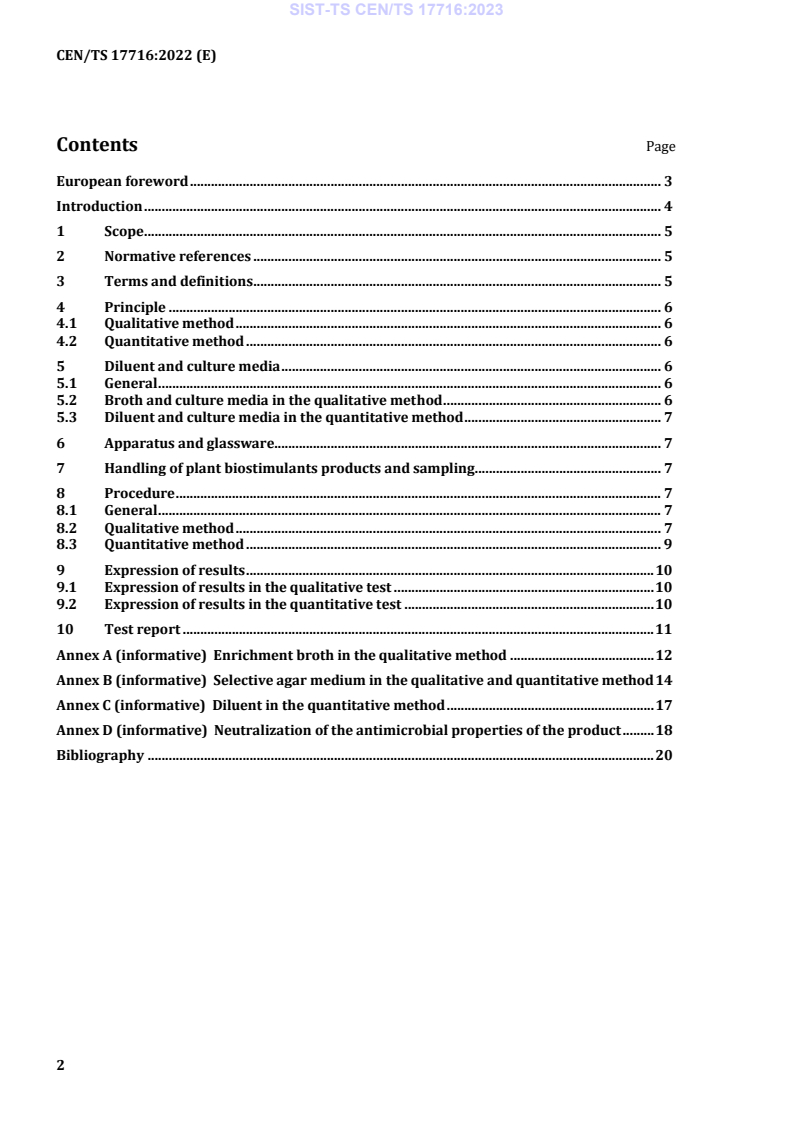
Contents Page
European foreword . 3
Introduction . 4
1 Scope . 5
2 Normative references . 5
3 Terms and definitions. 5
4 Principle . 6
4.1 Qualitative method . 6
4.2 Quantitative method . 6
5 Diluent and culture media . 6
5.1 General . 6
5.2 Broth and culture media in the qualitative method . 6
5.3 Diluent and culture media in the quantitative method . 7
6 Apparatus and glassware. 7
7 Handling of plant biostimulants products and sampling. 7
8 Procedure . 7
8.1 General . 7
8.2 Qualitative method . 7
8.3 Quantitative method . 9
9 Expression of results . 10
9.1 Expression of results in the qualitative test . 10
9.2 Expression of results in the quantitative test . 10
10 Test report . 11
Annex A (informative) Enrichment broth in the qualitative method . 12
Annex B (informative) Selective agar medium in the qualitative and quantitative method 14
Annex C (informative) Diluent in the quantitative method . 17
Annex D (informative) Neutralization of the antimicrobial properties of the product . 18
Bibliography . 20
CEN/TS 17716: 2022 (E)
European foreword
This document (CEN/TS 17716:2022) has been prepared by Technical Committee CEN/TC 455 “Plant
Biostimulants”, the secretariat of which is held by AFNOR.
Attention is drawn to the possibility that some of the elements of this document may be the subject of
patent rights. CEN shall not be held responsible for identifying any or all such patent rights.
This document has been prepared under a Standardization Request given to CEN by the European
Commission and the European Free Trade Association.
Any feedback and questions on this document should be directed to the users’ national standards body.
A complete listing of these bodies can be found on the CEN website.
According to the CEN/CENELEC Internal Regulations, the national standards organisations of the
following countries are bound to announce this Technical Specification: Austria, Belgium, Bulgaria,
Croatia, Cyprus, Czech Republic, Denmark, Estonia, Finland, France, Germany, Greece, Hungary, Iceland,
Ireland, Italy, Latvia, Lithuania, Luxembourg, Malta, Netherlands, Norway, Poland, Portugal, Republic of
North Macedonia, Romania, Serbia, Slovakia, Slovenia, Spain, Sweden, Switzerland, Turkey and the United
Kingdom.
Introduction
This document was prepared by the experts of CEN/TC 455 “Plant Biostimulants”. The European
Committee for Standardization (CEN) was requested by the European Commission (EC) to draft
European standards or European standardization deliverables to support the implementation of
Regulation (EU) 2019/1009 of 5 June laying down rules on the making available on the market of EU
fertilizing products (“FPR” or “Fertilising Products Regulation”).
This standardization request, presented as M/564, also contributes to the Communication on “Innovating
for Sustainable Growth: A Bio economy for Europe”. The Working Group 5 “Labelling and
denominations”, was created to develop a work program as part of this request. The technical committee
CEN/TC 455 “Plant Biostimulants” was established to carry out the work program that will prepare a
series of standards. The interest in biostimulants has increased significantly in Europe as a valuable tool
to use in agriculture. Standardization was identified as having an important role in order to promote the
use of biostimulants. The work of CEN/TC 455 seeks to improve the reliability of the supply chain,
thereby improving the confidence of farmers, industry, and consumers in biostimulants, and will promote
and support commercialisation of the European biostimulant industry.
Biostimulants used in agriculture can be applied in multiple ways: on soil, on plants, as seed treatment,
etc. A microbial plant biostimulant consists of a microorganism or a consortium of microorganisms, as
referred to in Component Material Category 7 of Annex II of the EU Fertilising Products Regulation.
This document is applicable to all microbial biostimulants in agriculture.
Table 1 summarizes many of the agro-ecological principles and the role played by biostimulants.
Table 1 — Agro-ecological principles and the role played by biostimulants [1]
Increase biodiversity
By improving soil microorganism quality/quantity
Reinforce biological regulation and interactions
By reinforcing plant-microorganism interactions
— symbiotic exchanges i.e. Mycorrhizae
— symbiotic exchanges i.e. Rhizobiaceae/Faba
— secretions mimicking plant hormones (i.e. Trichoderma)
By regulating plant physiological processes
— e.g. growth, metabolism, plant development
Improve biogeochemical cycles
— improve absorption of nutritional elements
— improve bioavailability of nutritional elements in the soil
— stimulate degradation of organic matter
WARNING — Persons using this document should be familiar with normal laboratory practice. This
document does not purport to address all of the safety problems, if any, associated with its use. It is the
responsibility of the user to establish appropriate safety and health practices and to ensure compliance
with any national regulatory conditions.
IMPORTANT — It is absolutely essential that tests conducted in accordance with this document be
carried out by suitably trained staff.
CEN/TS 17716: 2022 (E)
1 Scope
This document gives general guidelines for the detection and identification of the specified
microorganism Escherichia coli in technical and formulated biostimulant products, both in liquid and
solid state, and also the horizontal method for the enumeration of ß-glucuronidase-positive Escherichia
coli in plant biostimulants products (both in liquid and solid state).
The qualitative method described in this document is based on the detection of Escherichia coli in a non-
selective liquid medium (enrichment broth), followed by isolation on a selective agar medium. Other
methods can be appropriate, depending on the level of detection required.
NOTE For the detection of Escherichia coli, subcultures can be performed on non-selective culture media
followed by suitable identification steps (e.g. using identification kits).
The quantitative method described in this document uses a colony-count technique at 44 °C on a solid
medium containing a chromogenic ingredient for detection of the enzyme ß-glucuronidase.
WARNING — Strains of Escherichia coli which do not grow at 44 °C and, in particular, those that are
ß-glucuronidase negative, such as Escherichia coli O157, will not be detected.
2 Normative references
The following documents are referred to in the text in such a way that some or all of their content
constitutes requirements of this document. For dated references, only the edition cited applies. For
undated references, the latest edition of the referenced document (including any amendments) applies.
CEN/TS 17708, Plant Biostimulants — Preparation of sample for microbial analysis
EN ISO 21148, Cosmetics — Microbiology — General instructions for microbiological examination
(ISO 21148)
3 Terms and definitions
For the purposes of this document, the following terms and definitions apply.
3.1
Escherichia coli
gram-negative rod, motile, smooth colonies, member of Enterobacteriaceae
Note 1 to entry: The main characteristics for identification are catalase positive, oxidase negative, fermentation of
lactose, production of indole, growth on selective medium containing bile salts with characteristic colonies.
Note 2 to entry: Escherichia coli can be isolated from moist environmental sources (air, water, soil) and is a faecal
contamination indicator.
3.2
enrichment broth
non-selective liquid medium containing suitable neutralizers and/or dispersing agents and
demonstrated to be suitable for the product under test
3.3
ß-glucuronidase-positive Escherichia coli
bacteria which at 44 °C form typical blue colony on tryptone-bile-glucuronide medium (TBX) under the
conditions specified in the relative part of this document
3.4
enumeration of ß-glucuronidase-positive Escherichia coli
determination of the number of colony-forming-unit (CFU) of ß-glucuronidase-positive Escherichia coli,
per millilitre or per gram of sample, when test and calculations are carried out in accordance with the
relative part of this document
4 Principle
4.1 Qualitative method
The first step of the qualitative procedure is to perform an enrichment by using a non-selective broth
medium to increase the number of microorganisms without the risk of inhibition by the selective
ingredients that are present in selective/differential growth media.
The second step of the test (isolation) is performed on a selective medium followed by identification tests.
The presence or absence of Escherichia coli per gram or per millilitre of sample is calculated
(see Clause 9).
4.2 Quantitative method
In the quantitative method, duplicate plates of tryptone-bile-glucuronic medium (TBX) are inoculated
with the specified quantity of the test sample (if the product is liquid) or the initial suspension (if the
product is solid).
Under the same conditions, using decimal dilutions of the test sample or of the initial suspension, two
plates per dilution are inoculated.
The dishes are incubated for 18 h to 24 h at 44 °C ± 1 °C then examined to detect the presence of colonies
which, from their characteristics, are considered to be ß-glucuronidase-positive Escherichia coli.
The number of colony-forming units (CFU) of ß-glucuronidase-positive Escherichia coli per gram or per
millilitre of sample is calculated (see Clause 9).
5 Diluent and culture media
5.1 General
The following diluents and culture media are suitable for the detection of Escherichia coli and
enumeration of ß-glucuronidase-positive Escherichia coli according to the proper procedure. Other
diluents and culture media may be used if they have been demonstrated to be suitable for use.
Diluents and culture media may be prepared using the descriptions provided or from
reagents/dehydrated culture media, according to the instructions from the manufacturer. The
instructions provided by the supplier of the media/reagents should be followed for storage conditions,
expiry date and use.
NOTE Ready-to-use diluents and media can be used when their composition and/or growth yields are
comparable to those of the formulae given in the present document.
5.2 Broth and culture media in the qualitative method
5.2.1 Enrichment broth
The enrichment broth is used in the qualitative method to disperse the sample and to increase the initial
microbial population. See Annex A for the non-exhaustive list and recipes of the possible enrichment
broth.
CEN/TS 17716: 2022 (E)
5.2.2 Selective culture media: Tryptone-bile-glucuronic medium (TBX) for isolation of
Escherichia coli
The selective agar medium is used in the qualitative method for the isolation and identification of
Escherichia coli. See Annex B for the list and recipes of the selective agar medium.
5.3 Diluent and culture media in the quantitative method
5.3.1 Diluent
See Annex C for the list and recipes of the possible diluents to be used in the preparation of the initial
suspension and further decimal dilutions.
5.3.2 Culture media: Tryptone-bile-glucuronic medium (TBX)
See Annex B for the list and recipes of the culture medium to be used in the inoculation by plating
technique of the initial suspension and the further decimal dilutions.
6 Apparatus and glassware
The laboratory equipment, apparatus and glassware typical of microbiological laboratory according to
CEN/TS 17708 shall be used.
7 Handling of plant biostimulants products and sampling
It is important that the laboratory receives a sample which is truly representative and has not been
damaged or changed during transport or storage.
Sampling is not part of the method specified in this document (CEN/TS 17716): refer to CEN/TS 17702-1.
If necessary, the product to be tested may be equilibrated at room temperature before starting the
analysis.
8 Procedure
8.1 General
According to the aim of the analysis one of the following described methods may be performed.
The qualitative method (see 8.2) allows to evaluate the presence or absence of Escherichia coli in at least
1 g or 1 ml of the product under test.
The quantitative method (see 8.3) allows to determine the number of ß-glucuronidase-positive
Escherichia coli in terms of CFU per g or per ml of the product under test.
8.2 Qualitative method
8.2.1 General
Dispense 25 g or 25 ml of sample in 225 ml of sterile enrichment broth. Note S, the exact weight or volume
of the sample.
8.2.2 Solid formulations: Wettable Powder (WP), Water dispersible granules (WDG), Pellets,
granules, microgranules (slow release) formulation
® 1
The initial suspension (see 8.2.1) is processed in a stomacher for 2 min at highest speed. Soon after,
10 ml of this suspension are incubated (see 8.2.4).
8.2.3 Liquid formulations: water based formulations and oil based (emulsifiable concentrate -
EC) formulations
10 ml of the well mixed initial suspension (see 8.2.1) are sampled and incubated (see 8.2.4).
8.2.4 Incubation of the inoculated enrichment broth
Incubate the initial suspension prepared in broth (see 8.2.2 for solid formulations or 8.2.3 for liquid
formulations) at 32,5 °C ± 2,5 °C for at least 20 h (maximum 72 h).
8.2.5 Detection and identification of Escherichia coli
8.2.5.1 Isolation
Using a sterile loop, streak an aliquot of the incubated enrichment broth (8.2.4) onto the surface of
Tryptone-bile-glucuronic medium to obtain isolated colonies.
Invert the Petri dish and then incubate at 44 °C for 18 h to 24 h. The total incubation time shall not be
longer than 24 h. Check for characteristic colonies (see Table 2).
WARNING — If the presence of stressed cells is suspected, incubate for an initial period of 4 h at 37 °C,
and then raise the incubation temperature to 44 °C for 18 h to 24 h. The incubation temperature shall not
exceed 45 °C.
Table 2 — Morphological characteristics of Escherichia coli on Tryptone-bile-glucuronic agar
medium
Selective medium Characteristic colonial morphology of Escherichia coli
Tryptone-bile-glucuronic Blue to blue-green
medium
8.2.5.2 Identification of Escherichia coli
8.2.5.2.1 General
In case of doubts about the morphological characteristic grown colonies, proceed to the following tests
for these suspect colonies isolated on the selective agar medium. The presence of Escherichia coli may be
confirmed by other suitable, cultural and biochemical tests.
8.2.5.2.2 Gram stain
Perform the test specified in EN ISO 21148. Check for Gram-negative rods (bacilli).
8.2.5.2.3 Culture on levine eosin-methylene blue agar medium (EMB agar medium)
Inoculate the surface of the levine eosin-methylene blue agar medium (see Annex B for recipes) with
suspect isolated colonies grown on TBX agar medium, so that isolated colonies develop. Invert the Petri
dish and then incubate at 32,5 °C ± 2,5 °C for at least 24 h (maximum 48 h).
Check for characteristic colonies (see Annex B).
1 ®
A stomacher is an example of a suitable product available commercially. This information is given for the
convenience of users of this document and does not constitute an endorsement by CEN of this product.
CEN/TS 17716: 2022 (E)
8.3 Quantitative method
8.3.1 Test portion and initial suspension
8.3.1.1 General
A representative sample of the product is taken to prepare the initial suspension according to the
following procedure which takes into consideration the different formulations of biostimulants based
products.
8.3.1.2 Liquid - water based - formulations
Dispense 25 ml of sample in 225 ml of sterile Phosphate Buffer Solution (PBS) (see Annex C) maintained
at room temperature in a flask and shake for 10 min or more until the distribution is optimal, with a
magnetic stirrer at half speed.
8.3.1.3 Liquid – oil based (emulsifiable concentrate - EC) formulations
Dispense 25 ml or g of sample in 225 ml of sterile Phosphate Buffer Solution (PBS) (see Annex C)
maintained at room temperature in a flask and shake for 10 min or more until the distribution is optimal,
with a magnetic stirrer at half speed.
8.3.1.4 Solid - Wettable Powder (WP) formulations
Dispense 25 g of sample in 225 ml of sterile Phosphate Buffer Solution (PBS) (s
...