

EN 1104:2026
(Main)Paper and board intended to come into contact with foodstuffs - Determination of the transfer of antimicrobial constituents
- Abstract
This document specifies a test method for the determination of the transfer of antimicrobial constituents from paper and board materials and articles intended for food contact.
NOTE The use of this document is determined by legislation pertaining to paper and board intended to come into contact with foodstuffs.
- Status
- Not Published
- Publication Date
- 15-Dec-2026
- Technical Committee
- CEN/TC 172 - Pulp, paper and board
- Current Stage
- 6055 - CEN Ratification completed (DOR) - Publishing
- Start Date
- 09-Nov-2026
- Due Date
- 14-Oct-2026
- Completion Date
- 14-Oct-2026

EN 1104:2026 is a CEN European Standard for paper and board intended to come into contact with foodstuffs. It specifies a laboratory test method for determining the transfer of antimicrobial constituents from paper and board materials and articles, and it is used where food-contact legislation points to this test.
What does EN 1104:2026 specify?
EN 1104:2026 specifies one test method for checking whether antimicrobial constituents migrate from paper and board intended for food contact. The method is built around two challenge organisms, one bacterium and one fungus, so it can show transfer that affects both bacterial and fungal growth.
The document is organized as a laboratory method standard. Clause 1 gives the scope, Clause 2 lists the normative references, Clause 3 defines the key term used to judge the result, Clauses 4 to 9 describe the principle, equipment, media, test organisms, sampling, procedure and evaluation, and Clause 10 states what the test report must include. Annex A is informative and helps the laboratory interpret the different growth patterns seen on the plates.
The standard is focused on test performance and result interpretation. It is not a general food-contact rule; the note under the scope points readers to the legislation that determines when this method is used.
What are the key requirements of EN 1104:2026?
EN 1104:2026 is a plate diffusion-style microbiological test. In practice, the laboratory prepares agar plates inoculated with test organisms, places paper or board test pieces on the semi-solid medium, incubates them, and then checks whether growth is suppressed around the pieces.
Sampling and test pieces
Clause 7 requires sampling according to EN ISO 186. The samples are handled only by the edges, kept in a sterile vessel or wrapped immediately, and 20 circular test pieces are punched from at least 10 samples per unit. If the material is not homogeneous, the test has to represent each area, and if the food-contact side is unknown, both sides are tested. This matters because the result is judged per side or per area, so the sampling plan has to match the material structure.
Microorganisms and culture media
Clause 6 uses Bacillus subtilis subsp. spizizenii DSM 347 and Aspergillus niger DSM 1957. The document gives preparation media for working cultures and for the actual inhibition test, including medium compositions, pH targets and sterilization conditions, and it allows commercial ready-to-use media when they are comparable. This matters because the test result depends on healthy, standardized growth of the challenge organisms.
Plate preparation and controls
Clause 8 requires at least 3 Petri dishes for each test. For Bacillus subtilis, the test agar is inoculated to a density of 10^4 spores per ml; for Aspergillus niger, the density is 10^5 spores per ml. Three test pieces are placed on each plate, giving 9 test pieces per microorganism and tested area.
Each analysis also needs a negative control and a positive control. The negative control checks that the microorganism grows normally without sample or reference substance, while the positive control checks sensitivity by using penicillin G for Bacillus subtilis and amphotericin B or an isothiazolinon solution for Aspergillus niger. In practice, these controls tell the laboratory whether the run is valid before the sample result is accepted.
Incubation conditions
Clause 8 includes a 2 h prediffusion step at 5 °C ± 3 °C, then incubation for 3 days at 30 °C ± 2 °C for Bacillus subtilis or 5 days at 25 °C ± 2 °C for Aspergillus niger. Plates are stored with the lid underneath to avoid condensation falling onto the sample. The plates may then be read immediately or kept refrigerated for up to 3 days. This matters because timing and condensation can change the visible growth pattern around the test pieces.
How the result is judged
Clause 3 defines an inhibition zone as a growth-free area around the test piece caused by released water-soluble antimicrobial constituents, and it gives a minimum width of 2 mm at the edge for proving its presence. Clause 9 says each of the 9 test pieces is recorded for presence or absence of an inhibition zone, and if at least 2 of the 9 test pieces show an inhibition zone, the tested area or side is reported as positive. That gives users a clear pass/fail style conclusion for each side or area tested.
Reporting
Clause 10 requires the report to identify the standard, the test date and place, the material and test-piece diameter, the result, any deviations from the method, and any unusual observations. This matters for traceability, especially when the result is used in conformity work or supplier discussions.
What terms does EN 1104:2026 define?
Inhibition zone - an area around a test piece where the test microorganism does not grow because antimicrobial constituents have been released from the material.
Test piece - a circular piece cut from the sample and placed on the inoculated agar for the test.
Working culture - the prepared culture used to build the inoculating suspension for Bacillus subtilis or Aspergillus niger.
Inoculating spore suspension - the spore suspension added to the test agar so the plate contains a defined number of challenge spores.
Negative control - a plate without sample or reference substance, used to confirm normal microbial growth.
Positive control - a plate with discs impregnated with the reference antibiotic or antifungal agent, used to confirm that the test organism responds as expected.
Test microorganism - the microorganism used to challenge the sample; here Bacillus subtilis and Aspergillus niger.
Who uses EN 1104:2026?
EN 1104:2026 is used by laboratories that perform food-contact testing on paper and board. It is also relevant to paper and board manufacturers, converters, quality managers, and buyers who need to check whether antimicrobial constituents can transfer from a material or article intended for food contact.
The standard is mainly used for compliance support, product qualification, and supplier verification. In practice, it helps users decide whether a material shows an inhibition effect on the test organisms and how that result should be recorded in a test report.
What changed in EN 1104:2026 from the previous edition?
EN 1104:2026 supersedes EN 1104:2018. The foreword lists these technical changes:
- Clause 3.1 was updated to match current terminology rules.
- Clause 5 and the annex interpretation clauses were revised so measuring the width of the inhibition zone is part of the assessment.
- Clause 5.3 and Clause 7 were clarified for the punch iron and the wording around aseptic or sterile handling.
- Several media clauses were updated to simplify composition wording and storage information.
- The microorganism-preparation clauses were streamlined and clarified.
- The term “conidia” was replaced by “spores” for Aspergillus niger.
- The positive-control wording was updated for amphotericin B and the isothiazolinon solution.
- Clause 7 clarifies the number of test pieces and how the tested sides are handled.
- Clause 8 was rephrased for clearer plate preparation.
- Clause 8.3 allows plate evaluation after refrigerated storage for up to 3 days.
- Clause 9 allows repeating the assay without requiring a new inoculating suspension.
- Annex A corrects and clarifies the control interpretation text.
Which standards are used with EN 1104:2026?
EN 1104:2026 cites three normative references:
- EN ISO 186 - used for sampling paper and board so the test pieces are representative.
- EN ISO 7218 - provides the general microbiological laboratory requirements and guidance used for the equipment and handling conditions.
- EN ISO 11133 - gives the rules for preparing, storing and performance-testing culture media, including the water to use and media quality expectations.
What does the EN 1104:2026 document contain?
EN 1104:2026 contains the laboratory setup for the test, including apparatus, reagents, media formulations and preparation steps. It also gives the strains to use, the way to prepare working cultures and spore suspensions, and the target spore densities for the inoculated agar.
The document includes the sampling plan, test-piece preparation, plate arrangement, incubation conditions and the control plates needed for validation. It also sets out how to read the plates and how many test pieces must show an inhibition zone before the tested area or side is reported as positive.
Annex A is a practical interpretation guide. It uses figures to show normal growth, inhibition zones, modified growth, microbial contamination and, for Aspergillus niger, sporulation activation, so laboratories can distinguish a true inhibition zone from other edge effects.
Relations
- Effective Date
- 07-Aug-2024
Get Certified
Connect with accredited certification bodies for this standard

BSI Group
BSI (British Standards Institution) is the business standards company that helps organizations make excellence a habit.

Bureau Veritas
Bureau Veritas is a world leader in laboratory testing, inspection and certification services.

DNV
DNV is an independent assurance and risk management provider.
Sponsored listings
Frequently Asked Questions
EN 1104:2026 is a draft published by the European Committee for Standardization (CEN). Its full title is "Paper and board intended to come into contact with foodstuffs - Determination of the transfer of antimicrobial constituents". This standard covers: This document specifies a test method for the determination of the transfer of antimicrobial constituents from paper and board materials and articles intended for food contact. NOTE The use of this document is determined by legislation pertaining to paper and board intended to come into contact with foodstuffs.
This document specifies a test method for the determination of the transfer of antimicrobial constituents from paper and board materials and articles intended for food contact. NOTE The use of this document is determined by legislation pertaining to paper and board intended to come into contact with foodstuffs.
EN 1104:2026 is classified under the following ICS (International Classification for Standards) categories: 67.250 - Materials and articles in contact with foodstuffs; 85.060 - Paper and board. The ICS classification helps identify the subject area and facilitates finding related standards.
EN 1104:2026 has the following relationships with other standards: It is inter standard links to EN 1104:2018. Understanding these relationships helps ensure you are using the most current and applicable version of the standard.
EN 1104:2026 is available in PDF format for immediate download after purchase. The document can be added to your cart and obtained through the secure checkout process. Digital delivery ensures instant access to the complete standard document.
Standards Content (Sample)
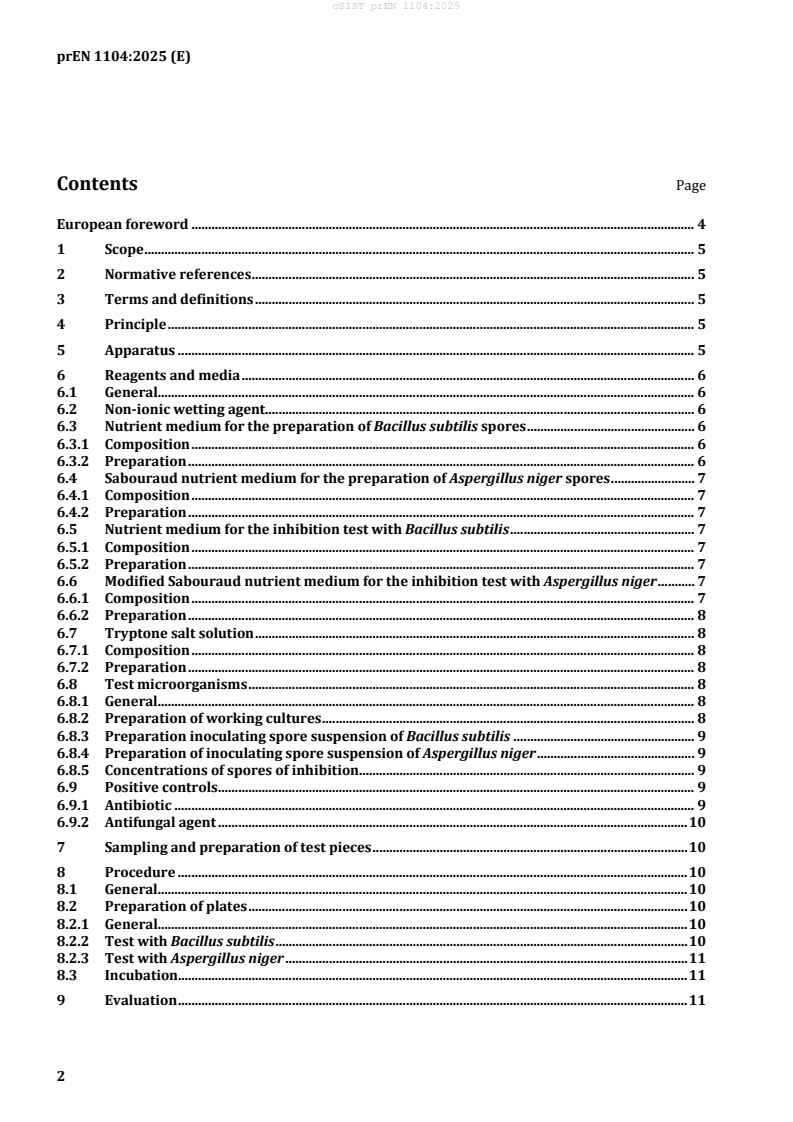
Contents
- 1 Scope
- 2 Normative references
- 3 Terms and definitions
- 3.1 inhibition zone
- 4 Principle
- 5 Apparatus
- 6 Reagents and media
- 6.1 General
- 6.2 Non-ionic wetting agent
- 6.3 Nutrient medium for the preparation of Bacillus subtilis spores
- 6.4 Sabouraud nutrient medium for the preparation of Aspergillus niger spores
- 6.5 Nutrient medium for the inhibition test with Bacillus subtilis
- 6.6 Modified Sabouraud nutrient medium for the inhibition test with Aspergillus niger
- 6.7 Tryptone salt solution
- 6.8 Test microorganisms
- 6.9 Positive controls
- 7 Sampling and preparation of test pieces
- 8 Procedure
- 8.1 General
- 8.2 Preparation of plates
- 8.3 Incubation
- 9 Evaluation
- 10 Test report
- Annex A
1 Scope
This document specifies a test method for the determination of the transfer of antimicrobial constituents from paper and board materials and articles intended for food contact. NOTE The use of this document is determined by legislation pertaining to paper and board intended to come into contact with foodstuffs.
2 Normative references
The following documents are referred to in the text in such a way that some or all of their content constitutes requirements of this document. For dated references, only the edition cited applies. For undated references, the latest edition of the referenced document (including any amendments) applies. EN ISO 186, Paper and board — Sampling to determine average quality (ISO 186) EN ISO 7218, Microbiology of the food chain — General requirements and guidance for microbiological examinations (ISO 7218)
EN ISO 11133 , Microbiology of food, animal feed and water — Preparation, production, storage and performance testing of culture media (ISO 11133)
3 Terms and definitions
For the purposes of this document, the following terms and definitions apply. ISO and IEC maintain terminology databases for use in standardization at the following addresses:
- ISO Online browsing platform: available at https://www.iso.org/obp/
- IEC Electropedia: available at https://www.electropedia.org/
3.1 inhibition zone
obvious area in which growth is absent and which forms around test pieces placed on a nutrient medium inoculated with a preselected test microorganism, due to the release of water-soluble antimicrobial constituents Note 1 to entry: The proof of the presence of an inhibition zone is provided by the absence of test microorganism growth (translucent zone) in a minimum of 2 mm width zone at the edges of the test pieces.
4 Principle
A prepared nutrient medium is mixed with an appropriate inoculum and poured into Petri dishes. The test pieces are placed on the nutrient medium before its complete solidification and incubated. When incubation is terminated, the existence of an inhibition zone is an indicator of the release of antimicrobial constituents.
The test is performed with a bacterium, bacillus subtilis, and with a fungus, aspergillus niger.
5 Apparatus
All laboratory equipment and parts of the equipment, according to EN ISO 7218, shall be used, in addition to the following.
Under revision.
oSIST prEN 1104:2025 prEN 1104:2025 (E) 5.1 Punch iron, with a diameter = 10 mm to 15 mm, sterilizable or aseptic. 5.2 Pressing device, suitable for pressing the test pieces on the agar plates (e.g. Drigalski spatula). 5.3 Zone reading device, allowing the measurement of the width of the inhibition zone.
6 Reagents and media
6.1 General
When water is mentioned in a formula, distilled or purified water shall be used, according to EN ISO 11133.
For preparing culture media, general requirements are described in EN ISO 11133. Culture media shall be prepared as follows, or from commercially available dehydrated culture media according to the manufacturer's instructions. Ready-to-use medium may be used when its composition and/or growth performance is comparable to that of formula given in 6.3 and 6.4 (according to EN ISO 11133).
6.2 Non-ionic wetting agent
For example, polyoxyethylenesorbitane monooleate can be used.
6.3 Nutrient medium for the preparation of Bacillus subtilis spores
6.3.1 Composition
- Beef extract: 3,0 g;
- Peptone from casein: 5,0 g;
- Sodium chloride: 5,0 g;
- Agar-agar: 12,0 g;
- Water: 1,0 l.
NOTE The addition of 10 mg/l MnSO4 to the nutrient medium for Bacillus subtilis will support the formation of spores.
6.3.2 Preparation
Dissolve the components, or a dehydrated ready-to-use medium, in the water by mixing while heating. Dispense one part of the nutrient medium into flasks (for instance 100 ml or 200 ml flasks) for further storage and the other part into test tubes for the preparation of working cultures (for instance 10 ml per tube in 15 to 20 tubes).
Sterilize flasks and test tubes in an autoclave for 15 min at 121 °C. After sterilization, the pH of the medium shall be equivalent to 7,2 ± 0,2 when measured at 45 °C. Before solidification, position the test tubes in such a way that the nutrient medium solidifies with a sloping surface. Medium may be stored according to EN ISO 11133.
oSIST prEN 1104:2025 prEN 1104:2025 (E)
6.4 Sabouraud nutrient medium for the preparation of Aspergillus niger spores
6.4.1 Composition
- Peptone from casein: 5,0 g;
- Meat peptone: 5,0 g;
- D-(+)-glucose C H O ·H O (dextrose): 40,0 g; 6 12 6 2
- Agar-agar: 10,0 g to 15,0 g;
- Water: 1,0 l.
6.4.2 Preparation
Dissolve the components, or a dehydrated ready-to-use medium, in the water by mixing while heating. Proceed as described in 6.3 by dispensing the medium into flasks and test tubes. Sterilize in an autoclave for 15 min at 121 °C. After sterilization, the pH of the medium shall be equivalent to 5,6 ± 0,2, when measured at 25 °C.
Medium may be stored according to EN ISO 11133.
6.5 Nutrient medium for the inhibition test with Bacillus subtilis
6.5.1 Composition
- Peptone from casein: 3,45 g;
- Meat peptone: 3,45 g;
- Sodium chloride: 5,1 g;
- Agar-agar: 13,0 g;
- Water: 1,0 l.
6.5.2 Preparation
Dissolve the components, or a dehydrated ready-to-use medium, in the water by mixing while heating. Dispense the medium into flasks.
Sterilize in an autoclave for 15 min at 121 °C. After sterilization, the pH medium shall be equivalent to 6,0 ± 0,2, when measured at 45 °C.
Cool the flasks to below 60 °C for the preparation of the inoculation medium (8.2.2) or allow to solidify if they have to be stored before use.
Medium may be stored according to EN ISO 11133.
6.6 Modified Sabouraud nutrient medium for the inhibition test with Aspergillus niger
6.6.1 Composition
- Peptone from casein: 5,0 g;
- Meat peptone: 5,0 g;
oSIST prEN 1104:2025 prEN 1104:2025 (E) - D-(+)-glucose C H O ·H O (Dextrose): 10,0 g; 6 12 6 2 - Maltose C H O ·H O: 10,0 g; 12 22 11 2 - Agar-agar: 10,0 g to 15,0 g; - Water: 1,0 l.
6.6.2 Preparation
Dissolve the components, or a dehydrated ready-to-use medium, in the water by mixing while heating. Dispense the medium into flasks.
Sterilize in an autoclave for 15 min at 121 °C. After sterilization, the pH of the medium shall be equivalent to 5,4 ± 0,2, when measured at 45 °C.
Cool the flasks to below 60 °C for the preparation of the inoculation medium (8.2.2) or allow to solidify if they have to be stored before use.
Medium may be stored according to EN ISO 11133.
6.7 Tryptone salt solution
6.7.1 Composition
- Peptone from casein: 1,0 g;
- Sodium chloride: 5,0 g;
- Water: 1,0 l.
6.7.2 Preparation
Dissolve the components in the water by mixing while heating.
Dispense into flasks or test tubes. Sterilize in an autoclave for 15 min at 121 °C. After sterilization, the pH shall be equivalent to 7,0 ± 0,2, when measured at room temperature.
6.8 Test microorganisms
6.8.1 General
The following strains are used:
- Bacillus subtilis subsp. spizizenii DSM 347 (other collection no.: WDCM 00003; ATCC 6633) and
- Aspergillus niger DSM 1957 (other collection no.: WDCM 00144; ATCC 6275).
6.8.2 Preparation of working cultures
Working cultures of Bacillus subtilis are obtained by inoculating the bacterial strain onto the test tubes of nutrient medium (6.3.2) and incubating for 7 days at 30 °C ± 2 °C. After incubation the working cultures are stored at 2 °C to 8 °C.
Working cultures of Aspergillus niger are obtained by inoculating the fungal strain onto the test tubes of nutrient medium (6.4.2) and incubating for 5 days at 25 °C ± 2 °C. After incubation the working cultures are stored at 2 °C to 8 °C.
oSIST prEN 1104:2025 prEN 1104:2025 (E)
6.8.3 Preparation inoculating spore suspension of Bacillus subtilis
Pour nutrient medium (6.3) cooled to approximately 45 °C in 10 sterile Petri dishes (diameter = 90 mm) or in a Roux flask and allow to solidify.
Wash off the colonies of 10 test tubes containing of the working solution of Bacillus subtilis (6.8.2) with 2,0 ml to 3,0 ml of sterile tryptone salt solution (6.7). Spread the washings over the surface of the 10 Petri dishes (each Petri dish is inoculated from a separate tube) or all the washings over the surface of a Roux flask.
Incubate for 7 days at 30 °C. Wash off the colonies from the Petri dishes with 3,0 ml of sterile tryptone salt solution (6.7) or the flask with 30,0 ml of sterile tryptone salt solution (6.7). Bring the suspension into a sterile flask.
Heat the solution with occasional shaking, for 30 min in a water bath at approx. 85 °C to kill the vegetative forms. After heating, transfer the spore suspension to a sterile centrifugating flask of 40,0 ml and centrifuge for 10 min at 10 000 × g. Eliminate the liquid. Wash the residue with 30,0 ml of sterile tryptone salt solution (6.7) and centrifuge again.
...