

EN 12795:2003
(Main)Road transport and traffic telematics - Dedicated Short Range Communication (DSRC) - DSRC data link layer: medium access and logical link control
- Abstract
This European Standard:
- defines the Data Link Layer of DSRC;
- is positioned with respect to other related standards by the layers defined in OSI Basic Reference Model [EN ISO/IEC 7498-1] as adopted for DSRC;
- supports broadcast and half-duplex transmission modes;
- supports a variety of fixed equipment configurations. It supports configurations where one fixed equipment communicates with one mobile equipment unit, as well as configurations where one fixed equipment can communicate with several mobile equipment units;
- takes into account that the mobile equipment communicates with the fixed equipment while passing through a limited communication zone;
- defines neither any specific configuration nor the layout of the communication zone;
- does not define to what extent different instances of fixed equipment, operating in the vicinity of each other, need to be synchronised with each other;
- defines parameters to be used in negotiation procedures taking place between fixed equipment and mobile equipment.
By defining two distinct sublayers, namely the medium access control sublayer and the logical link control sublayer, this standard defines:
a) medium access control procedures for the shared physical medium;
b) addressing rules and conventions;
c) data flow control procedures;
d) acknowledgement procedures;
e) error control procedures;
f) services provided to application layer.
The MAC sublayer is specific to the DSRC. The LLC services offered are unacknowledged and acknowledged connectionless services based on [ISO/IEC 8802-2].
- Status
- Published
- Publication Date
- 11-Mar-2003
- Withdrawal Date
- 29-Sep-2003
- Technical Committee
- CEN/TC 278 - Road transport and traffic telematics
- Drafting Committee
- CEN/TC 278/WG 1 - Electronic fee collection and access control (EFC)
- Current Stage
- 9093 - Decision to confirm - Review Enquiry
- Start Date
- 16-Mar-2026
- Completion Date
- 07-Oct-2026



Overview
EN 12795:2003 (CEN) defines the Data Link Layer for Dedicated Short Range Communication (DSRC) used in road transport and traffic telematics (RTTT). The standard positions the DSRC data link layer within the OSI reference model and specifies the split into two sublayers: the Medium Access Control (MAC) sublayer (DSRC‑specific) and the Logical Link Control (LLC) sublayer (LLC services based on ISO/IEC 8802-2). EN 12795:2003 supports broadcast and half‑duplex transmission modes and defines the addressing, frame format and control procedures needed for reliable short‑range vehicle ↔ roadside communication.
Key topics and technical requirements
- Layer architecture: Data Link Layer divided into MAC and LLC; services provided to the application layer.
- MAC behaviour: DSRC‑specific MAC uses asynchronous TDMA in a half‑duplex, unbalanced scheme where fixed equipment (RSU) controls medium access and grants:
- downlink windows (fixed → mobile),
- private uplink windows (one mobile exclusively),
- public uplink windows (multiple mobiles under rules).
- LLC services: Offers acknowledged and unacknowledged connectionless services following ISO/IEC 8802-2 principles.
- Frame format and error control: Frames include Flag, Link Address field, MAC Control field, LPDU and a 16-bit Frame Check Sequence (FCS) using the CRC polynomial X16+X12+X5+1 (ISO/IEC 3309).
- Addressing rules: Link Identifiers (LID) support private LIDs (multi‑octet), multicast LIDs and broadcast LID; Service Access Points (SAPs) for broadcast, private and multicast services are defined.
- Transparency and bit stuffing: Zero‑bit insertion to prevent flag sequences in payload; LSB-first octet ordering for fields.
- Operational constraints: Designed for short communication zones (vehicles pass through limited coverage); the standard defines negotiation parameter sets but does not mandate communication zone layout or inter‑RSU synchronization.
Applications and users
Who benefits:
- Roadside infrastructure vendors (RSU manufacturers) implementing MAC control and downlink/uplink windows.
- Vehicle onboard unit (OBU) manufacturers integrating DSRC MAC/LLC.
- ITS system integrators and traffic operators deploying tolling, parking, enforcement, access control, or roadside information services.
- Protocol implementers, test houses and conformity assessors validating frame formats, addressing and error control. Practical uses include multi‑application DSRC links that must handle short dwell times, broadcast alerts, and real‑time command/response exchanges between vehicles and roadside units.
Related standards
- EN 12253 - DSRC Physical Layer (5.8 GHz)
- EN 12834 - DSRC Application Layer
- EN 13372 - DSRC Profiles for RTTT Applications
- EN ISO/IEC 7498-1 - OSI Basic Reference Model
- ISO/IEC 8802-2 - Logical Link Control (LLC)
- ISO/IEC 3309 - HDLC frame structure (FCS)
Keywords: EN 12795:2003, DSRC data link layer, MAC, LLC, road transport telematics, DSRC addressing, DSRC frame format, RSU, OBU, ITS.
Relations
- Effective Date
- 28-Jan-2026
- Effective Date
- 28-Jan-2026
- Effective Date
- 28-Jan-2026
- Effective Date
- 28-Jan-2026
- Effective Date
- 28-Jan-2026
- Effective Date
- 28-Jan-2026
- Effective Date
- 28-Jan-2026
Get Certified
Connect with accredited certification bodies for this standard

BSI Group
BSI (British Standards Institution) is the business standards company that helps organizations make excellence a habit.

NYCE
Mexican standards and certification body.
Sponsored listings
Frequently Asked Questions
EN 12795:2003 is a standard published by the European Committee for Standardization (CEN). Its full title is "Road transport and traffic telematics - Dedicated Short Range Communication (DSRC) - DSRC data link layer: medium access and logical link control". This standard covers: This European Standard: - defines the Data Link Layer of DSRC; - is positioned with respect to other related standards by the layers defined in OSI Basic Reference Model [EN ISO/IEC 7498-1] as adopted for DSRC; - supports broadcast and half-duplex transmission modes; - supports a variety of fixed equipment configurations. It supports configurations where one fixed equipment communicates with one mobile equipment unit, as well as configurations where one fixed equipment can communicate with several mobile equipment units; - takes into account that the mobile equipment communicates with the fixed equipment while passing through a limited communication zone; - defines neither any specific configuration nor the layout of the communication zone; - does not define to what extent different instances of fixed equipment, operating in the vicinity of each other, need to be synchronised with each other; - defines parameters to be used in negotiation procedures taking place between fixed equipment and mobile equipment. By defining two distinct sublayers, namely the medium access control sublayer and the logical link control sublayer, this standard defines: a) medium access control procedures for the shared physical medium; b) addressing rules and conventions; c) data flow control procedures; d) acknowledgement procedures; e) error control procedures; f) services provided to application layer. The MAC sublayer is specific to the DSRC. The LLC services offered are unacknowledged and acknowledged connectionless services based on [ISO/IEC 8802-2].
This European Standard: - defines the Data Link Layer of DSRC; - is positioned with respect to other related standards by the layers defined in OSI Basic Reference Model [EN ISO/IEC 7498-1] as adopted for DSRC; - supports broadcast and half-duplex transmission modes; - supports a variety of fixed equipment configurations. It supports configurations where one fixed equipment communicates with one mobile equipment unit, as well as configurations where one fixed equipment can communicate with several mobile equipment units; - takes into account that the mobile equipment communicates with the fixed equipment while passing through a limited communication zone; - defines neither any specific configuration nor the layout of the communication zone; - does not define to what extent different instances of fixed equipment, operating in the vicinity of each other, need to be synchronised with each other; - defines parameters to be used in negotiation procedures taking place between fixed equipment and mobile equipment. By defining two distinct sublayers, namely the medium access control sublayer and the logical link control sublayer, this standard defines: a) medium access control procedures for the shared physical medium; b) addressing rules and conventions; c) data flow control procedures; d) acknowledgement procedures; e) error control procedures; f) services provided to application layer. The MAC sublayer is specific to the DSRC. The LLC services offered are unacknowledged and acknowledged connectionless services based on [ISO/IEC 8802-2].
EN 12795:2003 is classified under the following ICS (International Classification for Standards) categories: 35.100.20 - Data link layer; 35.240.60 - IT applications in transport. The ICS classification helps identify the subject area and facilitates finding related standards.
EN 12795:2003 has the following relationships with other standards: It is inter standard links to EN ISO/IEC 7498-1:1995, CEN/TS 15213-3:2006, EN ISO 14815:2005, CEN/TR 16040:2010, EN 13372:2004, EN 12834:2003, EN 15213-3:2013. Understanding these relationships helps ensure you are using the most current and applicable version of the standard.
EN 12795:2003 is associated with the following European legislation: Standardization Mandates: M/018. When a standard is cited in the Official Journal of the European Union, products manufactured in conformity with it benefit from a presumption of conformity with the essential requirements of the corresponding EU directive or regulation.
EN 12795:2003 is available in PDF format for immediate download after purchase. The document can be added to your cart and obtained through the secure checkout process. Digital delivery ensures instant access to the complete standard document.
Standards Content (Sample)
2003-01.Slovenski inštitut za standardizacijo. Razmnoževanje celote ali delov tega standarda ni dovoljeno.NUDWNHJDTélématique de la circulation et du Transport routier - Communication a courte portée - Couche de liaison de contrôle d'acces au média et de contrôle logique de liaisonRoad transport and traffic telematics - Dedicated Short Range Communication (DSRC) - DSRC data link layer: medium access and logical link control35.240.60Uporabniške rešitve IT v transportu in trgoviniIT applications in transport and trade35.100.20Podatkovni povezovalni slojData link layerICS:Ta slovenski standard je istoveten z:EN 12795:2003SIST EN 12795:2003en01-oktober-2003SIST EN 12795:2003SLOVENSKI
STANDARD
EUROPEAN STANDARDNORME EUROPÉENNEEUROPÄISCHE NORMEN 12795March 2003ICS 35.100.20; 35.240.60Supersedes ENV 12795:1997English versionRoad transport and traffic telematics - Dedicated Short RangeCommunication (DSRC) - DSRC data link layer: medium accessand logical link controlTélématique de la circulation et du Transport routier -Communication à courte portée - Couche de liaison decontrôle d'accès au média et de contrôle logique de liaisonThis European Standard was approved by CEN on 4 December 2002.CEN members are bound to comply with the CEN/CENELEC Internal Regulations which stipulate the conditions for giving this EuropeanStandard the status of a national standard without any alteration. Up-to-date lists and bibliographical references concerning such nationalstandards may be obtained on application to the Management Centre or to any CEN member.This European Standard exists in three official versions (English, French, German). A version in any other language made by translationunder the responsibility of a CEN member into its own language and notified to the Management Centre has the same status as the officialversions.CEN members are the national standards bodies of Austria, Belgium, Czech Republic, Denmark, Finland, France, Germany, Greece,Hungary, Iceland, Ireland, Italy, Luxembourg, Malta, Netherlands, Norway, Portugal, Slovakia, Spain, Sweden, Switzerland and UnitedKingdom.EUROPEAN COMMITTEE FOR STANDARDIZATIONCOMITÉ EUROPÉEN DE NORMALISATIONEUROPÄISCHES KOMITEE FÜR NORMUNGManagement Centre: rue de Stassart, 36
B-1050 Brussels© 2003 CENAll rights of exploitation in any form and by any means reservedworldwide for CEN national Members.Ref. No. EN 12795:2003 ESIST EN 12795:2003
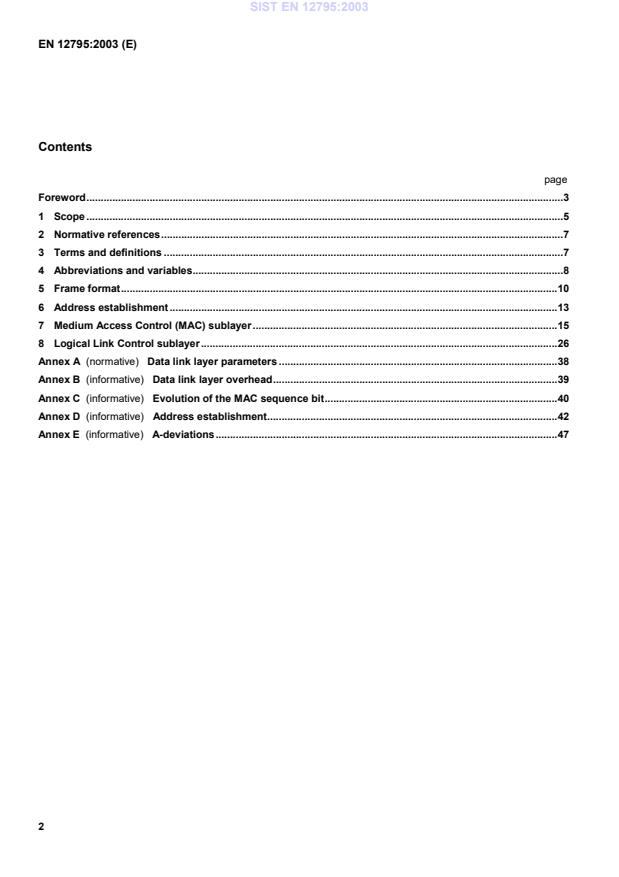
(normative)
Data link layer parameters.38Annex B
(informative)
Data link layer overhead.39Annex C
(informative)
Evolution of the MAC sequence bit.40Annex D
(informative)
Address establishment.42Annex E
(informative)
A-deviations.47SIST EN 12795:2003
The allocation may be a private uplink window or N5 public uplink windowsC/RThe LLC Command/Response bit shall be used to identify the LPDU as command orresponse. The LLC Command/Response bit shall be ignored if the LPDU Existence bit isset to 0. (For the use of the C/R bit see 8.3.1)0 = command LPDU1 = response LPDUSThe MAC Sequence bit shall be used to distinguish between first allocation of a privateuplink window and reallocation of a private uplink window. (see 7.4.2)XReserved, shall be set to 0.SIST EN 12795:2003
private uplink window
¾®preamblestart flag.end flaglayer 2 framemax. length of private uplink windowSIST EN 12795:2003
...