


prEN 13364
(Main)Natural stone test methods - Determination of the breaking load at dowel hole and slot-and-blade system
General Information
- Abstract
This document specifies a test method to determine the breaking load for two fixing methods available for natural stones used for cladding or lining in building. These two methods refer to:
a) dowel-hole, and
b) slot-blade fixing.
- Status
- Not Published
- Publication Date
- 30-Nov-2025
- Technical Committee
- CEN/TC 246 - Natural stones
- Drafting Committee
- CEN/TC 246/WG 2 - Test methods
- Current Stage
- 4098 - Decision to abandon - Enquiry
- Start Date
- 07-Jul-2025
- Completion Date
- 23-Sep-2026

Overview
The prEN 13364 standard, developed by CEN, specifies test methods for natural stone used in building facades, focusing on determining the breaking load at two common fixing systems: the dowel-hole and the slot-and-blade systems. These fixing methods are critical for the durability and safety of natural stone cladding or lining. This standard updates and supersedes EN 13364:2001, incorporating new testing procedures, particularly for the slot-blade system, and aligns with other natural stone testing standards.
The document offers practical guidelines on preparing test specimens, specifying apparatus, conducting tests, and reporting results, ensuring consistency and reliability in evaluating stone strength. It aims to support architects, engineers, stone manufacturers, and testing laboratories involved in quality control and installation.
Key Topics
Testing Methods
- Dowel-hole Method: Applying force perpendicular to a speciment face with a dowel positioned in a drilled hole.
- Slot-blade Method: Applying force via a metallic profile inserted in a slot on the stone edge.
Specimen Preparation
- Size and dimensional tolerances for specimens based on stone thickness and type of test (identification versus technological).
- Orientation relative to planes of anisotropy or bedding, when present, affecting breakage behavior.
- Surface finish options depending on application are defined, such as sawn, honed, polished, sanded, or flamed.
Apparatus and Conditions
- Specific equipment for drilling, cutting, load application, and measurement accuracy.
- Testing environment controlled to 20 ± 5 °C for consistency.
Test Procedures and Measurements
- Details on how to apply loads, clamp specimens, and record breaking loads in newtons.
- Definitions of essential parameters such as thickness, slot depth, hole diameter, and distances related to fracture edges.
- Statistical evaluation of results as specified in normative Annex A.
Break Load Determination
- Measurement of maximum force before stone failure in different load directions relative to anisotropy.
- Evaluation applies to natural stone cladding elements fixed by dowel or slot mechanisms, directly relevant to construction practice.
Applications
Building Facades and Cladding
The standard provides essential procedures to assess the mechanical integrity of natural stones used in external facades, ensuring safety in stone retention systems.Quality Control and Certification
Stone producers and testing laboratories utilize these methods to certify compliance with international safety and performance standards.Material Selection
Structural engineers and architects can assess natural stone properties for specific architectural details, especially where mechanical fixing systems are involved.Research and Development
The standard supports innovation in fastening solutions and surface finishing techniques by providing baseline mechanical strength data.Installation Guidelines
Contractors and facade installers benefit from standardized test results to guide fixing methods for natural stone, reducing failure risks during and after installation.
Related Standards
- EN 1925 – Water absorption coefficient by capillarity for natural stones
- EN 1926 – Uniaxial compressive strength determination
- EN 12372 – Flexural strength under concentrated load
- EN 12407 – Petrographic examination of natural stone
- EN 13919 – Resistance to ageing under SO2 action with humidity
- EN 14066 – Thermal shock resistance of natural stones
- Other natural stone test methods focusing on density, frost resistance, slip resistance, and hardness
The prEN 13364 standard functions as part of this comprehensive suite of standards developed by CEN/TC 246 to ensure consistent evaluation and reliable performance assessment of mineral building materials.
Keywords: prEN 13364, natural stone test methods, breaking load determination, dowel-hole fixing, slot-blade fixing, stone cladding, mineral materials, building facade, CEN standard, stone testing, mechanical strength, anisotropy, construction safety, stone fastening systems.
Relations
- Revises
EN 13364:2001 - Natural stone test methods - Determination of the breaking load at dowel hole - Effective Date
- 06-Sep-2023
Get Certified
Connect with accredited certification bodies for this standard

DIBt (Deutsches Institut für Bautechnik)
German Institute for Building Technology.
DIN CERTCO
DIN Group product certification.

Aboma Certification B.V.
Specialized in construction, metal, and transport sectors.
Sponsored listings
Frequently Asked Questions
prEN 13364 is a draft published by the European Committee for Standardization (CEN). Its full title is "Natural stone test methods - Determination of the breaking load at dowel hole and slot-and-blade system". This standard covers: This document specifies a test method to determine the breaking load for two fixing methods available for natural stones used for cladding or lining in building. These two methods refer to: a) dowel-hole, and b) slot-blade fixing.
This document specifies a test method to determine the breaking load for two fixing methods available for natural stones used for cladding or lining in building. These two methods refer to: a) dowel-hole, and b) slot-blade fixing.
prEN 13364 is classified under the following ICS (International Classification for Standards) categories: 73.020 - Mining and quarrying; 91.100.15 - Mineral materials and products. The ICS classification helps identify the subject area and facilitates finding related standards.
prEN 13364 has the following relationships with other standards: It is inter standard links to EN 13364:2001. Understanding these relationships helps ensure you are using the most current and applicable version of the standard.
prEN 13364 is available in PDF format for immediate download after purchase. The document can be added to your cart and obtained through the secure checkout process. Digital delivery ensures instant access to the complete standard document.
Standards Content (Sample)
SLOVENSKI STANDARD
01-februar-2025
Preskušanje naravnega kamna – Ugotavljanje lomne obremenitve ob sidrni izvrtini
in sistemu z režo in rezilom
Natural stone test methods - Determination of the breaking load at dowel hole and slot-
and-blade system
Prüfung von Naturstein - Bestimmung der Ausbruchlast am Ankerdornloch
Méthodes d’essai pour pierre naturelle - Détermination de l’effort de rupture au niveau du
trou de goujon et du système rainure-équerre
Ta slovenski standard je istoveten z: prEN 13364
ICS:
73.020 Rudarstvo in kamnolomsko Mining and quarrying
izkopavanje
91.100.15 Mineralni materiali in izdelki Mineral materials and
products
2003-01.Slovenski inštitut za standardizacijo. Razmnoževanje celote ali delov tega standarda ni dovoljeno.
DRAFT
EUROPEAN STANDARD
NORME EUROPÉENNE
EUROPÄISCHE NORM
November 2024
ICS 73.020; 91.100.15 Will supersede EN 13364:2001
English Version
Natural stone test methods - Determination of the
breaking load at dowel hole and slot-and-blade system
Méthodes d'essai pour pierre naturelle - Détermination Prüfung von Naturstein - Bestimmung der
de l'effort de rupture au niveau du trou de goujon et du Ausbruchlast am Ankerdornloch
système rainure-équerre
This draft European Standard is submitted to CEN members for enquiry. It has been drawn up by the Technical Committee
CEN/TC 246.
If this draft becomes a European Standard, CEN members are bound to comply with the CEN/CENELEC Internal Regulations
which stipulate the conditions for giving this European Standard the status of a national standard without any alteration.
This draft European Standard was established by CEN in three official versions (English, French, German). A version in any other
language made by translation under the responsibility of a CEN member into its own language and notified to the CEN-CENELEC
Management Centre has the same status as the official versions.
CEN members are the national standards bodies of Austria, Belgium, Bulgaria, Croatia, Cyprus, Czech Republic, Denmark, Estonia,
Finland, France, Germany, Greece, Hungary, Iceland, Ireland, Italy, Latvia, Lithuania, Luxembourg, Malta, Netherlands, Norway,
Poland, Portugal, Republic of North Macedonia, Romania, Serbia, Slovakia, Slovenia, Spain, Sweden, Switzerland, Türkiye and
United Kingdom.
Recipients of this draft are invited to submit, with their comments, notification of any relevant patent rights of which they are
aware and to provide supporting documentation.
Warning : This document is not a European Standard. It is distributed for review and comments. It is subject to change without
notice and shall not be referred to as a European Standard.
EUROPEAN COMMITTEE FOR STANDARDIZATION
COMITÉ EUROPÉEN DE NORMALISATION
EUROPÄISCHES KOMITEE FÜR NORMUNG
CEN-CENELEC Management Centre: Rue de la Science 23, B-1040 Brussels
© 2024 CEN All rights of exploitation in any form and by any means reserved Ref. No. prEN 13364:2024 E
worldwide for CEN national Members.
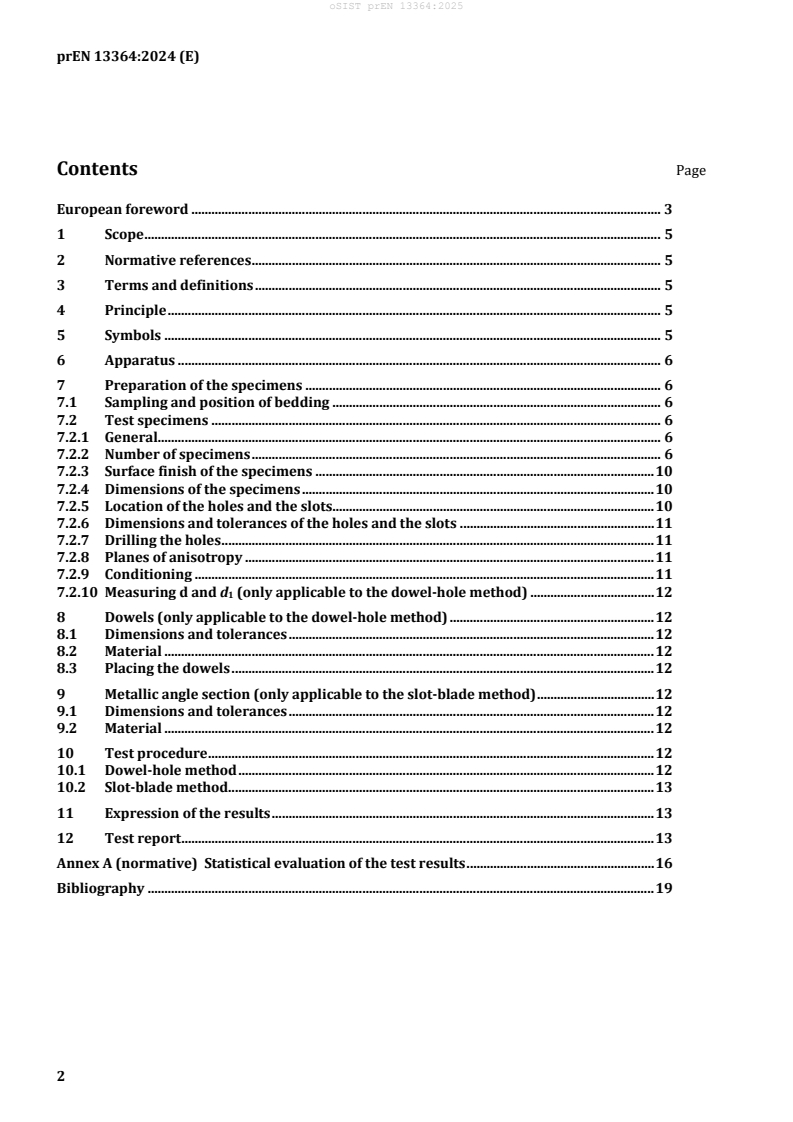
Contents Page
European foreword . 3
1 Scope . 5
2 Normative references . 5
3 Terms and definitions . 5
4 Principle . 5
5 Symbols . 5
6 Apparatus . 6
7 Preparation of the specimens . 6
7.1 Sampling and position of bedding . 6
7.2 Test specimens . 6
7.2.1 General. 6
7.2.2 Number of specimens . 6
7.2.3 Surface finish of the specimens . 10
7.2.4 Dimensions of the specimens . 10
7.2.5 Location of the holes and the slots. 10
7.2.6 Dimensions and tolerances of the holes and the slots . 11
7.2.7 Drilling the holes . 11
7.2.8 Planes of anisotropy . 11
7.2.9 Conditioning . 11
7.2.10 Measuring d and d (only applicable to the dowel-hole method) . 12
8 Dowels (only applicable to the dowel-hole method) . 12
8.1 Dimensions and tolerances . 12
8.2 Material . 12
8.3 Placing the dowels . 12
9 Metallic angle section (only applicable to the slot-blade method) . 12
9.1 Dimensions and tolerances . 12
9.2 Material . 12
10 Test procedure . 12
10.1 Dowel-hole method . 12
10.2 Slot-blade method . 13
11 Expression of the results . 13
12 Test report . 13
Annex A (normative) Statistical evaluation of the test results . 16
Bibliography . 19
European foreword
This document (prEN 13364:2024) has been prepared by Technical Committee CEN/TC 246 “Natural
Stone”, the secretariat of which is held by UNI.
This document is currently submitted to the CEN Enquiry.
This document will supersede EN 13364:2001.
— A complementary experimental method is integrated and concerns the slot-blade fixing system.
This document is one of the series of standards for tests on natural stone.
Test methods for natural stone consist of the following parts:
— EN 1925, Natural stone test methods — Determination of water absorption coefficient by capillarity
— EN 1926, Natural stone test methods — Determination of uniaxial compressive strength
— EN 1936, Natural stone test methods — Determination of real density and apparent density and of total
open porosity
— EN 12371, Natural stone test methods — Determination of frost resistance
— EN 12372, Natural stone test methods — Determination of flexural strength under concentrated load
— EN 12407, Natural stone test methods — Petrographic examination
— EN 13161, Natural stone test methods — Determination of flexural strength under constant moment
— EN 13373, Natural stone test methods — Determination of geometric characteristics on units
— EN 13755, Natural stone test methods — Determination of water absorption at atmospheric pressure
— EN 13919, Natural stone test methods — Determination of resistance to ageing by SO action in the
presence of humidity
— EN 14066, Natural stone test methods — Determination of thermal shock resistance
— EN 14158, Natural stone test methods — Determination of rupture energy
— EN 14205, Natural stone test methods — Determination of Knoop hardness
— EN 14231, Natural stone test methods — Determination of slip resistance by means of the pendulum
tester
— EN 14579, Natural stone test methods — Determination of sound speed propagation
— EN 14580, Natural stone test methods — Determination of static elastic modulus
— EN 14581, Natural stone test methods — Determination of linear thermal expansion coefficient
It is intended that other ENs call up this EN 13364 as the basis of evaluation of conformity. (Nevertheless,
it is not intended that all-natural stones products be subjected regularly to all the listed tests.
Specifications in other standards can call up only relevant test methods).
This document has an Annex A (normative).
1 Scope
This document specifies a test method to determine the breaking load for two fixing methods available
for natural stones used for cladding or lining in building. These two methods refer to:
a) dowel-hole, and
b) slot-blade fixing.
2 Normative references
The following documents are referred to in the text in such a way that some or all of their content
constitutes requirements of this document. For dated references, only the edition cited applies. For
undated references, the latest edition of the referenced document (including any amendments) applies.
EN 197-1, Cement - Part 1: Composition, specifications and conformity criteria for common cements
EN 10088-1, Stainless steels - Part 1: List of stainless steels
EN 12390-4, Testing hardened concrete - Part 4: Compressive strength - Specification for testing machines
3 Terms and definitions
No terms and definitions are listed in this document.
4 Principle
This test consists of applying a force in a direction perpendicular to the face of a specimen through:
i) a dowel previously placed in a hole drilled in one of its sides or;
ii) a metallic profile placed in a slot located in one of its sides and measuring the breaking load of the
specimen.
5 Symbols
d is the thickness of the test specimen, in millimetres;
p is the depth of the slot located in the test specimen, in millimetres;
s is the thickness of the slot located in the test specimen, in millimetres;
e is defined as [d/2 - s], in millimetres;
d is the distance from the hole wall to the face where fracture occurs, in millimetres;
bA is the maximum distance of the centre of the hole to the fracture edge on the face, in
millimetres;
F is the individual breaking load, in newtons;
is the mean value of d, in millimetres;
d
is the mean value of F, in newtons;
F
is the mean value of bA, in millimetres.
bA
6 Apparatus
6.1 A balance, capable of weighing the specimens with an accuracy of 0,01 % of their mass.
6.2 ventilated oven, capable of maintaining a temperature of (70 ± 5) °C.
6.3 A linear measuring device, with an accuracy of 0,05 mm.
6.4 A rotary drilling machine, equipped with a diamond or tungsten carbide tipped bit.
6.5 A cutting device, allowing the creation of the adequate slot.
6.6 A testing machine of appropriate force in accordance with EN 12390-4 and calibrated according
to this document.
6.7 A clamping device, consisting of two metal plates having the shape and sizes shown in Figure 1.
6.8 A device for applying loads, perpendicular to the axis of the dowel (see Figure 2) or the slot
(see Figure 3).
6.9 A non-deformable metallic corner, used to transmit the force (only applicable to the slot-blade
method (see Figure 3).
6.10 A room or chamber in which the temperature of the air can be maintained at (20 ± 5) °C.
7 Preparation of the specimens
7.1 Sampling and position of bedding
The sampling is not the responsibility of the test laboratory except where specially requested.
The position of any bedding or anisotropy shall be indicated on each specimen by means of at least two
parallel lines.
7.2 Test specimens
7.2.1 General
The test can be carried out as an identification test or as a technological test.
Identification tests are tests carried out when the use of the stone with respect to the position of the
planes of anisotropy and the thickness and surface finish of the elements in the cladding are not known.
Technological tests are those carried out when the use of the stone with respect to the position of the
planes of anisotropy and the thickness and surface finish of the elements in the cladding are known. In
this case the major faces of the specimens shall have the same orientation of the face that will be loaded
during use.
7.2.2 Number of specimens
The minimum number
...