

EN 3884:2001
(Main)Aerospace series - Heat resisting alloy NI-WH2601 (NiCr19Nb5Mo3Ti) - Filler metal for welding
- Abstract
This standard specifies the requirements relating to:
Heat resisting alloy NI-WH2601 (NiCr19Nb5Mo3Ti)
Filler metal for welding
for aerospace application.
- Status
- Published
- Publication Date
- 19-Jun-2001
- Withdrawal Date
- 30-Dec-2001
- Technical Committee
- ASD-STAN - Aerospace
- Drafting Committee
- ASD-STAN/D 4 - Metallic
- Current Stage
- 9093 - Decision to confirm - Review Enquiry
- Start Date
- 01-Jun-2017
- Completion Date
- 07-Oct-2026


Overview
EN 3884:2001 is a European standard developed by CEN that specifies the requirements for the aerospace-grade heat resisting alloy NI-WH2601 (NiCr19Nb5Mo3Ti) used as filler metal for welding. This standard ensures consistent quality and performance of the welding filler metal suitable for high-temperature aerospace applications. NI-WH2601 is a nickel-based alloy designed for excellent heat resistance, mechanical strength, and corrosion resistance, essential characteristics for aerospace components subjected to extreme conditions.
The standard is part of the broader aerospace series of metallic material standards and is aligned with other EN standards to provide a uniform framework for material specification, production, and testing across the aerospace sector.
Key Topics
- Material Composition: Defines the chemical composition limits of the NI-WH2601 alloy, including elements such as nickel, chromium, niobium, molybdenum, and titanium, which contribute to heat resistance and mechanical strength.
- Production Methods: Specifies vacuum melting and consumable electrode remelting for the alloy, ensuring high purity and homogeneity.
- Form and Delivery: Covers filler wire and filler rods produced through cold drawing, delivered in a cold drawn and annealed state to optimize welding performance.
- Specifications: Details dimensional limits, heat treatment procedures, and delivery condition codes relevant to the filler metal.
- Testing and Quality Control: References normative documents including EN 3879 and EN 2043 for general welding filler metal specifications, semi-finished product qualifications, and batch uniformity checks.
- Mechanical Properties: Addresses proof stress, tensile strength, elongation, hardness, and other mechanical requirements ensuring the filler metal’s fitness for aerospace welding applications.
Applications
EN 3884:2001 applies primarily to aerospace manufacturing and repair, where heat resisting filler metals are critical for welding high-temperature and corrosion-resistant components. Practical applications include:
- Welding of aerospace engine parts, turbine components, and exhaust systems exposed to extreme temperatures.
- Joining heat-resistant components in aircraft and spacecraft requiring durable and reliable welds.
- Maintenance and overhaul operations demanding standardized filler metal quality to ensure continued airworthiness.
- Fabrication of critical aerospace structures where consistent mechanical and thermal properties determine safety and performance.
The standard ensures that users procure filler metals that meet stringent aerospace quality requirements, enabling superior joint strength, heat endurance, and longevity in demanding operational environments.
Related Standards
EN 3884:2001 is part of an integrated standards family for aerospace metallic materials and welding consumables. Related standards include:
- EN 3879 - Aerospace series: Metallic materials - Filler metals for welding - Technical specifications. Complements EN 3884 regarding filler metal quality and testing protocols.
- EN 2043 - Aerospace series: Metallic materials - General requirements for semi-finished product qualification (excluding forgings and castings). Provides qualification procedures relevant to materials covered by EN 3884.
- EN 4258 - Aerospace series: Metallic materials - General organization of standardization - offers guidance on the structure and use of aerospace material standards.
- EN 4500-3 - Aerospace series: Rules for drafting and presentation of material standards - specific to heat resisting alloys, ensuring consistent documentation.
These standards form a cohesive framework supporting the aerospace industry in achieving quality control, safety, and interoperability in welding consumables and high-performance alloys.
Keywords: EN 3884:2001, heat resisting alloy, NI-WH2601, NiCr19Nb5Mo3Ti, aerospace welding filler metal, heat resistant welding wire, aerospace material standards, filler metal for aerospace, welding consumables, aerospace alloy specification, high-temperature welding alloy.
Relations
- Effective Date
- 28-Jan-2026
- Effective Date
- 28-Jan-2026
- Referred By
EN 4877-002:2023 - Aerospace series - Filler metals for welding - Part 002: Authorized filler metals - Effective Date
- 28-Jan-2026
- Effective Date
- 28-Jan-2026
Get Certified
Connect with accredited certification bodies for this standard

BUREAU VERITAS Certification Germany
Bureau Veritas certification in Germany.

Element Materials Technology
Materials testing and product certification.

AQMS Ltd.
AQMS provides ISO certification to SMEs across the UK.
Sponsored listings
Frequently Asked Questions
EN 3884:2001 is a standard published by the European Committee for Standardization (CEN). Its full title is "Aerospace series - Heat resisting alloy NI-WH2601 (NiCr19Nb5Mo3Ti) - Filler metal for welding". This standard covers: This standard specifies the requirements relating to: Heat resisting alloy NI-WH2601 (NiCr19Nb5Mo3Ti) Filler metal for welding for aerospace application.
This standard specifies the requirements relating to: Heat resisting alloy NI-WH2601 (NiCr19Nb5Mo3Ti) Filler metal for welding for aerospace application.
EN 3884:2001 is classified under the following ICS (International Classification for Standards) categories: 49.025.15 - Non-ferrous alloys in general. The ICS classification helps identify the subject area and facilitates finding related standards.
EN 3884:2001 has the following relationships with other standards: It is inter standard links to EN 4258:2024, EN 4632-005:2009, EN 4877-002:2023, EN ISO 19225:2017. Understanding these relationships helps ensure you are using the most current and applicable version of the standard.
EN 3884:2001 is available in PDF format for immediate download after purchase. The document can be added to your cart and obtained through the secure checkout process. Digital delivery ensures instant access to the complete standard document.
Standards Content (Sample)
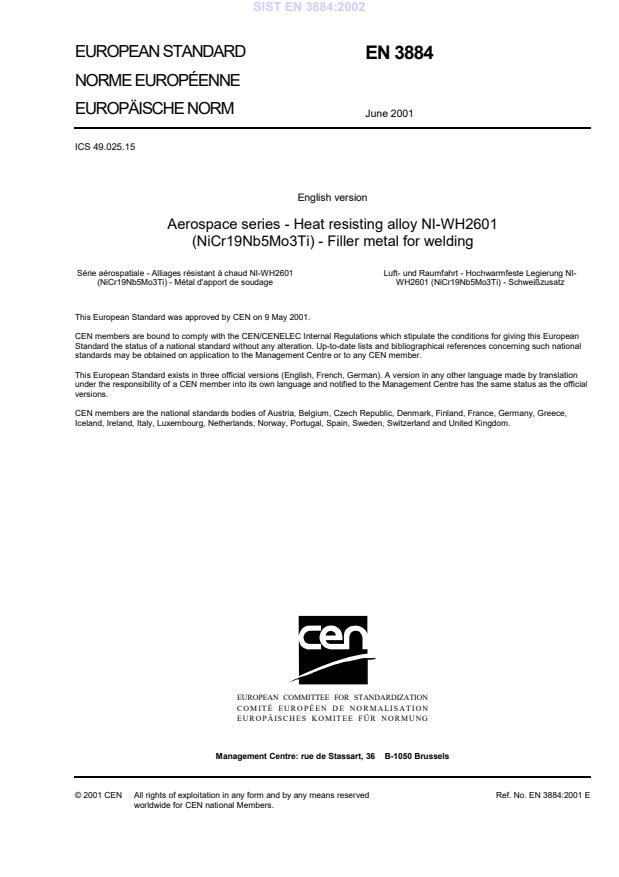
2003-01.Slovenski inštitut za standardizacijo. Razmnoževanje celote ali delov tega standarda ni dovoljeno.Aerospace series - Heat resisting alloy NI-WH2601 (NiCr19Nb5Mo3Ti) - Filler metal for weldingLuft- und Raumfahrt - Hochwarmfeste Legierung NI-WH2601 (NiCr19Nb5Mo3Ti) SchweißzusatzSérie aérospatiale - Alliage résistant a chaud NI-WH2601 (NiCr19Nb5Mo3Ti) - Métal d'apport de soudageAerospace series - Heat resisting alloy NI-WH2601 (NiCr19Nb5Mo3Ti) - Filler metal for welding49.025.15Neželezove zlitine na splošnoNon-ferrous alloys in generalICS:Ta slovenski standard je istoveten z:EN 3884:2001SIST EN 3884:2002en01-januar-2002SIST EN 3884:2002SLOVENSKI
STANDARD
EUROPEAN STANDARDNORME EUROPÉENNEEUROPÄISCHE NORMEN 3884June 2001ICS 49.025.15English versionAerospace series - Heat resisting alloy NI-WH2601(NiCr19Nb5Mo3Ti) - Filler metal for weldingSérie aérospatiale - Alliages résistant à chaud NI-WH2601(NiCr19Nb5Mo3Ti) - Métal d'apport de soudageLuft- und Raumfahrt - Hochwarmfeste Legierung NI-WH2601 (NiCr19Nb5Mo3Ti) - SchweißzusatzThis European Standard was approved by CEN on 9 May 2001.CEN members are bound to comply with the CEN/CENELEC Internal Regulations which stipulate the conditions for giving this EuropeanStandard the status of a national standard without any alteration. Up-to-date lists and bibliographical references concerning such nationalstandards may be obtained on application to the Management Centre or to any CEN member.This European Standard exists in three official versions (English, French, German). A version in any other language made by translationunder the responsibility of a CEN member into its own language and notified to the Management Centre has the same status as the officialversions.CEN members are the national standards bodies of Austria, Belgium, Czech Republic, Denmark, Finland, France, Germany, Greece,Iceland, Ireland, Italy, Luxembourg, Netherlands, Norway, Portugal, Spain, Sweden, Switzerland and United Kingdom.EUROPEAN COMMITTEE FOR STANDARDIZATIONCOMITÉ EUROPÉEN DE NORMALISATIONEUROPÄISCHES KOMITEE FÜR NORMUNGManagement Centre: rue de Stassart, 36
B-1050 Brussels© 2001 CENAll rights of exploitation in any form and by any means reservedworldwide for CEN national Members.Ref. No. EN 3884:2001 ESIST EN 3884:2002
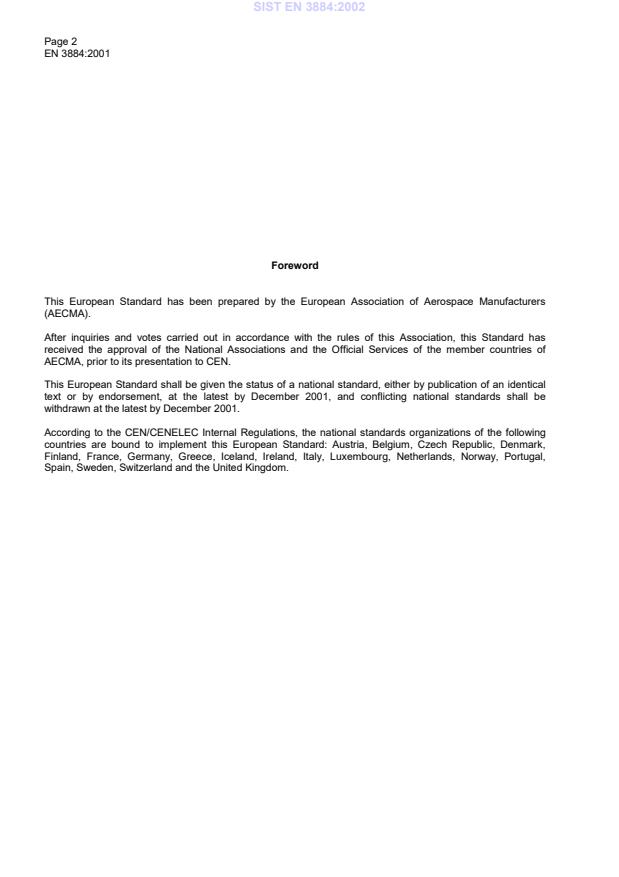
Page 2EN 3884:2001ForewordThis European Standard has been prepared by the European Association of Aerospace Manufacturers(AECMA).After inquiries and votes carried out in accordance with the rules of this Association, this Standard hasreceived the approval of the National Associations and the Official Services of the member countries ofAECMA, prior to its presentation to CEN.This European Standard shall be given the status of a national standard, either by publication of an identicaltext or by endorsement, at the latest by December 2001, and conflicting national standards shall bewithdrawn at the latest by December 2001.According to the CEN/CENELEC Internal Regulations, the national standards organizations of the followingcountries are bound to implement this European Standard: Austria, Belgium, Czech Republic, Denmark
...