

EN 16790:2016
(Main)Conservation of cultural heritage - Integrated pest management (IPM) for protection of cultural heritage
- Abstract
This European Standard defines Integrated Pest Management (IPM) and describes a comprehensive methodology for managing pest problems for protection of cultural heritage.
This European Standard applies to objects and buildings, housing collections, such as museums, archives, libraries, historic houses and buildings, places of worship, art dealers and auction rooms, art transport and storage companies.
This European Standard does not apply to caves, gardens, and parks.
- Status
- Published
- Publication Date
- 21-Jun-2016
- Technical Committee
- CEN/TC 346 - Conservation of cultural property
- Drafting Committee
- WG 19 - Management and protection of collections
- Current Stage
- 9093 - Decision to confirm - Review Enquiry
- Start Date
- 23-May-2022
- Completion Date
- 14-Oct-2026

EN 16790:2016 - Overview
EN 16790:2016, published by CEN, defines Integrated Pest Management (IPM) specifically for the conservation of cultural heritage. The standard provides a comprehensive, management‑level methodology for preventing, monitoring and responding to pest infestations and contaminations that threaten objects and buildings housing collections. It applies to museums, archives, libraries, historic houses, places of worship, art dealers, auction rooms, and art transport/storage companies. It does not apply to caves, gardens or parks.
Key topics and technical requirements
EN 16790 lays out IPM as a long‑term, holistic strategy emphasizing prevention and reduced use of biocidal treatments. Major technical topics include:
- IPM policy and governance
- Establishing an IPM policy and assigning an IPM coordinator with defined roles and responsibilities.
- Training, education and health & safety considerations for staff.
- Risk assessment and preventive measures
- Assessing material vulnerability, building and outdoor environment risks.
- Blocking pest access, controlling indoor environmental conditions, and improving housekeeping and maintenance.
- Operational procedures
- Inspection regimes, monitoring systems (traps/records), and quarantine procedures for incoming/outgoing objects.
- Procedures for detection, diagnosis and categorizing infestation vs contamination.
- Response and recovery
- Decision pathways for remedial action prioritizing non‑toxic methods, and guidance for treatments (e.g., low/high temperature, anoxia/controlled atmospheres, radiation, regulated biocidal products).
- Post‑treatment recovery, evaluation and documentation.
- Documentation
- Record‑keeping templates, inspection checklists and policy examples (included in informative annexes).
- Annexes
- Practical guidance on pests (insects, rodents, fungi, bacteria, photosynthetic organisms), inspection checklists, and treatment options.
The standard also notes the need to comply with European and national legislation regarding biocidal products, protected species, and health & safety.
Applications and who should use it
EN 16790 is essential for professionals responsible for preventive conservation and collection care, including:
- Museum conservators and collection managers
- Archivists, librarians and historic house custodians
- Facilities managers and pest control coordinators in cultural institutions
- Art transport, packing, storage and auction houses
- Heritage consultants and risk assessors
Benefits include reduced collection damage, lower long‑term treatment costs, better compliance with regulation, and safer working environments.
Related standards
- EN 15898 - Conservation of cultural property: main general terms and definitions (normative reference in EN 16790)
- Prepared by CEN/TC 346 (Conservation of Cultural Heritage)
Adopting EN 16790 supports a structured, auditable IPM program that prioritizes preventive conservation and minimizes chemical interventions while protecting cultural heritage assets.
Relations
- Effective Date
- 28-Jan-2026
- Effective Date
- 28-Jan-2026
Frequently Asked Questions
EN 16790:2016 is a standard published by the European Committee for Standardization (CEN). Its full title is "Conservation of cultural heritage - Integrated pest management (IPM) for protection of cultural heritage". This standard covers: This European Standard defines Integrated Pest Management (IPM) and describes a comprehensive methodology for managing pest problems for protection of cultural heritage. This European Standard applies to objects and buildings, housing collections, such as museums, archives, libraries, historic houses and buildings, places of worship, art dealers and auction rooms, art transport and storage companies. This European Standard does not apply to caves, gardens, and parks.
This European Standard defines Integrated Pest Management (IPM) and describes a comprehensive methodology for managing pest problems for protection of cultural heritage. This European Standard applies to objects and buildings, housing collections, such as museums, archives, libraries, historic houses and buildings, places of worship, art dealers and auction rooms, art transport and storage companies. This European Standard does not apply to caves, gardens, and parks.
EN 16790:2016 is classified under the following ICS (International Classification for Standards) categories: 97.195 - Items of art and handicrafts. Cultural property and heritage. The ICS classification helps identify the subject area and facilitates finding related standards.
EN 16790:2016 has the following relationships with other standards: It is inter standard links to EN 15898:2019, EN 17820:2023. Understanding these relationships helps ensure you are using the most current and applicable version of the standard.
EN 16790:2016 is available in PDF format for immediate download after purchase. The document can be added to your cart and obtained through the secure checkout process. Digital delivery ensures instant access to the complete standard document.
Standards Content (Sample)
2003-01.Slovenski inštitut za standardizacijo. Razmnoževanje celote ali delov tega standarda ni dovoljeno.Erhaltung des kulturellen Erbes - Integrierte Schädlingsbekämpfung zum Schutz des kulturellen ErbesConservation du patrimoine culturel - Gestion de lutte intégrée contre les nuisibles (IPM) pour la protection du patrimoine culturelConservation of cultural heritage - Integrated pest management (IPM) for protection of cultural heritage97.195GHGLãþLQDItems of art and handicrafts. Cultural property and heritageICS:Ta slovenski standard je istoveten z:EN 16790:2016SIST EN 16790:2016en,fr,de01-september-2016SIST EN 16790:2016SLOVENSKI
STANDARD
EUROPEAN STANDARD NORME EUROPÉENNE EUROPÄISCHE NORM
EN 16790
June
t r s x ICS
{ yä s { w English Version
Conservation of cultural heritage æ Integrated pest Conservation du patrimoine culturel æ Gestion intégrée culturel
Erhaltung des kulturellen Erbes æ Integrierte kulturellen Erbes This European Standard was approved by CEN on
w May
t r s xä
egulations which stipulate the conditions for giving this European Standard the status of a national standard without any alterationä Upætoædate lists and bibliographical references concerning such national standards may be obtained on application to the CENæCENELEC Management Centre or to any CEN memberä
translation under the responsibility of a CEN member into its own language and notified to the CENæCENELEC Management Centre has the same status as the official versionsä
CEN members are the national standards bodies of Austriaá Belgiumá Bulgariaá Croatiaá Cyprusá Czech Republicá Denmarká Estoniaá Finlandá Former Yugoslav Republic of Macedoniaá Franceá Germanyá Greeceá Hungaryá Icelandá Irelandá Italyá Latviaá Lithuaniaá Luxembourgá Maltaá Netherlandsá Norwayá Polandá Portugalá Romaniaá Slovakiaá Sloveniaá Spainá Swedená Switzerlandá Turkey andUnited Kingdomä
EUROPEAN COMMITTEE FOR STANDARDIZATION COMITÉ EUROPÉEN DE NORMALISATION EUROPÄISCHES KOMITEE FÜR NORMUNG
CEN-CENELEC Management Centre:
Avenue Marnix 17,
B-1000 Brussels
t r s x CEN All rights of exploitation in any form and by any means reserved worldwide for CEN national Membersä Refä Noä EN
s x y { rã t r s x ESIST EN 16790:2016
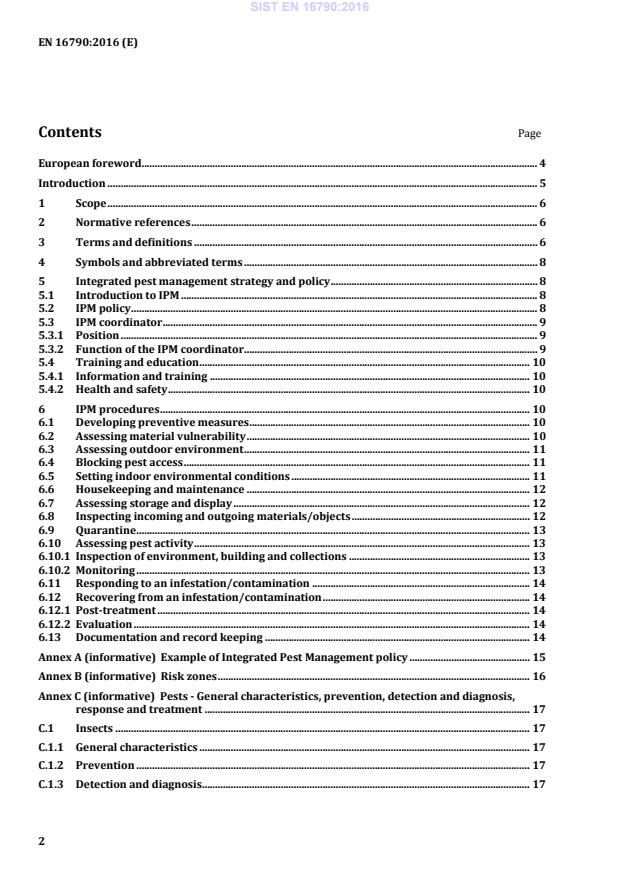
Page European foreword . 4 Introduction . 5 1 Scope . 6 2 Normative references . 6 3 Terms and definitions . 6 4 Symbols and abbreviated terms . 8 5 Integrated pest management strategy and policy . 8 5.1 Introduction to IPM . 8 5.2 IPM policy . 8 5.3 IPM coordinator . 9 5.3.1 Position . 9 5.3.2 Function of the IPM coordinator . 9 5.4 Training and education . 10 5.4.1 Information and training . 10 5.4.2 Health and safety . 10 6 IPM procedures . 10 6.1 Developing preventive measures . 10 6.2 Assessing material vulnerability . 10 6.3 Assessing outdoor environment . 11 6.4 Blocking pest access . 11 6.5 Setting indoor environmental conditions . 11 6.6 Housekeeping and maintenance . 12 6.7 Assessing storage and display . 12 6.8 Inspecting incoming and outgoing materials/objects . 12 6.9 Quarantine . 13 6.10 Assessing pest activity . 13 6.10.1 Inspection of environment, building and collections . 13 6.10.2 Monitoring . 13 6.11 Responding to an infestation/contamination . 14 6.12 Recovering from an infestation/contamination . 14 6.12.1 Post-treatment . 14 6.12.2 Evaluation . 14 6.13 Documentation and record keeping . 14 Annex A (informative)
Example of Integrated Pest Management policy . 15 Annex B (informative)
Risk zones . 16 Annex C (informative)
Pests - General characteristics, prevention, detection and diagnosis, response and treatment . 17 C.1 Insects . 17 C.1.1 General characteristics . 17 C.1.2 Prevention . 17 C.1.3 Detection and diagnosis . 17 SIST EN 16790:2016
Example of an IPM inspection check list . 23 D.1 Introduction. 23 D.2 General information . 23 D.3 Inspection . 23 D.4 Recommended actions . 25 Annex E (informative)
Treatments. 26 E.1 Introduction. 26 E.2 Low temperature . 26 E.3 Elevated temperature . 26 E.4 Anoxia or modified/controlled atmospheres . 26 E.5 Radiation. 27 E.6 Biocidal products . 27 E.7 Other treatments . 27 Bibliography . 28 SIST EN 16790:2016
Example of Integrated Pest Management policy IPM policy of [name of institution]. All objects are at risk and may harbour risks for other parts of the collection. At particular risk are the organic materials such as textiles, paper, furniture, ephemera, natural history and ethnographic collections. [Define the objective.] It is the duty of all staff to be alert and aware of the threat to objects posed by insects and other pests. An IPM co-ordinator will be tasked with developing and implementing the IPM programme in order to ensure that it is effective, including communication procedures and managerial levels of reporting. Adequate financial and staff resources will be provided. Appropriate training and support will be given to staff on IPM basics and pest identification. All collections entering the buildings will be subject to checking procedures, whether they are own objects or objects on loan. Materials and fabrics used for decorative and display purposes shall be chosen and checked with care so as not to be food sources for or harbour pests. Active monitoring programmes will provide information on pest activity levels and locations. Remedial action will be taken as and when the activity level poses a
...