

EN 3288:1994
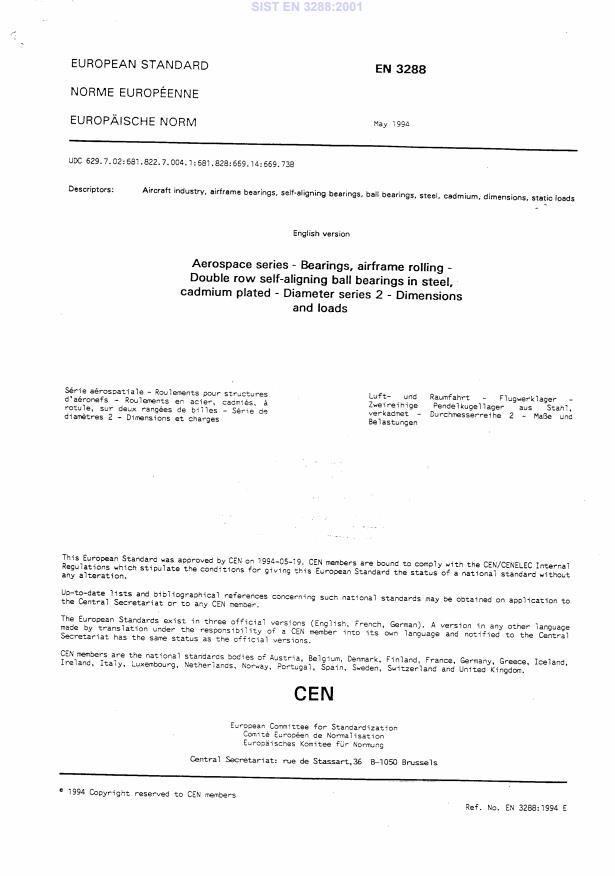
(Main)Aerospace series - Bearings, airframe rolling - Double row self-aligning ball bearings in steel, cadmium plated - Diameter series 2 - Dimensions and loads
- Abstract
This standard specifies the characteristics of double row self-aligning ball bearings in steel, cadmium plated, of diameter series 2 designed to withstand only slow rotations, oscillations and/or swivelling under load. They are intended for use between fixed and moving parts of the aircraft structure and their control mechanisms. The airframe rolling bearings defined in this standard are used from -54°C to 150°C.
- Status
- Published
- Publication Date
- 22-May-1994
- Withdrawal Date
- 29-Nov-1994
- Technical Committee
- ASD-STAN - Aerospace
- Drafting Committee
- ASD-STAN/D 3 - Mechanical
- Current Stage
- 9093 - Decision to confirm - Review Enquiry
- Start Date
- 21-Jan-2025
- Completion Date
- 07-Oct-2026

Overview
EN 3288:1994 is a vital European standard developed by CEN for the aerospace industry, specifying the requirements for double row self-aligning ball bearings used in airframe applications. These bearings are constructed from steel with a cadmium-plated finish, provided in diameter series 2, and are engineered to withstand slow rotations, oscillations, and swivelling under load. This standard ensures that such airframe rolling bearings consistently deliver optimal performance and safety in demanding aviation environments, operating reliably within a temperature range from -54°C to 150°C.
Key Topics
- Bearing Type: Double row self-aligning ball bearings
- Material Specification: High-grade steel, cadmium plated for enhanced corrosion resistance
- Application Range: Suitable for slow rotational movements, oscillations, and swivelling
- Size Series: Diameter series 2 - standardized dimensions and interface
- Load and Performance: Defined load ratings and operational limitations
- Temperature Range: Operable from -54°C up to 150°C
- Installation: Intended for use between moving and fixed sections within aircraft structures and control mechanisms
Applications
Airframe rolling bearings as specified in EN 3288:1994 are fundamental components in aerospace construction, delivering precise and durable movement solutions. Key application areas include:
- Aircraft Structures: Used where controlled movement between fixed and moving parts is necessary, such as fuselage assemblies, control surfaces, landing gear mechanisms, and wing flaps.
- Flight Control Mechanisms: Facilitates smooth oscillation or swivelling motion in control linkages, actuator assemblies, or other flight control subsystems.
- Performance in Extreme Conditions: Cadmium plating provides additional corrosion resistance, while the steel construction ensures mechanical strength, making these bearings suitable for environments exposed to both high and low temperatures commonly encountered in aviation.
Using bearings standardized by EN 3288:1994 helps manufacturers and maintenance teams select components that support structural reliability, meet strict aerospace quality requirements, and streamline supply chain operations through harmonized dimensions and load capacities.
Related Standards
Organizations and engineers working with EN 3288:1994 may also reference additional relevant standards in the aerospace series to ensure full compliance and compatibility, such as:
- EN 3290 - Specifications for different bearing series or performance classes
- EN ISO 11200 - Guidelines for general bearing testing and performance evaluation
- ISO 281 - Rolling bearing life and load calculations
- EN 3160 - Ball bearings for other diameter series or plating options
- National counterparts (e.g., SIST EN 3288:2001) - For implementation in specific countries
Adhering to harmonized international and European aerospace standards like EN 3288:1994 streamlines procurement, simplifies maintenance, and supports aircraft safety and performance objectives.
Relations
- Effective Date
- 28-Jan-2026
Get Certified
Connect with accredited certification bodies for this standard

BUREAU VERITAS Certification Germany
Bureau Veritas certification in Germany.

Element Materials Technology
Materials testing and product certification.

AQMS Ltd.
AQMS provides ISO certification to SMEs across the UK.
Sponsored listings
Frequently Asked Questions
EN 3288:1994 is a standard published by the European Committee for Standardization (CEN). Its full title is "Aerospace series - Bearings, airframe rolling - Double row self-aligning ball bearings in steel, cadmium plated - Diameter series 2 - Dimensions and loads". This standard covers: This standard specifies the characteristics of double row self-aligning ball bearings in steel, cadmium plated, of diameter series 2 designed to withstand only slow rotations, oscillations and/or swivelling under load. They are intended for use between fixed and moving parts of the aircraft structure and their control mechanisms. The airframe rolling bearings defined in this standard are used from -54°C to 150°C.
This standard specifies the characteristics of double row self-aligning ball bearings in steel, cadmium plated, of diameter series 2 designed to withstand only slow rotations, oscillations and/or swivelling under load. They are intended for use between fixed and moving parts of the aircraft structure and their control mechanisms. The airframe rolling bearings defined in this standard are used from -54°C to 150°C.
EN 3288:1994 is classified under the following ICS (International Classification for Standards) categories: 49.035 - Components for aerospace construction. The ICS classification helps identify the subject area and facilitates finding related standards.
EN 3288:1994 has the following relationships with other standards: It is inter standard links to EN 3280:2011. Understanding these relationships helps ensure you are using the most current and applicable version of the standard.
EN 3288:1994 is available in PDF format for immediate download after purchase. The document can be added to your cart and obtained through the secure checkout process. Digital delivery ensures instant access to the complete standard document.
Standards Content (Sample)
2003-01.Slovenski inštitut za standardizacijo. Razmnoževanje celote ali delov tega standarda ni dovoljeno.Aerospace series - Bearings, airframe rolling - Double row self-aligning ball bearings in steel, cadmium plated - Diameter series 2 - Dimensions and loadsLuft- und Raumfahrt - Flugwerklager - Zweireihige Pendelkugellager aus Stahl, verkadmet - Durchmesserreihe 2 - Maße und BelastungenSérie aérospatiale - Roulements pour structures d'aéronefs - Roulements en acier, cadmiés, a rotule, sur deux rangées de billes - Série de diametr
...