

EN 16167:2012
(Main)Sludge, treated biowaste and soil - Determination of polychlorinated biphenyls (PCB) by gas chromatography with mass selective detection (GC-MS) and gas chromatography with electron-capture detection (GC-ECD)
- Abstract
This European Standard specifies a method for quantitative determination of seven selected polychlorinated biphenyls (PCB28, PCB52, PCB101, PCB118, PCB138, PCB153 and PCB180) in sludge, treated biowaste and soil using GC-MS and GC-ECD (see Table 2).
The limit of detection depends on the determinants, the equipment used, the quality of chemicals used for the extraction of the sample and the clean-up of the extract.
Under the conditions specified in this European Standard, limit of application of 1 µg/kg (expressed as dry matter) may be achieved.
Sludge and treated biowaste may differ in properties and also in the expected contamination levels of PCBs and presence of interfering substances. These differences make it impossible to describe one general procedure. This European Standard contains decision tables based on the properties of the sample and the extraction and clean-up procedure to be used.
- Status
- Withdrawn
- Publication Date
- 21-Aug-2012
- Withdrawal Date
- 06-Oct-2026
- Technical Committee
- CEN/TC 444 - Environmental characterization
- Drafting Committee
- CEN/TC 444/WG 2 - Organic analysis
- Current Stage
- 9960 - Withdrawal effective - Withdrawal
- Start Date
- 15-Aug-2018
- Completion Date
- 07-Oct-2026

Relations
- Effective Date
- 22-Aug-2018
- Effective Date
- 25-Aug-2026
- Effective Date
- 17-Jun-2026
- Effective Date
- 09-Feb-2026
- Effective Date
- 28-Jan-2026
- Effective Date
- 28-Jan-2026
- Effective Date
- 28-Jan-2026
- Effective Date
- 28-Jan-2026
- Effective Date
- 28-Jan-2026
- Effective Date
- 28-Jan-2026
Get Certified
Connect with accredited certification bodies for this standard

CIS Institut d.o.o.
Personal Protective Equipment (PPE) certification body. Notified Body NB-2890 for EU Regulation 2016/425 PPE.

Kiwa BDA Testing
Building and construction product certification.
Kmetijski inštitut Slovenije
Agricultural Institute of Slovenia. Soil testing, plant health, agricultural product analysis.
Sponsored listings
Frequently Asked Questions
EN 16167:2012 is a standard published by the European Committee for Standardization (CEN). Its full title is "Sludge, treated biowaste and soil - Determination of polychlorinated biphenyls (PCB) by gas chromatography with mass selective detection (GC-MS) and gas chromatography with electron-capture detection (GC-ECD)". This standard covers: This European Standard specifies a method for quantitative determination of seven selected polychlorinated biphenyls (PCB28, PCB52, PCB101, PCB118, PCB138, PCB153 and PCB180) in sludge, treated biowaste and soil using GC-MS and GC-ECD (see Table 2). The limit of detection depends on the determinants, the equipment used, the quality of chemicals used for the extraction of the sample and the clean-up of the extract. Under the conditions specified in this European Standard, limit of application of 1 µg/kg (expressed as dry matter) may be achieved. Sludge and treated biowaste may differ in properties and also in the expected contamination levels of PCBs and presence of interfering substances. These differences make it impossible to describe one general procedure. This European Standard contains decision tables based on the properties of the sample and the extraction and clean-up procedure to be used.
This European Standard specifies a method for quantitative determination of seven selected polychlorinated biphenyls (PCB28, PCB52, PCB101, PCB118, PCB138, PCB153 and PCB180) in sludge, treated biowaste and soil using GC-MS and GC-ECD (see Table 2). The limit of detection depends on the determinants, the equipment used, the quality of chemicals used for the extraction of the sample and the clean-up of the extract. Under the conditions specified in this European Standard, limit of application of 1 µg/kg (expressed as dry matter) may be achieved. Sludge and treated biowaste may differ in properties and also in the expected contamination levels of PCBs and presence of interfering substances. These differences make it impossible to describe one general procedure. This European Standard contains decision tables based on the properties of the sample and the extraction and clean-up procedure to be used.
EN 16167:2012 is classified under the following ICS (International Classification for Standards) categories: 13.030.01 - Wastes in general; 13.080.10 - Chemical characteristics of soils. The ICS classification helps identify the subject area and facilitates finding related standards.
EN 16167:2012 has the following relationships with other standards: It is inter standard links to EN 16167:2018, ISO 18512:2007, EN ISO 5667-15:2026, ISO 8466-1:1990, EN ISO 22892:2011, EN 16495:2014, EN 16179:2012, EN ISO 11465:2025, EN ISO 16720:2007, EN ISO 5667-15:2009. Understanding these relationships helps ensure you are using the most current and applicable version of the standard.
EN 16167:2012 is associated with the following European legislation: EU Directives/Regulations: 86/278/EEC; Standardization Mandates: M/330. When a standard is cited in the Official Journal of the European Union, products manufactured in conformity with it benefit from a presumption of conformity with the essential requirements of the corresponding EU directive or regulation.
EN 16167:2012 is available in PDF format for immediate download after purchase. The document can be added to your cart and obtained through the secure checkout process. Digital delivery ensures instant access to the complete standard document.
Standards Content (Sample)
2003-01.Slovenski inštitut za standardizacijo. Razmnoževanje celote ali delov tega standarda ni dovoljeno.Schlamm, behandelter Bioabfall und Boden - Bestimmung von polychlorierten Biphenylen (PCB) mittels Gaschromatographie mit Massenspektrometrie-Kopplung (GC-MS) und Gaschromatographie mit Elektroneneinfangdetektion (GC-ECD)Boues, bio-déchets traités et sols - Détermination des biphényles polychlorés (PCB) par chromatographie en phase gazeuse-spectrométrie de masse (CG-SM) et chromatographie en phase gazeuse avec détection par capture d'électrons (CG-DCE)Sludge, treated biowaste and soil - Determination of polychlorinated biphenyls (PCB) by gas chromatography with mass selective detection (GC-MS) and gas chromatography with electron-capture detection (GC-ECD)13.080.10Chemical characteristics of soils13.030.20Liquid wastes. SludgeICS:Ta slovenski standard je istoveten z:EN 16167:2012SIST EN 16167:2013en,fr,de01-februar-2013SIST EN 16167:2013SLOVENSKI
STANDARD
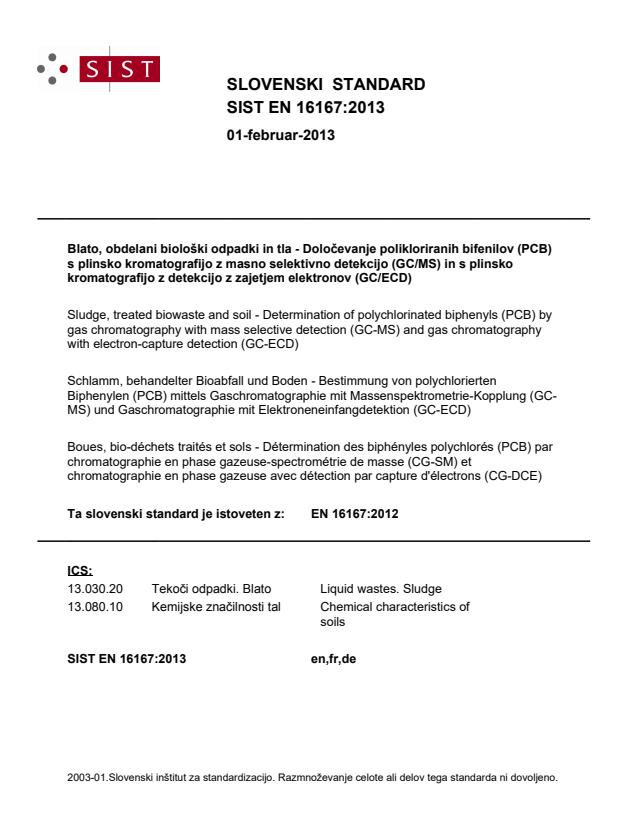
EUROPEAN STANDARD NORME EUROPÉENNE EUROPÄISCHE NORM
EN 16167
August 2012 ICS 13.030.01; 13.080.10 English Version
Sludge, treated biowaste and soil - Determination of polychlorinated biphenyls (PCB) by gas chromatography with mass selective detection (GC-MS) and gas chromatography with electron-capture detection (GC-ECD)
Boues, bio-déchets traités et sols - Détermination des biphényles polychlorés (PCB) par chromatographie en phase gazeuse-spectrométrie de masse (CG-SM) et chromatographie en phase gazeuse avec détection par capture d'électrons (CG-DCE)
Schlamm, behandelter Bioabfall und Boden - Bestimmung von polychlorierten Biphenylen (PCB) mittels Gaschromatographie mit massenspektrometrischer Detektion (GC-MS) und Gaschromatographie mit Elektroneneinfangdetektion (GC-ECD) This European Standard was approved by CEN on 24 May 2012.
CEN members are bound to comply with the CEN/CENELEC Internal Regulations which stipulate the conditions for giving this European Standard the status of a national standard without any alteration. Up-to-date lists and bibliographical references concerning such national standards may be obtained on application to the CEN-CENELEC Management Centre or to any CEN member.
This European Standard exists in three official versions (English, French, German). A version in any other language made by translation under the responsibility of a CEN member into its own language and notified to the CEN-CENELEC Management Centre has the same status as the official versions.
CEN members are the national standards bodies of Austria, Belgium, Bulgaria, Croatia, Cyprus, Czech Republic, Denmark, Estonia, Finland, Former Yugoslav Republic of Macedonia, France, Germany, Greece, Hungary, Iceland, Ireland, Italy, Latvia, Lithuania, Luxembourg, Malta, Netherlands, Norway, Poland, Portugal, Romania, Slovakia, Slovenia, Spain, Sweden, Switzerland, Turkey and United Kingdom.
EUROPEAN COMMITTEE FOR STANDARDIZATION
COMITÉ EUROPÉEN DE NORMALISATION EUROPÄISCHES KOMITEE FÜR NORMUNG
Management Centre:
Avenue Marnix 17,
B-1000 Brussels © 2012 CEN All rights of exploitation in any form and by any means reserved worldwide for CEN national Members. Ref. No. EN 16167:2012: ESIST EN 16167:2013
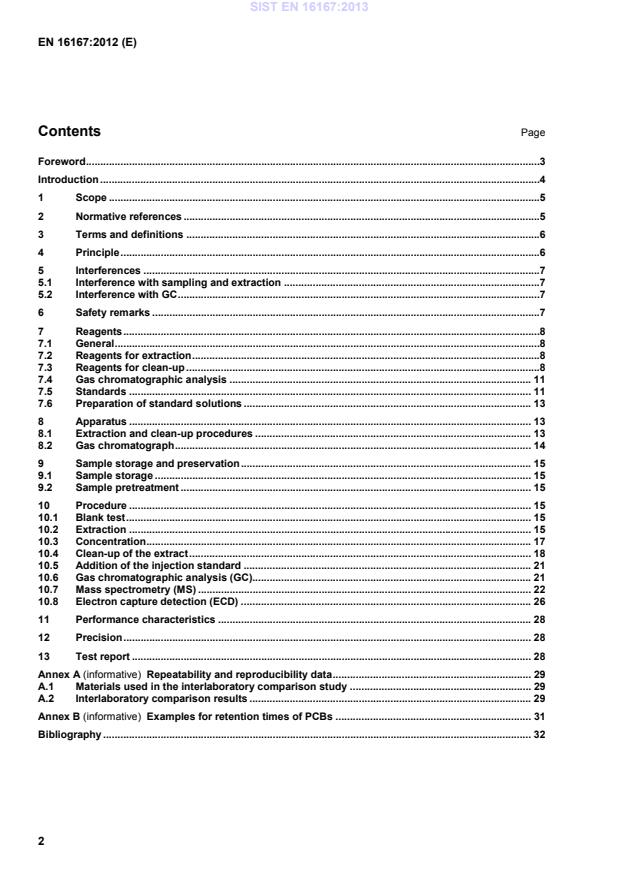
Repeatability and reproducibility data . 29A.1 Materials used in the interlaboratory comparison study . 29A.2 Interlaboratory comparison results . 29Annex B (informative)
Examples for retention times of PCBs . 31Bibliography . 32 SIST EN 16167:2013
WARNING — Persons using this European Standard should be familiar with usual laboratory practice. This European Standard does not purport to address all of the safety problems, if any, associated with its use. It is the responsibility of the user to establish appropriate safety and health practices and to ensure compliance with any national regulatory conditions. IMPORTANT — It is absolutely essential that tests conducted according to this European Standard be carried out by suitably trained staff. SIST EN 16167:2013
PCB28 2,4,4'-trichlorobiphenyl 7012-37-5 PCB52 2,2',5,5'-tetrachlorobiphenyl 35693-99-3 PCB101 2,2',4,5,5'-pentachlorobiphenyl 37680-37-2 PCB118 2,3',4,4',5-pentachlorobiphenyl 31508-00-6 PCB138 2,2',3,4,4',5'-hexachlorobiphenyl 35056-28-2 PCB153 2,2',4,4',5,5'-hexachlorobiphenyl 35065-27-1 PCB180 2,2',3,4,4',5,5'-heptachlorobiphenyl 35065-29-3 a CAS-RN Chemical Abstracts Service Registry Number. The limit of detection depends on the determinants, the equipment used, the quality of chemicals used for the extraction of the sample and the clean-up of the extract.
Under the conditions specified in this European Standard, limit of application of 1 µg/kg (expressed as dry matter) can be achieved.
Sludge and treated biowaste may differ in properties and also in the expected contamination levels of PCBs and presence of interfering substances. These differences make it impossible to describe one general procedure. This European Standard contains decision tables based on the properties of the sample and the extraction and clean-up procedure to be used.
2 Normative references The following documents, in whole or in part, are normatively referenced in this document and are indispensable for its application. For dated references, only the edition cited applies. For undated references, the latest edition of the referenced document (including any amendments) applies.
EN 15934, Sludge, treated biowaste, soil and waste — Calculation of dry matter fraction after determination of dry residue or water content EN 16179, Sludge, treated biowaste and soil — Guidance for sample pretreatment EN ISO 5667-15, Water quality — Sampling — Part 15: Guidance on the preservation and handling of sludge and sediment samples (ISO 5667-15) EN ISO 16720, Soil quality — Pretreatment of samples by freeze-drying for subsequent analysis (ISO 16720) EN ISO 22892, Soil quality — Guidelines for the identification of target compounds by gas chromatography and mass spectrometry (ISO 22892) ISO 8466-1, Water quality — Calibration and evaluation of analytical methods and estimation of performance characteristics — Part 1: Statistical evaluation of the linear calibration function ISO 18512, Soil quality — Guidance on long and short term storage of soil samples SIST EN 16167:2013
polychlorinated biphenyl PCB biphenyl substituted by one to ten chlorine atoms [SOURCE: EN 15308:2008, 3.1] 3.2 congener member of the same kind, class or group of chemicals, e.g. anyone of the two hundred and nine individual PCB Note 1 to entry: The IUPAC congener numbers are for easy identification; they do not represent the order of chromatographic elution. [SOURCE: EN 15308:2008, 3.2] 3.3 critical pair pair of congeners that will be separated to a predefined degree (e.g. R = 0,5) to ensure chromatographic separation meets minimum quality criteria [SOURCE: EN 15308:2008, 3.6] 4 Principle Due to the horizontal character of this European Standard, different procedures for different steps (modules) are allowed. Which modules should be used depends on the sample. A recommendation is given in this European Standard. Performance criteria are described and it is the responsibility of the laboratories applying this European Standard to show that these criteria are met. Using of spiking standards (internal standards) allows an overall check on the efficiency of a specific combination of modules for a specific sample. But it does not necessarily give the information upon the extensive extraction efficiency of the native PCB bonded to the matrix.
After pretreatment according to the methods referred to in 9.2, the test sample is extracted with a suitable solvent. The extract is concentrated by evaporation: If necessary, interfering compounds are removed by a clean-up method suitable for the specific matrix. The eluate is concentrated by evaporation. The extract is analyzed by gas chromatography. The various compounds are separated using a capillary column with a stationary phase of low polarity. Detection occurs with mass spectrometry (MS) or an electron capture detector (ECD) (see 8.2.1).
PCBs are identified and quantified by comparison of relative retention times and relative peak heights (or peak areas) with respect to internal standards added. The efficiency of the procedure depends on the composition of the matrix that is investigated. SIST EN 16167:2013
Presence of tetrachlorobenzyltoluene (TCBT)-mixtures may disturb the determination of the PCB with GC-ECD. 6 Safety remarks PCBs are highly toxic and shall be handled with extreme care. Avoid contact with solid materials, solvent extracts and solutions of standard PCB with the body shall not be allowed to occur. It is strongly advised that standard solutions are prepared centrally in suitably equipped laboratories or are purchased from suppliers specialised in their preparation.
Solvent solutions containing PCB shall be disposed of in a manner approved for disposal of toxic wastes. For the handling of hexane precautions shall be taken because of its neurotoxic properties. National regulations shall be followed with respect to all hazards associated with this method. SIST EN 16167:2013
7.2 Reagents for extraction 7.2.1 Acetone (2-propanone), (CH3)2 CO. 7.2.2 n-heptane, C7H16. 7.2.3 Petroleum ether, boiling range 40 °C to 60 °C. Hexane-like solvents with a boiling range between 30 °C and 69 °C are allowed. 7.2.4 Anhydrous sodium sulfate, Na2SO4. The anhydrous sodium sulfate shall be kept carefully sealed. 7.2.5 Distilled water or water of equivalent quality, H2O. 7.2.6 Sodium chloride, NaCl, anhydrous. 7.2.7 Keeper substance. High boiling compound, i.e. octane, nonane. 7.3 Reagents for clean-up 7.3.1 Clean-up A using aluminium oxide 7.3.1.1 Aluminium oxide, Al2O3. Basic or neutral, specific surface 200 m2/g, activity Super I according to Brockmann. 7.3.1.2 Deactivated aluminium oxide Deactivated with approximately 10 % water. Add approximately 10 g of water (7.2.5) to 90 g of aluminium oxide (7.3.1.1). Shake until all lumps have disappeared. Allow the aluminium oxide to condition before use for some 16 h, sealed from the air, use it for maximum two weeks. NOTE The activity depends on the water content. It can be necessary to adjust the water content. 7.3.2 Clean-up B using silica gel 60 for column chromatography 7.3.2.1 Silica gel 60, particle size 63 µm to 200 µm. 7.3.2.2 Silica gel 60, water content: mass fraction w(H2O) = 10 %. Silica gel 60 (7.3.2.1), heated for at least 3 h at 450 °C, cooled down in a desiccator and stored containing magnesium perchlorate or a suitable drying agent. Before use heat at least for 5 h at 130 °C in a drying oven. Then allow cooling in a desiccator and add 10 % water (mass fraction) in a flask. Shake for 5 min intensively by hand until all lumps have disappeared and then for 2 h in a shaking device. Store the deactivated silica gel in the absence of air, use it for maximum of two weeks. SIST EN 16167:2013
1) Bio-Beads is an example of a suitable product available commercially. This information is given for the convenience of users of this European Standard and does not constitute an endorsement by CEN of this product. Equivalent products may be used if they can be shown to lead to the same results. 2) Florisil is a trade name for a prepared diatomaceous substance, mainly consisting of anhydrous magnesium silicate. This information is given for the convenience of users of this European Standard and does not constitute an endorsement by CEN of this product. Equivalent products may be used if they can be shown to lead to the same results. SIST EN 16167:2013
Deoxygenated water 7.3.10.6 Pyrogenic copper Dissolve 45 g copper(II)-sulfate pentahydrate (7.3.10.1) in 480 ml water containing 20 ml hydrochloric acid (7.3.10.2) in a 1 000 ml beaker. Take 15 g of zinc granules size (7.3.10.3), add 25 ml water and one drop of anionic detergent solution (7.3.10.4) in another 1 000 ml beaker. Stir with a magnetic stirrer at a high speed to form a slurry. Then whilst stirring at this high speed, carefully add the copper(II)-sulfate solution drop by drop using a glass rod. Hydrogen is liberated and elemental pyrogenic copper is precipitated (red coloured precipitate). Stirring is continued until the hydrogen generation almost ceases. Then the precipitated copper is allowed to settle. The supernatant water is carefully removed and the product washed with deoxygenated water (7.3.10.5) three times, to eliminate residual salts. Then the water is carefully replaced with 250 ml acetone (7.2.1) (whilst continuously stirring the mixture). This operation is repeated twice more to ensure elimination of water. SIST EN 16167:2013
2,4,4'-trichlorobiphenyl (CAS-RN 7012-37-5) PCB52
2,2',5,5'-tetrachlorobiphenyl (CAS-RN 35693-99-3) PCB101
2,2',4,5,5'-pentachlorobiphenyl
(CAS-RN 37680-37-2) PCB118
2,3',4,4',5-pentachlorobiphenyl
(CAS-RN 31508-00-6) PCB138
2,2',3,4,4',5'-hexachlorobiphenyl
(CAS-RN 35056-28-2) PCB153 2,2',4,4',5,5'-hexachlorobiphenyl
(CAS-RN 35065-27-1) PCB180 2,2',3,4,4',5,5'-heptachlorobiphenyl
(CAS-RN 35065-29-3)
NOTE The numbers 28, 52 etc. correspond to the sequential numbers of chlorobiphenyls according to the IUPAC rules for the nomenclature of organic compounds. SIST EN 16167:2013
When highly contaminated samples are analysed, an aliquot of the extract is often used for further clean-up. This makes the costs of analyses caused by the use of labelled standard very high. In these cases, it is allowed to add the internal standard in two steps. Step 1 addition of unlabelled internal standards to the sample. Step 2 addition of labelled congeners to the aliquot of the extract used for clean-up.
At least three congeners, covering the chromatogram shall be used as internal standard. Other PCB not present in the sample, or 13C12-labelled PCBs not used as internal standard, can be used as injection standard. NOTE 1 Some PCB mixtures contain up to 2,5 % of PCB155. NOTE 2 PCB30, PCB143 and PCB207 are recommended as internal standards. NOTE 3 PCB198 or PCB209 are recommended as injection standards for ECD-detection because of lesser interferences. 7.5.3.2 Labelled PCB congeners PCB28 13C12-2,4,4’-trichlorobiphenyl
PCB52 13C12-2,2‘,5,5‘-tetrachlorobiphenyl
PCB101 13C12-2,2‘,4,5,5‘-pentachlorobiphenyl (CAS-RN 37680-73-2) PCB118 13C12-2,3‘,4,4‘,5-pentachlorobiphenyl
PCB138 13C12-2,2‘,3,4,4‘,5‘-hexachlorobiphenyl (CAS-RN 35065-28-2) PCB153 13C12-2,2‘,4,4‘,5,5‘-hexachlorobiphenyl
PCB180 13C12-2,2‘,3,4,4‘,5,5‘-heptachlorobiphenyl
7.5.3.3 Non-labelled PCB congeners PCB29
2,4,5-trichlorobiphenyl (CAS-RN 15862-07-4) PCB30
2,4,6-trichlorobiphenyl (CAS-RN 35693-92-6) PCB143 2,2',3,4,5,6'-hexachlorobiphenyl (CAS-RN 68194-15-0) PCB155
2,2',4,4',6,6'-hexachlorobiphenyl (CAS-RN 33979-03-2) PCB198 2,2',3,3',4,5,5’,6,-octachlorobiphenyl (CAS-RN 68194-17-2) PCB207 2,2',3,3',4,4',5,6,6'-nonachlorobiphenyl (CAS-RN 52663-79-3) PCB209 2,2',3,3',4,4',5,5’,6,6'-decachlorobiphenyl (CAS-RN 2051-24-3)
7.5.3.4 PCB congeners for resolution check PCB28
2,4,4'-trichlorobiphenyl (CAS-RN 7012-37-5) PCB 31
2,4',5-trichlorobiphenyl (CAS-RN 16606-02-3)
NOTE Because of the dangerous nature of the substances to be used, commercially available - preferably certified - standard solutions or mixed standard solutions are preferred. Avoid skin contact.
The working standard solutions shall be in the same solvent like the extract. Store the primary and diluted standard solutions in a dark place at a temperature of (5 ± 3) °C. The solutions are stable for at least one year, provided that evaporation of solvent is negligible. Components present in mixed standard solutions should be completely separated by the gas chromatographic columns used. 7.6.2 Preparation of internal standard solution Prepare a concentrated primary internal standard solution, containing at least three different components (7.5.3), of about 0,4 mg/ml in n-heptane (7.2.2) by weighing approximately 10 mg of each of the chosen internal standards to the nearest 0,1 mg and dissolving them in 25 ml of n-heptane. Prepare from this a secondary internal solution with such a concentration that the added amount gives a peak with measurable peak area or peak height in the chromatogram (at least 10 times the detection limit). If the two step procedure for GC-MS is used, make two different internal standard solutions, one containing the non-labelled compounds. At least two unlabelled congeners shall be used in the first internal standard solution and at least three labelled congeners in the second solution. 7.6.3 Preparation of injection standard solution Prepare a concentrated primary injection standard solution, containing at least two different components (7.5.3), of about 0,4 mg/ml in n-heptane (7.2.2) by weighing approximately 10 mg of each of the chosen injection standards to the nearest 0,1 mg and dissolving them in 25 ml of n-heptane. Prepare from this a secondary internal solution which such a concentration that the added amount gives a peak with measurable peak area or peak surface in the chromatogram (at least 10 times the detection limit). 8 Apparatus 8.1 Extraction and clean-up procedures Usual laboratory glassware. All glassware and material that comes into contact with the sample or extract shall be thoroughly cleaned.
8.1.1 Sample bottles, made of glass, stainless steel or aluminium, with glass stopper or screw top and polytetrafluoroethylene (PTFE) seal of appropriate volume. Glass is not appropriate for sludge samples. WARNING — For safety reasons, biologically active sludge samples shall not be stored in a sealed container. SIST EN 16167:2013
NOTE The retention times for the PCB on different capillary columns are given in Annex B.
3) CP-Sil 19, OV 1701 are examples of suitable products available commercially. This information is given for the convenience of users of this European Standard and does not constitute an endorsement by CEN of these products. Equivalent products may be used if they can be shown to lead to the same results. SIST EN 16167:2013
If necessary, sludge samples shall be stored according to EN ISO 5667-15. Dried samples can be stored at room temperature in a dark place up to one month. Soil samples shall be stored according to ISO 18512. 9.2 Sample pretreatment Pretreat samples according to EN 16179, if not otherwise specified, and considering the specific drying procedures as specified in Table 3 to obtain a test sample. Pretreatment is necessary to reduce the moisture content to enable extraction of the PCBs and to increase the homogeneity. Complete drying of the sample is essential if Soxhlet is used for extraction or to increase the homogeneity. Complete drying is also recommended if the sample shall be stored for a long period. Table 3 — Drying techniques for samples of different matrices for subsequent analyses of PCB Matrix Drying technique Air drying Freeze drying (EN ISO 16720) Na2SO4 No drying Sludge x x xa
Biowaste (compost, mixed waste)
x x x Soil (e. g. sand, clay) x x x x a Na2SO4 can be used for the preservation of hygroscopic dried sludge.
10 Procedure 10.1 Blank test Perform a blank test following the applied procedure (selected extraction and clean-up procedure) using the same amount of reagents that are used for the pretreatment, extraction, clean-up and analysis of a sample. Analyse the blank immediately prior to analysis of the samples to demonstrate sufficient freedom from contamination. The blank shall be less than 50 % of the lowest reporting limit. 10.2 Extraction 10.2.1 General Depending on the test sample (matrix and moisture content), choose a suitable extraction method (see Table 4). Extraction method 1 (10.2.2) or 3 (10.2.4) are recommended if it is important to break up aggregates in the sample to access the PCBs. With wet samples these methods shall be applied in order to eliminate the presence of water. If dissolving of the PCBs is the most important step (waste and organic rich materials) and SIST EN 16167:2013
Soil-like materials, sludge, biowaste, compost Acetone/ petroleum ether Agitation Extraction procedure 1(see 10.2.2)
Sludge, biowaste, compost,
Petroleum ether Soxhlet, pressurised liquid extraction Extraction procedure 2(see 10.2.3)
Wet
Soil-like materials, biowaste, compost Acetone/ petroleum ether Agitation Extraction procedure 1(see 10.2.2) Also applicable for field moist samples with dry matter content >75 %
Soil-like material biowaste, compost Acetone/ petroleum ether/NaCl Agitation Extraction procedure 3(see 10.2.4)
10.2.2 Extraction procedure 1: Samples using acetone/petroleum ether and agitation Place the test sample in a bottle (8.1.1). Add a definite volume of the secondary internal standard solution (7.5.2). Add 50 ml of acetone (7.2.1) to the test sample and extract by shaking thoroughly to break up aggregates for 30 min. Then add 50 ml of petroleum ether (7.2.3) and shake again thoroughly during at least 12 h. Use a horizontal shaking device (8.1.2) and have the solvent movement in the sample bottle as long as possible (horizontal position). After the solids have been settled, decant the supernatant. Wash the solid phase with 50 ml of petroleum ether (7.2.3) and decant again. Collect the extracts in a separating funnel (8.1.4) and remove the acetone by shaking twice with 400 ml of water (7.2.5). Dry the extract over anhydrous sodium sulfate (7.2.4). Rinse the sodium sulfate with petroleum ether (7.2.3) and add the rinsing to the extract. SIST EN 16167:2013
NOTE 2 In matrices with a high organic matter content (e.g. some sludges) longer extraction procedures can be necessary. Extraction procedure 2 (see 10.2.3) may be preferred for these samples. 10.2.3 Extraction procedure 2: Samples using Soxhlet Place the test sample in the extraction thimble (8.1.6). Add the definite amount of the secondary internal standard solution (7.5.3) and approximately 70 ml of the extraction solvent (7.2.2) to the extraction vessel. Extract the sample with the Soxhlet extraction apparatus (8.1.
...