


EN 312:2003
(Main)Particleboards - Specifications
Particleboards - Specifications
This European Standard specifies the requirements for resin-bonded unfaced particleboards.
NOTE 1 This standard will be called up in EN 13986 for construction applications.
The values listed in this standard relate to product properties but they are not characteristic values to be used in design calculations.
NOTE 2 Such characteristic values (e. g. for use in design calculation in ENV 1995-1-1) are given either in EN 12369-1 or derived by testing according to EN 789, EN 1058 and ENV 1156.
Additional information on supplementary properties for certain applications is also given.
NOTE 3 Particleboards in accordance with this standard may be referred to as P1 to P7-boards.
NOTE 4 A new grade of board type P3 has been included and is intended for use as a non load-bearing board for use in humid conditions.
Boards of type P4 to P7 are intended for use in design and construction of load-bearing or stiffening building elements, e. g. walls, flooring, roofing and I-beams (see EN V 1995-1-1 and/or performance standards).
This standard does not give requirements for Oriented Strand Boards (OSB); these are set out in EN 300.
This standard does not apply to extruded particleboards.
This standard does not give requirements for Oriented Strand Boards (OSB); these are set out in EN 300.
This standard does not apply to extruded particleboards.
Spanplatten - Anforderungen
Panneaux de particules - Exigences
La présente Norme européenne prescrit les exigences pour les panneaux de particules liées à la résine et non revêtus.
NOTE 1 La présente norme est référencée dans la norme EN 13986 pour les applications dans la construction.
Les valeurs données dans la présente norme concernent les caractéristiques du produit mais ne sont pas les valeurs caractéristiques à utiliser dans les calculs de conception.
NOTE 2 De telles valeurs caractéristiques (par exemple pour des calculs de conception selon ENV 1995-1-1) sont soit données dans la norme EN 12369-1 soit obtenues à partir d'essais selon les normes EN 789, EN 1058 et ENV 1156.
Des informations supplémentaires sur des caractéristiques complémentaires relatives à certaines applications sont également fournies.
NOTE 3 Les panneaux de particules conformes à cette norme peuvent être désignés comme panneaux P1 à P7.
NOTE 4 Un nouveau type de panneau type P3 a été incorporé et est destiné à des usages en panneau non travaillant en milieu humide.
Les panneaux de type P4 à P7 sont destinés à être utilisés dans la conception et la construction d'éléments de bâtiment travaillants ou raidisseurs, par exemple en mur, plancher, toiture ou poutre en I (voir ENV 1995-1-1 et/ou les normes de réalisation).
La présente norme ne donne d'exigences pour les panneaux de lamelles longues, minces et orientées (OSB), ces dernières se trouvent dans EN 300.
La présente norme ne s'applique pas aux panneaux extrudés.
Iverne plošče - Specifikacije
General Information
- Status
- Withdrawn
- Publication Date
- 19-Aug-2003
- Withdrawal Date
- 31-Aug-2010
- Technical Committee
- CEN/TC 112 - Woodbased panels
- Drafting Committee
- CEN/TC 112/WG 11 - Particleboards and fibreboards
- Current Stage
- 9960 - Withdrawal effective - Withdrawal
- Start Date
- 01-Sep-2010
- Completion Date
- 01-Sep-2010
- Directive
- 89/106/EEC - Construction products
Relations
- Replaces
EN 312-1:1996 - Particleboards - Specifications - Part 1: General requirements for all board types - Effective Date
- 22-Dec-2008
- Effective Date
- 22-Dec-2008
- Effective Date
- 22-Dec-2008
- Effective Date
- 22-Dec-2008
- Effective Date
- 22-Dec-2008
- Effective Date
- 22-Dec-2008
- Effective Date
- 22-Dec-2008
- Effective Date
- 17-Feb-2009

Get Certified
Connect with accredited certification bodies for this standard

Gozdarski inštitut Slovenije
Slovenian Forestry Institute. Forest management certification support, timber testing.
Sponsored listings
Frequently Asked Questions
EN 312:2003 is a standard published by the European Committee for Standardization (CEN). Its full title is "Particleboards - Specifications". This standard covers: This European Standard specifies the requirements for resin-bonded unfaced particleboards. NOTE 1 This standard will be called up in EN 13986 for construction applications. The values listed in this standard relate to product properties but they are not characteristic values to be used in design calculations. NOTE 2 Such characteristic values (e. g. for use in design calculation in ENV 1995-1-1) are given either in EN 12369-1 or derived by testing according to EN 789, EN 1058 and ENV 1156. Additional information on supplementary properties for certain applications is also given. NOTE 3 Particleboards in accordance with this standard may be referred to as P1 to P7-boards. NOTE 4 A new grade of board type P3 has been included and is intended for use as a non load-bearing board for use in humid conditions. Boards of type P4 to P7 are intended for use in design and construction of load-bearing or stiffening building elements, e. g. walls, flooring, roofing and I-beams (see EN V 1995-1-1 and/or performance standards). This standard does not give requirements for Oriented Strand Boards (OSB); these are set out in EN 300. This standard does not apply to extruded particleboards. This standard does not give requirements for Oriented Strand Boards (OSB); these are set out in EN 300. This standard does not apply to extruded particleboards.
This European Standard specifies the requirements for resin-bonded unfaced particleboards. NOTE 1 This standard will be called up in EN 13986 for construction applications. The values listed in this standard relate to product properties but they are not characteristic values to be used in design calculations. NOTE 2 Such characteristic values (e. g. for use in design calculation in ENV 1995-1-1) are given either in EN 12369-1 or derived by testing according to EN 789, EN 1058 and ENV 1156. Additional information on supplementary properties for certain applications is also given. NOTE 3 Particleboards in accordance with this standard may be referred to as P1 to P7-boards. NOTE 4 A new grade of board type P3 has been included and is intended for use as a non load-bearing board for use in humid conditions. Boards of type P4 to P7 are intended for use in design and construction of load-bearing or stiffening building elements, e. g. walls, flooring, roofing and I-beams (see EN V 1995-1-1 and/or performance standards). This standard does not give requirements for Oriented Strand Boards (OSB); these are set out in EN 300. This standard does not apply to extruded particleboards. This standard does not give requirements for Oriented Strand Boards (OSB); these are set out in EN 300. This standard does not apply to extruded particleboards.
EN 312:2003 is classified under the following ICS (International Classification for Standards) categories: 79.060.20 - Fibre and particle boards. The ICS classification helps identify the subject area and facilitates finding related standards.
EN 312:2003 has the following relationships with other standards: It is inter standard links to EN 312-1:1996, EN 312-7:1997, EN 312-2:1996, EN 312-4:1996, EN 312-5:1997, EN 312-3:1996, EN 312-6:1996, EN 312:2010. Understanding these relationships helps ensure you are using the most current and applicable version of the standard.
EN 312:2003 is associated with the following European legislation: EU Directives/Regulations: 305/2011, 89/106/EEC; Standardization Mandates: M/113. When a standard is cited in the Official Journal of the European Union, products manufactured in conformity with it benefit from a presumption of conformity with the essential requirements of the corresponding EU directive or regulation.
EN 312:2003 is available in PDF format for immediate download after purchase. The document can be added to your cart and obtained through the secure checkout process. Digital delivery ensures instant access to the complete standard document.
Standards Content (Sample)
2003-01.Slovenski inštitut za standardizacijo. Razmnoževanje celote ali delov tega standarda ni dovoljeno.Spanplatten - AnforderungenPanneaux de particules - ExigencesParticleboards - Specifications79.060.20Fibre and particle boardsICS:Ta slovenski standard je istoveten z:EN 312:2003SIST EN 312:2004en01-januar-2004SIST EN 312:2004SLOVENSKI
STANDARDSIST EN 312-5:1998SIST EN 312-6:1997SIST EN 312-7:1998SIST EN 312-4:1997SIST EN 312-1:1997SIST EN 312-2:1997SIST EN 312-3:19971DGRPHãþD
EUROPEAN STANDARDNORME EUROPÉENNEEUROPÄISCHE NORMEN 312August 2003ICS 79.060.20Supersedes EN 312-1:1996, EN 312-2:1996,EN 312-3:1996, EN 312-4:1996, EN 312-5:1997,EN 312-6:1996 and EN 312-7:1997English versionParticleboards - SpecificationsPanneaux de particules - ExigencesSpanplatten - AnforderungenThis European Standard was approved by CEN on 16 May 2003.CEN members are bound to comply with the CEN/CENELEC Internal Regulations which stipulate the conditions for giving this EuropeanStandard the status of a national standard without any alteration. Up-to-date lists and bibliographical references concerning such nationalstandards may be obtained on application to the Management Centre or to any CEN member.This European Standard exists in three official versions (English, French, German). A version in any other language made by translationunder the responsibility of a CEN member into its own language and notified to the Management Centre has the same status as the officialversions.CEN members are the national standards bodies of Austria, Belgium, Czech Republic, Denmark, Finland, France, Germany, Greece,Hungary, Iceland, Ireland, Italy, Luxembourg, Malta, Netherlands, Norway, Portugal, Slovakia, Spain, Sweden, Switzerland and UnitedKingdom.EUROPEAN COMMITTEE FOR STANDARDIZATIONCOMITÉ EUROPÉEN DE NORMALISATIONEUROPÄISCHES KOMITEE FÜR NORMUNGManagement Centre: rue de Stassart, 36
B-1050 Brussels© 2003 CENAll rights of exploitation in any form and by any means reservedworldwide for CEN national Members.Ref. No. EN 312:2003 ESIST EN 312:2004
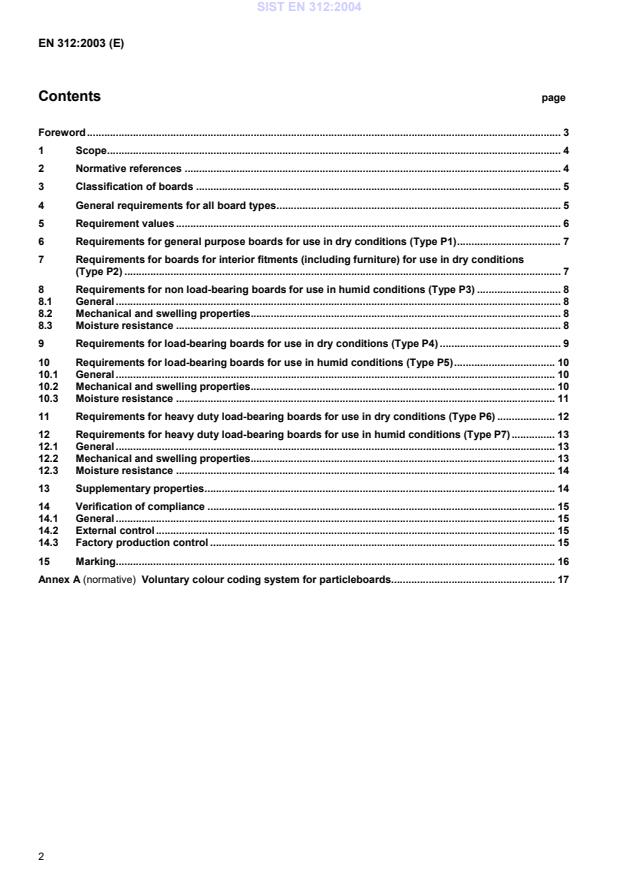
Voluntary colour coding system for particleboards.17SIST EN 312:2004
1)Humid conditions are defined in terms of service class 2 of ENV 1995-1-1 which is characterized by a moisture content inthe material corresponding to a temperature of 20 °C and the relative humidity of the surrounding air only exceeding 85 %for a few weeks per year. Boards of this type are suitable for use in biological hazard classes 1 and 2 of EN 335-3.SIST EN 312:2004
Formaldehyde releaseaccording to EN 13986— Class E 1Perforator valueSteady state emission valuecEN 120ENV 717-1Content £ 8 mg/100 g oven dry boarddRelease £ 0,124 mg/m3 air— Class E 2Perforator valueSteady state emission valuecEN 120ENV 717-1Content > 8 mg/100 g oven dry board£ 30 mg/100 g oven dry boardRelease > 0,124 mg/m3 airaThese values are characterized by a moisture content in the material corresponding to a relative humidity of 65 % and atemperature of 20 °C.bThe perforator values apply to boards with moisture contents H of 6,5 %. In the case of particleboards with differentmoisture content (in the range of 3 %
H 10 %) the perforator value shall be multiplied by a factor F which can be cal-culated from the following equation:F = - 0,133 H + 1,86cRequired for initial type testing other than for established products where initial type testing may also be done on the ba-sis of existing data with EN 120 or ENV 717-1 testing, either from factory production control or from external inspection.dExperience has shown that to ensure compliance with these limits, the rolling average of the EN 120 values found fromthe internal factory production control over a period of ½ year should not exceed 6,5 mg HCHO/100 g panel mass.5 Requirement valuesThe requirements in tables 2 to 11 shall be met by 5 percentile values (95 percentile values in the case of thicknessswelling) based on the mean values for individual boards and calculated in accordance with EN 326-1. In the caseof thickness swelling they shall be equal to or less than the values in tables 2 to 11 and in the case of all otherproperties they shall be equal to or greater than the values in tables 2 to 11.The values in tables 2 to 11 for both bending strength and modulus of elasticity shall apply to test results obtainedin the weakest direction in the plane of the panel.NOTE The manufacturer may test the panel in only the main direction if this direction is clearly indicated on the machinedready to use panel.SIST EN 312:2004
...
Questions, Comments and Discussion
Ask us and Technical Secretary will try to provide an answer. You can facilitate discussion about the standard in here.
Loading comments...