


EN 1290:1998/A2:2003
(Amendment)Non-destructive testing of welds - Magnetic particle testing of welds
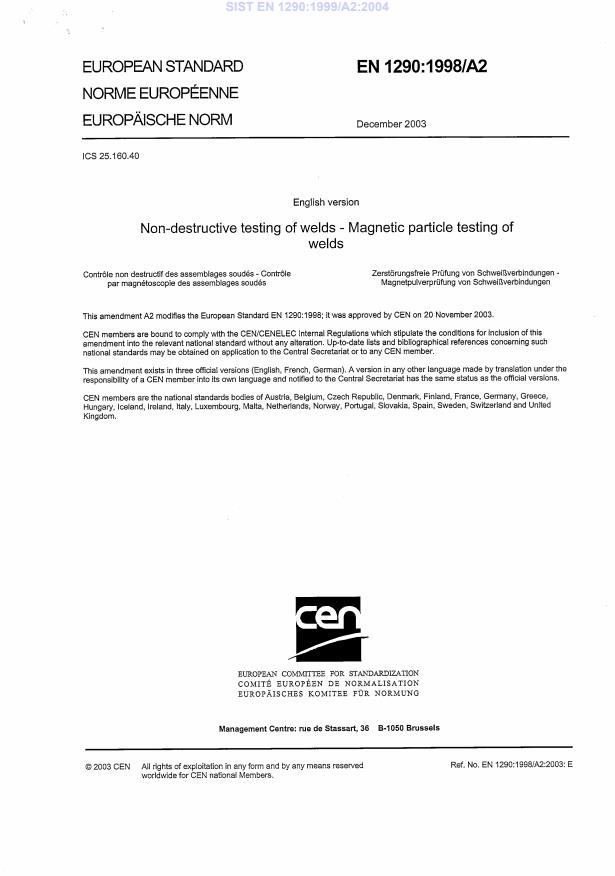
Non-destructive testing of welds - Magnetic particle testing of welds
This standard specifies magnetic particle examination techniques for the detection of surface imperfections in ferromagnetic welds including the heat affected zones using the magnetic method. Techniques recommended are suitable for most welding processes and joint configurations. Variations to the basic techniques that will provide a higher or lower examination sensitivity, are described in annex A. Techniques for examination of welds, with geometries in accordance with those shown in tables 1, 2 and 3 can be used directly from this standard. Acceptance levels for indications are described in prEN 1291.
Zerstörungsfreie Prüfung von Schweißverbindungen - Magnetpulverprüfung von Schweißverbindungen
Diese Norm legt Anwendungen des Magnetpulververfahrens zum Nachweis von Unregelmäßigkeiten in der Oberfläche von ferromagnetischen Schweißnähten, einschließlich der Wärmeeinflußzonen fest. Die empfohlenen Techniken sind bei den meisten Schweißverfahren und Verbindungsarten geeignet. Variationen dieser Techniken mit höherer oder niedriger Prüfempfindlichkeit sind im Anhang A beschrieben.
Contrôle non destructif des assemblages soudés - Contrôle par magnétoscopie des assemblages soudés
La présente norme spécifie les méthodes de contrôle pour la détection des défauts de surface par magnétoscopie des soudures dans les matériaux ferromagnétiques y compris les zones affectées thermiquement à l'aide de la méthode de magnétisation par passage de courant. Les techniques recommandées sont appropriées pour la plupart des procédés de soudage et des configurations d'assemblages. Des variantes des techniques de base donnant une sensibilité plus élevée ou plus faible sont données en annexe A.
Neporušitvene preiskave zvarov - Preiskava zvarov z magnetnimi delci
General Information
- Status
- Withdrawn
- Publication Date
- 09-Dec-2003
- Withdrawal Date
- 10-Nov-2009
- Technical Committee
- CEN/TC 121 - Welding
- Drafting Committee
- CEN/TC 121/SC 5 - Testing of welds (destructive and non-destructive)
- Current Stage
- 9960 - Withdrawal effective - Withdrawal
- Start Date
- 11-Nov-2009
- Completion Date
- 11-Nov-2009
- Directive
- 97/23/EC - Pressure equipment
Relations
- Replaced By
EN ISO 17638:2009 - Non-destructive testing of welds - Magnetic particle testing (ISO 17638:2003) - Effective Date
- 14-Nov-2009
- Effective Date
- 08-Jun-2022
Get Certified
Connect with accredited certification bodies for this standard

National Aerospace and Defense Contractors Accreditation Program (NADCAP)
Global cooperative program for special process quality in aerospace.
CARES (UK Certification Authority for Reinforcing Steels)
UK certification for reinforcing steels and construction.
DVS-ZERT GmbH
German welding certification society.
Sponsored listings
Frequently Asked Questions
EN 1290:1998/A2:2003 is a amendment published by the European Committee for Standardization (CEN). Its full title is "Non-destructive testing of welds - Magnetic particle testing of welds". This standard covers: This standard specifies magnetic particle examination techniques for the detection of surface imperfections in ferromagnetic welds including the heat affected zones using the magnetic method. Techniques recommended are suitable for most welding processes and joint configurations. Variations to the basic techniques that will provide a higher or lower examination sensitivity, are described in annex A. Techniques for examination of welds, with geometries in accordance with those shown in tables 1, 2 and 3 can be used directly from this standard. Acceptance levels for indications are described in prEN 1291.
This standard specifies magnetic particle examination techniques for the detection of surface imperfections in ferromagnetic welds including the heat affected zones using the magnetic method. Techniques recommended are suitable for most welding processes and joint configurations. Variations to the basic techniques that will provide a higher or lower examination sensitivity, are described in annex A. Techniques for examination of welds, with geometries in accordance with those shown in tables 1, 2 and 3 can be used directly from this standard. Acceptance levels for indications are described in prEN 1291.
EN 1290:1998/A2:2003 is classified under the following ICS (International Classification for Standards) categories: 25.160.40 - Welded joints and welds. The ICS classification helps identify the subject area and facilitates finding related standards.
EN 1290:1998/A2:2003 has the following relationships with other standards: It is inter standard links to EN ISO 17638:2009, EN 1290:1998. Understanding these relationships helps ensure you are using the most current and applicable version of the standard.
EN 1290:1998/A2:2003 is associated with the following European legislation: EU Directives/Regulations: 97/23/EC; Standardization Mandates: M/071. When a standard is cited in the Official Journal of the European Union, products manufactured in conformity with it benefit from a presumption of conformity with the essential requirements of the corresponding EU directive or regulation.
EN 1290:1998/A2:2003 is available in PDF format for immediate download after purchase. The document can be added to your cart and obtained through the secure checkout process. Digital delivery ensures instant access to the complete standard document.
Standards Content (Sample)
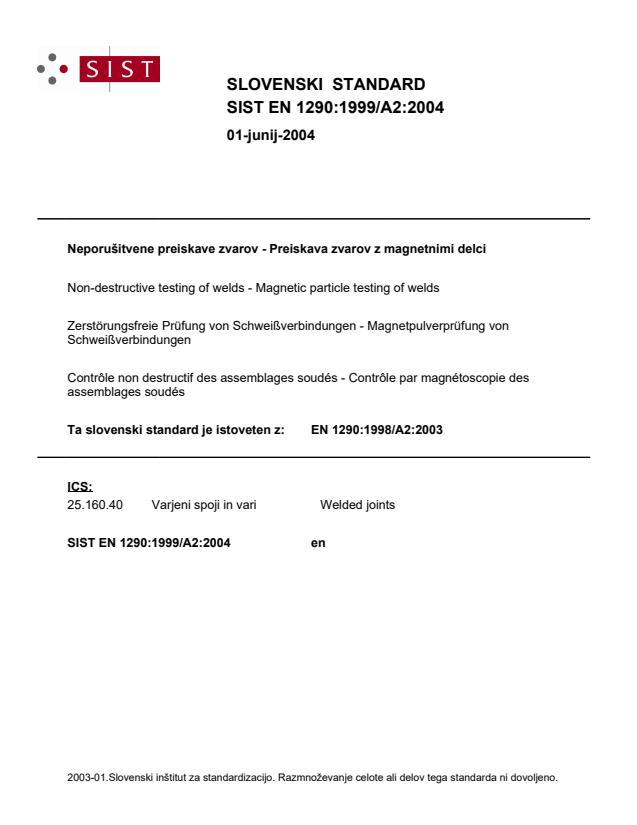
SLOVENSKI STANDARD
01-junij-2004
Neporušitvene preiskave zvarov - Preiskava zvarov z magnetnimi delci
Non-destructive testing of welds - Magnetic particle testing of welds
Zerstörungsfreie Prüfung von Schweißverbindungen - Magnetpulverprüfung von
Schweißverbindungen
Contrôle non destructif des assemblages soudés - Contrôle par magnétoscopie des
assemblages soudés
Ta slovenski standard je istoveten z: EN 1290:1998/A2:2003
ICS:
25.160.40 Varjeni spoji in vari Welded joints
2003-01.Slovenski inštitut za
...
Questions, Comments and Discussion
Ask us and Technical Secretary will try to provide an answer. You can facilitate discussion about the standard in here.
Loading comments...