

EN 3475-302:2006
(Main)Aerospace series - Cable, electrical, aircraft use - Test methods - Part 302: Voltage proof test
General Information
- Abstract
This standard specifies a method of performing voltage proof tests on finished cables and cables in course of production.
It shall be used together with EN 3475-100.
- Status
- Published
- Publication Date
- 16-May-2006
- Withdrawal Date
- 29-Nov-2006
- Technical Committee
- ASD-STAN - Aerospace
- Drafting Committee
- ASD-STAN/D 2 - Electrical
- Current Stage
- 9093 - Decision to confirm - Review Enquiry
- Start Date
- 01-Jun-2017
- Completion Date
- 30-Sep-2026

Overview
EN 3475-302:2006 is a CEN/AECMA-STAN European standard that specifies a method for voltage proof testing of finished and in-production aircraft electrical cables. It is intended to be used together with EN 3475-100 (general test methods). The standard sets repeatable procedures to verify insulation integrity and to detect defects that could cause flashover or breakdown in service.
Key procedural elements in the standard include the immersion test, dry spark test, dry impulse test, and voltage testing of cable components (screened cables). The standard defines specimen preparation, test durations, frequency ranges, electrode arrangements and acceptance criteria (no perforation of insulation or jacket).
Key Topics
Immersion test
- Specimens: typically 15 m lengths with ends at least 150 mm below solution surface.
- Test solution (15–25 °C): 30 g sodium chloride, 1 000 g distilled water, 2 g wetting agent.
- After 1 h immersion, the specified voltage (40–60 Hz) is applied between conductor (or shield) and an electrode in contact with the liquid for 5 minutes.
- Voltage rise rate: 300 V/s to 500 V/s.
- Acceptance: no perforation of insulation or jacket.
Dry spark test (production)
- Continuous-testing electrode made of chains/metallic feelers to contact the cable surface.
- Cable speed and electrode length ensure each point is exposed at least 0.20 s.
- Voltage applied between conductor(s) (or shield) and electrode at frequency 40–60 Hz.
- Acceptance: no flash-over or perforation; defects trimmed per note.
Dry impulse test (production alternative)
- Uses negative pulses with a damped oscillation and controlled waveform parameters.
- Rise time: ≤ 75 µs (0–90 % of peak). Pulse rate: 200–500 pulses/s.
- Capacitive load tolerance defined to limit peak voltage reduction.
- Detection: error circuit must interrupt supply on faults and detect arcs at 75 % of test voltage via a 20 kΩ path.
- Calibration: voltmeter accuracy and oscilloscope checks required.
Voltage test of components (screened cables)
- RMS voltage (40–60 Hz) applied for ≥ 1 min between one component and others (with screen connected together).
- Acceptance: no insulation perforation.
Applications
- Production-line quality control for aerospace cable assemblies
- Final acceptance testing of finished aircraft electrical cables
- Screening of cable batches to prevent in-service electrical failures
Benefits include improved electrical safety, consistent manufacturing quality, and reduced risk of insulation breakdown in flight-critical systems.
Related Standards
- EN 3475-100 - Aerospace series: Cables, electrical, aircraft use - Test methods - Part 100: General (normative reference).
- Other EN 3475 series parts addressing mechanical, environmental and electrical test methods for aircraft cables.
For implementation, follow EN 3475-302:2006 in conjunction with project technical specifications that state the test voltages and acceptance criteria relevant to the cable design and application.
Relations
- Effective Date
- 22-Dec-2008
- Effective Date
- 28-Jan-2026
- Effective Date
- 09-Sep-2026
- Effective Date
- 09-Sep-2026
- Effective Date
- 28-Jan-2026
- Effective Date
- 28-Jan-2026
- Effective Date
- 28-Jan-2026
- Effective Date
- 28-Jan-2026
- Effective Date
- 28-Jan-2026
- Effective Date
- 28-Jan-2026
- Effective Date
- 28-Jan-2026
- Effective Date
- 28-Jan-2026
- Effective Date
- 28-Jan-2026
- Effective Date
- 28-Jan-2026
- Effective Date
- 28-Jan-2026
Get Certified
Connect with accredited certification bodies for this standard

BUREAU VERITAS Certification Germany
Bureau Veritas certification in Germany.

Element Materials Technology
Materials testing and product certification.

AQMS Ltd.
AQMS provides ISO certification to SMEs across the UK.
Sponsored listings
Frequently Asked Questions
EN 3475-302:2006 is a standard published by the European Committee for Standardization (CEN). Its full title is "Aerospace series - Cable, electrical, aircraft use - Test methods - Part 302: Voltage proof test". This standard covers: This standard specifies a method of performing voltage proof tests on finished cables and cables in course of production. It shall be used together with EN 3475-100.
This standard specifies a method of performing voltage proof tests on finished cables and cables in course of production. It shall be used together with EN 3475-100.
EN 3475-302:2006 is classified under the following ICS (International Classification for Standards) categories: 49.060 - Aerospace electric equipment and systems. The ICS classification helps identify the subject area and facilitates finding related standards.
EN 3475-302:2006 has the following relationships with other standards: It is inter standard links to EN 3475-302:2002, EN 3475-100:2010, EN 4604-010:2026, EN 4604-009:2026, EN 2713-007:2005, EN 4611-004:2018, EN 3838:2010, EN 2713-011:2006, EN 4604-010:2011, EN 2084:2018, EN 4604-001:2009, EN 4612-006:2019, EN 2714-008:2006, EN 2854-003:2009, EN 4604-007:2019. Understanding these relationships helps ensure you are using the most current and applicable version of the standard.
EN 3475-302:2006 is available in PDF format for immediate download after purchase. The document can be added to your cart and obtained through the secure checkout process. Digital delivery ensures instant access to the complete standard document.
Standards Content (Sample)
2003-01.Slovenski inštitut za standardizacijo. Razmnoževanje celote ali delov tega standarda ni dovoljeno.Luft- und Raumfahrt - Elektrische Leitungen für Luftfahrtverwendung - Prüfverfahren - Teil 302: SpannungsfestigkeitSérie aérospatiale - Câbles électriques à usage aéronautique - Méthodes d'essais - Partie 302 : Tenue en tensionAerospace series - Cable, electrical, aircraft use - Test methods - Part 302: Voltage proof test49.060Aerospace electric equipment and systemsICS:Ta slovenski standard je istoveten z:EN 3475-302:2006SIST EN 3475-302:2009en,de01-marec-2009SIST EN 3475-302:2009SLOVENSKI
STANDARDSIST EN 3475-302:20041DGRPHãþD
EUROPEAN STANDARDNORME EUROPÉENNEEUROPÄISCHE NORMEN 3475-302May 2006ICS 49.060Supersedes EN 3475-302:2002
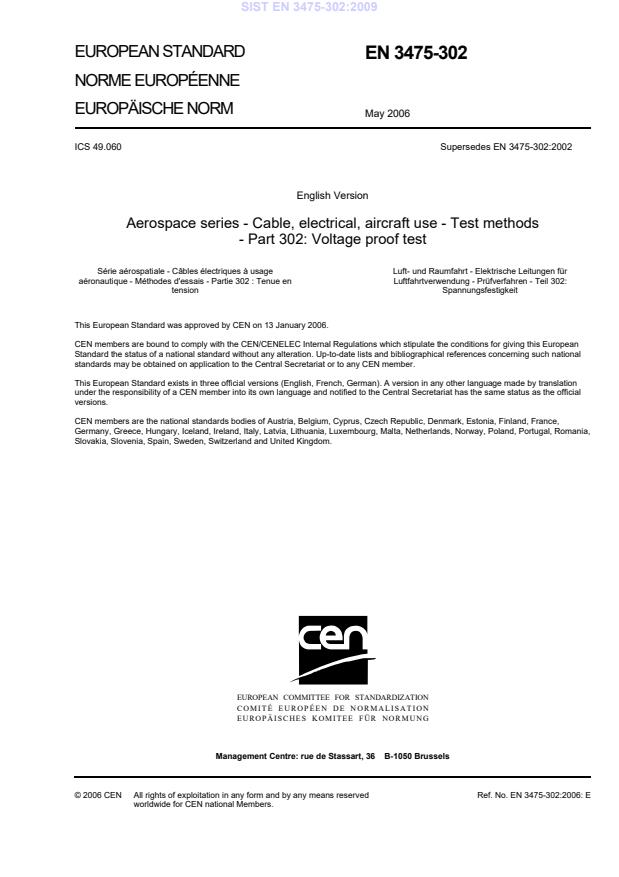
English VersionAerospace series - Cable, electrical, aircraft use - Test methods- Part 302: Voltage proof testSérie aérospatiale - Câbles électriques à usageaéronautique - Méthodes d'essais - Partie 302 : Tenue entensionLuft- und Raumfahrt - Elektrische Leitungen fürLuftfahrtverwendung - Prüfverfahren - Teil 302:SpannungsfestigkeitThis European Standard was approved by CEN on 13 January 2006.CEN members are bound to comply with the CEN/CENELEC Internal Regulations which stipulate the conditions for giving this EuropeanStandard the status of a national standard without any alteration. Up-to-date lists and bibliographical references concerning such nationalstandards may be obtained on application to the Central Secretariat or to any CEN member.This European Standard exists in three official versions (English, French, German). A version in any other language made by translationunder the responsibility of a CEN member into its own language and notified to the Central Secretariat has the same status as the officialversions.CEN members are the national standards bodies of Austria, Belgium, Cyprus, Czech Republic, Denmark, Estonia, Finland, France,Germany, Greece, Hungary, Iceland, Ireland, Italy, Latvia, Lithuania, Luxembourg, Malta, Netherlands, Norway, Poland, Portugal, Romania,Slovakia, Slovenia, Spain, Sweden, Switzerland and United Kingdom.EUROPEAN COMMITTEE FOR STANDARDIZATIONCOMITÉ EUROPÉEN DE NORMALISATIONEUROPÄISCHES KOMITEE FÜR NORMUNGManagement Centre: rue de Stassart, 36
B-1050 Brussels© 2006 CENAll rights of exploitation in any form and by any means reservedworldwide for CEN national Members.Ref. No. EN 3475-302:2006: ESIST EN 3475-302:2009
30 g distilled water 1 000 g wetting agent 2 g After immersion for 1 h, the voltage specified by the technical specification with a frequency of 40 Hz to 60 Hz, shall be applied between the conductor of the cable and the screen, if present, or an electrode in contact with the liquid for 5 min. Single and multicore (jacketed) without shield: between the conductor(s) and an electrode in contact with the liquid Sh
...