

EN 14272:2011
(Main)Plywood - Calculation method for some mechanical properties
- Abstract
This European Standard specifies, for plywood panels of any composition, symmetrical or not, a calculation method to derive some mechanical properties (strength and stiffness in bending, tension, compression, panel and planar shear) as well as density from the wood compounding the layers.
NOTE Usually, the lay-up of the panels is symmetrical but, very often, the surface appearance of the face and the surface appearance of the back face differ, hence a difference between the mechanical properties of the respective veneers. Therefore, in this case, the composition is not mechanically symmetrical and a symmetry independent calculation method is needed.
Provided that structural characteristic values are taken for the layers, the resulting values for the panels can be used as characteristic values as required by EN 1995-1-1.
Conversely, Annex A defines the procedures to derive the veneer properties, in bending, tension and compression, either from testing panels according to EN 789 and EN 1058 or from timber testing according to EN 408 or from imposed values defined in EN 338.
Annex B provides practical spreadsheets, which are applications of the equations in the main part of this standard.
Annex C provide an example for the calculation of bending strength, in accordance with Annex B.
- Status
- Published
- Publication Date
- 20-Dec-2011
- Withdrawal Date
- 29-Jun-2012
- Technical Committee
- CEN/TC 112 - Woodbased panels
- Drafting Committee
- CEN/TC 112/WG 2 - Plywood
- Current Stage
- 9093 - Decision to confirm - Review Enquiry
- Start Date
- 23-May-2024
- Completion Date
- 07-Oct-2026

Overview
EN 14272:2011 - Plywood: Calculation method for some mechanical properties is a CEN European Standard that defines a calculation framework to derive key mechanical properties of plywood panels from the properties of the constituent veneers. The standard applies to plywood panels of any composition - symmetrical or non‑symmetrical - and covers strength and stiffness in bending, tension and compression, panel and planar shear, plus density. Annex A (normative) explains how to derive veneer (basic) values from tests or timber data; Annex B supplies practical spreadsheets; Annex C gives a worked example for bending strength.
Key topics and requirements
- Scope and principle: Calculate panel-level properties by weighting veneer properties according to layer geometry and orientation; works for mechanically non‑symmetrical lay-ups (different face/back veneers).
- Mechanical properties covered:
- Bending: modulus of elasticity (E) and bending strength
- Tension and compression: stiffness and capacity of layers and panel
- Shear: panel shear rigidity and strength (through-thickness) and planar shear (in-plane)
- Density: characteristic density derived from veneer densities
- Veneer (basic) values: Can be obtained by
- Testing plywood panels (EN 789, EN 1058)
- Timber testing (EN 408)
- Using imposed values (EN 338)
- Characteristic values and design: When veneer characteristic values are used, calculated panel values may serve as characteristic values required for structural design under EN 1995‑1‑1 (Eurocode 5).
- Support materials: Normative spreadsheets in Annex B implement the equations; Annex C demonstrates calculation steps for bending strength.
Practical applications and users
EN 14272 is practical for:
- Plywood manufacturers seeking to declare panel mechanical properties for product datasheets or CE marking.
- Structural engineers and designers using plywood in timber construction and needing characteristic values for Eurocode 5 design.
- Test laboratories converting veneer or timber test results into panel properties.
- Specifiers, architects, and contractors evaluating plywood performance for beams, floors, sheathing, formwork or stressed-skin panels.
- Certification bodies and standards organizations aligning product assessment with European norms.
Related standards
- EN 1995‑1‑1 (Eurocode 5) - timber design requirements
- EN 789, EN 1058 - plywood test methods and characteristic values
- EN 408 - timber testing (mechanical/physical properties)
- EN 338 - structural timber strength classes
- EN 12369‑2, EN 384, EN 325, EN 14358 - related wood panel and timber standards
EN 14272:2011 is essential when you need a robust, repeatable method to convert veneer or timber data into reliable plywood panel properties for design, testing and compliance.
Relations
- Effective Date
- 08-Jun-2022
- Effective Date
- 28-Jan-2026
- Effective Date
- 28-Jan-2026
- Effective Date
- 28-Jan-2026
- Refers
EN 12369-2:2025 - Wood-based panels - Characteristic values for structural design - Part 2: Plywood - Effective Date
- 28-Jan-2026
- Effective Date
- 28-Jan-2026
- Effective Date
- 28-Jan-2026
- Effective Date
- 28-Jan-2026
- Effective Date
- 28-Jan-2026
- Effective Date
- 09-Feb-2026
- Effective Date
- 09-Feb-2026
- Effective Date
- 09-Feb-2026
- Effective Date
- 28-Jan-2026
- Effective Date
- 28-Jan-2026
- Referred By
EN 636:2012 - Plywood - Specifications - Effective Date
- 28-Jan-2026
Get Certified
Connect with accredited certification bodies for this standard

Gozdarski inštitut Slovenije
Slovenian Forestry Institute. Forest management certification support, timber testing.
Sponsored listings
Frequently Asked Questions
EN 14272:2011 is a standard published by the European Committee for Standardization (CEN). Its full title is "Plywood - Calculation method for some mechanical properties". This standard covers: This European Standard specifies, for plywood panels of any composition, symmetrical or not, a calculation method to derive some mechanical properties (strength and stiffness in bending, tension, compression, panel and planar shear) as well as density from the wood compounding the layers. NOTE Usually, the lay-up of the panels is symmetrical but, very often, the surface appearance of the face and the surface appearance of the back face differ, hence a difference between the mechanical properties of the respective veneers. Therefore, in this case, the composition is not mechanically symmetrical and a symmetry independent calculation method is needed. Provided that structural characteristic values are taken for the layers, the resulting values for the panels can be used as characteristic values as required by EN 1995-1-1. Conversely, Annex A defines the procedures to derive the veneer properties, in bending, tension and compression, either from testing panels according to EN 789 and EN 1058 or from timber testing according to EN 408 or from imposed values defined in EN 338. Annex B provides practical spreadsheets, which are applications of the equations in the main part of this standard. Annex C provide an example for the calculation of bending strength, in accordance with Annex B.
This European Standard specifies, for plywood panels of any composition, symmetrical or not, a calculation method to derive some mechanical properties (strength and stiffness in bending, tension, compression, panel and planar shear) as well as density from the wood compounding the layers. NOTE Usually, the lay-up of the panels is symmetrical but, very often, the surface appearance of the face and the surface appearance of the back face differ, hence a difference between the mechanical properties of the respective veneers. Therefore, in this case, the composition is not mechanically symmetrical and a symmetry independent calculation method is needed. Provided that structural characteristic values are taken for the layers, the resulting values for the panels can be used as characteristic values as required by EN 1995-1-1. Conversely, Annex A defines the procedures to derive the veneer properties, in bending, tension and compression, either from testing panels according to EN 789 and EN 1058 or from timber testing according to EN 408 or from imposed values defined in EN 338. Annex B provides practical spreadsheets, which are applications of the equations in the main part of this standard. Annex C provide an example for the calculation of bending strength, in accordance with Annex B.
EN 14272:2011 is classified under the following ICS (International Classification for Standards) categories: 79.060.10 - Plywood. The ICS classification helps identify the subject area and facilitates finding related standards.
EN 14272:2011 has the following relationships with other standards: It is inter standard links to ENV 14272:2002, EN 325:2025, EN 1058:2024, EN 338:2009, EN 12369-2:2025, EN 789:2004, EN 408:2010+A1:2012, EN 384:2016+A2:2022, EN 14358:2016, EN 82079-1:2012, EN IEC/IEEE 82079-1:2020, EN 62744:2015, EN 636:2012+A1:2015, EN ISO 10628-1:2015, EN 636:2012. Understanding these relationships helps ensure you are using the most current and applicable version of the standard.
EN 14272:2011 is associated with the following European legislation: EU Directives/Regulations: 305/2011, 89/106/EEC. When a standard is cited in the Official Journal of the European Union, products manufactured in conformity with it benefit from a presumption of conformity with the essential requirements of the corresponding EU directive or regulation.
EN 14272:2011 is available in PDF format for immediate download after purchase. The document can be added to your cart and obtained through the secure checkout process. Digital delivery ensures instant access to the complete standard document.
Standards Content (Sample)
2003-01.Slovenski inštitut za standardizacijo. Razmnoževanje celote ali delov tega standarda ni dovoljeno.Sperrholz - Rechenverfahren für einige mechanische EigenschaftenContreplaqué - Méthode de calcul pour certaines caractéristiques mécaniquesPlywood - Calculation method for some mechanical properties79.060.10Vezan lesPlywoodICS:Ta slovenski standard je istoveten z:EN 14272:2011SIST EN 14272:2012en,fr,de01-april-2012SIST EN 14272:2012SLOVENSKI
STANDARDSIST-TS ENV 14272:20041DGRPHãþD
EUROPEAN STANDARD NORME EUROPÉENNE EUROPÄISCHE NORM
EN 14272
December 2011 ICS 79.060.10 Supersedes ENV 14272:2002English Version
Plywood - Calculation method for some mechanical properties
Contreplaqué - Méthode de calcul pour certaines caractéristiques mécaniques
Sperrholz - Rechenverfahren für einige mechanische Eigenschaften This European Standard was approved by CEN on 1 October 2011.
CEN members are bound to comply with the CEN/CENELEC Internal Regulations which stipulate the conditions for giving this European Standard the status of a national standard without any alteration. Up-to-date lists and bibliographical references concerning such national standards may be obtained on application to the CEN-CENELEC Management Centre or to any CEN member.
This European Standard exists in three official versions (English, French, German). A version in any other language made by translation under the responsibility of a CEN member into its own language and notified to the CEN-CENELEC Management Centre has the same status as the official versions.
CEN members are the national standards bodies of Austria, Belgium, Bulgaria, Croatia, Cyprus, Czech Republic, Denmark, Estonia, Finland, France, Germany, Greece, Hungary, Iceland, Ireland, Italy, Latvia, Lithuania, Luxembourg, Malta, Netherlands, Norway, Poland, Portugal, Romania, Slovakia, Slovenia, Spain, Sweden, Switzerland and United Kingdom.
EUROPEAN COMMITTEE FOR STANDARDIZATION
COMITÉ EUROPÉEN DE NORMALISATION EUROPÄISCHES KOMITEE FÜR NORMUNG
Management Centre:
Avenue Marnix 17,
B-1000 Brussels © 2011 CEN All rights of exploitation in any form and by any means reserved worldwide for CEN national Members. Ref. No. EN 14272:2011: ESIST EN 14272:2012
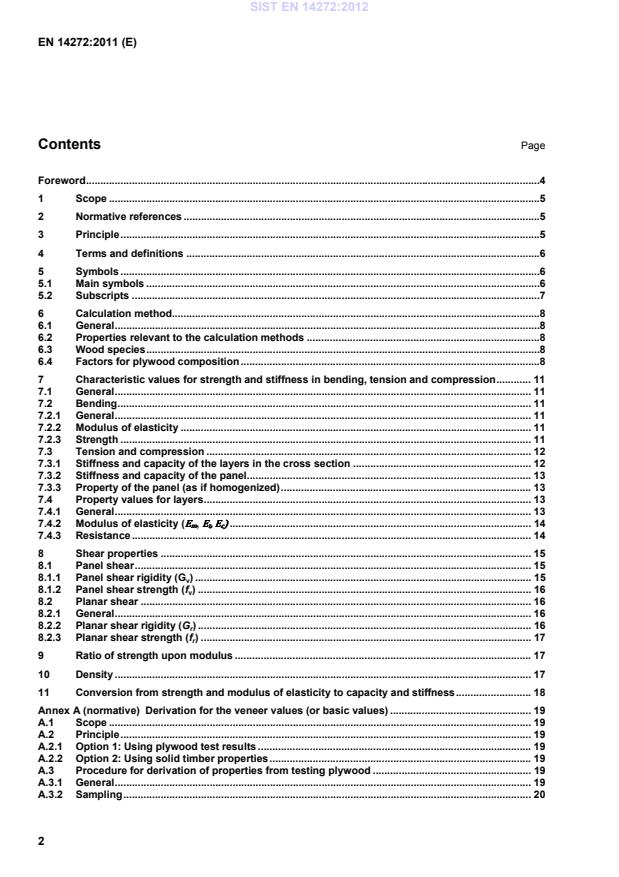
Derivation for the veneer values (or basic values) . 19A.1 Scope . 19A.2 Principle . 19A.2.1 Option 1: Using plywood test results . 19A.2.2 Option 2: Using solid timber properties . 19A.3 Procedure for derivation of properties from testing plywood . 19A.3.1 General . 19A.3.2 Sampling . 20SIST EN 14272:2012
Practical spreadsheets to derive the properties . 27B.1 General . 27B.2 Bending . 28B.2.1 General . 28B.2.2 Main tables . 28B.2.3 Tables for strength values . 31B.3 Tension and compression . 33B.4 Panel shear . 39B.5 Planar shear . 40B.5.1 General . 40B.5.2 Available veneer values . 40B.5.3 Veneer values not available . 42Annex C (informative)
Example of bending strength . 43C.1 Determination of the stress in the layers . 43C.2 Determination of the panel strength . 45Bibliography . 47 SIST EN 14272:2012
Provided that structural characteristic values are taken for the layers, the resulting values for the panels can be used as characteristic values as required by EN 1995-1-1. Conversely, Annex A defines the procedures to derive the veneer properties, in bending, tension and compression, either from testing panels according to EN 789 and EN 1058 or from timber testing according to EN 408 or from imposed values defined in EN 338. Annex B provides practical spreadsheets, which are applications of the equations in the main part of this standard. Annex C provide an example for the calculation of bending strength, in accordance with Annex B. 2 Normative references The following referenced documents are indispensable for the application of this document. For dated references, only the edition cited applies. For undated references, the latest edition of the referenced document (including any amendments) applies. EN 325, Wood-based panels — Determination of dimensions of test pieces EN 338:2009, Structural timber — Strength classes EN 384, Structural timber — Determination of characteristic values of mechanical properties and density EN 408, Timber structures — Structural timber and glued laminated timber — Determination of some physical and mechanical properties EN 789, Timber structures — Test methods — Determination of mechanical properties of wood based panels EN 1058, Wood-based panels — Determination of characteristic 5-percentile values and characteristic mean values EN 12369-2, Wood-based panels — Characteristic values for structural design — Part 2 Plywood EN 14358, Timber structures — Calculation of characteristic 5-percentile values and acceptance criteria for a sample 3 Principle Using the mechanical properties of the wood species, which compound the layers (in this standard referred to as veneer or basic values), it consists in deriving, by calculation, the mechanical properties of a panel.
For bending, tension and compression, each layer property value, along and across the length of the panel, is weighted by a geometrical factor related to its weight in the panel cross section.
NOTE Characteristic values of the wood species, along and across the grain, are fifth percentile values for strength but either mean values or fifth percentile values for stiffness (modulus of elasticity). 4.5 reference panel value value of a given mechanical property of a panel composition NOTE
It is to be used to derive the veneer value (or basic value) of the property.
5 Symbols 5.1 Main symbols A area (b · tnom), in square millimetres f strength, in Newtons per square millimetre E modulus of elasticity, in Newton per square millimetre Fs shear forces in a bending panel, in Newtons SIST EN 14272:2012
density, in kilograms per cubic metre ka modification factor, appearance class grade z distance of the axis of a layer to the neutral axis of the panel, in millimetres Ζ
distance of the neutral axis from either face of the panel, in millimetres Ecc eccentricity factor, no dimension ∆L/L relative elongation of the layers (bending, tension and compression) P property V strength or modulus, in Newton per square millimetre Rw in the set of layers, the weaker ratio of strength upon modulus for the properties of the wood species involved in the composition of a panel Up stiffness of the panel s standard deviation 5.2 Subscripts m bending t tension c compression v panel shear r planar shear w applies to the lower ratio strength/modulus (f/E) of a property of a layer in a multi-species panel
nom, mean nominal value and mean value respectively n number of layers of the panel (from top face to bottom face) i rank of layers from top face ax stands for neutral axis in bending ρ density 0 parallel to length of the plywood (direction of the grain of the face layers) 90 perpendicular to the length SIST EN 14272:2012
(Modulus of elasticity of the ith layer in Table 2) (1) or
ifiV=
(Strength of the ith layer in Table 2) (2) SIST EN 14272:2012
fm, 05: Bending
ft, 05: Tension
fc, 05: Compression
fv, 05: Panel shear
fr, 05: Planar shear Mean values for stiffness properties, N/mm2
Em: Bending
Et: Tension
Ec: Compression
Gv: Panel shear Characteristic values for stiffness properties, N/mm2
Em, 05: Bending
Et, 05: Tension
Ec, 05: Compression
Gv, 05: Panel shear
ρ, 05: Density values, kg/m3
Layer
rank Wood
Species ti (mm) Vi
(N/mm²)kai Grain direction 1
========== 2
lllllllllllllllllllll 3
========== ------------- ----------------- ----------------- ----------------- ----------------- ---------------------------------------- i -1
========== i
llllllllllllllllllll i+1
========== ------------- ----------------- ----------------- ----------------- ----------------- ---------------------------------------- n -2
========== n -1
lllllllllllllllllllll n
========== ti : layer thickness Vi : mechanical property of the ith layer ka : appearance factor ====== : grain along the length llllllllllllllll : grain across the length SIST EN 14272:2012
7.2 Bending 7.2.1 General The general equation to be used for the derivation of the second moment of area of a cross section is based on the area Ai of the elementary rectangles compounding the cross section of the panel: ∑∑====×+×=niiiiniiiitAzAI121212 (3) NOTE This equation can be applied to any composition, symmetrical or not. If calculation is based on a unit of width, Equation (3) becomes: ∑∑====+×=niiiniiiitztI131212 (4) 7.2.2 Modulus of elasticity The stiffness of the panel (as if homogenised) is equal to the sum of the stiffness of the compounding layers as defined by the following equation: ∑∑====×+××=×=×niiiminiiiimimmtVztVTEpIEp131231212 (5) 31131212×+×××=∑∑∑======niiiniiiminiiiimimttVztVEp (6) Width is assumed to be equal to 1 unit.
Cross layers properties can be taken into account where the values are derived from timber. Emi shall be input as 0 wherever the cross layers are not taken into account in the determination of the basic values as defined in Annex A. Annex B provide practical spreadsheets to carry out this calculation (see Tables B.1 and B.2).
7.2.3 Strength The capacity of the panel (as if homogenised) is equal to the sum of the capacities of the compounding layers as defined by the following equations: SIST EN 14272:2012
ZtttVztVfpniiiniiiniiiminiiiimim×××+×××=∑∑∑∑========2121311312 (8) It can be simplified as: 211312212×××+×××=∑∑∑======niiiniiiminiiiimimtZtVztVfp (9) Width is assumed to be equal to 1 unit. NOTE 1 However, Equation (8) should be preferred because it allows the use of the same procedure of calculation as Equation (6), the difference between Equations (6) and (8) lying in the factor of eccentricity of the neutral axis Ecc = T/2Ζ
to be applied on the result yielded by Equation (5). ZtZTEccniii×==∑==221 (10) Ζ is the distance (or eccentricity) of the neutral axis to either face or back face. Where composition is not symmetrical, the bigger value shall be picked so as to be on the safe side; it is expressed as: −=∑==niiaxiaxZtZZ1;max (11) NOTE 2 For symmetrical composition Ζ = T/2 and the calculation can be made using Equation (6) where Epm value is substituted by fmp value. For safety in the determination of the ultimate limit state, cross layers properties shall not be taken into account. Annex B provide practical spreadsheets to carry out this calculation (see Tables B.1 to B.4). 7.3 Tension and compression 7.3.1 Stiffness and capacity of the layers in the cross section The stiffness or capacity of the panel is given by: SIST EN 14272:2012
Where the inner layers are not appearance graded, class 4 (ka = 0,75) shall be assumed. NOTE This table is relevant where the basic values are derived from panels made of veneers with an appearance grade E, I or II. Where these values are derived from panels with faces with appearance class III, ka, if faces are classified IV, is derived according to: 88.0,,==basicalayeraakkk (15) where SIST EN 14272:2012
ka of the veneer of the layer of the panel to be calculated. 7.4.2 Modulus of elasticity (, ––––…………;;;; For bending as well as for tension and compression, the basic value of the modulus of elasticity of the veneer of the plies of each layer is input, weighted with the appearance class, together with the thickness of the layer.
iaiiEkV×= (16) If the purpose is to derive a mean value or a 5th percentile for the panel, then the mean modulus or the 5th modulus respectively is input. 7.4.3 Resistance 7.4.3.1 General For strength properties, the veneer value of a specified layer depends on: the corresponding property of its wood species; its stress level.
7.4.3.2 Common procedure to bending, tension and compression Firstly, the 5th percentile value of the strength of the wood species of each layer is picked (in accordance with Annex A). Secondly, the stress level in the layer shall be derived prior to enter the stress value; though similar in principle, the procedure for tension-compression and bending differ slightly. Thirdly, in case of mixed species panels or of mixed grade single species panels, as the weaker layer(s) may fail before reaching the maximum load, the procedure of calculation shall be resumed. Once the first calculation is over, the weaker layer(s) and the corresponding panel strength is recorded in the relevant direction of grain, another calculation shall be carried out with the input, for them, of close to 0 values for strength and modulus of elasticity (but the input shall be such that the value of the ratio fmi/Emi shall not be the lower in the composition). NOTE 1 For instance, an equal value of 1/1000 N/mm² can be input for Emi and fmi. Indeed, for the weaker layer(s), zero values cannot be input in the equations (or the spreadsheets of Annex B) because the calculation of the ratio fmi/Emi of the layer(s) cannot be determined. This result of the calculation is then recorded. This procedure shall be repeated as long as the result of strength is greater than the one obtained previously. As soon as the strength value is less than the previous one, the higher value in the set of results provided by the repetition of the procedure shall be accepted as the panel strength. NOTE 2 The repetition of the procedure is justified by the fact that EN 789 aims at determining the maximum force as the failure force. 7.4.3.3 Tension and compression strength (ft, fc) The strength Vi of the ith layer is given by: SIST EN 14272:2012
(17) Where Rwtc =→tcitcinEf1min (18) Rwtc is the minimum value taken by this ratio within the whole set of layers compounding the panel in the direction under consideration.
NOTE The layer (pair of layers where composition is symmetrical) made of the wood species with the lowest capacity in elongation in the set of layers is the first to fail. This corresponds to the lower ∆L / L (Rwtc) of the wood species involved in the panel composition: in the other layers, it determines a stress level less than the failure level.
According to species, fm/Em is in a range [2.5/1000 (red balau) - 10/1000 (kotibé)].
7.4.3.4 Bending strength (fm) First, the following ratio of the weaker layer in the composition is determined with Equation (19) ×=→miiminbEzfMinRw1 (19) Rwb is the minimum value taken by this ratio within the whole set of layers in the direction under consideration. When this weaker layer fails and if it is not the face layer (or closer to the face in crosswise bending), it entails a certain stress level in the reference face layer. It is given by Equation (20) 1111mbmfRwzES××=
(20) Then the stress value Vi of the ith layer is in proportion to the stress level of the first layer and takes the following value: miaiifkSV××=1
(21) 8 Shear properties 8.1 Panel shear 8.1.1 Panel shear rigidity (Gv) Panel shear rigidity Gv (as in EN 789) is an average value of shear rigidities of all the individual layers in the panel and shall be calculated with equation: ∑∑====××=niiiniiiviaivttGkG11 (22) SIST EN 14272:2012
vvvRwGf×= (23) where Rwv: =→vivinvGfMinRw1 (24) Table B.11 provides a calculation template. 8.2 Planar shear 8.2.1 General The planar shear properties are derived by using equations derived from those in EN 789 which defines a test method where a constant stress level is applied across the thickness of the panel.
NOTE In most of the practical conditions, such as bending, the stress level is not constant. Therefore, the designer can determine the distribution of the stress level across the thickness of the panel and compare it to the capacity of each layer. 8.2.2 Planar shear rigidity (Gr) 8.2.2.1 General Two options are possible: the available figures for stiffness apply to the homogenized panel (as derived from the current EN 789 calculation equations) or to the veneers across the shear direction. 8.2.2.2 Homogenized shear fitness Planar shear stiffness is determined by all the layers in each direction of the shear forces. It shall be calculated with:
∑∑====×=niiriaiiniiirGkttG11 (25) 8.2.2.3 Veneer shear stiffness Equation (25) applies but the thickness of the layers whose grain is parallel to the shear forces direction is not relevant. Therefore, the ti values of the layers across the shear forces direction are only input in Equation (25). NOTE Mechanically, mixing length and cross layers to derive a homogenized is rather approximate. Indeed, the layers whose grain is parallel to the shear forces are much stiffer than those across (they are even assumed as being infinitely stiff if compared to the layers whose grain is perpendicular to the shear force). However, EN 789 does not take this fact into account and gives only a homogenized shear planar modulus. Annex A provides details to derive the cross veneer stiffness modulus. SIST EN 14272:2012
In practice, short span (in relation to panel thickness) allows for high shear forces Fs, hence higher planar shear strains. 9 Ratio of strength upon modulus This ratio is needed to derive the strength of the panel for all properties addressed by EN 789. Two options are available to derive this ratio: either the equations defined in this part of the standard or an experimental derivation as defined in Annex A. The first option is the ratio of the 5th percentile value of the strength upon the mean value of the modulus of elasticity (as in this part); the second option is the 5th percentile value of this ratio as defined in Annex A. 10 Density The characteristics density of the panel (Pp,05) is calculated as follows: ∑==∑==×=ni1iiptniiiti105,05,
(28) The characteristic density of each wood species, of the ith layer in the panel is derived from its mean value in accordance with:
Bending fm MPa or N/mm2
fm W / b
N
Tension ft MPa or N/mm2
ft A / b
N/mm
Compression fc MPa or N/mm2
fc A / b
N/mm
Modulus of Elasticity Stiffnessa
Bending Em MPa or N/mm2
Em I / b
kNmm
Tension Et MPa or N/mm2
Et A / b
kN/mm
Compression Ec MPa or N/mm2
Ec A / b
kN/mm a The capacity and stiffness values are per unit panel width b.
Derivation for the veneer values (or basic values) A.1 Scope The calculation method is based on the fact that plywood is an engineered product and therefore can be manufactured in different compositions which may involve several wood species. If a wood species used in plywood panels, has no well-established properties values (strength and modulus of elasticity both for the mean and the characteristic value), this annex gives suitable methods to determine the property values to be applied to those species where used in plywood. A.2 Principle A.2.1 Option 1: Using plywood test results The veneer values of properties to be used for the layers of a given species are derived from the corresponding properties obtained by testing plywood panels symmetrically made of that single species. Properties along and possibly across the length of the panels are taken to derive the value of the property of the veneers: along their grain (length direction); across it only for the modulus of bending, tension and compression where both directions are tested. A.2.2 Option 2: Using solid timber properties Two sub-options are available: to test solid timber in accordance with EN 408 and EN 384; to use imposed values fully defined in EN 338.
In both cases, the modulus of bending, tension and compression across the length can be taken into account by referring to EN 338 values. NOTE These two options are penalizing, especially the EN 338 one.
A.3 Procedure for derivation of properties from testing plywood A.3.1 General Each of the plywood panels to be tested to provide the basic values of a given wood species shall be made entirely made of this wood species. The other following conditions apply: the minimum number of layers is 5; SIST EN 14272:2012
A.3.3 Test pieces A.3.3.1 Cutting Two options are allowed: cutting test pieces only along the length of the panels; cutting test pieces along and across the length of the panels. In both cases, the 32 test pieces corresponding to each direction to be tested shall be cut according to the cutting plans defined in EN 789. A.3.3.2 Conditioning The test pieces are conditioned in climate (20 ± 2) °C, (65 ± 5) % relative humidity as defined in EN 789. A.3.4 Testing A.3.4.1 Semi-size values A.3.4.1.1 General The procedure specified in EN 789 for modulus and strength applies to bending, tension and compression and shear (panel and planar).
For shear modulus, the testing as well as the exploitation of the results according to EN 789 provides a homogenised value but not a veneer value.
A.3.4.1.2 Planar shear modulus of elasticity EN 789 derives a homogenized Gr value for this property, suitable to all panels but plywood. Indeed, the stiffness of the layers parallel to shear direction is not of the same order as the stiffness of the layers across and their slip (u in the equation hereunder) can be neglected compared to that of the layers across. Therefore, the true modulus of elasticity of the veneers across the direction of the shear forces is given by the equation derived from the one in EN 789: SIST EN 14272:2012
A.3.4.2 Small test pieces values The procedure defined in EN 310 can be applied to the determination of the modulus of elasticity and the strength. NOTE This procedure can be useful to determine internal control values wherever only short production runs are available. It cannot claim relevance to load-bearing applications. A.3.4.3 Density It is measured on at least one test piece cut from each panel of the sample. A.3.4.4 Thickness The thickness of each panel is measured in accordance with EN 325. The thickness of the layers is either provided by the manufacturer or measured with a suitable device. NOTE Optical meters accurate to 1/10 mm are suitable. A.3.5 Exploitation of the results A.3.5.1 General The purpose of the calculation method is to get veneer characteristic values, 5th percentile or mean values (according to the property), for the wood species involved in the testing. The characteristic values of the relevant property of the layers are obtained from a reference value of the panel, along its tested direction. The thickness of each layer and its surface appearance are recorded. Then, according to the sampling, the reference values of each test piece are processed to yield a veneer value specific to the wood species along and, if relevant, across the length of the panel. A.3.5.2 Procedure for deriving a veneer value for a wood species A.3.5.2.1 General The procedure applies first to each test piece and then, the whole sample shall be processed taking into account the tested directions. SIST EN 14272:2012
...