


EN ISO 21909-1:2023
(Main)Passive neutron dosimetry systems - Part 1: Performance and test requirements for personal dosimetry (ISO 21909-1:2021)
Passive neutron dosimetry systems - Part 1: Performance and test requirements for personal dosimetry (ISO 21909-1:2021)
This document applies to all passive neutron detectors that can be used within a personal dosemeter in part or in all of the above-mentioned neutron energy range. No distinction between the different techniques available in the marketplace is made in the description of the tests. Only generic distinctions, for instance, as disposable or reusable dosemeters, are considered.
This document describes type tests only. Type tests are made to assess the basic characteristics of the dosimetry systems and are often ensured by recognized national laboratories
This document does not present performance tests for characterizing the degradation induced by the following:
— intrinsic temporal variability of the quality of the dosemeter supplied by the manufacturer;
— intrinsic temporal variability of preparation treatments (before irradiation and/or before reading), if existing;
— intrinsic temporal variability of reading process;
— degradation due to environmental effects on the preparation treatments, if existing;
— degradation due to environmental effects on the reading process.
This document gives information for extremity dosimetry in the Annex C, based on recommendations given by ICRU Report 66. This document addresses only neutron personal monitoring and not criticality accident conditions.
The links between this document and ISO 21909-2 are given in Annex A.
Passive Dosimetriesysteme für Neutronenstrahlung - Teil 1: Leistungs- und Prüfanforderungen an die Personendosimetrie (ISO 21909-1:2021)
Dieses Dokument liefert Leistungs- und Prüfanforderungen zur Feststellung der Eignung von Neutronendosi¬metriesystemen für die Messung der Tiefen-Personendosis Hp(10) von Neutronenstrahlung im Energiebereich von thermischer Energie bis 20 MeV1.
Dieses Dokument gilt für alle passiven Neutronendetektoren, die ganz oder teilweise in dem oben genannten Neutronenenergiebereich als Personendosimeter eingesetzt werden können. Bei der Beschreibung der Prüf¬verfahren wird nicht zwischen den verschiedenen auf dem Markt verfügbaren Techniken unterschieden. Nur allgemeine Unterscheidungen wie z. B. Einwegdosimeter oder wiederverwendbare Dosimeter werden getrof¬fen.
Dieses Dokument beschreibt nur die Bauartprüfungen. Bauartprüfungen werden durchgeführt, um die grund¬legenden Eigenschaften der Dosimetriesysteme zu ermitteln und werden häufig von anerkannten, nationalen Laboratorien durchgeführt.
Dieses Dokument beschreibt keine Leistungsprüfungen, die der Ermittlung eines Leistungsabfalls aufgrund folgender Umstände dienen:
immanente zeitliche Schwankung der Qualität des vom Hersteller gelieferten Dosimeters;
– immanente zeitliche Schwankung der Vorbehandlung (vor der Bestrahlung und/oder vor dem Auslesen), soweit zutreffend;
– immanente zeitliche Schwankung des Ausleseprozesses;
– Verschlechterung aufgrund von Umgebungseinflüssen auf die vorbereitende Behandlung, soweit zutref¬fend;
– Verschlechterung aufgrund von Umgebungseinflüssen auf den Ausleseprozess.
Dieses Dokument enthält im Anhang C Informationen für die Teilkörperdosimetrie, basierend auf den Empfeh¬lungen des ICRU Report 66. Dieses Dokument befasst sich nur mit der Personendosimetrie bei Neutronen¬strahlung und nicht mit den Bedingungen eines Kritikalitätsunfalls.
Die Verknüpfungen zwischen diesem Dokument und ISO 21909-2 sind in Anhang A angegeben.
Systèmes dosimétriques passifs pour les neutrons - Partie 1: Exigences de fonctionnement et d'essai pour la dosimétrie individuelle (ISO 21909-1:2021)
Le présent document fournit des exigences de fonctionnement et d’essai permettant de déterminer l’acceptabilité des systèmes dosimétriques pour les neutrons qui doivent être utilisés pour le mesurage de l’équivalent de dose individuel, Hp(10), dans une gamme d’énergies neutroniques s’étendant des énergies thermiques à 20 MeV.
Le présent document s’applique à tous les détecteurs passifs de neutrons utilisables dans un dosimètre individuel dans une partie ou dans toute la gamme d’énergies neutroniques mentionnée ci-dessus. Dans la description des essais, aucune distinction n’est faite entre les différentes techniques disponibles sur le marché. Seules des distinctions générales, telles que dosimètres à usage unique ou réutilisables par exemple, sont prises en compte.
Le présent document ne décrit que les essais de type. Les essais de type ont pour objet d’évaluer les caractéristiques de base des systèmes dosimétriques et ils sont souvent assurés par des laboratoires nationaux reconnus.
Le présent document ne décrit pas d’essais de fonctionnement pour caractériser la dégradation induite par:
— la variabilité temporelle intrinsèque de la qualité du dosimètre fourni par le fabricant;
— la variabilité temporelle intrinsèque des traitements de préparation (avant l’irradiation et/ou avant la lecture), le cas échéant;
— la variabilité temporelle intrinsèque du processus de lecture;
— les effets environnementaux sur les traitements de préparation, le cas échéant;
— les effets environnementaux sur le processus de lecture.
L’Annexe C du présent document fournit des informations relatives à la dosimétrie aux extrémités, basées sur les recommandations données dans le Rapport 66 de l’ICRU. Le présent document traite uniquement de la surveillance de la dose individuelle neutron, et non des conditions d’accident de criticité.
Les liens entre le présent document et l’ISO 21909-2 sont indiqués à l’Annexe A.
Sistemi pasivne nevtronske dozimetrije - 1. del: Zahteve za delovanje in preskušanje za osebno dozimetrijo (ISO 21909-1:2021)
Ta dokument podaja zahteve za delovanje in preskušanje za ugotavljanje sprejemljivosti sistemov nevtronske dozimetrije, ki se uporabljajo za merjenje ekvivalentne osebne doze, Hp(10), za
nevtrone z različno energijo od toplotne do 20 MeV1.
Ta dokument se uporablja za vse pasivne detektorje nevtronov, ki se lahko v osebnem dozimetru uporabljajo
delno ali v celotnem navedenem energijskem območju nevtronov. V opisu preskusov se ne razlikuje med različnimi tehnikami, ki so na voljo na trgu. Upoštevana so le splošna razlikovanja, na primer dozimetri za enkratno ali večkratno uporabo.
Ta dokument samo opisuje tipske preskuse. Tipski preskusi se izvajajo za ocenjevanje osnovnih značilnosti dozimetričnih sistemov in jih pogosto zagotavljajo priznani nacionalni laboratoriji.
V tem dokumentu niso predstavljeni preskusi delovanja za karakterizacijo degradacije, ki jo povzročajo
naslednji dejavniki:
– lastna časovna spremenljivost kakovosti dozimetra, ki ga je dobavil proizvajalec;
– lastna časovna spremenljivost pripravljalnih postopkov (pred obsevanjem in/ali pred odčitavanjem),
če obstajajo;
– lastna časovna spremenljivost postopka odčitavanja;
– degradacija zaradi okoljskih vplivov na pripravljalne postopke, če obstajajo;
– degradacija zaradi okoljskih vplivov na postopek odčitavanja.
General Information
- Status
- Published
- Publication Date
- 18-Jul-2023
- Current Stage
- 6060 - Definitive text made available (DAV) - Publishing
- Start Date
- 19-Jul-2023
- Due Date
- 26-Apr-2025
- Completion Date
- 19-Jul-2023
Relations
- Effective Date
- 09-Feb-2026
- Effective Date
- 09-Feb-2026
- Effective Date
- 28-Jan-2026
- Effective Date
- 28-Jan-2026
- Effective Date
- 09-Feb-2026
Overview
EN ISO 21909-1:2023 (adoption of ISO 21909-1:2021 by CEN) specifies performance and test requirements for passive neutron dosimetry systems used in personal dosimetry. The standard applies to all passive neutron detectors that can be used wholly or partly within a personal dosemeter across the neutron energy range. It focuses on type tests - laboratory evaluations of basic characteristics - typically carried out by recognized national laboratories. The document addresses routine personal monitoring and gives additional guidance for extremity dosimetry (Annex C, based on ICRU Report 66). It does not cover criticality accident conditions or long‑term degradation arising from intrinsic temporal variability or environmental effects on preparation/reading processes.
Key topics and requirements
- Scope and definitions for passive neutron dosimetry systems and quantities relevant to personal dose monitoring.
- General test conditions and reference radiation requirements for reproducible type testing.
- Performance tests for intrinsic characteristics, including:
- Controlled irradiations and dose response measurements
- Coefficient of variation (precision) and linearity of response
- Energy and angle dependence of the dosimeter response
- Specific tests for thermal neutron sensitivity
- Stability and robustness tests simulating realistic use:
- Fading, ageing, and storage effects for unexposed dosemeters
- Effects of photon cross‑exposure, radon, climatic conditions, light exposure, and mechanical stress (drop tests)
- Effects of distance to a phantom and sealing
- Qualification procedures that may allow simplification (e.g., eliminating full neutron/photon packages) with documented test methods and interpretation rules.
- Identification and documentation requirements for traceability and user information.
- Links to ISO 21909‑2 for related test methods and interpretation (Annex A).
Practical applications and users
This standard is essential for:
- Dosimetry manufacturers designing, qualifying, and documenting passive neutron personal dosemeters (disposable or reusable).
- Accredited calibration and test laboratories performing type tests and issuing conformity reports.
- Radiation protection officers, health physicists, and employers implementing personal monitoring programs for neutron workers.
- Regulatory bodies and procurement teams specifying acceptance criteria and compliance for workplace neutron monitoring.
Use EN ISO 21909-1:2023 to ensure reliable, consistent testing and performance characterization of passive neutron dosimetry systems, improve workplace radiation protection, and support procurement and regulatory compliance.
Related standards
- ISO 21909‑2 (linked in Annex A) - complementary methods and guidance
- ICRU Report 66 - recommendations referenced for extremity dosimetry guidance

Get Certified
Connect with accredited certification bodies for this standard

NSF International
Global independent organization facilitating standards development and certification.

BSMI (Bureau of Standards, Metrology and Inspection)
Taiwan's standards and inspection authority.
CIS Institut d.o.o.
Personal Protective Equipment (PPE) certification body. Notified Body NB-2890 for EU Regulation 2016/425 PPE.
Sponsored listings
Frequently Asked Questions
EN ISO 21909-1:2023 is a standard published by the European Committee for Standardization (CEN). Its full title is "Passive neutron dosimetry systems - Part 1: Performance and test requirements for personal dosimetry (ISO 21909-1:2021)". This standard covers: This document applies to all passive neutron detectors that can be used within a personal dosemeter in part or in all of the above-mentioned neutron energy range. No distinction between the different techniques available in the marketplace is made in the description of the tests. Only generic distinctions, for instance, as disposable or reusable dosemeters, are considered. This document describes type tests only. Type tests are made to assess the basic characteristics of the dosimetry systems and are often ensured by recognized national laboratories This document does not present performance tests for characterizing the degradation induced by the following: — intrinsic temporal variability of the quality of the dosemeter supplied by the manufacturer; — intrinsic temporal variability of preparation treatments (before irradiation and/or before reading), if existing; — intrinsic temporal variability of reading process; — degradation due to environmental effects on the preparation treatments, if existing; — degradation due to environmental effects on the reading process. This document gives information for extremity dosimetry in the Annex C, based on recommendations given by ICRU Report 66. This document addresses only neutron personal monitoring and not criticality accident conditions. The links between this document and ISO 21909-2 are given in Annex A.
This document applies to all passive neutron detectors that can be used within a personal dosemeter in part or in all of the above-mentioned neutron energy range. No distinction between the different techniques available in the marketplace is made in the description of the tests. Only generic distinctions, for instance, as disposable or reusable dosemeters, are considered. This document describes type tests only. Type tests are made to assess the basic characteristics of the dosimetry systems and are often ensured by recognized national laboratories This document does not present performance tests for characterizing the degradation induced by the following: — intrinsic temporal variability of the quality of the dosemeter supplied by the manufacturer; — intrinsic temporal variability of preparation treatments (before irradiation and/or before reading), if existing; — intrinsic temporal variability of reading process; — degradation due to environmental effects on the preparation treatments, if existing; — degradation due to environmental effects on the reading process. This document gives information for extremity dosimetry in the Annex C, based on recommendations given by ICRU Report 66. This document addresses only neutron personal monitoring and not criticality accident conditions. The links between this document and ISO 21909-2 are given in Annex A.
EN ISO 21909-1:2023 is classified under the following ICS (International Classification for Standards) categories: 13.280 - Radiation protection; 17.240 - Radiation measurements. The ICS classification helps identify the subject area and facilitates finding related standards.
EN ISO 21909-1:2023 has the following relationships with other standards: It is inter standard links to ISO 29661:2012, ISO 12789-1:2008, EN 2588:2006, EN 71-20:2025, prEN IEC 61526:2025. Understanding these relationships helps ensure you are using the most current and applicable version of the standard.
EN ISO 21909-1:2023 is available in PDF format for immediate download after purchase. The document can be added to your cart and obtained through the secure checkout process. Digital delivery ensures instant access to the complete standard document.
Standards Content (Sample)
SLOVENSKI STANDARD
01-september-2023
Sistemi pasivne nevtronske dozimetrije - 1. del: Zahteve za delovanje in
preskušanje za osebno dozimetrijo (ISO 21909-1:2021)
Passive neutron dosimetry systems - Part 1: Performance and test requirements for
personal dosimetry (ISO 21909-1:2021)
Systèmes dosimétriques passifs pour les neutrons - Partie 1: Exigences de
fonctionnement et d'essai pour la dosimétrie individuelle (ISO 21909-1:2021)
Ta slovenski standard je istoveten z: EN ISO 21909-1:2023
ICS:
13.280 Varstvo pred sevanjem Radiation protection
17.240 Merjenje sevanja Radiation measurements
2003-01.Slovenski inštitut za standardizacijo. Razmnoževanje celote ali delov tega standarda ni dovoljeno.
EN ISO 21909-1
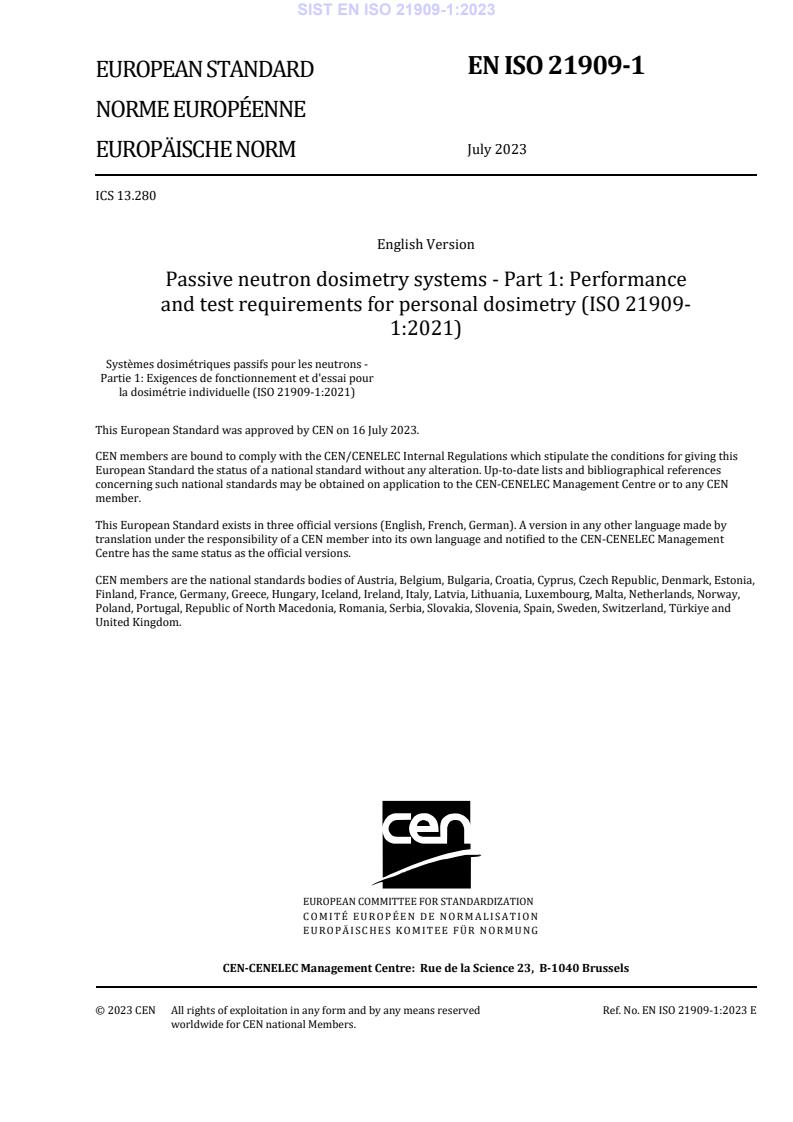
EUROPEAN STANDARD
NORME EUROPÉENNE
July 2023
EUROPÄISCHE NORM
ICS 13.280
English Version
Passive neutron dosimetry systems - Part 1: Performance
and test requirements for personal dosimetry (ISO 21909-
1:2021)
Systèmes dosimétriques passifs pour les neutrons -
Partie 1: Exigences de fonctionnement et d'essai pour
la dosimétrie individuelle (ISO 21909-1:2021)
This European Standard was approved by CEN on 16 July 2023.
CEN members are bound to comply with the CEN/CENELEC Internal Regulations which stipulate the conditions for giving this
European Standard the status of a national standard without any alteration. Up-to-date lists and bibliographical references
concerning such national standards may be obtained on application to the CEN-CENELEC Management Centre or to any CEN
member.
This European Standard exists in three official versions (English, French, German). A version in any other language made by
translation under the responsibility of a CEN member into its own language and notified to the CEN-CENELEC Management
Centre has the same status as the official versions.
CEN members are the national standards bodies of Austria, Belgium, Bulgaria, Croatia, Cyprus, Czech Republic, Denmark, Estonia,
Finland, France, Germany, Greece, Hungary, Iceland, Ireland, Italy, Latvia, Lithuania, Luxembourg, Malta, Netherlands, Norway,
Poland, Portugal, Republic of North Macedonia, Romania, Serbia, Slovakia, Slovenia, Spain, Sweden, Switzerland, Türkiye and
United Kingdom.
EUROPEAN COMMITTEE FOR STANDARDIZATION
COMITÉ EUROPÉEN DE NORMALISATION
EUROPÄISCHES KOMITEE FÜR NORMUNG
CEN-CENELEC Management Centre: Rue de la Science 23, B-1040 Brussels
© 2023 CEN All rights of exploitation in any form and by any means reserved Ref. No. EN ISO 21909-1:2023 E
worldwide for CEN national Members.
Contents Page
European foreword . 3
European foreword
The text of ISO 21909-1:2021 has been prepared by Technical Committee ISO/TC 85 "Nuclear energy,
nuclear technologies, and radiological protection” of the International Organization for Standardization
(ISO) and has been taken over as EN ISO 21909-1:2023 by Technical Committee CEN/TC 430 “Nuclear
energy, nuclear technologies, and radiological protection” the secretariat of which is held by AFNOR.
This European Standard shall be given the status of a national standard, either by publication of an
identical text or by endorsement, at the latest by January 2024, and conflicting national standards shall
be withdrawn at the latest by January 2024.
Attention is drawn to the possibility that some of the elements of this document may be the subject of
patent rights. CEN shall not be held responsible for identifying any or all such patent rights.
Any feedback and questions on this document should be directed to the users’ national standards body.
A complete listing of these bodies can be found on the CEN website.
According to the CEN-CENELEC Internal Regulations, the national standards organizations of the
following countries are bound to implement this European Standard: Austria, Belgium, Bulgaria,
Croatia, Cyprus, Czech Republic, Denmark, Estonia, Finland, France, Germany, Greece, Hungary, Iceland,
Ireland, Italy, Latvia, Lithuania, Luxembourg, Malta, Netherlands, Norway, Poland, Portugal, Republic of
North Macedonia, Romania, Serbia, Slovakia, Slovenia, Spain, Sweden, Switzerland, Türkiye and the
United Kingdom.
Endorsement notice
The text of ISO 21909-1:2021 has been approved by CEN as EN ISO 21909-1:2023 without any
modification.
INTERNATIONAL ISO
STANDARD 21909-1
Second edition
2021-12
Passive neutron dosimetry systems —
Part 1:
Performance and test requirements
for personal dosimetry
Systèmes dosimétriques passifs pour les neutrons —
Partie 1: Exigences de fonctionnement et d'essai pour la dosimétrie
individuelle
Reference number
ISO 21909-1:2021(E)
ISO 21909-1:2021(E)
© ISO 2021
All rights reserved. Unless otherwise specified, or required in the context of its implementation, no part of this publication may
be reproduced or utilized otherwise in any form or by any means, electronic or mechanical, including photocopying, or posting on
the internet or an intranet, without prior written permission. Permission can be requested from either ISO at the address below
or ISO’s member body in the country of the requester.
ISO copyright office
CP 401 • Ch. de Blandonnet 8
CH-1214 Vernier, Geneva
Phone: +41 22 749 01 11
Email: copyright@iso.org
Website: www.iso.org
Published in Switzerland
ii
ISO 21909-1:2021(E)
Contents Page
Foreword .v
Introduction .vii
1 Scope . 1
2 Normative references . 1
3 Terms and definitions . 2
3.1 General terms and definitions . 2
3.2 Quantities . 3
3.3 Calibration and evaluation . . 5
3.4 List of symbols . 7
4 General test conditions .9
4.1 Test conditions . 9
4.2 Reference radiation . 9
5 Test and performance requirements .10
6 Qualification for eliminating the use of the full neutron and photon package .11
6.1 Purpose of the test . 11
6.2 Method of test . 11
6.3 Interpretation of results . 11
7 Performance tests for the intrinsic characteristics of the dosimetry systems .12
7.1 General .12
7.2 Irradiations .12
7.3 Coefficient of variation . 16
7.3.1 General . 16
7.3.2 Method of test . 16
7.3.3 Interpretation of results . 17
7.4 Linearity . 17
7.4.1 General . 17
7.4.2 Method of test . 17
7.4.3 Interpretation of results . 17
7.5 Energy and angle dependence of the response. 18
7.5.1 General . 18
7.5.2 Method of test . 18
7.5.3 Interpretation of results . 18
7.6 Specific test for thermal neutrons . 18
7.6.1 General . 18
7.6.2 Method of test . 19
7.6.3 Interpretation of results . 19
8 Performance tests for stability in the range of realistic conditions of use of the
dosemeters .19
8.1 Fading . 19
8.1.1 General . 19
8.1.2 Method of test . 19
8.1.3 Interpretation of results . 20
8.2 Ageing . 20
8.2.1 General .20
8.2.2 Method of test . 20
8.2.3 Interpretation of results . 20
8.3 Effect of storage for unexposed dosemeters . 21
8.3.1 General . 21
8.3.2 Method of test . 21
8.3.3 Interpretation of results . 21
8.4 Exposure to radiation other than neutrons . 21
iii
ISO 21909-1:2021(E)
8.4.1 General . 21
8.4.2 Photon radiation . 21
8.4.3 Radon . 23
8.5 Stability under various climatic conditions . 23
8.5.1 General .23
8.5.2 Effect on the dose equivalent response . 23
8.5.3 Effect for unexposed dosemeters . 24
8.6 Effect of light exposure (sensitivity to light) . 24
8.6.1 Effect on the dose response . 24
8.6.2 Effect for unexposed dosemeters . 25
8.7 Drop test . 25
8.7.1 Effect on the dose response . 25
8.7.2 Effect for unexposed dosemeters . 26
8.8 Distance to the phantom. 26
8.8.1 General .26
8.8.2 Method of test . 26
8.8.3 Interpretation of results . 27
8.9 Sealing . 27
9 Identification and accompanying documentation .27
9.1 Individual marking . 27
9.2 Collective marking . 27
9.3 Accompanying documentation . 27
Annex A (informative) Links between this document and ISO 21909-2 .29
Annex B (normative) Performance requirements .30
Annex C (informative) Dosimetry for the irradiation of the extremities .35
Annex D (normative) Reference and standard test conditions .36
Annex E (normative) Irradiation conditions .37
Annex F (normative) Confidence limits .38
Bibliography .42
iv
ISO 21909-1:2021(E)
Foreword
ISO (the International Organization for Standardization) is a worldwide federation of national standards
bodies (ISO member bodies). The work of preparing International Standards is normally carried out
through ISO technical committees. Each member body interested in a subject for which a technical
committee has been established has the right to be represented on that committee. International
organizations, governmental and non-governmental, in liaison with ISO, also take part in the work.
ISO collaborates closely with the International Electrotechnical Commission (IEC) on all matters of
electrotechnical standardization.
The procedures used to develop this document and those intended for its further maintenance are
described in the ISO/IEC Directives, Part 1. In particular the different approval criteria needed for the
different types of ISO documents should be noted. This document was drafted in accordance with the
editorial rules of the ISO/IEC Directives, Part 2 (see www.iso.org/directives).
Attention is drawn to the possibility that some of the elements of this document may be the subject of
patent rights. ISO shall not be held responsible for identifying any or all such patent rights. Details of
any patent rights identified during the development of the document will be in the Introduction and/or
on the ISO list of patent declarations received (see www.iso.org/patents).
Any trade name used in this document is information given for the convenience of users and does not
constitute an endorsement.
For an explanation on the voluntary nature of standards, the meaning of ISO specific terms and
expressions related to conformity assessment, as well as information about ISO's adherence to the
World Trade Organization (WTO) principles in the Technical Barriers to Trade (TBT) see the following
URL: www.iso.org/iso/foreword.html. This document was prepared by technical committee ISO/TC 85,
Nuclear energy, nuclear technologies, and radiological protection, Subcommittee SC 2, Radiological
protection.
This second edition cancels and replaces ISO 21909:2015, which has been technically revised.
The main changes compared to the previous edition, based on feedbacks from laboratories applying
ISO 21909-1, are as follows:
— link between ISO 21909-1 and ISO 21909-2 improved by the addition of a flow chart explaining the
link between the two parts;
— irradiations qualities for the energy test modified:
— fast energy range enlarged to a range between 10 MeV and 19 MeV;
— modification of the possible relative contribution of the thermal field in the mixed field composed
252 241
of Cf or Am-Be with a thermal one;
— modification in the tests and/or criteria for:
— the test to potentially eliminate the use of the full neutron and photon package;
— the test of the coefficient of variation: criteria given by a function;
— the linearity test: modifications in the equation and associated criteria consequently;
— the energy and angle dependence of the response test: modification of the performance limits
using trumpet curves;
— alignment of the criteria for the following 3 tests: Stability under various climatic conditions/
effect of light exposure (opacity to light) / effect of storage, all for unexposed dosemeters.
A list of all parts in the ISO 21909 series can be found on the ISO website.
v
ISO 21909-1:2021(E)
Any feedback or questions on this document should be directed to the user’s national standards body. A
complete listing of these bodies can be found at www.iso.org/members.html.
vi
ISO 21909-1:2021(E)
Introduction
This document gives laboratory-based performance and test requirements for passive dosimetry
systems to be used for the determination of personal dose equivalent, H (10), in neutron fields with
p
energies ranging from thermal to approximately 20 MeV.
A dosimetry system may consist of the following elements:
a) a passive device, referred to here as a detector, which, after the exposure to radiation, stores
information (signal) for use in measuring one or more quantities of the incident radiation field;
b) a dosemeter, made up of one or more detector(s) incorporated together and with some means of
identification;
c) a reader which is used to read out the stored signal from the detector, and the associated algorithm,
if applicable, aiming to determine the personal dose equivalent.
A treatment to prepare the dosemeter before irradiation and/or before reading is also part of the
process and is considered in the document.
This document does not focus on any technique in particular, but intends to be general, including new
techniques as they emerge. When distinctions are necessary, they are defined as generically as possible,
e.g., disposable/reusable dosemeters and photon-sensitive dosemeters. In conclusion, no performance
tests are dedicated to one particular technique, unless it is absolutely necessary. Consequently, this
document aims to define performance tests leading to similar results, independently of the techniques
used.
The main objective of this document is to achieve correspondence between performance tests and
conditions of use at workplaces. Dosimetry systems complying with this document exhibit consistent
annual dosimetry results in workplace environments. Reaching such an objective means that this
document accounts for the various situations of exposure in terms of dose levels and neutron energy
distributions.
Annual exposures of many workers comprise the sum of several low doses close to the minimum
recording value. The dosemeter needs therefore to be well characterized, not only for use in relatively
high dose situations but also for use in low dose situations, to ensure that the annual dose is determined
with an adequate uncertainty. In this document, false positive events when there is not any irradiation,
are considered but there is no test of the detection threshold by measuring the background signal of
the dosemeter when it is not irradiated. However, all the tests aimed at characterizing the dosimetric
performance of the system (coefficient of variation and linearity, energy and angle dependence of
the responses) are required at two levels of dose: around 1 mSv and close to the minimum recording
value. The criteria applied at these two levels of dose could differ. This choice is made to ensure that
dosimetric systems are adapted to the range of doses usually encountered at workplaces.
The main goal of this document is to ensure that a dosemeter is reliable enough to use in most
workplaces. Reference neutron radiation characteristics and methodologies for the proper calibration
of the dosemeters are reported in ISO 8529 (all parts), ISO 12789-1 and ISO 29661. The dose equivalent
241 252
distributions of the most common reference radiation sources (e.g. Am-Be or Cf) as used for
calibration are generally higher in energy (where the fluence-to-dose-equivalent conversion coefficients
are greater) than the ones encountered in workplaces. The performance of the dosemeters for neutron
energies between a few tens and a few hundreds of keV specifically needs to be determined to ensure
good response in most of the workplaces. To address this need, some performance tests with mono-
energetic neutrons fields at low energies are required in this document.
241 252
One well-characterized neutron field (e.g., Am-Be or Cf) is sufficient to test the stability of
dosimetric performances for influencing factors (e.g., fading, ageing, the impact of non-neutron radiation
on the neutron signal, harsh climatic conditions, light exposure, physical damage, and sealing).
vii
ISO 21909-1:2021(E)
This document does not present performance tests for characterizing any type of potential degradation
(see Scope). However, to ensure the stability of the dosimetry system, it is necessary for the laboratory
to evaluate the potential degradation and/or set adapted controls on processing.
For the case that a dosimetry system does not comply with the full range of requirements of this
document with regard to the dependence of the response on the energy and direction distributions
of the neutron fluence, it is necessary to evaluate the performance for the conditions of the selected
workplace. This is addressed in ISO 21909-2 which gives methodologies and criteria to qualify the
dosimetry system at the workplace. Even when the dosimetry system fulfils the requirements of this
document, it may still be desirable to make a similar study at the workplace.
This document may be extended in the future to another part for the ambient dose equivalent H*(10)
for ambient and environmental dosimetry.
viii
INTERNATIONAL STANDARD ISO 21909-1:2021(E)
Passive neutron dosimetry systems —
Part 1:
Performance and test requirements for personal
dosimetry
1 Scope
This document provides performance and test requirements for determining the acceptability of
neutron dosimetry systems to be used for the measurement of personal dose equivalent, H (10), for
p
1)
neutrons ranging in energy from thermal to 20 MeV .
This document applies to all passive neutron detectors that can be used within a personal dosemeter
in part or in all of the above-mentioned neutron energy range. No distinction between the different
techniques available in the marketplace is made in the description of the tests. Only generic distinctions,
for instance, as disposable or reusable dosemeters, are considered.
This document describes type tests only. Type tests are made to assess the basic characteristics of the
dosimetry systems and are often ensured by recognized national laboratories
This document does not present performance tests for characterizing the degradation induced by the
following:
— intrinsic temporal variability of the quality of the dosemeter supplied by the manufacturer;
— intrinsic temporal variability of preparation treatments (before irradiation and/or before reading),
if existing;
— intrinsic temporal variability of reading process;
— degradation due to environmental effects on the preparation treatments, if existing;
— degradation due to environmental effects on the reading process.
This document gives information for extremity dosimetry in the Annex C, based on recommendations
given by ICRU Report 66. This document addresses only neutron personal monitoring and not criticality
accident conditions.
The links between this document and ISO 21909-2 are given in Annex A.
2 Normative references
The following documents are referred to in the text in such a way that some or all of their content
constitutes requirements of this document. For dated references, only the edition cited applies. For
undated references, the latest edition of the referenced document (including any amendments) applies.
ISO 29661, Reference radiation fields for radiation protection — Definitions and fundamental concepts
1) This maximal limit of the energy range is only an order of magnitude. The reference radiation fields used
for the performance tests are those defined in ISO 8529-1. This means that the maximal energies could only be
14,8 MeV or 19 MeV. This document gives performance requirements to 14,8 MeV which is the typical neutron
energy encountered for fusion. For fission spectra, the highest energies are around 20 MeV but the contribution to
dose equivalent coming from neutrons with energy higher than 14,8 MeV is negligible.
ISO 21909-1:2021(E)
ISO 21909-2, Passive neutron dosimetry systems — Part 2: Methodology and criteria for the qualification
of personal dosimetry systems in workplaces
ISO 8529-1, Reference neutron radiations — Part 1: Characteristics and methods of production
ISO 8529-2, Reference neutron radiations — Part 2: Calibration fundamentals of radiation protection
devices related to the basic quantities characterizing the radiation field
ISO 8529-3, Reference neutron radiations — Part 3: Calibration of area and personal dosimeters and
determination of response as a function of energy and angle of incidence
ISO 12789-1, Reference radiation fields — Simulated workplace neutron fields — Part 1: Characteristics
and methods of production
JCGM 100, GUM 1995 with minor corrections, Evaluation of measurement, data — Guide to the expression
of uncertainty in measurement
3 Terms and definitions
For the purposes of this document, the following terms and definitions apply.
ISO and IEC maintain terminological databases for use in standardization at the following addresses:
— ISO Online browsing platform: available at https:// www .iso .org/ obp
— IEC Electropedia: available at http:// www .electropedia .org/
3.1 General terms and definitions
3.1.1
ageing
change with time of physical, chemical or electrical properties of a component or module under specified
operating conditions, which could result in degradation of significant performance characteristics
[SOURCE: IEC 60050-393:2007, 393-18-41]
3.1.2
detector
radiation detector
apparatus or substance used to convert incident ionizing radiation energy into a signal suitable for
indication and/or measurement
[SOURCE: IEC 60050-394:2007, 394-24-01, modified — The term “detector” has been added as the first
preferred term.]
3.1.3
fading
loss of signal under certain circumstances such as storage, transmission, humidity or temperature
change
[SOURCE: IEC 60050-393:2007, 393-38-54]
3.1.4
dosemeter
dosimeter
device having a reproducible, measurable response to radiation that can be used to measure the
absorbed dose (3.2.1) or dose equivalent (3.2.3) quantities in a given system
[SOURCE: ISO 12749-2:2013, 5.5]
ISO 21909-1:2021(E)
3.1.5
personal dosemeter
meter designed to measure the personal dose equivalent (rate) (3.2.5)
Note 1 to entry: A personal dosemeter can be worn on the trunk (whole-body personal dosemeter), at the
extremities (extremity personal dosemeter) or close to the eye lens (eye lens dosemeter).
[SOURCE: ISO 29661:2012, 3.1.21]
3.1.6
dosimetry system
system used for measuring absorbed dose (3.2.1) or dose equivalent (3.2.3), consisting of dosemeters,
measurement instruments and their associated reference standards, and procedures for the system’s
use
[SOURCE: ISO 12749-4:2015, 3.1.3, modified — Definition slightly reworded.]
3.2 Quantities
3.2.1
absorbed dose
D
differential quotient of ε with respect to m, where ε is the mean energy (ISO 80000-5) imparted by
ionizing radiation to matter of mass, m:
dε
D=
dm
Note 1 to entry: The gray is a special name for joule per kilogram, to be used as the coherent SI unit for absorbed
dose. 1 Gy = 1 J/kg
ε = Dmd
∫
where dm is the element of mass of the irradiated matter.
Δε
In the limit of a small domain, the mean specific energy z = is equal to the absorbed dose D.
Δm
The absorbed dose can also be expressed in terms of the volume of the mass element by:
dεεd
D==
dmVρ d
[SOURCE: ISO 80000-10:2019, 10-81.1]
3.2.2
quality factor
Q
factor in the calculation and measurement of dose equivalent (item 3.2.3), by which the absorbed dose
(item 3.2.1) is to be weighted in order to account for different biological effectiveness of radiations, for
radiation protection purposes
[SOURCE: ISO 80000-10:2019, 10-82]
3.2.3
dose equivalent
H
ISO 21909-1:2021(E)
product of the absorbed dose D (3.2.1) to tissue at the point of interest and the quality factor Q (3.2.2)
at that point:
HD= Q
−1
Note 1 to entry: The unit of dose equivalent is joule per kilogram (J·kg ), and its special name is Sievert (Sv).
[SOURCE: ISO 80000-10:2019, 10-83, modified — Note 1 to entry added.]
3.2.4
neutron fluence
Φ
differential quotient of N with respect to a, where N is the number of neutrons incident on a sphere of
cross-sectional area a:
dN
Φ =
da
−2 −2
Note 1 to entry: The unit of neutron fluence is m , a frequently unit used is cm .
[SOURCE: ISO 80000-10:2019, 10-43, modified — Note 1 to entry added.]
3.2.5
personal dose equivalent
H (d)
p
dose equivalent (3.2.3) in soft tissue at an appropriate depth, d, below a specified point on the human
body
−1
Note 1 to entry: The unit of personal dose equivalent is joule per kilogram (J·kg ) and its special name is sievert
(Sv).
Note 2 to entry: The specified point is usually given by the position where the individual’s dosimeter is worn.
[SOURCE: ICRP 103:2007]
3.2.6
ambient dose equivalent
H*(10), H’(0,07) or H’(3)
dose equivalent (3.2.3) that would be produced by the corresponding aligned and expanded field in the
ICRU sphere at a depth, d, on the radius opposing the direction of the aligned field
[SOURCE: IAEA – Radiation Protection and Safety of Radiation Sources: International Basic Safety
Standards - Interim Edition IAEA Safety Standards Series GSR Part 3, 2011]
3.2.7
conversion coefficient
h (10,E,α)
pΦ
quotient of the personal dose equivalent (3.2.5) at 10 mm depth, H (10), and the neutron fluence, Φ (3.2.4),
p
at a point in the radiation field used to convert neutron fluence into the personal dose equivalent at
10 mm depth in the ICRU tissue slab phantom, where E is the energy of the incident neutrons impinging
on the phantom at an angle α
Note 1 to entry: The unit of the conversion coefficient is Sv⋅m . A commonly used unit of the conversion coefficient
is pSv⋅cm .
ISO 21909-1:2021(E)
3.3 Calibration and evaluation
3.3.1
arithmetic mean
x
average of a series of n measurements, x , given by the following formula:
i
n
x= x
∑ i=1 i
n
3.3.2
conv
conventional true value for the neutron personal dose equivalent H
quantity value attributed by agreement to a quantity for a given purpose
conv
Note 1 to entry: The conventional value H is the best estimate of the quantity to be measured, determined by a
primary standard or a secondary or working measurement standard which are traceable to a primary standard.
Note 2 to entry: In this document, the quantity is the neutron personal dose equivalent.
[SOURCE: ISO/IEC Guide 99:2007, 2.12, modified — Term and notes to entry modified.]
3.3.3
calibration
operation that, under specified conditions, in a first step, establishes a relation between the quantity
values with measurement uncertainties provided by measurement standards and corresponding
readings with associated measurement uncertainties and, in a second step, uses this information to
establish a relation for obtaining a measurement result from an indication
Note 1 to entry: Calibration may be expressed by a statement, calibration function, calibration diagram,
calibration curve, or calibration table. In some cases, it may consist of an additive or multiplicative correction of
the indication with associated measurement uncertainty.
Note 2 to entry: Calibration should not be confused with adjustment of a measuring system, often mistakenly
called “self-calibration”, or with verification of calibration.
Note 3 to entry: Often, the first step alone in the above definition is perceived as being calibration.
[SOURCE: ISO/IEC Guide 99:2007, 2.39]
3.3.4
calibration factor
N
conv
quotient of the conventional quantity value (3.3.2), H , divided by the reading, M (3.3.14), derived
under standard conditions, given by the following formula:
conv
H
N=
M
Note 1 to entry: Mathematical functions, in some cases families of functions, can be used to provide calibration
factors over a range of conditions. Several different calibration functions can be defined for the same dosimetry
system and possibly be used for different conditions of exposure.
3.3.5
calibration quantity
physical quantity used to establish the calibration of the dosemeter
Note 1 to entry: For the purpose of this document, the calibration quantity is the personal dose equivalent at
10 mm depth in the ICRU tissue slab phantom, H (10).
p
ISO 21909-1:2021(E)
3.3.6
standard deviation
s
parameter for a series of n measurements, x , characterizing the dispersion and given by the following
i
formula:
n 2
s= ()xx−
∑ i=1 i
n−1
where x is the arithmetic mean of the results of n measurements.
3.3.7
coefficient of variation
C
ratio of the standard deviation s to the arithmetic mean x of a set of n measurements x given by the
i
following formula:
s
n
C == xx−
()
∑ i=1 i
xx n−1
[SOURCE: IEC 60050-394, 394-40-14]
3.3.8
minimum recording value
H
min
minimum value of dose which is recorded, i.e the lower limit of the dose range, defined by the dosimetry
laboratory
Note 1 to entry: H can be equal to 0,10 mSv or 0,20 mSv or even 0,30 mSv for example. The choice depends
min
on the country of the dosimetry laboratory. Indeed, H would be logically at least equal or lower to the legal
min
threshold of the country.
Note 2 to entry: In this document, H cannot exceed 0,3 mSv : H ≤ 03, mSv .
min min
3.3.9
influence quantity
quantity (parameter) that may have a bearing on the result of a measurement without being the subject
of the measurement
[SOURCE: ISO 8529-3:1998, 3.2.1, modified – by adding the word “parameter” and removing Note 1 to
entry.]
3.3.10
measured dose equivalent
H
M
product of the reading (3.3.13), M, and the calibration factor (3.3.4), N:
HM=⋅N
M
Note 1 to entry: More elaborate algorithms may also be used.
3.3.11
phantom
object constructed to simulate the scattering and absorption properties of the human body for a given
ionizing radiation
Note 1 to entry: For calibrations for whole body radiation protection considerations, the ISO water slab phantom
is employed. It is made with polymethyl metacrylate (PMMA) walls (front wall 2,5 mm thick, other walls 10 mm
thick), of outer dimensions 30 cm × 30 cm × 15 cm and filled with water.
ISO 21909-1:2021(E)
Note 2 to entry: In the cases of very non-uniform irradiation conditions, an extremity cylinder, pillar or rod
phantom may be used as described in ICRU report 66.
[SOURCE: ISO 12749-2, 4.1.6.1 modified — Notes 1 and 2 to entry added.]
3.3.12
reference conditions
set of influence quantities for which the calibration factor (3.3.4) is valid without any correction
[SOURCE: ISO 8529-3: 1998, 3.2.2]
3.3.13
reading
M
quantitative indication of a detector (3.1.2) or dosemeter (3.1.4) when it is read out, generally corrected
for background, ageing, fading and non-linearity of the process or the read out system
3.3.14
read out
process of determining the indication of a detector (3.1.2) or dosem
...
Questions, Comments and Discussion
Ask us and Technical Secretary will try to provide an answer. You can facilitate discussion about the standard in here.
Loading comments...