

FprEN 18259
(Main)Soil improvers and growing media - Determination of aqua regia soluble elements
- Abstract
This document specifies a method for the determination of elements in soil improvers or growing media extracts using inductively coupled plasma-atomic emission spectrometry (ICP-AES).
NOTE 1 Alternatively, other suitable analytical techniques, e.g. inductively coupled plasma mass spectrometry (ICP-MS) or atomic absorption spectrometry (AAS), are suitable for the measurement if the user proves that the method gives the same results.
This method is applicable to aqua regia extracts prepared according to EN 13650.
NOTE 2 The method is suitable for the determination of other elements, provided the user has verified the applicability.
NOTE 3 This method has been validated in an interlaboratory study with specific products that were present on the market during the study (as included in Annex A, being biowaste compost (dry HM spiked, Rottegrad 3, milled, sieved at 0,5 mm, dried and spiked), green compost (dry HM spiked, Rottegrad 5, milled, sieved at 0,5 mm, dried and spiked), liquid digestate (HM spiked, sieved 0 mm to 12 mm, spiked), expanded clay (dry HM spiked, milled, sieved at 0,5 mm, dried and spiked), mineral wool (fresh), soil improver (dry HM spiked, milled, sieved at 0,5 mm, dried and spiked) and growing media blend 1 dry HM spiked, white peat, green compost, wood fibre, lime, inorganic fertilizer (NPK + micro elements), milled, sieved at 0,5 mm, dried and spiked)).
- Status
- Not Published
- Publication Date
- 13-Jan-2027
- Technical Committee
- CEN/TC 223 - Soil improvers and growing media
- Drafting Committee
- CEN/TC 223/WG 4 - Analytical methods
- Current Stage
- 5020 - Submission to Vote - Formal Approval
- Start Date
- 24-Sep-2026
- Due Date
- 21-Dec-2024
- Completion Date
- 24-Sep-2026



FprEN 18259 is a CEN draft European Standard for determining aqua regia soluble elements in soil improvers and growing media extracts by inductively coupled plasma-atomic emission spectrometry (ICP-AES). It is written for laboratories that analyze aqua regia extracts prepared according to prEN 13650:2025, and it allows other suitable techniques such as ICP-MS or AAS only when the user shows that they give the same results.
What does FprEN 18259 specify?
FprEN 18259 specifies an analytical method for measuring elements in soil improvers or growing media extracts. The scope is focused on the measurement step after digestion, so the standard is part of a modular approach rather than the full sampling-to-result chain.
The method applies to aqua regia extracts and can also be used for other elements if the user verifies suitability. Sampling itself is not covered by the method and follows EN 12579:2024.
The document is organized into clauses that cover:
- Scope, normative references, and terms and definitions
- Principle of the ICP-AES measurement
- Interferences and their control
- Reagents and apparatus
- Sampling
- Procedure, including test solution, calibration, measurement, and spiking
- Calculation and expression of results
- Test report
- Validation of the method
Annex A is informative and gives the performance characteristics from the validation study.
What are the key requirements of FprEN 18259?
The method is an ICP-AES measurement on aqua regia extracts
FprEN 18259 measures element concentrations in aqua regia extracts by ICP-AES. The extract may be diluted before measurement, and the solution is nebulized into an argon plasma where element-specific emission lines are measured.
In practice, this means the laboratory needs an ICP-AES system set up for trace elemental analysis and a way to bring the extract into the calibration range without changing the chemistry more than necessary. The standard also allows sequential or simultaneous optical systems and different plasma viewing modes.
The extraction and sampling chain is defined by other standards
FprEN 18259 uses aqua regia extracts prepared according to prEN 13650:2025, and sampling follows EN 12579:2024. The standard explicitly says that sampling is not part of the method.
For the reader, this means the result depends on a separate digestion and a representative sample. A laboratory can only use this method correctly if the sample has been collected, transported, stored, and digested under the linked standards.
Interferences must be recognized and controlled
FprEN 18259 gives a structured approach to spectral, transport, excitation, chemical, and memory interferences. It describes background correction, alternative wavelengths, mathematical correction, dilution, matrix matching, standard addition, and rinse steps.
In practice, this is the main quality safeguard for unknown or difficult matrices. If the matrix is complex, the lab must check the signal behavior, confirm that the wavelength is suitable, and use dilution or standard addition when matrix effects or overlaps appear.
Calibration and quality checks are part of every run
FprEN 18259 uses calibration solutions prepared in the same acid matrix as the samples. It gives separate calibration series for cadmium and for arsenic, copper, chromium, lead, nickel, and zinc, and it allows other ranges when needed.
The instrument must be stabilized before measurement, and the calibration blank and a calibration check solution are run every 20 samples or less and at the end of the measurement. For the reader, this means routine checking is not optional - calibration drift and contamination have to be controlled during the run, not only at the start.
Unknown matrices must be checked by spike, dilution, or wavelength change
FprEN 18259 requires matrix checks when the sample matrix is unknown. It uses spike recovery, fivefold dilution, and measurement at another wavelength as checks, and it gives acceptance criteria for recovery and agreement between original and diluted results.
In practice, if the matrix behaves badly, the laboratory does not simply accept the first reading. The method tells the analyst to compare approaches and move to the standard addition method when the matrix effect is too large.
The result is calculated as mg/kg on a dry matter basis
FprEN 18259 calculates element content as a mass fraction in mg/kg on a dry matter basis using the measured test solution, the blank solution, extraction volume, sample mass, dry matter content, and dilution factor.
This matters because the reported result is not just the instrument reading. The laboratory has to correct for blanks, dilution, and dry matter so that the value is suitable for product comparison and reporting.
The test report has a defined minimum content
FprEN 18259 requires the report to identify the sample, state the method used, identify the extraction method, give the results, and record the sampling date and procedure when known. It also asks for the analysis completion date and any non-standard operating details or incidents that could have influenced the result.
For a buyer, quality manager, or lab supervisor, this means the report should be traceable enough to support product control, audits, and comparisons between laboratories.
Validation is based on an interlaboratory study
FprEN 18259 states that the method was validated in accordance with ISO 5725-2 and that performance characteristics were established in an interlaboratory study. Annex A gives the validation data for seven materials covering composts, liquid digestate, expanded clay, mineral wool, soil improver, and a growing media blend.
This matters because users can see that the method has been exercised on several real matrices, not only on one simple test material.
What terms does FprEN 18259 define?
FprEN 18259 uses the terminology of CEN/TS 17732:2022. The key terms and working expressions in the method are:
- Aqua regia extract - the solution obtained after aqua regia digestion, which is the test solution measured by ICP-AES.
- ICP-AES - inductively coupled plasma-atomic emission spectrometry, the measurement technique used to quantify elements from their emission lines.
- Matrix effects - changes caused by the sample composition that alter signal intensity or sensitivity.
- Standard addition method - a procedure where a known analyte amount is added to the sample to check or correct matrix effects.
- Spike recovery - the comparison used to judge whether added analyte is recovered acceptably in the sample matrix.
- Calibration verification solution - a calibration standard used to check that the instrument calibration remains valid during a run.
- Blank solution - a solution prepared without sample analyte, used to correct contamination and background contribution.
Who uses FprEN 18259?
FprEN 18259 is used by laboratories that test soil improvers and growing media for elemental content. It is relevant for analytical labs, product control laboratories, and quality managers who need traceable results for composts, digestates, growing media blends, and similar materials.
It is also useful for manufacturers and buyers who need a common test method for comparing products, checking incoming materials, or verifying compliance with product specifications and regulatory-related requirements.
Which standards are used with FprEN 18259?
| Standard | Role in FprEN 18259 |
|---|---|
| CEN/TS 17732:2022 | Provides the terms and definitions used in the document. |
| EN 12579:2024 | Gives the sampling procedure for soil improvers and growing media. |
| prEN 13650:2025 | Defines the aqua regia digestion used to prepare the extract measured by this method. |
| ISO 5725-2 | Provides the validation framework for repeatability and reproducibility. |
| EN ISO 11885 | Is cited for example wavelengths and potentially interfering elements when choosing measurement lines. |
What does the FprEN 18259 document contain?
FprEN 18259 contains a full analytical procedure, from the principle of ICP-AES measurement to calculation of dry-matter-based results. It also includes practical sections on interferences, reagents, apparatus, calibration, instrument conditions, blank handling, matrix checks, and spiking.
The document gives a worked procedure for preparing calibration solutions and diluted test solutions, and it explains how to treat unknown matrices when interference is suspected. Annex A contains the validation tables and performance characteristics for the materials used in the interlaboratory study, which helps users understand the method’s behavior across different product types.
Get Certified
Connect with accredited certification bodies for this standard

Control Union Certifications
Global certification for agriculture and sustainability.

ECOCERT
Organic and sustainability certification.

FSC International
Forest Stewardship Council certification.
Sponsored listings
Frequently Asked Questions
FprEN 18259 is a draft published by the European Committee for Standardization (CEN). Its full title is "Soil improvers and growing media - Determination of aqua regia soluble elements". This standard covers: This document specifies a method for the determination of elements in soil improvers or growing media extracts using inductively coupled plasma-atomic emission spectrometry (ICP-AES). NOTE 1 Alternatively, other suitable analytical techniques, e.g. inductively coupled plasma mass spectrometry (ICP-MS) or atomic absorption spectrometry (AAS), are suitable for the measurement if the user proves that the method gives the same results. This method is applicable to aqua regia extracts prepared according to EN 13650. NOTE 2 The method is suitable for the determination of other elements, provided the user has verified the applicability. NOTE 3 This method has been validated in an interlaboratory study with specific products that were present on the market during the study (as included in Annex A, being biowaste compost (dry HM spiked, Rottegrad 3, milled, sieved at 0,5 mm, dried and spiked), green compost (dry HM spiked, Rottegrad 5, milled, sieved at 0,5 mm, dried and spiked), liquid digestate (HM spiked, sieved 0 mm to 12 mm, spiked), expanded clay (dry HM spiked, milled, sieved at 0,5 mm, dried and spiked), mineral wool (fresh), soil improver (dry HM spiked, milled, sieved at 0,5 mm, dried and spiked) and growing media blend 1 dry HM spiked, white peat, green compost, wood fibre, lime, inorganic fertilizer (NPK + micro elements), milled, sieved at 0,5 mm, dried and spiked)).
This document specifies a method for the determination of elements in soil improvers or growing media extracts using inductively coupled plasma-atomic emission spectrometry (ICP-AES). NOTE 1 Alternatively, other suitable analytical techniques, e.g. inductively coupled plasma mass spectrometry (ICP-MS) or atomic absorption spectrometry (AAS), are suitable for the measurement if the user proves that the method gives the same results. This method is applicable to aqua regia extracts prepared according to EN 13650. NOTE 2 The method is suitable for the determination of other elements, provided the user has verified the applicability. NOTE 3 This method has been validated in an interlaboratory study with specific products that were present on the market during the study (as included in Annex A, being biowaste compost (dry HM spiked, Rottegrad 3, milled, sieved at 0,5 mm, dried and spiked), green compost (dry HM spiked, Rottegrad 5, milled, sieved at 0,5 mm, dried and spiked), liquid digestate (HM spiked, sieved 0 mm to 12 mm, spiked), expanded clay (dry HM spiked, milled, sieved at 0,5 mm, dried and spiked), mineral wool (fresh), soil improver (dry HM spiked, milled, sieved at 0,5 mm, dried and spiked) and growing media blend 1 dry HM spiked, white peat, green compost, wood fibre, lime, inorganic fertilizer (NPK + micro elements), milled, sieved at 0,5 mm, dried and spiked)).
FprEN 18259 is classified under the following ICS (International Classification for Standards) categories: 65.080 - Fertilizers. The ICS classification helps identify the subject area and facilitates finding related standards.
FprEN 18259 is associated with the following European legislation: EU Directives/Regulations: 2019/1009; Standardization Mandates: M/564, M/564 AMD 1, M/564 AMD 2. When a standard is cited in the Official Journal of the European Union, products manufactured in conformity with it benefit from a presumption of conformity with the essential requirements of the corresponding EU directive or regulation.
FprEN 18259 is available in PDF format for immediate download after purchase. The document can be added to your cart and obtained through the secure checkout process. Digital delivery ensures instant access to the complete standard document.
Standards Content (Sample)
SLOVENSKI STANDARD
oSIST prEN 18259:2025
01-december-2025
Izboljševalci tal in rastni substrati - Določanje elementov, topnih v zlatotopki
Soil improvers and growing media - Determination of aqua regia soluble elements
Bodenverbesserungsmittel und Kultursubstrate - Bestimmung von Elementen löslich in
Königswasser
Amendements du sol et supports de culture - Détermination des éléments solubles dans
l'eau régale
Ta slovenski standard je istoveten z: prEN 18259
ICS:
65.080 Gnojila Fertilizers
oSIST prEN 18259:2025 en,fr,de
2003-01.Slovenski inštitut za standardizacijo. Razmnoževanje celote ali delov tega standarda ni dovoljeno.
oSIST prEN 18259:2025
oSIST prEN 18259:2025
DRAFT
EUROPEAN STANDARD
prEN 18259
NORME EUROPÉENNE
EUROPÄISCHE NORM
October 2025
ICS 65.080
English Version
Soil improvers and growing media - Determination of aqua
regia soluble elements
Amendements du sol et supports de culture - Bodenverbesserungsmittel und Kultursubstrate -
Détermination des éléments solubles dans l'eau régale Bestimmung von Elementen löslich in Königswasser
This draft European Standard is submitted to CEN members for enquiry. It has been drawn up by the Technical Committee
CEN/TC 223.
If this draft becomes a European Standard, CEN members are bound to comply with the CEN/CENELEC Internal Regulations
which stipulate the conditions for giving this European Standard the status of a national standard without any alteration.
This draft European Standard was established by CEN in three official versions (English, French, German). A version in any other
language made by translation under the responsibility of a CEN member into its own language and notified to the CEN-CENELEC
Management Centre has the same status as the official versions.
CEN members are the national standards bodies of Austria, Belgium, Bulgaria, Croatia, Cyprus, Czech Republic, Denmark, Estonia,
Finland, France, Germany, Greece, Hungary, Iceland, Ireland, Italy, Latvia, Lithuania, Luxembourg, Malta, Netherlands, Norway,
Poland, Portugal, Republic of North Macedonia, Romania, Serbia, Slovakia, Slovenia, Spain, Sweden, Switzerland, Türkiye and
United Kingdom.
Recipients of this draft are invited to submit, with their comments, notification of any relevant patent rights of which they are
aware and to provide supporting documentation.
Warning : This document is not a European Standard. It is distributed for review and comments. It is subject to change without
notice and shall not be referred to as a European Standard.
EUROPEAN COMMITTEE FOR STANDARDIZATION
COMITÉ EUROPÉEN DE NORMALISATION
EUROPÄISCHES KOMITEE FÜR NORMUNG
CEN-CENELEC Management Centre: Rue de la Science 23, B-1040 Brussels
© 2025 CEN All rights of exploitation in any form and by any means reserved Ref. No. prEN 18259:2025 E
worldwide for CEN national Members.
oSIST prEN 18259:2025
prEN 18259:2025 (E)
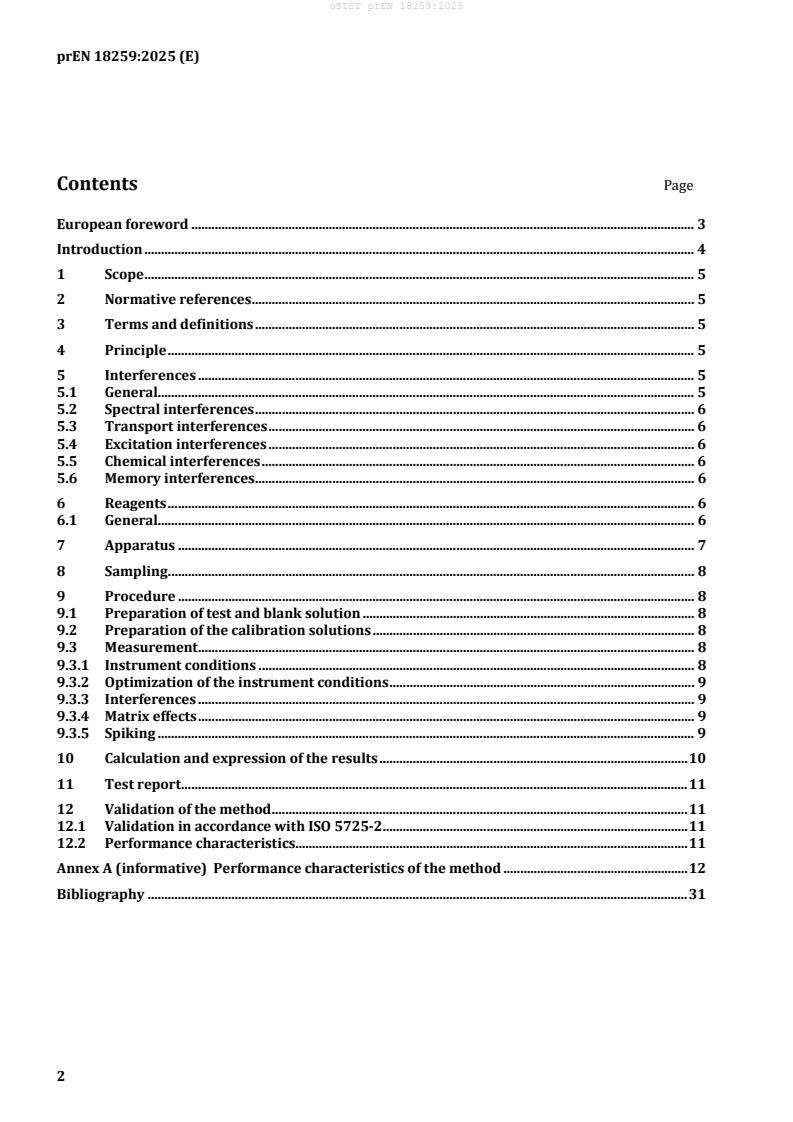
Contents Page
European foreword . 3
Introduction . 4
1 Scope . 5
2 Normative references . 5
3 Terms and definitions . 5
4 Principle . 5
5 Interferences . 5
5.1 General. 5
5.2 Spectral interferences . 6
5.3 Transport interferences . 6
5.4 Excitation interferences . 6
5.5 Chemical interferences . 6
5.6 Memory interferences . 6
6 Reagents . 6
6.1 General. 6
7 Apparatus . 7
8 Sampling . 8
9 Procedure . 8
9.1 Preparation of test and blank solution . 8
9.2 Preparation of the calibration solutions . 8
9.3 Measurement . 8
9.3.1 Instrument conditions . 8
9.3.2 Optimization of the instrument conditions . 9
9.3.3 Interferences . 9
9.3.4 Matrix effects . 9
9.3.5 Spiking . 9
10 Calculation and expression of the results . 10
11 Test report . 11
12 Validation of the method . 11
12.1 Validation in accordance with ISO 5725-2. 11
12.2 Performance characteristics. 11
Annex A (informative) Performance characteristics of the method . 12
Bibliography . 31
oSIST prEN 18259:2025
prEN 18259:2025 (E)
European foreword
This document (prEN 18259:2025) has been prepared by Technical Committee CEN/TC 223 “Soil
improvers and growing media”, the secretariat of which is held by NEN.
This document is currently submitted to the CEN Enquiry.
This document has been prepared under a standardization request addressed to CEN by the European
Commission. The Standing Committee of the EFTA States subsequently approves these requests for its
Member States.
oSIST prEN 18259:2025
prEN 18259:2025 (E)
Introduction
This document is part of a modular approach and concerns the analytical measurement step. “Modular”
means that a test standard concerns a specific step in assessing a property and not the whole chain of
measurements. Inductively coupled plasma atomic emission spectrometry (ICP-AES) is nowadays widely
used and a well-established method in many laboratories.
oSIST prEN 18259:2025
prEN 18259:2025 (E)
1 Scope
This document specifies a method for the determination of elements in soil improvers or growing media
extracts using inductively coupled plasma-atomic emission spectrometry (ICP-AES).
NOTE 1 Alternatively, other suitable analytical techniques, e.g. inductively coupled plasma mass spectrometry
(ICP-MS) or atomic absorption spectrometry (AAS), are suitable for the measurement if the user proves that the
method gives the same results.
This method is applicable to aqua regia extracts prepared according to prEN 13650:2025.
NOTE 2 The method is suitable for the determination of other elements, provided the user has verified the
applicability.
2 Normative references
The following documents are referred to in the text in such a way that some or all of their content
constitutes requirements of this document. For dated references, only the edition cited applies. For
undated references, the latest edition of the referenced document (including any amendments) applies.
CEN/TS 17732:2022, Soil improvers and growing media - Terminology
EN 12579:2024, Soil improvers and growing media - Sampling
prEN 13650:2025, Soil improvers and growing media — Digestion by aqua regia for subsequent
determination of elements
3 Terms and definitions
For the purposes of this document, the terms and definitions given in CEN/TS 17732:2022 apply.
4 Principle
The method is based on the inductively coupled plasma atomic emission spectrometry (ICP-AES)
measurement of the concentration of elements in soil improvers and growing media in aqua regia
extracts. The elements are determined after an appropriate dilution of the extract, if necessary. The
solution is dispersed by a suitable nebulizer of the ICP-AES instrument and the resulting aerosol is
transported into the plasma torch. Element specific emission spectra are produced by a radiofrequency
inductively coupled argon plasma where atoms or ions are excited at high temperature. The emission
spectra are dispersed by a spectrometer, and the intensities of the emission lines are monitored by
photosensitive devices. Multi-element determinations using sequential or simultaneous optical systems
and axial, radial or dual viewing of the plasma may be used.
5 Interferences
5.1 General
Interferences and matrix effects shall be recognized and appropriate measures to minimize them shall be
made. There are several types of interferences – see 5.2 to 5.6.
oSIST prEN 18259:2025
prEN 18259:2025 (E)
5.2 Spectral interferences
Spectral interferences are due to incomplete isolation of the radiation emitted by the analyte from other
detected radiation sources. Spectral interferences are caused by the background emission from
continuous or recombination phenomena, by stray light which causes background increase or overlap of
a spectral line from another element, or by the unresolved overlap of molecular band spectra. Background
emission and stray light can usually be compensated for by subtracting the background emission
measured adjacent to the analyte wavelength peak. To correct a sloping background shift, background
correction points on each side of the peak are used. The increase of background is more intensive with
axial-view instruments. Background correction is not required in cases of line broadening where a
background correction measurement would actually degrade the analytical result. A spectral line overlap
usually leads to the choice of an alternative line. If this is not possible, mathematical correction
procedures (e.g. inter-element correction technique or multi-component spectral fitting) can be used to
compensate for the interference. These correction procedures are usually a part of the instrument
software.
5.3 Transport interferences
Transport interferences are caused by differences in the properties between the sample solutions and
the calibration solutions (viscosity, surface tension, density, dissolved solid content, type and
concentration of acids). As a consequence, the supply of solution to the nebuliser, the efficiency of
nebulisation and the droplet size distribution of the aerosol is altered, resulting in a change of sensitivity.
Errors due to these interferences can be overcome by dilution of the solutions, by matrix matching, by
standard addition or by internal standard.
5.4 Excitation interferences
Excitation interferences are attributed to a change in the excitation conditions in the plasma, especially
by the presence of easily ionisable elements. The interference depends on the operating conditions of the
plasma (e.g. power, sample introduction, gas flowrate or observation height) and differ from element to
element. Improvement of the plasma conditions can therefore reduce excitation interferences. Other
possibilities are dilution of the solutions, matrix matching or the standard addition technique.
5.5 Chemical interferences
Chemical interferences are not significant with the ICP-AES technique, but if observed, they can be
minimized by a careful selection of operating conditions (e.g. radio frequency power, observation
position, gas flow rate and so forth).
5.6 Memory interferences
Memory interferences result when analytes in a previous sample contribute to the signals measured in a
new sample. This type of interference may be caused by sample deposits or the accumulation in pump
tubing, nebulizer, spray chamber or plasma torch. The possibility of memory interferences should be
recognized within an analytical run and suitable rinse steps and rinse times should be used.
6 Reagents
6.1 General
All reagents including water shall be of recognized analytical grade and they shall have negligible
concentration of the element to be determined if compared to the lowest concentration of that element
in the sample solution.
6.2 Nitric acid, c(HNO ) ≈ 14,3 mol/l; mass concentration ρ ≈ 1,4 g/ml
oSIST prEN 18259:2025
prEN 18259:2025 (E)
6.2.1 Diluted nitric acid solution, c(HNO ) = 5 mol/l
Add 350 ml of nitric acid (6.2) to 650 ml of water.
6.3 Hydrochloric acid, c(HCl) ≈ 12 mol/l; ρ ≈ 1,18 g/ml
6.4 Mixed acid solution, 0,8 mol/l nitric acid and 1,8 mol/l hydrochloric acid
Add 150 ml of hydrochloric acid (6.3) and 56 ml nitric acid (6.2) to 800 ml of water.
6.5 Standard stock solutions, c = 1 000 mg/l for each element
Both single-element stock solutions and multi-element stock solutions with adequate specification,
stating the acid used and the preparation technique, are commercially available. Multi-element stock
solutions are usually available at the individual mass concentration equal to 100 mg/l for each element.
These solutions are considered to be stable for more than one year, but in reference to guaranteed
stability, the recommendations of the manufacturer should be considered. Alternatively, the stock
solutions may be prepared by the dissolution of high purity metals.
6.5.1 Standard solution, c = 100 mg/l of element
Use commercially available solution of this concentration for each element or pipette, 10 ml of the
appropriate element stock solution (6.5) into a 100 ml volumetric flask. Add 10 ml of diluted nitric acid
(6.2.1), fill to the mark with water and mix well. This solution is used to prepare spiked test solutions and
calibration solutions.
6.5.2 Standard solution, c = 10 mg/l of element
Pipette 10 ml of standard solution (6.5.1) into a 100 ml volumetric flask. Add 10 ml of diluted nitric acid
(6.2.1), fill to the mark with water and mix well. This solution is used to prepare calibration solutions e.g.
for cadmium.
6.6 Argon, purity 99,995 % or better
7 Apparatus
7.1 Common laboratory glassware
7.2 Inductively coupled plasma atomic emission spectrometer
WARNING – It is essential that the manufacturer’s safety instructions are strictly observed when using
this apparatus.
The inductively coupled plasma atomic-emission spectrometer consists of a sample introduction system,
the plasma as an excitation source, an optical system, a detector and a computer with suitable software.
The sample is transported by the introduction system (rotation tube pump, nebuliser and a spray
chamber) to the plasma torch. Around the torch a water-cooled RF coil is placed. A frequency of 27 MHz
to 56 MHz with a power of 600 W to 2 000 W is usually used. The emission from the plasma can be
observed either from the side (radial) or from the torch central symmetrical axis (axial). Axial viewing
gives more signal intensity due to the increased observation path length of the normal analytical zone of
the plasma, but an increase of interference is also commonly observed. Spectral lines are measured and
registered either in a sequential or a simultaneous manner.
oSIST prEN 18259:2025
prEN 18259:2025 (E)
8 Sampling
Sampling is not part of the method specified in this document. EN 12579:2024 shall be followed dealing
with soil improvers and growing media. It is important that the laboratory receives a sample that is
representative of the product under consideration. The sample should not have been damaged or
changed during transport or storage.
9 Procedure
9.1 Preparation of test and blank solution
Aqua regia extracts are usually measured using ICP-AES directly with calibration solutions of the same
final concentration of aqua regia. The aqua regia extracts may also be used for the determination of other
elements.
A blank test is prepared for the measurement following the same procedure as for samples.
If dilution is necessary, dilute an aliquot portion of the extract in one or more steps so that the final
concentration of the element to be determined is approximately in the middle of the given calibration
range (9.2). In the final diluting step fill to the mark with the mixed acid solution (6.4) and mix well.
Prepare a diluted blank solution by pipetting a blank solution and dilute in the same way as the test
solution.
9.2 Preparation of the calibration solutions
Individual calibration series for each element or mixed series may be used. For cadmium calibration
standards, pipette volumes of 0 ml; 0,5 ml; 1 ml; 2 ml and 5 ml of the standard solution (6.5.2) into five
100 ml volumetric flasks respectively. For arsenic, copper, chromium, lead, nickel and zinc calibration
standards pipette volumes of 0 ml; 1 ml; 2 ml; 5 ml and 10 ml of the standard solution (6.5.1) into the
same five 100 ml volumetric flasks respectively.
Fill the volumetric flasks to the mark with the mixed acid solution (6.4).
The mass concentrations of cadmium in the calibration solutions are: 0 mg/l; 0,05 mg/l; 0,1 mg/l;
0,2 mg/l and 0,5 mg/l. The mass concentrations of arsenic, copper, chromium, lead, nickel and zinc in the
calibration solutions are: 0 mg/l; 1 mg/l; 2 mg/l; 5 mg/l and 10 mg/l respectively.
Individual sets of calibration solutions for each element may be used instead of the mixed calibration
solutions for all elements. If necessary, calibration solutions of higher or lower concentrations may be
prepared in the same way.
NOTE 1 Small differences in acid concentration between sample extracts and calibration solutions do not affect
the measurement.
NOTE 2 It is possible to calibrate the instrument for higher concentrations of the elements if the calibration curve
is linear.
9.3 Measurement
9.3.1 Instrument conditions
Due to differences between various kinds of instruments, no detailed instructions are given to operate
the specific instrument. The instruction provided by the manufacturer for waiting time, instrument
stability, gas flows, plasma conditions, nebuliser conditions, sample uptake rate, etc. should be followed.
The software of the instrument is used to calculate concentrations of the elements in the individual test
solutions. All test solutions, blanks and calibration solutions are measured under the same optimized
conditions using background correction and other suitable steps to eliminate or minimize interferences.
oSIST prEN 18259:2025
prEN 18259:2025 (E)
9.3.2 Optimization of the instrument conditions
The aim is to find the best sensitivity and precision and to minimize interferences for the set of lines to
be used. Emission efficiency is related, amongst other parameters, to the plasma temperature, which is a
function of RF power, argon gas flows and observation height (for radially viewed plasmas). Also, the type
of nebuliser and sample uptake rate will have an impact on the signal and the background.
9.3.3 Interferences
Background shall be measured adjacent to analyte lines on sample during analysis. The position selected
for the background intensity measurement, on one or both sides of the analytical line, will be determined
by the complexity of the spectrum adjacent to the analytical line. When working with an unknown matrix
it is necessary to check the signal of every element to be measured for possible interferences by studying
the region of the line. If spectral interferences (partial line overlap, line coincidence) occur, the
measurement shall be carried out at another wavelength. If this is not possible, correction of the
interference by mathematical correction procedures shall be carried out. High plasma power can
minimize the matrix influence.
Spectral lines which are free of interference by other elements shall be selected. As the spectral
interferences depend on the instrument resolution, they shall be identified for each type of instrument in
practical trials using mixtures of standard solutions containing the elements typically contained in
organic fertilizers and organo-mineral fertilizer samples of varying concentrations.
9.3.4 Matrix effects
The calibration blank and calibration solutions, calibration verification solution (one of the calibration
standard solutions used to check calibration of the instrument), blank test, sample solutions and quality
control solutions are measured after the stabilization of the instrument and verification of stable
conditions. Read the emission intensity of the solution at least twice and average the values. Run a
calibration blank and a calibration check solution every 20 samples or less and at the end of the
measurement.
Whenever an unknown matrix is encountered, check the following:
— matrix effects by running the spike sample;
— matrix effects by running a fivefold diluted sample;
— matrix effects by analysing at a different wavelength.
Spike recovery shall be between 90 % and 110 %. The difference between the results for the original
sample and the fivefold-diluted sample shall be less than 10 %. If the spike recovery or difference for the
diluted sample exceeds the given limit, a standard addition method shall be used.
9.3.5 Spiking
Add a known amount of a standard solution of the analyte and an equal amount of a blank solution to two
separate but equal portions of the sample solution (or its dilution). The spike shall be between 0,4 and
2 times the expected sample mass concentration. Measure both solutions as sample solutions. Determine
the ‘measured spike concentration' as the difference in mass concentration between the two spiked
sample portions.
EXAMPLE Spiking procedure: pipette 10 ml of a soil improver or growing medium extract or diluted extract
into two test tubes, add 0,1 ml of a standard solution (6.5.1) into the first test tube and 0,1 ml of blank into the
second test tube. Mix well and measure. To achieve a higher concentration of an element by spiking, stock solutions
of higher concentration may be used.
oSIST prEN 18259:2025
prEN 18259:2025 (E)
If the analytical results according to the standard addition method and the standard calibration method are equal,
the calibration curve method may be applied.
The standard addition method, spike recovery and dilution are recommended to check the efficiency of
interference reduction especially in complicated matrices and for unknown samples.
Examples of adequate wavelength are to be found in EN ISO 11885 (alternative wavelengths may be used
according to the instrument and recommendations of the producer) as well as potentially interfering
elements.
10 Calculation and expression of the results
Calculate the content of an element in the fertilizer, m , as a mass fraction in mg/kg according to
X
Formula (1).
V × XX− ××D 100
( )
dig S b
m = (1)
X
M× DM
w
...