

EN 13160-3:2016
(Main)Leak detection systems - Part 3: Requirements and test/assessment methods for liquid systems for tanks
- Abstract
This European Standard gives requirements and the corresponding test/assessment methods applicable to leak detection kits based on the drop of the liquid level in the leak detection liquid reservoir. Leak detection kits are intended to be used with double skin, underground or above ground, non-pressurized, tanks designed for water polluting liquids.
The liquid leak detection kits are usually composed of:
- sensing device (liquid sensor);
- evaluation device;
- alarm device.
- Status
- Withdrawn
- Publication Date
- 05-Jul-2016
- Withdrawal Date
- 06-Oct-2026
- Technical Committee
- CEN/TC 393 - Equipment for storage tanks and for service stations
- Drafting Committee
- CEN/TC 393/WG 2 - Leak detecting devices for tanks and pipes
- Current Stage
- 9960 - Withdrawal effective - Withdrawal
- Start Date
- 13-Nov-2024
- Completion Date
- 07-Oct-2026

Relations
- Effective Date
- 18-Jul-2012
- Effective Date
- 18-Sep-2024
- Effective Date
- 25-Aug-2026
- Effective Date
- 09-Feb-2026
- Effective Date
- 09-Feb-2026
- Effective Date
- 09-Feb-2026
- Effective Date
- 28-Jan-2026
- Refers
EN ISO 2719:2025 - Determination of flash point - Pensky-Martens closed cup method (ISO 2719:2025) - Effective Date
- 28-Jan-2026
- Effective Date
- 28-Jan-2026
- Effective Date
- 28-Jan-2026
- Effective Date
- 28-Jan-2026
- Effective Date
- 28-Jan-2026
- Effective Date
- 28-Jan-2026
- Effective Date
- 28-Jan-2026
- Effective Date
- 28-Jan-2026
Get Certified
Connect with accredited certification bodies for this standard

IMQ S.p.A. (Certification)
Italian electrical product certification.

SLG Prüf- und Zertifizierungs GmbH
German testing and certification body.

UL Solutions
Global safety science company with testing, inspection and certification.
Sponsored listings
Frequently Asked Questions
EN 13160-3:2016 is a standard published by the European Committee for Standardization (CEN). Its full title is "Leak detection systems - Part 3: Requirements and test/assessment methods for liquid systems for tanks". This standard covers: This European Standard gives requirements and the corresponding test/assessment methods applicable to leak detection kits based on the drop of the liquid level in the leak detection liquid reservoir. Leak detection kits are intended to be used with double skin, underground or above ground, non-pressurized, tanks designed for water polluting liquids. The liquid leak detection kits are usually composed of: - sensing device (liquid sensor); - evaluation device; - alarm device.
This European Standard gives requirements and the corresponding test/assessment methods applicable to leak detection kits based on the drop of the liquid level in the leak detection liquid reservoir. Leak detection kits are intended to be used with double skin, underground or above ground, non-pressurized, tanks designed for water polluting liquids. The liquid leak detection kits are usually composed of: - sensing device (liquid sensor); - evaluation device; - alarm device.
EN 13160-3:2016 is classified under the following ICS (International Classification for Standards) categories: 23.020.01 - Fluid storage devices in general; 23.040.99 - Other pipeline components; 29.260.20 - Electrical apparatus for explosive atmospheres. The ICS classification helps identify the subject area and facilitates finding related standards.
EN 13160-3:2016 has the following relationships with other standards: It is inter standard links to EN 13160-3:2003, EN 13160-3:2016+A1:2024, ISO 431:1981, EN 60079-0:2012, EN 61672-1:2013, ISO 7619-1:2010, EN 13160-1:2016, EN ISO 2719:2025, EN 13341:2005+A1:2011, CEN/TS 14938-2:2006, EN 1412:2016, EN 13160-7:2016+A1:2024, EN ISO 3104:2023, EN ISO 175:2010, EN 12285-3:2019. Understanding these relationships helps ensure you are using the most current and applicable version of the standard.
EN 13160-3:2016 is associated with the following European legislation: EU Directives/Regulations: 305/2011, 89/106/EEC; Standardization Mandates: M/131. When a standard is cited in the Official Journal of the European Union, products manufactured in conformity with it benefit from a presumption of conformity with the essential requirements of the corresponding EU directive or regulation.
EN 13160-3:2016 is available in PDF format for immediate download after purchase. The document can be added to your cart and obtained through the secure checkout process. Digital delivery ensures instant access to the complete standard document.
Standards Content (Sample)
2003-01.Slovenski inštitut za standardizacijo. Razmnoževanje celote ali delov tega standarda ni dovoljeno.Leckanzeigesysteme - Teil 3: Anforderungen und Prüfung/Bewertung von Flüssigkeitssystemen für TanksSystèmes de détection de fuites - Partie 3 : Exigences et méthodes d'essai/d'évaluation des systèmes à liquide pour des citernesLeak detection systems - Part 3: Requirements and test/assessment methods for liquid systems for tanks23.040.99Drugi sestavni deli za cevovodeOther pipeline components23.020.10UH]HUYRDUMLStationary containers and tanksICS:Ta slovenski standard je istoveten z:EN 13160-3:2016SIST EN 13160-3:2016en,fr,de01-november-2016SIST EN 13160-3:2016SLOVENSKI
STANDARDSIST EN 13160-3:20041DGRPHãþD
EUROPEAN STANDARD NORME EUROPÉENNE EUROPÄISCHE NORM
EN 13160-3
July
t r s x ICS
t uä r t rä r sâ
t uä r v rä { { Supersedes EN
s u s x ræ uã t r r uEnglish Version
Leak detection systems æ Part
uã Requirements and Systèmes de détection de fuites æ Partie
uã Exigences et pour des réservoirs
Leckanzeigesysteme æ Teil
uã Anforderungen und PrüfæTanks This European Standard was approved by CEN on
z April
t r s xä
egulations which stipulate the conditions for giving this European Standard the status of a national standard without any alterationä Upætoædate lists and bibliographical references concerning such national standards may be obtained on application to the CENæCENELEC Management Centre or to any CEN memberä
translation under the responsibility of a CEN member into its own language and notified to the CENæCENELEC Management Centre has the same status as the official versionsä
CEN members are the national standards bodies of Austriaá Belgiumá Bulgariaá Croatiaá Cyprusá Czech Republicá Denmarká Estoniaá Finlandá Former Yugoslav Republic of Macedoniaá Franceá Germanyá Greeceá Hungaryá Icelandá Irelandá Italyá Latviaá Lithuaniaá Luxembourgá Maltaá Netherlandsá Norwayá Polandá Portugalá Romaniaá Slovakiaá Sloveniaá Spainá Swedená Switzerlandá Turkey and United Kingdomä
EUROPEAN COMMITTEE FOR STANDARDIZATION COMITÉ EUROPÉEN DE NORMALISATION EUROPÄISCHES KOMITEE FÜR NORMUNG
CEN-CENELEC Management Centre:
Avenue Marnix 17,
B-1000 Brussels
t r s x CEN All rights of exploitation in any form and by any means reserved worldwide for CEN national Membersä Refä Noä EN
s u s x ræ uã t r s x ESIST EN 13160-3:2016
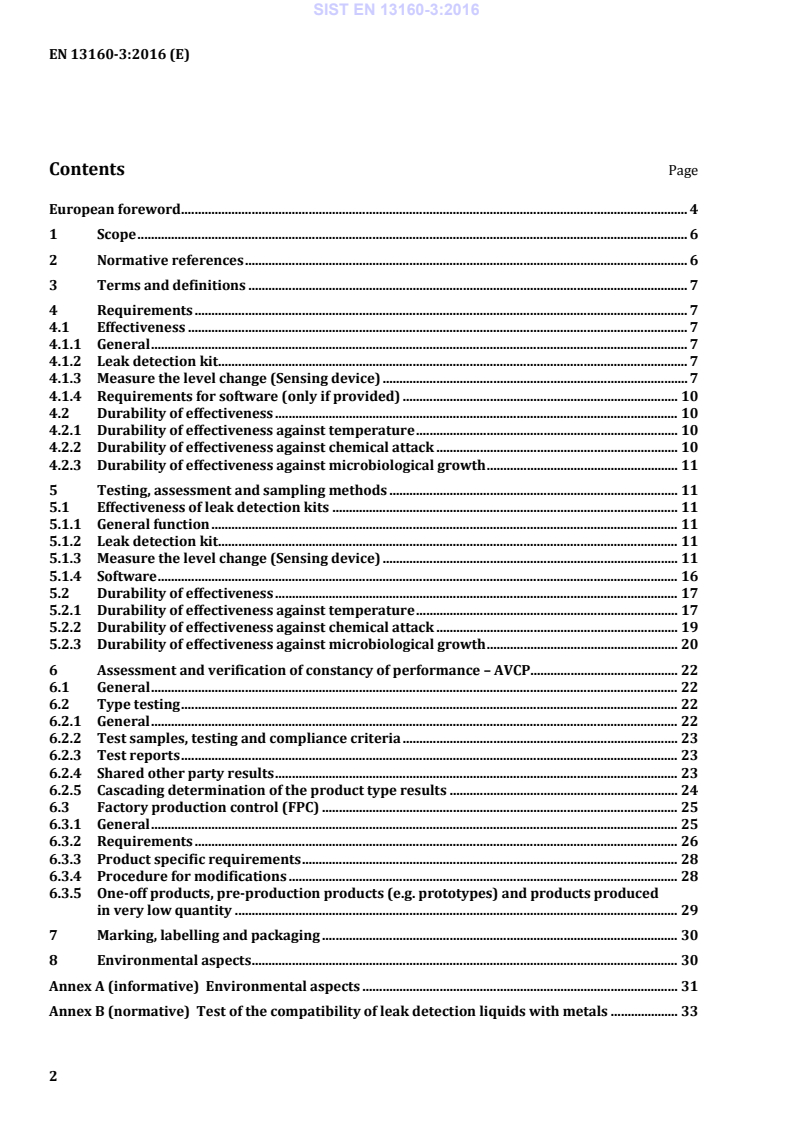
Environmental aspects . 31 Annex B (normative)
Test of the compatibility of leak detection liquids with metals . 33 SIST EN 13160-3:2016
Clauses of this European Standard addressing the provisions of the EU Construction Products Regulation 305/2011/EU . 37 ZA.1 Scope and relevant characteristics . 37 ZA.2 Procedure for AVCP of liquid systems for tanks . 38 ZA.2.1 System(s) of AVCP . 38 ZA.2.2 Declaration of performance (DoP) . 40 ZA.2.2.1 General . 40 ZA.2.2.2 Content . 40 ZA.2.2.3 Example of DoP . 41 ZA.3 CE marking and labelling . 42 Bibliography . 46
> 100 cm2. For further information see 7.4.2 of EN 60079-0:2012. Polymer materials for leak detection liquid reservoirs shall be weather resistant according to Table 1 of EN 13341:2005+A1:2011. 4.1.3.2 Leak detection liquid 4.1.3.2.1 General The manufacturer shall specify which leak detection liquids are suitable for the leak detection system and which leak detection liquids can be mixed. NOTE 1 If the term “leak detection liquid” is used in the standard the concentrate of leak detection liquid diluted with water according to the ratio specified by the manufacturer is meant. NOTE 2 Leak detection liquid can only be mixed if its compatibility is approved. Leak detection liquids shall have the properties according to 4.1.3.2.2 to 4.1.3.2.9. 4.1.3.2.2 Electrical conductivity The leak detection liquid shall have an electrical conductivity greater than 10 mS m-1, if required. 4.1.3.2.3 Viscosity The leak detection liquid shall have a viscosity not greater than 200 mm2 s-1 for the temperature range according to 4.2.1. 4.1.3.2.4 Freezing point The leak detection liquid shall have a freezing point below the minimum temperature of the appropriate temperature range according to 4.2.1. 4.1.3.2.5 Flash point The leak detection liquid shall have a flash point not below +80 °C. SIST EN 13160-3:2016
¶ 30 mm for potentially explosive atmospheres of group II A and II B according to EN 60079-0 or — the outer diameter of the connection lines is
¶ 20 mm for potentially explosive atmospheres of group II C according to EN 60079-0 or — the wall thickness of the connection lines is
¶ 2 mm for potentially explosive atmospheres of group II A and II B according to EN 60079-0 by using conductive leak detection liquid or — the wall thickness of the connection lines is
¶ 0,2 mm for potentially explosive atmospheres of group II C according to EN 60079-0 by using conductive leak detection liquid. For further information see 7.4.2 of EN 60079-0:2012. SIST EN 13160-3:2016
· 70 dB (A) in a distance of minimum 1 m with a signal according to Table 1 of EN 981:1996+A1:2008 which shall be maintained for a minimum period of 36 h. The visible alarm shall be clearly indicated i.e. by a “red” light. The visible alarm shall have no switch off option. A test possibility shall be provided to test the functionality of the audible and visible alarm. The alarm device should be designed for connecting an additional alarm device, e.g. signal horn. The output parameter shall be stated. 4.1.4 Requirements for software (only if provided) The software, where provided, shall have a facility for self-checking by fulfilling the following requirements: — a self-diagnostic mode to test the integrity of the system at start up and periodically during use. A negative result of self-diagnostic mode shall result in an alarm condition; — a facility to check the consistency of the input and output data, malfunction shall result in an alarm condition. 4.2 Durability of effectiveness 4.2.1 Durability of effectiveness against temperature At a temperature of (20 ± 5) °C the leak detection kit shall be work proper after 1 × 10⁴ alarm cycles. The temperature ranges for leak detection kits shall be as follows: — Type
sã
« t r °C to +60 °C; — Type 2: 0 °C to +40 °C; — Type
uã
« v r °C to +40 °C. 4.2.2 Durability of effectiveness against chemical attack 4.2.2.1 Polymer materials Plastic parts of liquid leak detection kits that can get into contact with the leak detection liquid or its vapour shall be resistant. SIST EN 13160-3:2016
Key 1 conical separating funnel, 1 l 2 graduation 3 cock 4 sieve Figure 1 — Conical separating funnel 5.1.3.2.7.4 Evaluation If the deposit volume is greater than 0,5 cm3/l, or if it does not pass completely through the strainer, then the leak detection liquid shall be deemed to have failed the test. 5.1.3.2.8 Compatibility with metallic materials According to Annex B. 5.1.3.2.9 Reaction with stored product 5.1.3.2.9.1 Test equipment — adiabatic calorimeter with maximum working pressure of 14 MPa (140 bar) with an accuracy of 50 kPa (500 mbar) and a temperature range from 0 °C to 500 °C with an accuracy of 0,1 K; — measuring cell of the adiabatic calorimeter for — temperature range from 10 °C to 200 °C and a measurement of temperature change of minimum 100 K min-1; — pressure range 100 kPa (1 bar) to 1 MPa (10 bar) and a measurement of pressure change of minimum 50 kPa min-1 (500 mbar min-1); — temperature measuring device with measurement range from 0 °C to 500 °C within an accuracy of ± 0,1 K; — pressure measuring device with measurement range from 0 kPa (0 bar) to 20 MPa (200 bar) within an accuracy of ± 10 mbar; SIST EN 13160-3:2016
· 1 m2 and weighs at least 200 kg m-2. The absorption coefficient for sound shall be
¶ 0,05; — sound level meter class 2 according to EN 61672-1; SIST EN 13160-3:2016
· 70 dB (A) after the fatigue test. 5.1.4 Software 5.1.4.1 Test equipment — Transformer (variable power supply); — measuring device for current/voltage. 5.1.4.2 Preparation The test set-up shall be according to Figure 2.
Key 1 test sample 2 variable power supply 3 measuring device Figure 2 — Test setup for software SIST EN 13160-3:2016
«40 °C to +70 °C within an accuracy of 2 K; — cycle counter; —
time measuring device having a time indication in steps of 1 s to a total of 24 h, within an accuracy of ± 1 s; — minimum 0,5 l of concentrate of leak detection liquid for every type according to temperature range. 5.2.1.2 Preparation The sensor shall be installed in the test vessel for the function test in such a way that it can be immersed either by changing the level of leak detection liquid or by raising and lowering of the sensor. The concentrate of leak detection liquid shall be diluted with water according to the ratio specified by the manufacturer suitable for the appropriate type according to temperature range. All equipment shall be installed in an environmental chamber for the function test. The sensor under test shall be connected to the evaluation device. 5.2.1.3 Procedure The reliability test of the alarm transmitter and the sensors shall be carried out as follows: — at a temperature of (20 ± 5) °C with 1 × 10⁴ alarm cycles; the sensor shall be immersed and emerged once per test cycle in the liquid and the alarm shall operate in every case; SIST EN 13160-3:2016
«25 °C to +25 °C – Test sequence 1
+25 °C to +70 °C - Test sequence 2 — for Type 2:
«5 °C to +25 °C - Test sequence 1
+25 °C to +50 °C - Test sequence 2 — for Type 3:
«40 °C to +25 °C - Test sequence 1
+25 °C to +50 °C - Test sequence 2 — Test sequence 1 over a period of 120 h. The starting temperature shall be the lowest temperature for each type. The temperature profile shall be according to Figure 3 with an accuracy of 2 K for the temperature and 15 min for the time. The cycle shall be repeated every 24 h.
Key X time in h Y temperature in °C a one cycle Figure 3 — Example for type 1, test sequence 1 — Test sequence 2 over a period of 120 h. The starting temperature shall be the highest temperature for each type. The temperature profile shall be according to Figure 4 with an accuracy of 2 K for the temperature and 15 min for the time. The cycle shall be repeated every 24 h. SIST EN 13160-3:2016
Key X time in h Y temperature in °C a one cycle Figure 4 — Example for type 1, test sequence 2 During the total test time a leak shall be simulated at time intervals of approximately 5 min by removing the leak detection liquid from contact with the sensor until the alarm operates. The time to alarm shall be measured and recorded at least once during the stable period at each maximum and minimum temperature. 5.2.1.4 Evaluation The test shall be deemed to have been passed if the alarm setting after the test cycle or after the time interval was triggered. 5.2.2 Durability of effectiveness against chemical attack 5.2.2.1 Polymer materials 5.2.2.1.1 Test equipment — according to EN ISO 175; — test samples or parts of the leak detection kit, which are exposed to the leak detection liquid; — minimum 10 l leak detection liquid. 5.2.2.1.2 Preparation The parts of the leak detection kit, which are exposed to the leak detection liquid, shall be identified. According to EN ISO 175. 5.2.2.1.3 Procedure According to EN ISO 175, but with a test time of 4 weeks and a test temperature of (60 ± 5) °C. 5.2.2.1.4 Evaluation Qualitatively estimated changes: None or barely perceptible according to Table 1 of EN ISO 175:2010. SIST EN 13160-3:2016
The test is in effect if in each of the 3 control flasks a growth of the fungi is detected. Satisfactory fungicidal effects are only present with Grades 0 and 1. Grades 2, 3 and 4 do not meet the requirements. Table 1 — Composition of the mineral salt solution NaNO3 2,0 g KH2PO4 0,7 g K2HPO4 0,3 g KCI 0,5 g MgSO4
® 7H2O 0,5 g FeSO4
® 7H2O 0,01 g H2O distilled 1 000 ml Table 2 — Composition of the Sabouraud maltose medium with low sugar content special peptone 10,0 g maltose 20,0 g H2O distilled 1 000 ml Table 3 — Test fungi fungi and species applied culturesa Aspergillus flavus ATCCb 9643 DSMc 1959 CBS 131.61d BAM 3e Aspergillus niger ATCC 6275 DSM 1957 CBS 131.52 BAM 4 Chaetomium globosum ATCC 6205 DSM 1962 CBS 148.51 BAM 12 Paecilomyces variotii ATCC 10121 DSM 1961 CBS 284.48 BAM 19 Penicillium funiculosum ATCC 11797 DSM 10640 CBS 235.94 BAM 22 Trichoderma virens ATCC 9645 DSM 1963 CBS 430.54 BAM 34 a Catalog numbers of different providers to identify fungi cultures. These cultures can be bought at any culture collection, for example as follows: b American Type Culture Collection, 10801 University Blvd, Manassas, VA 20110–2209, USA c German Collection for Mikroorganismen und
...