


prEN ISO 4259-1
(Main)Petroleum and related products - Precision of measurement methods and results - Part 1: Determination of precision data in relation to methods of test (ISO/DIS 4259‑1:2025)
Petroleum and related products - Precision of measurement methods and results - Part 1: Determination of precision data in relation to methods of test (ISO/DIS 4259‑1:2025)
ISO 4259-1:2017 specifies the methodology for the design of an Interlaboratory Study (ILS) and calculation of precision estimates of a test method specified by the study. In particular, it defines the relevant statistical terms (Clause 3), the procedures to be adopted in the planning of ILS to determine the precision of a test method (Clause 4), and the method of calculating the precision from the results of such a study (Clauses 5 and 6).
The procedures in ISO 4259-1:2017 have been designed specifically for petroleum and petroleum related products, which are normally considered as homogeneous. However, the procedures described in ISO 4259-1:2017 can also be applied to other types of homogeneous products. Careful investigations are necessary before applying ISO 4259-1:2017 to products for which the assumption of homogeneity can be questioned.
Mineralöl und verwandte Produkte - Präzision von Messverfahren und Ergebnissen - Teil 1: Bestimmung der Präzisionsdaten von Prüfverfahren (ISO/DIS 4259‑1:2025)
Produits pétroliers et connexes - Fidélité des méthodes de mesure et de leurs résultats - Partie 1: Détermination des valeurs de fidélité relatives aux méthodes d'essai (ISO/DIS 4259-1:2025)
ISO 4259-1:2017 spécifié la méthodologie pour la conception d'un essai interlaboratoires (ILS) et pour le calcul des estimations de fidélité d'une méthode d'essai spécifié par cet ILS. En particulier, il définit les termes statistiques concernés (Article 3), les procédures à suivre dans l'organisation d'un ILS destiné à déterminer la fidélité d'une méthode d'essai (Article 4) et la méthode de calcul de la fidélité à partir des résultats d'un tel ILS (Articles 5 et 6).
Les procédures de l' ISO 4259-1:2017 ont été conçues spécifiquement pour les produits pétroliers et leurs produits connexes qui sont normalement considérés homogènes. Les procédures décrites dans le présent document peuvent cependant aussi s'appliquer à d'autres types de produits homogènes. Il est nécessaire de procéder à des contrôles attentifs avant d'appliquer ce document à des produits pour lesquels la présomption d'homogénéité peut être mise en question.
Nafta in sorodni proizvodi - Natančnost merilnih metod in rezultatov - 1. del: Določevanje natančnosti preskusnih metod (ISO/DIS 4259-1:2025)
General Information
- Status
- Not Published
- Publication Date
- 02-Nov-2026
- Technical Committee
- CEN/TC 19 - Petroleum products, lubricants and related products
- Current Stage
- 4060 - Closure of enquiry - Enquiry
- Start Date
- 01-Jul-2025
- Completion Date
- 01-Jul-2025
Relations
- Effective Date
- 21-Feb-2024
- Effective Date
- 21-Feb-2024
- Effective Date
- 21-Feb-2024
Overview
prEN ISO 4259-1 (ISO/DIS 4259‑1:2025) defines the methodology for designing Interlaboratory Studies (ILS) and for calculating precision estimates of test methods for petroleum and related products. Intended primarily for products normally considered homogeneous, this second edition updates ISO 4259-1:2017 (incorporating Amendments 1 and 2) and clarifies sample and statistical requirements used to express repeatability and reproducibility of laboratory methods.
Key topics and requirements
- Scope and applicability: Procedures are tailored to petroleum and petroleum‑related products but can be applied to other homogeneous materials with caution where homogeneity is uncertain.
- ILS planning stages: Drafting the method, pilot studies (at least two laboratories), planning and executing the full ILS.
- Statistical terminology: Definitions of precision‑related terms (Clause 3) aligned with ISO statistical vocabulary.
- Pre‑screening and outlier handling: Use of the GESD technique for pre‑screening, data transformations, outlier tests, and rules for rejecting entire sample results or laboratories.
- Data handling rules: Procedures for estimating missing or rejected repeat values and treating influential samples.
- Analysis of variance (ANOVA): Detailed ANOVA procedures (Clauses 6.x) for calculating precision estimates, degrees of freedom, mean squares, and expression of precision.
- Design limits and sample size: Minimum of six samples in an ILS; no sample leverage > 4/n (n = planned samples); improved rationale for a 30 minimum degrees‑of‑freedom criterion.
- Supporting annexes: Annexes cover sample number determination, transformations, weighted linear regression, rounding rules, GESD details, notation and worked examples (e.g., Bromine Number).
Applications and users
- Laboratories validating or characterizing test methods for petroleum products.
- Standards developers and method authors preparing test methods or specifying precision statements.
- Quality managers, regulatory bodies, and accreditation assessors who need statistically defensible precision data for compliance, contract testing, or specification limits.
- Test method users assessing measurement uncertainty, repeatability (r), reproducibility (R), and R/r ratio for decision making.
Related standards
- ISO 4259‑2 (application and use of precision data)
- ISO 3534‑2 (statistical terminology)
- ISO 5725‑2 (precision of measurement methods - referenced for special cases)
- Cross‑references: ASTM D6300 and ASTM D3244 are historical sources integrated into the ISO approach.
This standard is essential for anyone establishing robust, statistically sound precision estimates for test methods in the petroleum sector and related homogeneous product testing.


Get Certified
Connect with accredited certification bodies for this standard

ABS Quality Evaluations Inc.
American Bureau of Shipping quality certification.

Element Materials Technology
Materials testing and product certification.

ABS Group Brazil
ABS Group certification services in Brazil.
Sponsored listings
Frequently Asked Questions
prEN ISO 4259-1 is a draft published by the European Committee for Standardization (CEN). Its full title is "Petroleum and related products - Precision of measurement methods and results - Part 1: Determination of precision data in relation to methods of test (ISO/DIS 4259‑1:2025)". This standard covers: ISO 4259-1:2017 specifies the methodology for the design of an Interlaboratory Study (ILS) and calculation of precision estimates of a test method specified by the study. In particular, it defines the relevant statistical terms (Clause 3), the procedures to be adopted in the planning of ILS to determine the precision of a test method (Clause 4), and the method of calculating the precision from the results of such a study (Clauses 5 and 6). The procedures in ISO 4259-1:2017 have been designed specifically for petroleum and petroleum related products, which are normally considered as homogeneous. However, the procedures described in ISO 4259-1:2017 can also be applied to other types of homogeneous products. Careful investigations are necessary before applying ISO 4259-1:2017 to products for which the assumption of homogeneity can be questioned.
ISO 4259-1:2017 specifies the methodology for the design of an Interlaboratory Study (ILS) and calculation of precision estimates of a test method specified by the study. In particular, it defines the relevant statistical terms (Clause 3), the procedures to be adopted in the planning of ILS to determine the precision of a test method (Clause 4), and the method of calculating the precision from the results of such a study (Clauses 5 and 6). The procedures in ISO 4259-1:2017 have been designed specifically for petroleum and petroleum related products, which are normally considered as homogeneous. However, the procedures described in ISO 4259-1:2017 can also be applied to other types of homogeneous products. Careful investigations are necessary before applying ISO 4259-1:2017 to products for which the assumption of homogeneity can be questioned.
prEN ISO 4259-1 is classified under the following ICS (International Classification for Standards) categories: 75.080 - Petroleum products in general. The ICS classification helps identify the subject area and facilitates finding related standards.
prEN ISO 4259-1 has the following relationships with other standards: It is inter standard links to EN ISO 4259-1:2017/A2:2020, EN ISO 4259-1:2017/A1:2019, EN ISO 4259-1:2017. Understanding these relationships helps ensure you are using the most current and applicable version of the standard.
prEN ISO 4259-1 is available in PDF format for immediate download after purchase. The document can be added to your cart and obtained through the secure checkout process. Digital delivery ensures instant access to the complete standard document.
Standards Content (Sample)
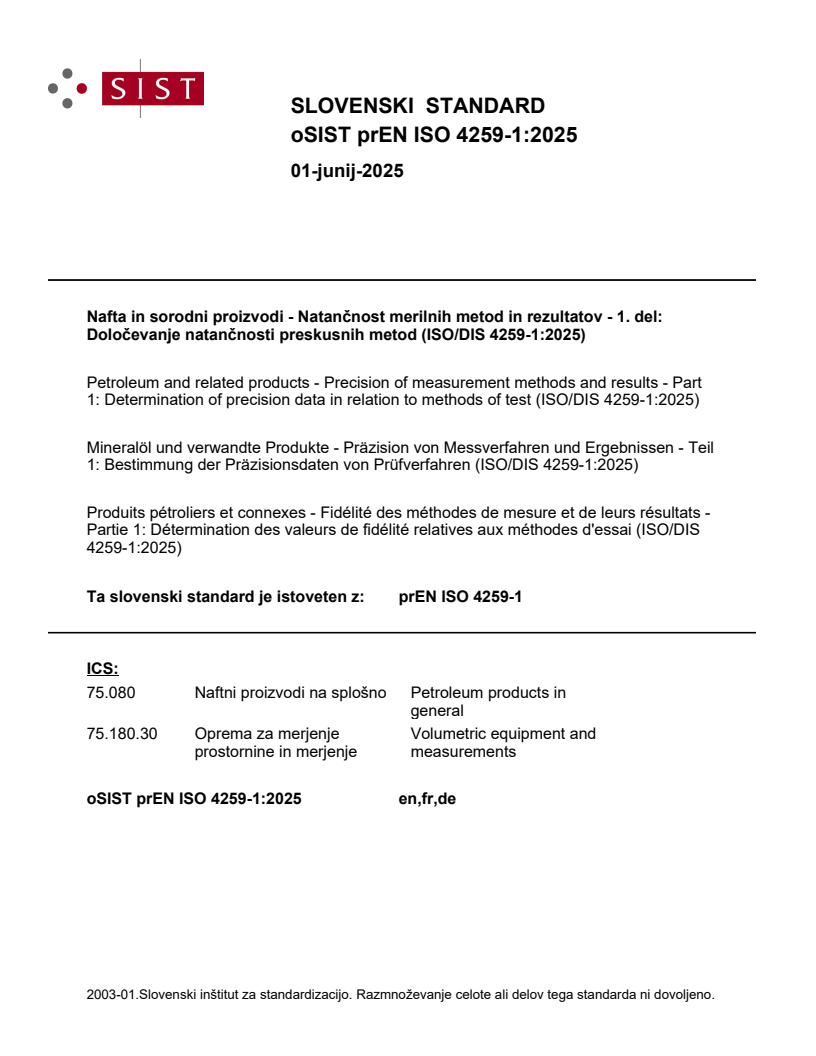
SLOVENSKI STANDARD
01-junij-2025
Nafta in sorodni proizvodi - Natančnost merilnih metod in rezultatov - 1. del:
Določevanje natančnosti preskusnih metod (ISO/DIS 4259-1:2025)
Petroleum and related products - Precision of measurement methods and results - Part
1: Determination of precision data in relation to methods of test (ISO/DIS 4259-1:2025)
Mineralöl und verwandte Produkte - Präzision von Messverfahren und Ergebnissen - Teil
1: Bestimmung der Präzisionsdaten von Prüfverfahren (ISO/DIS 4259-1:2025)
Produits pétroliers et connexes - Fidélité des méthodes de mesure et de leurs résultats -
Partie 1: Détermination des valeurs de fidélité relatives aux méthodes d'essai (ISO/DIS
4259-1:2025)
Ta slovenski standard je istoveten z: prEN ISO 4259-1
ICS:
75.080 Naftni proizvodi na splošno Petroleum products in
general
75.180.30 Oprema za merjenje Volumetric equipment and
prostornine in merjenje measurements
2003-01.Slovenski inštitut za standardizacijo. Razmnoževanje celote ali delov tega standarda ni dovoljeno.
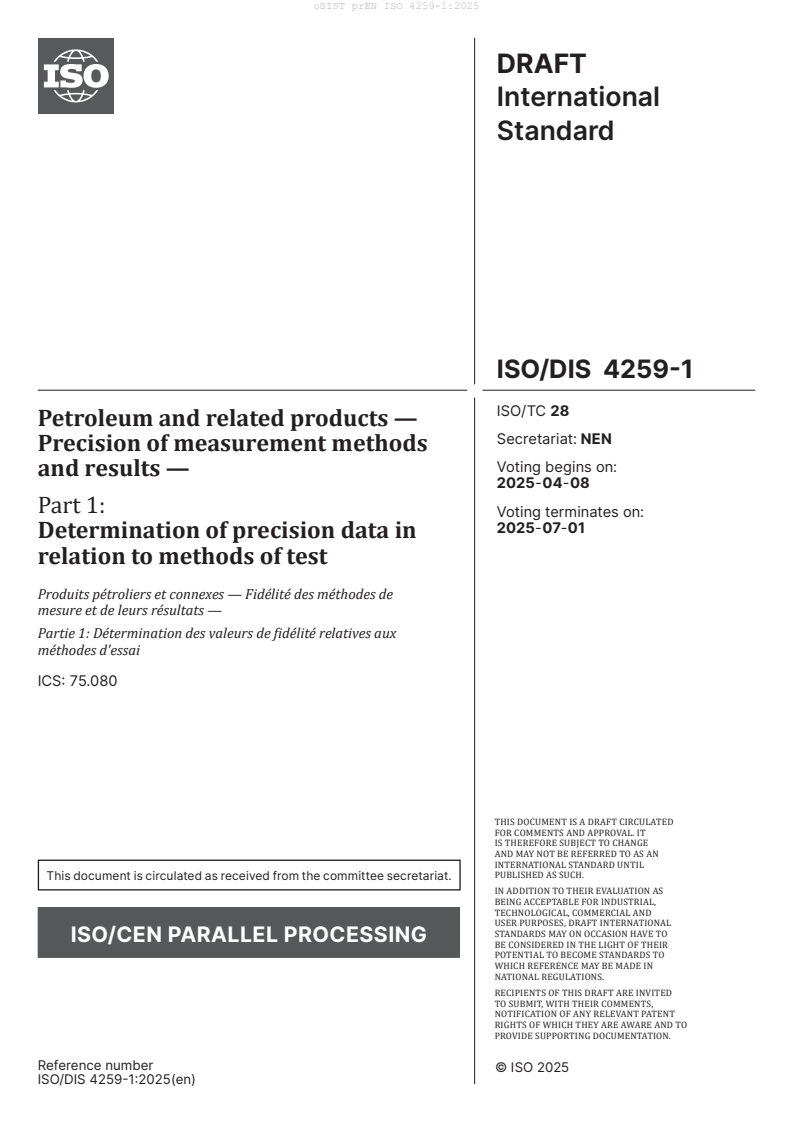
DRAFT
International
Standard
ISO/DIS 4259-1
ISO/TC 28
Petroleum and related products —
Secretariat: NEN
Precision of measurement methods
Voting begins on:
and results —
2025-04-08
Part 1:
Voting terminates on:
2025-07-01
Determination of precision data in
relation to methods of test
Produits pétroliers et connexes — Fidélité des méthodes de
mesure et de leurs résultats —
Partie 1: Détermination des valeurs de fidélité relatives aux
méthodes d'essai
ICS: 75.080
THIS DOCUMENT IS A DRAFT CIRCULATED
FOR COMMENTS AND APPROVAL. IT
IS THEREFORE SUBJECT TO CHANGE
AND MAY NOT BE REFERRED TO AS AN
INTERNATIONAL STANDARD UNTIL
PUBLISHED AS SUCH.
This document is circulated as received from the committee secretariat.
IN ADDITION TO THEIR EVALUATION AS
BEING ACCEPTABLE FOR INDUSTRIAL,
TECHNOLOGICAL, COMMERCIAL AND
USER PURPOSES, DRAFT INTERNATIONAL
STANDARDS MAY ON OCCASION HAVE TO
ISO/CEN PARALLEL PROCESSING
BE CONSIDERED IN THE LIGHT OF THEIR
POTENTIAL TO BECOME STANDARDS TO
WHICH REFERENCE MAY BE MADE IN
NATIONAL REGULATIONS.
RECIPIENTS OF THIS DRAFT ARE INVITED
TO SUBMIT, WITH THEIR COMMENTS,
NOTIFICATION OF ANY RELEVANT PATENT
RIGHTS OF WHICH THEY ARE AWARE AND TO
PROVIDE SUPPORTING DOCUMENTATION.
Reference number
ISO/DIS 4259-1:2025(en)
DRAFT
ISO/DIS 4259-1:2025(en)
International
Standard
ISO/DIS 4259-1
ISO/TC 28
Petroleum and related products —
Secretariat: NEN
Precision of measurement methods
Voting begins on:
and results —
Part 1:
Voting terminates on:
Determination of precision data in
relation to methods of test
Produits pétroliers et connexes — Fidélité des méthodes de
mesure et de leurs résultats —
Partie 1: Détermination des valeurs de fidélité relatives aux
méthodes d'essai
ICS: 75.080
THIS DOCUMENT IS A DRAFT CIRCULATED
FOR COMMENTS AND APPROVAL. IT
IS THEREFORE SUBJECT TO CHANGE
AND MAY NOT BE REFERRED TO AS AN
INTERNATIONAL STANDARD UNTIL
PUBLISHED AS SUCH.
This document is circulated as received from the committee secretariat.
IN ADDITION TO THEIR EVALUATION AS
BEING ACCEPTABLE FOR INDUSTRIAL,
© ISO 2025
TECHNOLOGICAL, COMMERCIAL AND
USER PURPOSES, DRAFT INTERNATIONAL
All rights reserved. Unless otherwise specified, or required in the context of its implementation, no part of this publication may
STANDARDS MAY ON OCCASION HAVE TO
ISO/CEN PARALLEL PROCESSING
be reproduced or utilized otherwise in any form or by any means, electronic or mechanical, including photocopying, or posting on
BE CONSIDERED IN THE LIGHT OF THEIR
the internet or an intranet, without prior written permission. Permission can be requested from either ISO at the address below
POTENTIAL TO BECOME STANDARDS TO
WHICH REFERENCE MAY BE MADE IN
or ISO’s member body in the country of the requester.
NATIONAL REGULATIONS.
ISO copyright office
RECIPIENTS OF THIS DRAFT ARE INVITED
CP 401 • Ch. de Blandonnet 8
TO SUBMIT, WITH THEIR COMMENTS,
CH-1214 Vernier, Geneva
NOTIFICATION OF ANY RELEVANT PATENT
Phone: +41 22 749 01 11
RIGHTS OF WHICH THEY ARE AWARE AND TO
PROVIDE SUPPORTING DOCUMENTATION.
Email: copyright@iso.org
Website: www.iso.org
Published in Switzerland Reference number
ISO/DIS 4259-1:2025(en)
ii
ISO/DIS 4259-1:2025(en)
Contents Page
Foreword .v
Introduction .vi
1 Scope . 1
2 Normative references . 1
3 Terms and definitions . 1
4 Stages in the planning of an interlaboratory study for the determination of the precision
of a test method . 4
4.1 General .4
4.2 Preparing a draft method of test .5
4.3 Planning a pilot study with at least two laboratories .5
4.4 Planning the ILS . .5
4.5 Executing the ILS .6
5 Statistical treatment of ILS results. 7
5.1 General recommendation .7
5.2 Pre-screen using GESD technique .7
5.3 Transformation of data and outlier tests .8
5.3.1 General .8
5.3.2 Outlier identification after pre-screening .11
5.3.3 Uniformity of repeatability .11
5.3.4 Uniformity of reproducibility .11
5.4 Rejection of complete data (from all laboratories) for a sample .11
5.5 Estimating missing or rejected values . 12
5.5.1 One of the two repeat values missing or rejected. 12
5.5.2 Both repeat values missing or rejected. 12
5.6 Rejection test for outlying laboratories . 12
5.7 Confirmation of selected transformation . 13
5.7.1 General . 13
5.7.2 Identification of excessively influential sample(s) . 13
6 Analysis of variance, calculation and expression of precision estimates . 14
6.1 General .14
6.2 Analysis of variance .14
6.2.1 Forming the sums of squares for the laboratories × samples interaction sum of
squares .14
6.2.2 Forming the sum of squares for the exact analysis of variance . 15
6.2.3 Degrees of freedom . 15
6.2.4 Mean squares and analysis of variance. 15
6.3 Expectation of mean squares and calculation of precision estimates . 15
6.3.1 Expectation of mean squares with no estimated values . 15
6.3.2 Expectation of mean squares with estimated values .16
6.3.3 Calculation of precision estimates .17
6.4 Expression of precision estimates of a method of test .18
6.5 Specification of scope for the test method .19
6.6 Reporting limits instruction for the test method .19
7 R/r ratio .20
Annex A (normative) Determination of number of samples required .21
Annex B (informative) Derivation of formula for estimating the number of laboratories and
samples required to meet minimum 30 degrees of freedom .23
Annex C (normative) Notation and tests .25
Annex D (normative) Illustration of procedures using ILS results for Bromine Number and
statistical tables .30
iii
ISO/DIS 4259-1:2025(en)
Annex E (normative) Types of dependence and corresponding transformations .49
Annex F (normative) Weighted linear regression analysis .55
Annex G (normative) Rules for rounding .62
Annex H (normative) GESD technique to simultaneously identify multiple outliers in a data set .63
Annex I (informative) Glossary .71
Bibliography . 74
iv
ISO/DIS 4259-1:2025(en)
Foreword
ISO (the International Organization for Standardization) is a worldwide federation of national standards
bodies (ISO member bodies). The work of preparing International Standards is normally carried out through
ISO technical committees. Each member body interested in a subject for which a technical committee
has been established has the right to be represented on that committee. International organizations,
governmental and non-governmental, in liaison with ISO, also take part in the work. ISO collaborates closely
with the International Electrotechnical Commission (IEC) on all matters of electrotechnical standardization.
The procedures used to develop this document and those intended for its further maintenance are described
in the ISO/IEC Directives, Part 1. In particular, the different approval criteria needed for the different types
of ISO document should be noted. This document was drafted in accordance with the editorial rules of the
ISO/IEC Directives, Part 2 (see www.iso.org/directives).
ISO draws attention to the possibility that the implementation of this document may involve the use of (a)
patent(s). ISO takes no position concerning the evidence, validity or applicability of any claimed patent
rights in respect thereof. As of the date of publication of this document, ISO had not received notice of (a)
patent(s) which may be required to implement this document. However, implementers are cautioned that
this may not represent the latest information, which may be obtained from the patent database available at
www.iso.org/patents. ISO shall not be held responsible for identifying any or all such patent rights.
Any trade name used in this document is information given for the convenience of users and does not
constitute an endorsement.
For an explanation of the voluntary nature of standards, the meaning of ISO specific terms and expressions
related to conformity assessment, as well as information about ISO's adherence to the World Trade
Organization (WTO) principles in the Technical Barriers to Trade (TBT), see www.iso.org/iso/foreword.html.
This document was prepared by Technical Committee ISO/TC 28, Petroleum and related products, fuels and
lubricants from natural or synthetic sources.
This second edition cancels and replaces the first edition (ISO 4259-1:2017), which has been technically
revised.
The main changes are as follows:
— inclusion of amendments 1 and 2;
— sufficient number of samples in the ILS is at least six;
— no sample shall have a leverage exceeding 4/n where n is the total number of planned samples;
t t
— the explanation for choice of 30 as minimum degrees of freedom is improved.
A list of all parts in the ISO 4259 series can be found on the ISO website.
Any feedback or questions on this document should be directed to the user’s national standards body. A
complete listing of these bodies can be found at www.iso.org/members.html.
v
ISO/DIS 4259-1:2025(en)
Introduction
For purposes of quality control and to check compliance with specifications, the properties of commercial
petroleum products are assessed by standard laboratory test methods. Two or more measurements of the
same property of a specific sample by a specific test method, or, by different test methods that purport to
measure the same property, will not usually give exactly the same result. It is, therefore, necessary to take
proper account of this fact, by arriving at statistically based estimates of the precision for a method, i.e. an
objective measure of the degree of agreement expected between two or more results obtained in specified
circumstances.
[1]
This document makes reference to ISO 3534-2, which gives a different definition of true value (3.24). This
document also refers to ISO 5725-2. The latter is required in particular and unusual circumstances (see
5.3.1) for the purpose of estimating precision.
The two parts of ISO 4259 encompass both the derivation of precision estimates and the application
[2]
of precision data. They combine the information in ASTM D6300 regarding the determination of the
[3]
precision estimates and the information in ASTM D3244 for the utilization of test data.
A glossary of the variables used in this document and ISO 4259-2 is included as Annex I in this document.
vi
DRAFT International Standard ISO/DIS 4259-1:2025(en)
Petroleum and related products — Precision of measurement
methods and results —
Part 1:
Determination of precision data in relation to methods of test
1 Scope
This document specifies the methodology for the design of an interlaboratory study (ILS) and calculation of
precision estimates of a test method specified by the study. In particular, it defines the relevant statistical
terms (see Clause 3), the procedures to be adopted in the planning of an ILS to determine the precision of a
test method (see Clause 4), and the method of calculating the precision from the results of such a study (see
Clauses 5 and 6).
The procedures in this document have been designed specifically for petroleum and petroleum related
products, which are normally considered as homogeneous. However, the procedures described in this
document can also be applied to other types of homogeneous products. Careful investigations are necessary
before applying this document to products for which the assumption of homogeneity can be questioned.
2 Normative references
The following documents are referred to in the text in such a way that some or all of their content constitutes
requirements of this document. For dated references, only the edition cited applies. For undated references,
the latest edition of the referenced document (including any amendments) applies.
ISO 5725-2, Accuracy (trueness and precision) of measurement methods and results — Part 2: Basic method for
the determination of repeatability and reproducibility of a standard measurement method
3 Terms and definitions
For the purposes of this document, the following terms and definitions apply.
ISO and IEC maintain terminological databases for use in standardization at the following addresses:
— ISO Online browsing platform: available at https:// www .iso .org/ obp
— IEC Electropedia: available at https:// www .electropedia .org/
3.1
analysis of variance
ANOVA
technique that enables the total variance of a method to be broken down into its component factors
3.2
accepted reference value
ARV
agreed-upon reference value for a specific property of a material determined using an accepted reference
method and protocol, e.g. derived from an ILS (3.8)
ISO/DIS 4259-1:2025(en)
3.3
between laboratory variance
component of the total variance (3.25) attributable to the difference between the means (3.10) of different
laboratories
Note 1 to entry: When results obtained by more than one laboratory are compared, the scatter is usually wider than
when the same number of tests is carried out by a single laboratory, and there is some variation between means
obtained by different laboratories. These give rise to the between laboratory variance which is that component of the
overall variance due to the difference in the means obtained by different laboratories.
Note 2 to entry: There is a corresponding definition for between operator variance.
Note 3 to entry: The term “between laboratory” is often shortened to “laboratory” when used to qualify representative
parameters of the dispersion of the population of results, for example as “laboratory variance”.
3.4
bias
difference between the population mean of test results (3.21) from a very large number
of different laboratories for the property of a material obtained using a specific test method versus the
accepted reference value (3.2) for the property where this is available
Note 1 to entry: See Note 1 to entry in 3.12 for an interpretation of “population mean of test results”.
3.5
blind coding
assignment of a different number to each sample so that no other identification or information on any sample
is given to the operator (3.13)
3.6
degrees of freedom
divisor used in the calculation of variance (3.25)
Note 1 to entry: The definition applies strictly only in the simplest cases. Definitions for more complex cases are
beyond the scope of this document.
3.7
determination
process of carrying out the series of operations specified in a test method, whereby a single value is obtained
3.8
interlaboratory study
ILS
study specifically designed to estimate the repeatability and reproducibility of a test method achieved
at a fixed point in time by multiple laboratories through the statistical analysis of their test results (3.21)
obtained on aliquots prepared from multiple materials
3.9
known value
quantitative value for a property that can be theoretically derived or calculated by the preparation of the sample
Note 1 to entry: The known value does not always exist, for example for empirical tests such as flash point.
3.10
mean
sum of a set of results (3.21) divided by the number of results
3.11
mean square
sum of squares (3.23) divided by the degrees of freedom (3.6)
ISO/DIS 4259-1:2025(en)
3.12
normal distribution
probability distribution of a continuous random variable, x, such that, if x is any real number, the probability
density is as shown in Formula (1):
1 1 x−μ
fx()=−exp ,−∞<
2 σ
σπ2
Note 1 to entry: In the context of modelling a distribution of test results, μ is the population mean (3.10), or true
value (3.24) of the property as determined by a specific test method; σ is the standard deviation (3.22) of the normal
distribution used to describe the distribution of an infinite number of test results obtained using the same test method
by an infinite number of laboratories (σ > 0).
3.13
operator
person who normally and regularly carries out a particular test
3.14
outlier
result (3.21) far enough in magnitude from other results to be considered not a part of the set
3.15
precision
closeness of agreement between the results (3.21) obtained by applying the same test procedure several
times on essentially the same materials and under prescribed conditions
Note 1 to entry: The smaller the random part of the experimental error, the more precise the procedure.
3.16
random error
component of measurement error that in replicate measurements varies in an unpredictable manner
3.17
repeatability limit
quantitative expression for the random error (3.16) associated with the difference between two independent
results (3.21) obtained under repeatability conditions (3.18) in the normal and correct operation of the same
method, that is expected to be exceeded with an approximate probability of 5 %
Note 1 to entry: The representative parameter for the dispersion of the population that can be associated with these
results is repeatability standard deviation (3.22) or repeatability variance (3.25). Repeatability refers to the maximum
difference attributable to random variation between two results obtained under the state of minimum random
variability. Therefore, the period of time during which repeat results are to be obtained should be short enough to
exclude time dependent variation, for example, variation caused by environmental changes, or variation associated
with multiple calibrations.
Note 2 to entry: The term “repeatability” is not to be confused with the terms “between repeats” or “repeats”.
3.18
repeatability conditions
conditions where independent test results (3.21) are obtained using the same method for test material
considered to be the same in the same laboratory by the same operator (3.13) using the same equipment
within short intervals of time
ISO/DIS 4259-1:2025(en)
3.19
reproducibility limit
quantitative expression for the random error (3.16) associated with the difference between two independent
results (3.21) obtained under reproducibility conditions (3.20) in the normal and correct operation of the
same method, that is expected to be exceeded with an approximate probability of 5 %
Note 1 to entry: The representative parameter of the dispersion of the population that can be associated with these
results (3.21) is reproducibility standard deviation (3.22) or reproducibility variance (3.25). Reproducibility refers to
the maximum difference attributable to random variation between two results obtained under the state of maximum
random variability.
3.20
reproducibility conditions
conditions where independent test results (3.21) are obtained using the same method for test material
considered to be the same in different laboratories, where different laboratory means a different operator
(3.13), different equipment, different geographic location, and under different supervisory control
3.21
result
final value obtained by following the complete set of instructions in a test method
Note 1 to entry: It is assumed that the result is rounded off according to the procedure specified in Annex G.
3.22
standard deviation
measure of the dispersion of a series of results (3.21) around their mean (3.10), equal to the positive square
root of the variance (3.25) and estimated by the positive square root of the mean square (3.11)
3.23
sum of squares
sum of squares of the differences between a series of results (3.21) and their mean (3.10)
3.24
true value
for practical purposes, value towards which the average of single results (3.21) obtained by n laboratories
tends, as n tends towards infinity
Note 1 to entry: Such a true value is associated with the particular method of test.
[1]
Note 2 to entry: A different and idealized definition is given in ISO 3534-2 .
3.25
variance
mean of the squares of the deviation of a random variable from its mean (3.10), estimated by the mean
square (3.11)
4 Stages in the planning of an interlaboratory study for the determination of the
precision of a test method
4.1 General
The stages in planning an interlaboratory study (ILS) are as follows:
a) preparing a draft method of test;
b) planning a pilot study with at least two laboratories if necessary (see 4.3);
c) planning the ILS;
d) executing the ILS.
ISO/DIS 4259-1:2025(en)
The four stages are described in turn in 4.2 to 4.5.
4.2 Preparing a draft method of test
This shall contain all the necessary details for carrying out the test and reporting the results. Any condition
that could alter the results shall be specified.
The ILS shall be designed so that it covers the intended range of the test method (see also 6.5). A clause on
precision is included in the draft method of the test at this stage only as a heading.
4.3 Planning a pilot study with at least two laboratories
A pilot study is necessary for the following reasons:
a) to verify the details in the operation of the test;
b) to find out how well operators can follow the instructions of the method, and thus of the ILS;
c) to check the precautions regarding samples;
d) to estimate approximately the precision of the test.
At least two samples are required, covering the range of results to which the test method is intended to
apply; however, at least 12 laboratory/sample combinations shall be included. Each sample is tested twice
by each laboratory under repeatability conditions. The samples should be equally distributed across the test
method range, and should include major product groups covered in the test method scope. If any omissions
or inaccuracies in the draft test method are revealed, they shall now be corrected. The results shall be
analysed for precision, and bias for sample(s) with accepted reference values. If either is considered to be
too large, then alterations to the test method shall be considered.
4.4 Planning the ILS
There shall be at least six participating laboratories, but it is recommended this number be increased to
eight or more in order to ensure the final precision is based on at least six laboratories and to ensure the
precision statement is more representative of the user population.
The number of samples shall be sufficient to adequately represent the types of materials to which the test
method is to be applied, to cover the range of the property measured at approximately equidistant intervals,
and to give reliability to the precision estimates. At least six samples shall be used in the ILS. In order to
correctly estimate precision versus level relationship, it is important that the choice of samples evenly covers
the range and materials for the property measured, so that an estimated relationship is not too dependent
upon the leverage of a sample with extreme property value.
It is strongly recommended that the leverage of each planned sample in the sample set design, lev be
i,
assessed using Formula (2). No sample shall have a leverage exceeding 4/n . See Table D.11 for an example of
t
leverage calculation (second column from the right under heading 'lev ').
i
1 ()xi−x
lev =+ (2)
i
n
n t
t
()xx−
k
∑
k=1
where
lev is leverage of sample i;
i
n is total number of planned samples;
t
x is Napierian logarithm, ln (p ), with p being the planned property level for sample i;
i i i
x
is grand average of all x .
i
ISO/DIS 4259-1:2025(en)
In any event, it is necessary to obtain at least 30 degrees of freedom for both repeatability and reproducibility
(see Annex B for the corresponding rationale). For repeatability, this means obtaining a total of at least
30 pairs of results in the ILS.
For reproducibility, Annex A, Table A.1 gives the minimum number of samples required in terms of L, P and
Q, where L is the number of participating laboratories, and P and Q are the ratios of variance component
estimates obtained from the pilot study. Specifically, P is the ratio of the interaction component to the
repeats component and Q is the ratio of the laboratories component to the repeats component. Annex B gives
the derivation of the formula used. If Q is much larger than P, then 30 degrees of freedom cannot be achieved;
the blank entries in Table A.1 correspond to this situation (i.e. when more than 20 samples are required).
For these cases, there is likely to be a significant bias between laboratories.
In the absence of pilot study information to permit the use of Table A.1, the number of samples shall be at
least six, and chosen such that the number of laboratories times the number of samples is greater than or
equal to 42.
When it is known or suspected that different types of materials exhibit different precision functional forms
when tested by the test method, consideration should be given to conducting separate ILS for each type of
material.
4.5 Executing the ILS
One person shall be responsible for the entire ILS, from the distribution of the texts of the test method and
samples to the final appraisal of the results. This person shall be familiar with the test method, but shall not
personally take part in the tests.
The text of the test method shall be distributed to all the laboratories in time to allow any queries to be
raised before the tests begin. If any laboratory wants to practice the method in advance, than this shall be
carried out with samples other than those used in the ILS.
The samples shall be accumulated, subdivided and distributed by the coordinator, who shall also keep a
reserve of each sample for emergencies. It is most important that the individual laboratory portions be
homogeneous and stable for the property of interest throughout the entire duration of the ILS. Prior to
distribution, the ILS sample set shall be blind coded in a manner that preserves the anonymity of the nature
of the test material and the expected value of the property. The following information shall be sent with the
ILS sample set.
a) Agreed (draft) method of test.
b) Handling and storage requirements for the samples.
c) Order in which the samples are to be tested. A different random order for each laboratory is highly
recommended. For large number of laboratories, several unique test orders may be randomly assigned
to groups of laboratories, with no more than 4 laboratories per group.
d) For statistical reasons, it is imperative that the repeat results are obtained independently of each other,
i.e. that the second result is not biased by knowledge of the first. This is achieved by blind coding where
the repeat for each material in the ILS design is included in the test set sent to ILS participants without
disclosing that it is a repeat, with an accompanying statement that a single result is to be obtained on
each sample in the test set, in the specified testing order, by the same operator with the same apparatus
within a short time. If this blind coding is regarded as infeasible to achieve, then the statement shall
state that a pair of results associated with a sample shall be obtained by the same operator with the
same apparatus within a short time, without disclosing the nature of the sample.
e) Period of time within which all the samples are to be tested.
f) Blank form for reporting the results. For each sample, there shall be space for the date of testing, the test
results, and any unusual occurrences. The unit of accuracy for reporting the results shall be specified.
g) Statement that the test shall be carried out under normal conditions, using qualified operators who
carry out this kind of test routinely and that the duration of the test shall be the same as normal.
ISO/DIS 4259-1:2025(en)
h) A questionnaire requesting information on the conditions used in the application of the test method,
e.g. apparatus details, reagents and materials, calibration and verification procedures, quality control
procedure, any deviations from either the test method or the instructions supplied, observations and
suggestions for future improvement of the test method.
Operators that participated in the pilot study may also participate in the ILS. If their extra experience in
testing a few more samples produces a noticeable effect, it serves as a warning that the test method is not
satisfactory. They shall be identified in the report of the results so that any effect can be noted.
[4] [2]
NOTE For additional guidance on the planning and execution of an ILS, consult ASTM D7778 and ASTM D6300 .
5 Statistical treatment of ILS results
5.1 General recommendation
Although the procedures described in Clauses 5 and 6 of this document are in a form suitable for hand
calculation, it is strongly advised that these procedures be carried out using an electronic computer with
appropriately validated software designed specifically to store and analyse ILS test results based on the
procedures of this document. It is also highly recommended that these procedures be carried out under the
guidance of a statistician.
[13]
NOTE A software package historically used in the ISO and ASTM community is D2PP. That software package
does not include GESD or Cook's Distance assessment in line with this document.
In the clauses to follow, procedures are specified to achieve the following:
a) pre-screen the results as reported from the ILS on a sample-by-sample basis for grossly discordant
results (outliers);
b) assess independence or dependence of precision and the level of results after pre-screening;
c) assess uniformity of precision from laboratory to laboratory by detecting the presence (or absence) of
additional outliers using the detection power from the entire data set.
The procedures are described in mathematical terms based on the notation of Annex C.
Illustration of the procedures is provided in referenced annexes.
For all the procedures, it is assumed that the results are either from a single normal distribution or capable
of being transformed into such a distribution (see 5.3). Other cases (which are rare) require a different
treatment that is beyond the scope of this document. See Reference [6] for a statistical test on normality.
5.2 Pre-screen using GESD technique
Prior to execution of 5.3 to 5.7, examine all information returned by ILS participants to determine compliance
with agreed-upon test protocol and method of test. If the investigation disclosed no clerical, sampling or
procedural errors, apply the generalized extreme studentized deviation (GESD) technique as outlined in
this clause to results received for each ILS sample to identify unusual or extreme results. Investigation
for causes associated with unusual results shall be conducted. If acceptable cause(s) is found during the
investigation, the unusual results shall be either corrected, replaced, or rejected. Correction or replacement
of the unusual results with a new set of results shall be approved by the ILS coordinator in consultation with
the ILS statistician. If no acceptable cause is found, the unusual or extreme results as identified by the GESD
technique at the 99 % confidence level shall be rejected.
An overall summary of this GESD pre-screening technique is outlined below.
For each ILS sample, execute the following steps.
1) Calculate the sample median using all results received for the sample.
ISO/DIS 4259-1:2025(en)
2) Calculate difference for each pair of results as received from laboratories that have reported both
results.
3) Identify outlier(s) in the data set of differences obtained from step 2) by following the methodology
outlined in Annex H.
4) For each outlying difference identified, remove the member from the pair that is farthest from the
sample median calculated in 1) and replace it with the value of the remaining result.
5) For laboratories that have only reported one result, i.e. the other result is missing, assign the value of
the single reported result to the missing result before proceeding to step 6).
6) Calculate the sum of the pair of the results for each lab. For laboratories that have reported both results
and neither result has been rejected, this will be the sum of both reported results. In the case where one
of the pair of results is missing [not reported or rejected from step 4)], this sum will be twice the single
reported result since the missing result is assigned the same value as the reported result.
7) Identify outlier(s) in data set of sums as obtained from step 6) by following the methodology outlined in
Annex H.
8) For each outlying sum of results, exclude both results from further statistical analysis.
9) For the pairs of results with sums that have not been rejected, retain both reported results for analysis
if both results are as originally received from the laboratories. If one of the two results of the pair is an
assigned value from step 4) or step 5), retain the reported result from the laboratories for analysis, and
treat the other result as “missing”.
10) The data set remaining after completion of step 9) then constitutes the data set to be further analysed
as per 5.3 to 5.7.
5.3 Transformation of data and outlier tests
5.3.1 General
In many test methods, the precision depends on the level of the test result, and thus the variability of the
reported results is different from sample to sample. The method of analysis outlined in this document
requires that this shall not be so and the position is rectified, if necessary, by a transformation.
The laboratories standard deviations, D , and the repeats standard deviations, d , for sample j (see Annex C
j j
for notation explanation) are calculated and plotted separately against the sample means, m , in accordance
j
with Annexes D and E.
Perform linear regression of D versus m and of d versus m to obtain the following linear relationship:
D = b + b × m; d= b + b × m (3)
0 1 0 1
where
b represents the constant term;
b represents the slope.
In both cases, test whether the value of b is statistically different from zero (0) at 5 % significance level. If
b from each regression is not statistically different from zero, no transformation is required. Proceed to
section 5.3.2 directly and continue.
If, however, at least one of the values for b is significant, or if the plotted points are curves of the form
D = f (m) and d = f (m), then a transformation is necessary. Proceed as follows:
1 2
The relationships D = f (m) and d = f (m) are not, in general, identical. The statistical procedures of this
1 2
document require, however, that the same transformation be applicable both for repeatability and for
ISO/DIS 4259-1:2025(en)
reproducibility. For this reason, the two relationships are combined into a single dependency relationship
D = f(m) (where D now includes d) by including a dummy variable, T. This takes account of the difference
between the relationships, if one exists, and provides a means of testing for this difference (see F.1).
The single rel
...
Questions, Comments and Discussion
Ask us and Technical Secretary will try to provide an answer. You can facilitate discussion about the standard in here.
Loading comments...